Saturday, 16 November 2013

eagles

White-tailed Eagle is probably annual, with odd birds along the northern Kansai coast and beyond up the Noto Hanto (Noto Peninsular) as well as occasionally south as far as northern Lake Biwa. When birds do arrive they usually stay throughout winter but, between wandering over a large area for food and sitting for long periods in a favourite tree, even long stayers can be tricky to see on any given day.


Of course Hokkaido is the place to see the haliaeetus eagles and White-tailed can be found quite easily in summer as well as winter.


Adult Ochiishi Peninsular, Hokkaido, January 2013.


Immature Notsuke Peninsular, Hokkaido, January 2013.


Immature Cape Nosapu, Hokkaido January 2013.


Adult Shiretoko Peninsular, Hokkaido, August 2012.


For years there's been a wintering adult Steller's Sea Eagle at Kohoku-cho in northern Biwako, if my memory serves, November 26 is its expected arrival date. Though I've seen three additional birds on the lake over the years, it'll be a big miss when it no longer turns up. It's easy to find the bird, from the Kohoku-cho Wild Bird Center look back across the fields away from the lake and you'll see a hill. The eagle is always sitting in the trees when it's not duck hunting on the lake, there are invariably lines of photographers waiting for it to fly! As with White-tailed, Hokkaido is by far the best place to see this species.


Immature Steller's Notsuke Peninsular, Hokkaido, January 2013.


Adult Notsuke Peninsular, Hokkaido, January 2013. All the white-winged gulls are a dead giveaway this isn't in Kansai!


Adult Notsuke Peninsular, Hokkaido, January 2013.


Heading south to the opposite end of the country Ryukyu Serpent Eagle is equally easy to see. It's very common on Iriomote and only slightly less so on Ishigaki. They sit on roadside telegraph poles and are impossible to miss. They are also quite approachable.


Iriomote, April 2013.


Iriomote, April 2013.


Iriomote, April 2013.


Immature Iriomote, April 2013.


Immature Iriomote, April 2013.


The place to see Golden Eagle in Kansai is Ibukiyama, on the border of Shiga and Gifu prefectures. The 17km access (toll) road is closed to vehicles during winter but it is nevertheless a great platform for birding on the forested slopes. Snow makes for heavy going and I've never made it all the way to the top during winter. It might be possible to walk the much shorter zig-zagging path directly from foot to summit on the west side, I've never tried it. 


I don't know of any other aquila records from Kansai but for many years a Greater Spotted Eagle spent each winter in Kyushu. When that bird stopped coming it seemed there'd been no more opportunities to see the species however a juvenile appeared in the winter of 2014/15 so perhaps it'll continue the tradition.


Juvenile Greater Spotted Eagle in Kyushu, December 2015.


Golden Eagle Ibukiyama, November 2006.


Birds settling to roost Ibukiyama, November 2006.


Mountain Hawk Eagle is a low density breeder throughout the region's higher mountains including the Ibukiyama area, central Kyoto prefecture and the spine of the Kii Peninsular, but they are wide-ranging birds and luck is needed to see them. Away from Kansai, I've had great views of them in roadside trees along a stretch of route 317 in Aomori pefecture on different visits to the area over a number of years.


The distinctive shape of an overhead Hawk Eagle. Kyoto prefecture April 2014.


Mountain Hawk Eagle near Hirosaki, Aomori, August 2013.


Near Hirosaki, Aomori, August 2013.

Thursday, 14 November 2013

storks & spoonbills

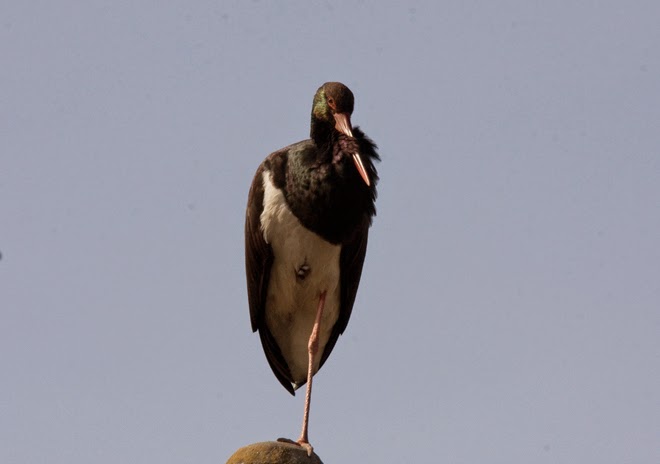
Historically there are records of Black Stork in Kansai but until recently it had disappeared from Japan as a wintering species. The previous few winter there have been a couple of birds wintering around Isahaya Bay in Kyushu but as the population as a whole isn't growing this is very unlikely to herald the return of the species to its former status.

One of two Black storks at Isahaya Bay, January 2015.

Oriental White Stork is another species that disappeared but even more dramatically as it was formerly a widespread breeding species. It still occurs, usually in winter but it's rare and could turn up anywhere in the country. I've seen two in Kansai over the years, a wandering immature which by chance stumbled upon the Hyogo re-introduction programme headquarters and stopped wandering. And another, a Chinese ringed bird, which settled for the winter at Kameoka, just outside Kyoto city. This bird seemed to become a source of civic pride among the local dog-walkers and farmers.

Video-grab of the Chinese-ringed Oriental White Stork soon after arrival, November 2004, Kameoka.

Now that birds from the re-introduction scheme based at Toyoka (Hyogo prefecture) are successfully breeding in the wild it is possible to run into these birds in rural Hyogo and Kyoto in any season, though you'd still need to be very lucky. Or indeed, even further afield as birds from this scheme have wandered the length and breadth of Honshu and as far as Hokkaido and Kyushu.


Oriental White Storks in north Shiga, 2014.

The Crested Ibis re-introduction project on Sado Island is more recent and as yet smaller scale but at least one bird has turned up in Ishikawa, an area in which they hung on until late in the day, there may be hope for this species re-occupying its former range too.

Eurasian and Black-faced Spoonbills both occur in Japan in winter. Though Black-faced is more numerous overall, it's Eurasian that's more frequent in Kansai. However numbers are very low and it's impossible to guess when or where they might turn up. Ponds around northern Lake Biwa have a good track record of hosting wintering birds and I've seen a number there over the years.

Adult Eurasian with its dipped-in-custard bill on a pond near Lake Biwa.

Black-faced Spoonbill will be of more interest to most overseas visitors but fewer come as far east as Kansai and visting birders who have the time will expect to see this species in Kyushu where it is quite easy to find at certain locations, particularly estuaries in the north and north west.

An immature Black-faced on the Yodo River in Osaka city was a good local record.

A party of Black-faced Spoonbills, Kyushu.

Eurasian and Black-faced together in Kyushu.

Almost synchronised spooners.

Immature Black-faced Spoonbill in Kyushu, December 2015. 


bitterns & small herons

Eurasian Bittern formerly bred at larger reedbeds near the south east of Lake Biwa but habitat reduction had a severe effect. I haven't tried to listen for them in recent years and I'm unsure about their current status but I believe they do still occur. Perhaps Lake Sainoko just to the north would be a better place to try nowadays. Small numbers also occur in the region in winter, I've seen three birds together at Lake Shinji just to the west of Kansai so it's certainly possible here but bitterns being bitterns, aren't always cooperative.

There was a rather atypically behaved bird in a park in Osaka a few years ago. It you were there at the right time, it would parade around on the lawn in front of the reeds giving great views. But what really set it apart was its habit of flying off into the woodland where it would hunt along small streams under closed canopy or sit motionless in sasa on steep wooded hillsides.

   Lurking in sparse sasa on a steep woodland slope, the most improbable Bittern I've seen here.

Yellow Bittern is another bird that can be found at the larger remaining reedbeds at Lake Biwa. There are also some good reedbeds along the Yodo River between Osaka and Kyoto to look for them too. Unfortunately, the large reedbed further upstream on the Uji River at Ogura is harvested then burnt-off each winter and is only beginning to re-grow when the Bitterns are returning.

If there was ever any reliable chance of seeing Schrenck's in Kansai, I'm sure that time has long gone. The only ones I'd seen until recently were at Lake Kasumigaura in Kanto when they were still regular breeders there and a spring migrant on Tsushima. However, in November 2014 an obliging individual turned up at a small pond in Nishinomya, Hyogo and provided wonderful photographic opportunities for those with better equipment than me.


Schrenck's Bittern, November 2014.

Cinnamon Bittern is no more likely to occur in Kansai but it is reasonably common in the Nansei Islands and can be seen easily at Kijyoka, Okinawa.

Female Cinnamon Bittern Kijyoka, Okinawa.

Male Cinnamon Bittern, Kijyoka, Okinawa. This is without question the best place I've visited to see this species with several flying around and reasonably approachable by car.

Striated Heron isn't rare in Kansai but it is hard to find, not just because it's an unobtrusive and solitary species but also the population density seems low. Having said that I used to see them more often than I do now. The bird below on the Katsura River is unusual in such an open setting, the September date suggests it's a migrant. Local birds are more often found further up stream along wooded stretches of river.

Straiated Heron, Katsura River, Kyoto city. 

                                  Japanese Night Heron, Osaka Castle Park, April 2013.

                                 Japanese Night Heron, Osaka Castle Park, April 2013.

Japanese Night Heron breeds in Kyoto prefecture forests but is difficult to find and the average visitor probably wouldn't want to invest the time listening out for singing males night after night with no guarantee of seeing one. Spring migrants can often be found on islands in the Japan Sea but perhaps the best chance a visitor has of seeing one is if their trip coincides with the arrival of a migrant in a city park. This isn't quite as improbable as it sounds because birds do drop into parks with reasonable regularity. There have been two in Osaka city this year (2013) and it isn't unusual for them to stay two or three days. Interestingly these birds seem to show no fear of humans, unlike birds in the forests, and I remember one in Kyoto Imperial Palace Park strolling between tripod legs, causing confusion and amusement amongst the photographers. No doubt for every bird stopping off in a park there must be many more moving through surrounding forests and I've bumped into three September/October migrants at Mt.Inari in Kyoto as well as one or two others in the area. Apart from seabirds this is perhaps the most difficult species for a visiting birder to connect with.

Malayan Night Heron can't be found in Kansai but is easily seen in the Yaeyama Islands in the far south. Driving on rainy nights on Iriomote it's possible to get great headlight views of several birds taking advantage of all the frogs crossing the wet roads. They can also be found during the day, usually asleep in village gardens or more actively foraging in the forest, particularly on wet days.

Black-crowned Night Heron on the other hand is a common breeder in Kansai and they're easy to see in the centre of Kyoto city on the Kamogawa from the breeding season when adults are fishing round the clock and through summer when juveniles start to appear. As with many herons, small weirs along the river through the city are a focal point. While larger species might wade into the faster water the Night Herons are usually standing hunched on the bank. At other times they can often be heard overhead just after nightfall as they make their way to feeding areas. There are a number of roosts at temples and shrines for example at a small pond on the north side of the main precinct of Fushimi Inari Shrine.

       Presumably a sub-adult with bi-coloured bill and grey in the crown on the Katrura River, Kyoto city.

A roosting juvenile along the Uji River, Kyoto city.

Chinese Pond Heron is definitely not to be expected in Kansai, though it is regular on islands in the Japan Sea, particularly in spring.

Presumed 2cy on Tsushima, early May 2012.

Adult Mishima, early May 2005.

Adult Yonaguni, early April 2013.