Showing posts with label Starling Red-billed. Show all posts

Saturday, 16 January 2016

Chinese Penduline Tits and Red-billed Starlings

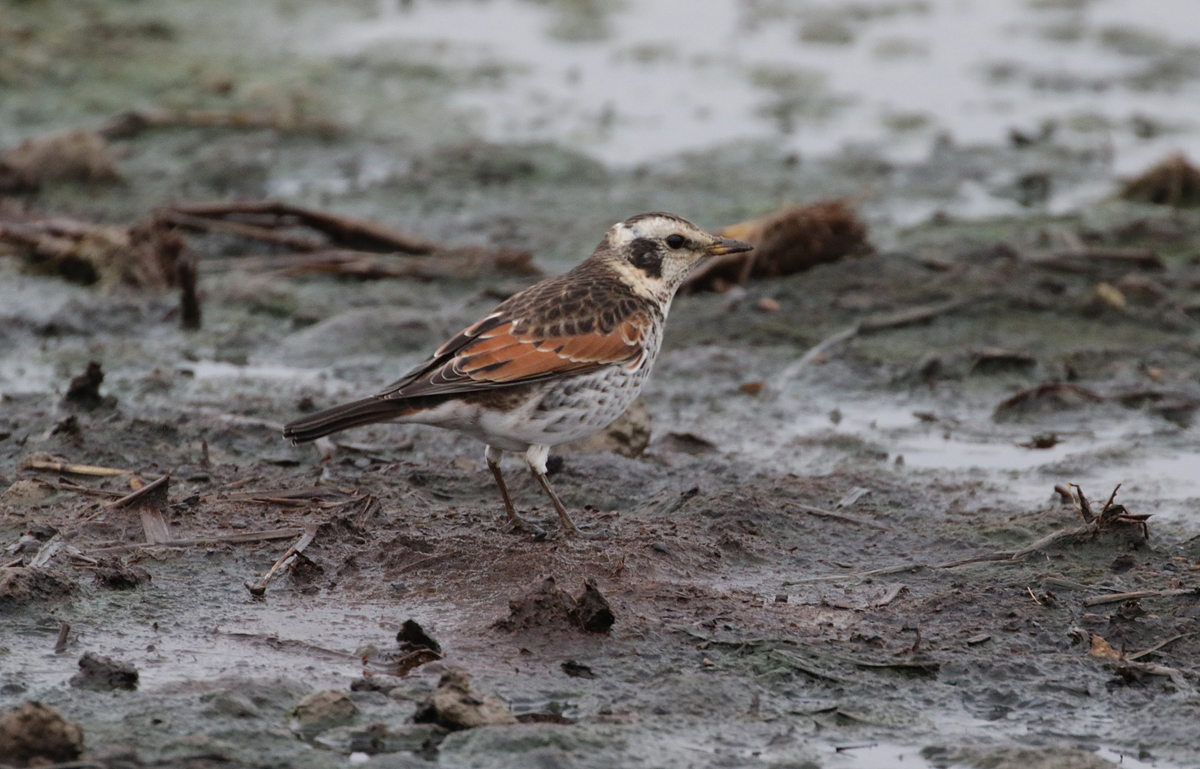
A quick drive round the fields on my final morning at Arasaki produced the usual birds; the two Whooper Swans in winter residence, a few Common Shelducks, many Dusky and Pale Thrushes and plenty of Russet Sparrows.


Large flocks of Russet Sparrows are a common sight on the wires.


Less often seen are Hawfinches and, surprisingly, Kestrel. They were far more common at Isahaya Bay.


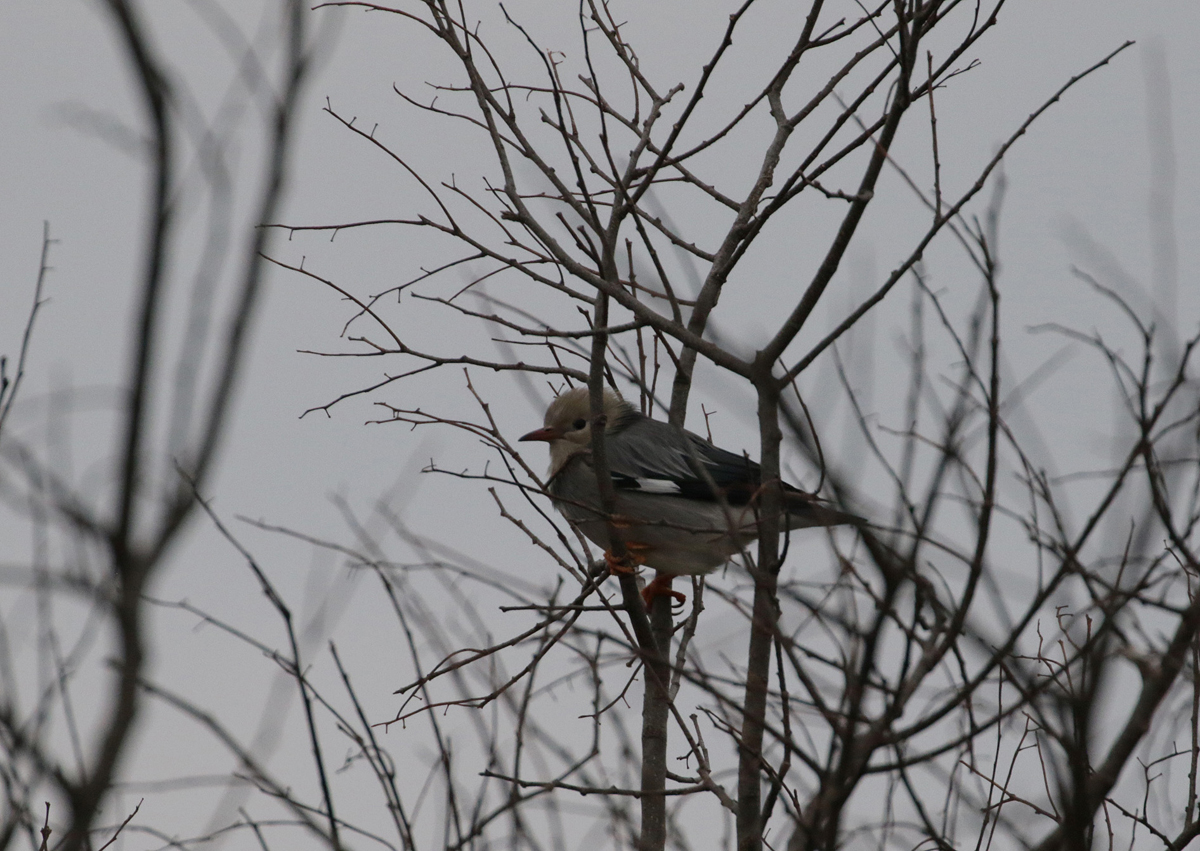
The best encounter of the morning was a party of Red-billed Starlings with the Common and White-cheeked by the pig farm.


Common Starling.


The first two Red-billed Starlings were a surprise but as I walked into the pig farm I found many more. 


A single Commom (top) with Red-billed.


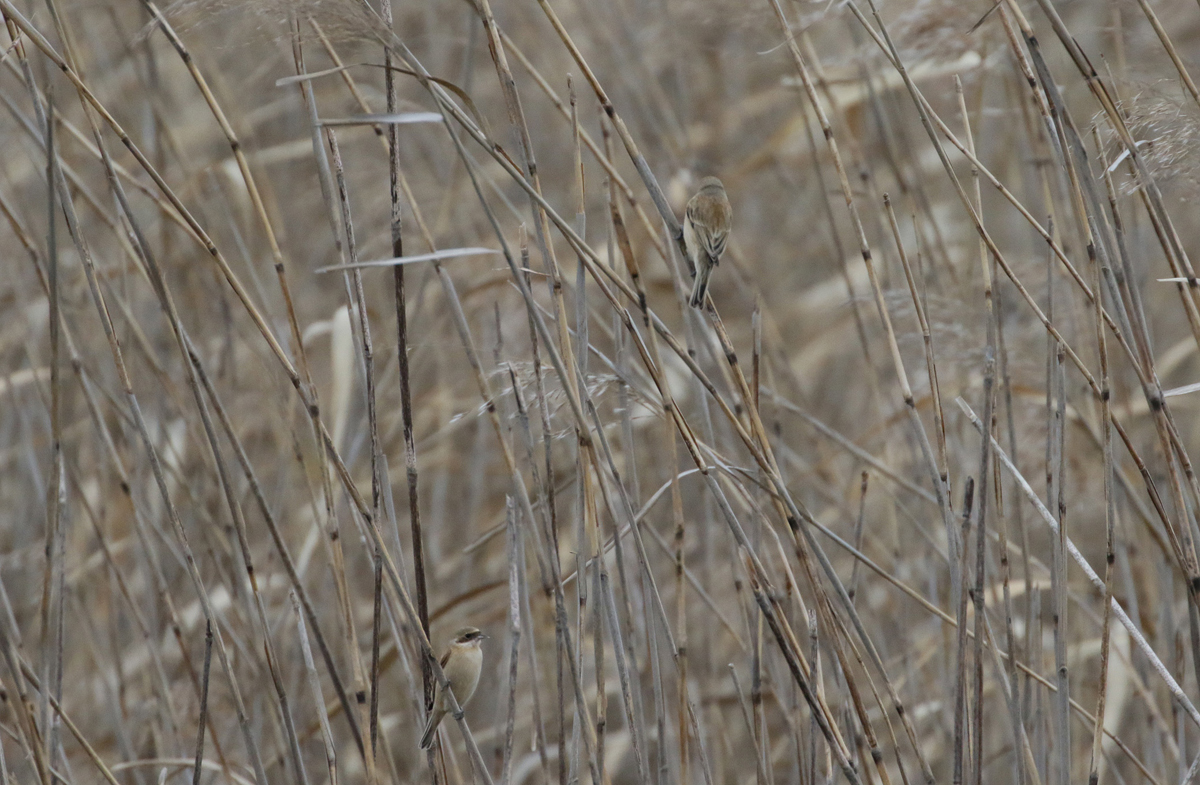
With some time left before having to start the long drive back to Kyoto I decided to have one last try for Penduline Tit. I'd heard them several times, both here and at Isahaya Bay but so far one brief flight view was all I'd managed. Fortunately conditions were very calm this morning and it didn't take long to find small groups flying this way and that across the reeds. about 40 birds was the biggest group I saw in flight but there were obviously a lot more birds present judging by the calls in both directions along the river.


They sometimes came quite close but were hidden, low in thick reeds. The only photographic opportunity was slightly further away where there was a break in the reeds and I could get these more distant shots.


On one of the occasions a party crashed into the reeds close by they flushed a Dusky Warbler! It flew up and called dropping back into the reeds four or five metres on but continued to call for a short time. I've no idea how many Duskys may winter in this part of Japan but this is my second at Arasaki, after one seen well with Sean Minns and Mark Carmody in 2008.


And one other bird along the river... spot the Hen Harrier.


The list of 119 species recorded during the week-long Kyushu trip:-


Whooper Swan
Common Shelduck
Mandarin Duck
Gadwall
Falcated Duck
Eurasian Wigeon
Mallard
Eastern Spot-billed Duck
Northern Shoveler
Northern Pintail
Eurasian Teal
Common Pochard
Tufted Duck
Little Grebe
Great Crested Grebe
Eurasian Spoonbill
Black-faced Spoonbill
Black-crowned Night Heron
Grey Heron
Great White Egret
Little Egret
Great Cormorant
Eurasian Kestrel
Merlin
Peregrine
Osprey
Black Kite
Eastern Marsh Harrier
Hen Harrier
Eurasian Sparrowhawk
Northern Goshawk
Eastern Water Rail
Ruddy-breasted Crake
Common Moorhen
Common Coot
Sandhill Crane
White-naped Crane
Common Crane
Hooded Crane
Eurasian Oystercatcher
Northern Lapwing
Grey plover
Long-billed Plover
Little Ringed Plover
Kentish Plover
Common Snipe
Eurasian Curlew
Common Greenshank
Green Sandpiper
Terek Sandpiper
Common Sandpiper
Dunlin
Black-tailed Gull
Common Gull
Vega Gull
Mongolian Gull
Slaty-backed Gull
Taimyr Gull
Black-headed Gull
Saunder's Gull
Caspian Tern
Rock Dove
Oriental Turtle Dove
Ural Owl
Long-eared Owl
Short-eared Owl
Common Kingfisher
Crested Kingfisher
Japanese Pygmy Woodpecker
Great Spotted Woodpecker
Japanese Woodpecker
Ryukyu Minivet
Bull-headed Shrike
Daurian Jackdaw
Rook
Carrion Crow
Large-billed Crow
Eastern Great Tit
Varied Tit
Chinese Penduline Tit
Barn Swallow
Long-tailed Tit
Japanese Skylark
Zitting Cisticola
Brown-eared Bulbul
Japanese Bush Warbler
Dusky Warbler
Japanese White-eye
Eurasian Nuthatch
Red-billed Starling
White-cheeked Starling
Common Starling
Pale Thrush
Dusky Thrush
Red-flanked Buletail
Daurian Redstart
Blue Rock Thrush
Brown Dipper
Russet Sparrow
Eurasian Tree Sparrow
Forest Wagtail
Eastern Yellow Wagtail
Grey Wagtail
White wagtail
Japanese Wagtail
Olive-backed Pipit
Red-throated Pipit
Buff-bellied Pipit
Brambling
Oriental Greenfinch
Long-tailed Rosefinch
Hawfinch
Japanese Grosbeak
Meadow Bunting
Chestnut-eared Bunting
Rustic Bunting
Elegant Bunting
Black-faced Bunting
Common Reed Bunting


Wednesday, 8 January 2014

Leiothrix to starlings


Red-billed Leiothrix was a long term bogey bird for me and to this day I haven't seen one around Kyoto city even though everyone else, even casual visitors, seems to have bumped into them at least once. However they do seem quite common in the central mountains of the Kii Peninsular which is where I took the following shots. Since finally getting the monkey off my back I've regularly seen them in central Kyoto prefecture too.

 
Mt.Misen, June 2013.
 
Japanese White-eye is a very common species almost everywhere in Kansai, having said that there are areas in northern Kyoto and Hyogo where I've never seen any. For the visitor, they're impossible to miss in and around Kyoto city. Chestnut-flanked White-eye is something that could occur, certainly along the Japan sea coast. I've seen them on Hegurajima but they seem to be more frequent on islands further north in the Japan Sea.

No more than a record shot of Chestnut-flanked White-eye on Hegurajima, 12 October 2011.

Japanese White-eyes in Kyoto botanical gardens.

Presumably the race loochooensis on Iriomote, April 2013. I was surprised it was noticeably smaller in the field than the race japonicus I'm used to seeing in Kyoto.

Goldcrest can be found in conifers throughout the region including those around the city and often even in the Imperial Palace Park and the botanical gardens in the city centre.
I rarely see Wren in the city parks but they are fairly common around the city and more frequent further out in the hills.
Nuthatch is another bird that can be found in the region's forests but sightings are unpredictable, sometimes I see several at Ashyu for example and other times none. I've only ever seen two in Kyoto both sightings were at Fushimi Inari Shrine many years apart showing there is some movement. Treecreeper is another discreet bird of the region's hill forests, I've never seen one in Kyoto city and sightings further afield depend on luck though they seem more numerous in mountains of central Nara than the hills of northern Kyoto.

These Goldcrests were October migrants on Hegurajima.

Wren is common in the region's hills, this in Ashyu Forest, Kyoto.

A rather tatty August Nuthatch in Hokkaido.

Early on a misty mountain morning in Nara, note the duller belly of amurensis compared to the white underparts of asiatica in Hokkaido.

A roadside Treecreeper on Mt.Misen, Nara.

White-cheeked Starling is common in the region and in winter huge numbers roost in city centres. Chestnut-cheeked is a common northward migrant in April and early May, I see many along the the Uji River in Kyoto, but they're very infrequent in autumn. The introduced Crested Myna breeds in the Osaka area but they seem nomadic. Beyond that starlings aren't to be expected here, I've found one wintering European in Kyoto which seems to have been a one-off and White-shouldered and Red-billed are irregular winter visitors in Kansai. Records of Red-billed seem to be increasing in recent years. Daurian is the rarest of the starlings, I've only seen one, a spring migrant on Mishima and I've never heard of one in Kansai.

Crested Myna, one of a group that bred under a major bridge over the Yodo River in Osaka city.

Female Chestnut-cheeked Starling along the Uji River, 3 May 2013.

A male Chestnut-cheeked Starling with a White-shouldered on Tsushima, 4 May 2012.

Red-billed Starling on Mishima, 30 April 2012.

White-cheeked Starling on the Yamato River, Osaka. 

Common Starling is a common winter visitor to Kyushu, flocks of 50 aren't unusual.

Common Starling Kyushu, January 2015.

Common Starling on Hegurajima, October 2007.