Showing posts with label Minivet Ashy. Show all posts

Thursday, 30 April 2015

Mishima: bad weather, good birds!

The sky was very overcast when I woke this morning but it didn't look like there'd been any of the forecast rain. No sooner had I got outside than it started. There was drizzle and heavier showers throughout the day with the sun just starting to show as it was setting.

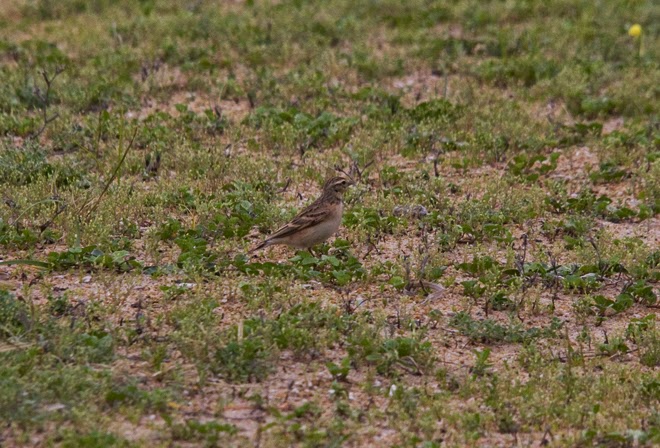
My camera stayed in the bag most of the day but it was bright enough for the bird of the day, a Greater Short-toed Lark I found at about 4:30. Unfortunately it was quite nervous, unlike the White Wagtails it was with (also new in) and these shots were the best I could muster. At least it's identifiable.


Downtown Utu witht the ferry arriving. The Lark was on the strtch of short grass behind the beach.

The day started slowly but by late morning things began to pick up, birds were obviously arriving. The thrushes were the first indicator and by day's end I'd added Siberian, Grey-backed (the other star bird of the day), Brown-headed (very common) and Pale to the trip list.


This pair of Ospreys, the smaller male with a fish, were the only birds I got a shot of in the morning before the rain began and the helicopter was leaving the radar station on top of the highest hill. I was once trying to digiscope a Wryneck through the fence of the small hilltop base and before long a military vehicle arrived and I wasn't surprised they told me I could stand there with my scope and camera peering through the fence... I'd have to stand on the other side of the road! So I moved four metres back and they were quite satisfied with that, bizarre.


The Short-toed Lark and Grey-backed Thrush may have been the best birds of the day, but they weren't the high point. That came in early afternoon with an amazing congregation of birds, or flocks of birds. Along a 50 metre stretch I estimated there were about 30 singing Eastern Crowned warblers, a few Sakhalin Warblers, 23 Ashy Minivets, 150 Bramblings, 20 Siskin, a lone Japanese Grosbeak, a huge number of White-eyes, three Blue and White Flycatchers, uncountable Narcissus Flycatchers
and a Lesser Cuckoo. They weren't passing through in waves, the finches were sitting about being finchy and the rest were dashing madly around without going anywhere. Only the Cuckoo didn't hang about. There wasn't much point in using the binoculars to go through them all, it was really a stand in awe moment. The Minivets below were part of a different flock.


Yesterday Sakhalin Leaf Warblers had been far more common than Eastern Crowned. Of course Eastern Crowned are usually silent unless singing whereas Sakhalins call frequently which can skew perception of numbers, two of the three I recorded yesterday were singing birds, it's no exaggeration to say there were hundreds singing today.

After leaving the Lark by the beach in Utu village I bumped into another good bird, a great bird, and the sun was just coming out to try to do it justice. A wonderful Broad-billed Roller. I can't bring myself to say Dollarbird, it sounds too cheap for such a cracking bird. As a kid European Rollers and Hoopoe were the two most exotic birds I'd dream of seeing.


We'll probably be getting clear skies again tonight and tomorrow so I can only hope there are still some good birds that arrived today waiting to be found. Though as I was writing that I heard a Pacific Golden Plover flying over, we're due a few waders.

Saturday, 10 May 2014

Migrants on the Noto Peninsular

The drive from Wajima to the end of the peninsular at Rokkozaki reminded me of birding on Tsushima, there are so many attractive patches of habitat along the route it's hard to know where to stop, but daylight was a factor I drove directly to Rokkozaki to check-out how suitable the area looked in reality rather than just on satellite imagery.

The small harbour village of Noroshi was remarkably quite, one or two locals and the odd motorcycle tourist, despite the large car parks tour buses hadn't made it past the Senmaida terraced paddies as far as I could see. I made my way directly to the lighthouse on top of the hill above the village. It's a very short walk through a mix of woodland, vegetable plots and ornamental shrubbery. In the hour before dusk I could confirm the area along with the fields in the flat valley bottom and nearby forest on the next ridge combined to make an attractive patchwork of habitats which could be very productive in the right conditions. Migrants were conspicuous enough to make the prospect of dawn birding quite exciting.

It starts to get light at about 5am at this time of year and I began the day walking the fields until there was sufficient light to bird under the trees. Apart from Asian House Martins overhead and a hidden Green Pheasant displaying in some reeds there was dishearteningly little about but once on the hill there were plenty of thrushes, Siberian, Eye-browed, Japanese, Brown-headed and Dusky. A flock of Japanese Waxwings was a nice surprise as was a male Tristram's Bunting. There was a spodocephala Black-faced Bunting too, it looks like I was right about the place being a good migrant trap. There were singing Asian Stubtails and Blue and White Flycatchers and though it became quieter as the morning wore on I added Pacific Swifts, Ashy Minivets, a Siberian Rubythroat, Chestnut-cheeked Starlings and Narcissus Flycatchers. There was even a mid-morning Red Fox.

Brown-headed, one of many thrushes in the trees on the headland. 

After often hearing Ashy Minivet overhead it was nice to get one below the canopy.

I had planned to spend a full day but by early afternoon I decided to move on to my final destination, Kemmin Kaihin Park further down the peninsular in Kanazawa. This excellent coastal park is always a great spot for migrants (and winter visitors) so I though it might be good to give it an evening followed by an early morning as I had for Rokkozaki.

Immature Temminck's Cormorant exercise routine.

One thing I hadn't given much thought to was the number of photographers there would be at the park in Kanazawa, I'd been the only person, let alone only birder, wandering round the hills and fields at Rokkozaki but there were knots of photographers gathered at all strategic locations in the park. This isn't a great problem in itself but it detracts from the thrilling sense of expectation that any rarity is mine for the finding.

One of the first migrants I found was a Lesser Cuckoo and the resident Azure-winged Magpies are always great to see as it's a species I can't see around Kyoto. There were warblers, Oriental Reed, Yellow-browed, Sakhalin, Eastern Crowned and Stubtail as well as thrushes, Siberian, Brown-headed, Eyebrowed, Japanese and Dusky. All these in the last couple of hours before sunset, once again I was full of high hopes for the following morning.

I settled down in the car for an early night but was suddenly roused by a couple of fighting Racoon Dogs in the car park. Later two more animals were searching for roadkill on a nearby bridge, moving aside to allow cars to pass. Hopes of hearing owls during the night came to nothing.

By 05:45 some of the same photographers who had been there the previous evening were already hurrying to their favourite spots, and who could blame them - the birding was excellent. I found two more Tristram's Buntings to add to the three I'd seen the previous evening, there were two male Siberian Thrushes, a Common/Oriental Cuckoo, a couple of Rubythroats and Siberian Blue Robin. I heard Common Greenshank overhead and Green Pheasants were displaying in the scrub behind the dunes.

One of many Eyebrowed Thrushes. 

Asian Brown Flycatcher.

There were four male and one female Tristram's Buntings in the park.


Everything had been going really well up to this point. Too well? At 07:00 I jumped up onto a sawn-off length of felled tree trunk to look for a singing Rubythroat, lost my balance and had to jump back down. Unfortunately another section of the same tree was laying there and prevented me taking the step back my momentum required and over it I went. Like any good birder would I grabbed my bins with one hand and camera with the other as I back flopped over the trunk. I might have dropped into some springy bushes but no such luck, there was a 6-7cm high wooden spike, a cut-off piece of branch sticking up, and I planted my right kidney area right on top.

I lay a moment to take stock and plan how to stand up, no easy feat, that took a couple of minutes. I was feeling incredibly weak and groggy and my only thought was get back to the car in case there was worse to come. Each shuffled step seemed to take an age but suffice to say I did make it back to the car and started a slow and painful drive home. Making my way through the park I was vaguely aware of lots of birds to my right and left but one bird in particular, a male Tristram's, wouldn't move out of my way... I could have bent down and picked it up. My only thought at the time was one day I'll be amazed by that bird.

Thursday, 19 December 2013

minivets to Paradise Flycatcher

Ashy Minivet seems to be declining in numbers while Ryukyu is possibly expanding in range. In Kyoto city Ashy is a migrant and parties can sometimes be seen on the surrounding hills but it's much easier to find in the forested hills to the north or in the mountains of Nara and Wakayama. It is frequently heard and seen flying overhead and I'd be slightly surprised not to see them (or at least hear them) if I were spending a day in Ashyu Forest or the spine of the Kii Peninsular. However it's more difficult to get good perched views, a matter of being in the right place at the right time with such a mobile species. You can't go rushing off the trail in persuit on the steep-sided hills but on the other hand these steep slopes make it possible to get eye-level views of this canopy species. Ryukyu Minivet seems to be expanding into Kyushu but as far as I'm aware there has never been a record this far north. It's common in the Nansei Island forests and its habits are much like Ashy, it's more often seen flying overhead than perched, however I have seen them away from woodland in coastal scrub.


Female on Mishima, Yamaguchi 4 May 2008. Birds are reasonably common on the island and good views are a more regular event with good of access to the wooded hills. 


Female Mishima, Yamaguchi 3 May 2009. 


Male Ashy Minivet on the Noto Peninsular May 2014.


Male Ryukyu Minivet, one of a party a couple of kilometres from the nearest forest. Iriomote, 4 April 2013.


Bull-headed Shrike is very common in the region and in Kyoto it will be seen on any walk near  scrubby riparian habitat or arable land. They are early breeders and though quieter at this time they still perch prominently and are hard to miss. Outside the breeding season and their harsh calls are very much a feature of birding along the city's rivers.


Bull-headed is the only shrike that can be expected in the region, though several others turn up from time to time. A Great Grey wintered near Kyoto 2012/2013 and a Brown in Osaka the previous winter. Chinese Grey is a rare and irregular winter visitor to the Japan Sea side of the region. Other species are even less likely, Long-tailed is a rare winter visitor and Tiger, though a breeding species in Japan, is probably the most difficult species to see unless you happen to know a breeding site.


A breeding male, looking very bull-headed, along the Uji/Yodo River in Kyoto city, 10 April.


A breeding female along the Uji/Yodo River in Kyoto city, 15 April.


An immature on the Yamatogawa in Osaka, December.


A wintering male lucionensis Brown Shrike at Arasaki, Kyushu. Birds are more often seen as migrant in spring and autumn on the Japan Sea islands.


Brown Shrikes winter in the southern Nansei Islands, this one of several in heavy moult on Yonaguni in early April 2013. 


Japan's first Red-backed Shrike wintered in Shikoku (3 March 2007).


Isabelline Shrike on Hegurajima May 2014.


A wintering Great Grey Shrike in Kyushu, 2014/15.


A wintering Chinese Grey Shrike in Kyushu.


Black-naped Oriole is mainly seen as a spring migrant on the Japan Sea islands. Despite their bright colouration their habits make them very difficult to see, hence they're more often heard than seen on the larger forested islands. A pair may have bred at a site east of Kansai in 2013 but even there it was very difficult to see a bird. On smaller islands such as Hegurajima getting a decent views is far more likely.


A video grab of a bird on Hegura.


Drongos are rare in the region, Black and Ashy have both been recorded in recent years. Black is possibly increasing as a rare migrant in western Japan, I found three on Tsushima in 2012 and I heard of 3-4 others during that week.


A bird at the northern end of Tsushima 29 April 2012.


Two of a threesome at the southern end of the island on the same date.


Ashy Drongo, Hegurajima October 2014.


Japanese Paradise Flycatcher breeds in broadleaf forests in the region but is nowhere common. I see more migrants on the islands than in the region.


If I'd had a camera rather than digiscoping I'd have got some great shots of this obliging cliff-top spring migrant on Mishima.