I sailed on the Ogasawara Maru, the only transportation link between Tokyo and the Ogasawara Islands, at 10am on the 7th. The ferry departs from Takeshiba-sanbashi pier once a week, the same location as departures for Miyake and Hachijojima. The return voyage left Chichijima at 2pm on the 11th getting into Tokyo at 3:20pm the following day. Amazingly I was back in my own living room in Kyoto just three and a half hours later!
Views along the slow exit from the pier towards the open sea, about three long hours, were lost behind a curtain of drizzle much of the time and the clouds were so low that jets landing at Haneda suddenly and silently appeared over us, water streaming off their wings. Past Hanada, then the ventilation island for the Aqua-Line and down the Boso Peninsular where the first Streaked Shearwaters began to appear. Once into open water the weather began to improve slightly.
An artificial island island in the middle of Tokyo Bay providing ventilation for the Tokyo Bay Aqua-Line linking Kawasaki to the base of the Boso Peninsular in Chiba.
Further into the bay this sub heading in was something I hadn't expected.
The first Bulwer's Petrel appeared off Oshima and there were about 18 more during the course of the afternoon. Apart from Streaked Shearwaters I saw little else just two distant possible Short-tailed Shearwaters which would have been the only ones of the trip had I confirmed them, a shark cruising by and a single flying fish. Others had more luck, there was a Black-footed Albatross and South polar Skua seen from the other side of the boat. By far the most surprising though was an unidentified immature tropicbird off Oshima. I think the real highlight was being show a fantastic shot of Mottled Petrel just off Tommakomai (Hokkaido) a week earlier!
The following morning I was up at 4am, far too early but anticipation and a wafer-thin mattress can do wonders for an early start.
In the event there was nothing until 6:45 but realistically who would risk a lie-in? Then suddenly a Bulwer's Petrel and Bannerman's Shearwater together. The Bannerman's was a lifer for me and to get it right next to a Bulwer's removed any doubt I might have had about judging distance as well as any later second thoughts that might have crept in. The two shots below with Bulwer's and Wedge-tailed Shearwater respectively may not be good enough to show any details but do give good size comparison.
 Bannerman's with Bulwer's. Not the original duo but it turned out both were sufficiently common for a repeat performance. The first time I'd been too busy taking it all in to think of using the camera.
 Not just a distant Wedge-tailed, that tiny brown and white smudge in front of it really is a Bannerman's.
Twenty minutes later we were in Wedge-tailed Shearwater territory, Streaked were left behind, and at almost 7:30 the first Brown Booby pulled alongside. With the first on the scene others were bound to follow. Ships act as magnets for them, or rather the flying fish that burst from the bow wave do. All the boobies have to do is effortlessly slipstream the ship in wait then peel off in pursuit as the fish glides to what it thinks is safety. If you ask me "booby" is a totally inappropriate name.
 More Brown Boobies overhauling the ship to take their place above the bridge.
 After chasing a fish they'll quicky come back up the wake to re-assume their post over or around the bridge.
Before arriving on Chichijima at 11:30 Brown Booby and Wedge-tailed Shearwater became the backdrop for just two or three other species of interest; 4-5 Brown Noddies, 4-5 Bulwer's Petrels and another small shearwater in the distance. Other birders had 4 Bonin Petrels and a Sperm Whale.
 Finding good rail space wasn't always easy, this was very exceptional as most ferry trips are totally birderless.
Sailing into Omura port looks bound to end in disaster, nothing of the port can be seen from open water.
It gradually becomes apparent there's a hidden inner bay, the entrance just coming into view in the centre of this shot.
Arriving in Chichijima harbour.
The Hahajima ferry waiting for transferring passengers as we docked.
 Our ship, the Ogasawara Maru in the foreground with the much smaller Hahajima Maru behind it.
The main street of Omura, the big city of the islands.
In the other direction, this must be the suburb.
There aren't many species of bird on the island but there are several distinct sub species, perhaps most famously the nominate race of Japanese Bush Warbler but there are also Eastern Buzzards, Black Woodpigeons, Bulbuls and White-eyes.
The local toyoshimai race of Eastern Buzzard.
 From above it looks much darker and the whitish ovals hardly contrasting here in the base of the outer primaries are so striking as to recall nightjar wing patches.
 The long-billed nominate diphone race of Japanese Bush Warbler.
 The local squamiceps race of Brown-eared Bulbul.
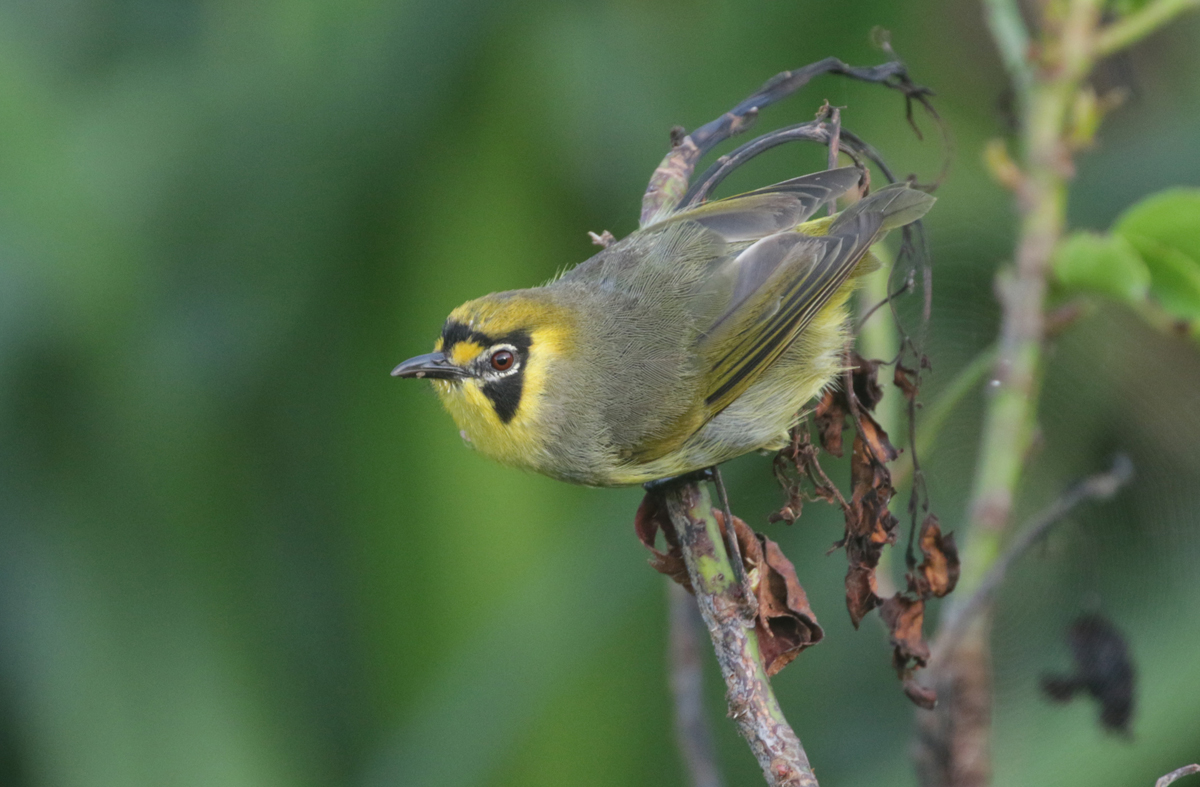
 Japanese White-eyes are not only abundant but in the absence of competition seem to occupy all habitats on the island.
The invasive Green Anole is responsible for several native insect extinctions on Chichijima but it has also become a favourite on the indigenous Buzzard menu.
Also know as the American Chameleon, the Green Anole seems equally comfortable in brown.
Of course delightful as it may be, Chichijima isn't exciting enough to attract a ferry full of birders and that evening we were due to set sail on the once-a-year cruise around the Iwo Islands. I'll write up that fantastic experience as a separate post and continue here with the return journey to Tokyo as if a normal Ogasawara trip.
Conditions were duller, becoming overcast as we were leaving the islands, perhaps the influence of the huge typhoon passing through Honshu to the north. The birds were good though, Bulwer's Petrels were very common but after three hours sailing numbers had dwindled to the odd one now and then. Wedge-tailed Shearwaters were equally common at the outset but numbers didn't tail off so much. A Bannerman's Shearwater was the only other bird while passing the other islands in the group.
Bulwer's Petrel very common off Chichijima.
 Wedge-tailed Shearwater very common in southern waters.
Continuing north there weren't the huge numbers of seabirds there had been further south, though I did see three more Brown Noddies, three Brown Boobies and three Bonin Petrels. On a bit of a roll with "B" species here, five out of six seen so far, but that has nothing to do with when a Sooty Tern was called I thought it was Bridled. I'd already been watching it when it was called and though Sooty would be the expected tern in these waters (I've seen many here compared to zero Bridled in the past), I'd also expect it to look very black and white in these dull conditions which it didn't so I'll have to put it down as a dark-backed tern sp.
 Bonin Petrel, a straight forward ID compared to some pterodromas.
 Brown Noddy.
The final day brought dismay; the decks were closed because of "high seas". Glimpsing shearwaters through salt-smeared windows was the only option. The sea had been a bit lumpy during the night, no doubt the influence of that typhoon again, but it seemed incomprehensible that the present two-metre swell could be considered sufficiently dangerous to keep us cooped-up inside. Admittedly this is smaller vessel than the northern route ferries, with the lowest open deck much closer to the waterline but nothing more than a potential dousing with not even cold water is hardly threatening. I've been on the northern route in huge seas in the tail of a typhoon while the doors stayed open. A Yonaguni to Ishigaki sailing would've embarrassed a jet-coaster designer but there was no restriction. What was the problem here? After getting back I checked through old note books and found this comment from February 1988 "A rough crossing, people throwing-up everywhere. Access is limited to the lower deck so many birds are obscured". So, no problem in those days then.
Just before 7am the cafe area on the stern opened and at about 7:15, as we were passing Hachijojima, we were given the run of the aft half of the lower deck. With the improved viewing it was easy to see we'd passed into cooler waters as all the large shearwaters were now Streaked. A Red-tailed Tropicbird just south of Miyake was a huge surprise and a possible Wilson's Petrel seen by other birders off Miyake would also have been a good find. The only one I've ever seen in Japan was also in early July and Japanese birders seem to think white rumped petrels in this area at this time are likely to be Wilson's.
A Red-tailed Tropicbird which seemed to be going to overtake the ship but in the end cut across the wake and disappeared.
 Streaked Shearwater, the normal in-shore shearwater for most of Japan.