Showing posts with label Thrush Eyebrowed. Show all posts

Thursday, 4 May 2017

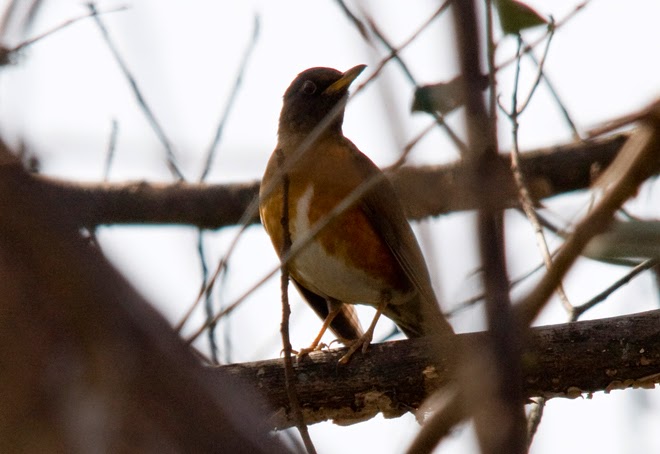
Eye-browed Thrush

We've probably all heard of rogue grouse or pheasants, even if we haven't been lucky enough to see one, but who's ever heard of a rogue Eyebrowed Thrush?!


Last weekend I had great views of four species of thrush out in the open on a mown lawn just after dawn; Brown-headed, Japanese, Pale and Dusky. Well of course Dusky, when aren't they out in the open? There were plenty more skulking turdus in the dense understorey as the morning progressed but not a single Eyebrowed. But then almost back at the car, passing that lawn again, the evaporation of thrushes long since complete, I noticed an Eyebrowed lurking on the woodland edge. At first it remained largely hidden as you might expect, a tail tip visible from this perch, lower belly from another. Playing by thrush rules in essence. Then it began to deviate and before long ripped up the Eyebrowed manual altogether. It got bolder sitting on exposed branches then dropped down onto the grass to perform Dusky-style.


There were a few other cooperative birds, a pair of Blue Rock Thrushes and a few Black-faced Buntings...


Friday, 6 May 2016

Lots of thrushes

I had hoped to get back to Hegurajima this week but it wasn't to be. I set off on the off-chance the sea might calm sufficiently to allow the ferry to sail. As I continued to check the marine forecast while heading north it became clear this wasn't going to happen so I didn't waste my time driving up the Noto Peninsular to Wajima.


I had left home the afternoon before yesterday allowing time for a quick stop in the hills on the way up, even if the ferry had been running. No sign of Copper Pheasant, display has tailed off somewhat but this showy Japanese Woodpecker was nice.


Ashy Minivets were frequently overhead but none came within decent camera range and this pair was the best I could manage.


I was disappointed I wasn't going to make it out to the island, the weather looked promising but it meant when I arrived in Kanazawa there was time to grab a little sleep before dawn. When I did clamber out of the van I had this snowy reminder that some parts of Japan get real winter, unlike Kansai.


To be honest the winter scene was the second surprise, the first was before I even clambered out of the van. There were Eyebrowed, Brown-headed and Dusky Thrushes running round on the short grass next to where I'd parked. Dusky I could understand but the other two are often no more than a fleeting tail breaking from the undergrowth before vanishing through the canopy. Unfortunately in the early light they required a very high ISO to capture them so the results aren't as impressive as they might have been.


Almost a nice grouping: male and female Eyebrowed Thrushes but the Blue and White Flycatcher (tail just visible behind a branch on the left) chose to move before I could get the shot.


A stunning male, they don't even look this good in field guides.


Brown-headed Thrush.


There were plenty of other migrants around, the place was teaming with phylloscs, Eastern Crowned were everywhere, very vocal, very active, and Sakhalin Leaf were fairly numerous too. A couple of Chestnut-cheeked Starlings became half a dozen as the morning wore on and an Ashy Minivet heard only once probably passed straight through. Two or three Japanese Robins were singing and there was at least one Siberian Rubythroat as well. Several Narcissus, Asian Brown and Blue and White Flycatchers were dotted around the park but I came across just a single Japanese Yellow Bunting. Also represented by a lone individual, Oriental and Northern Hawk Cuckoo sand intermittently throughout the day but I only saw the former. Another invisible songster was an Oriental Reed Warbler, quite what it was doing in woodland I don't know but there were several in more expected habitat nearby. Just as good for me was an Azure-winged Magpie so I'll mention it with the migrants. I don't see them in Kansai and this is the closest to home I can find them, great looking birds.   


Chestnut-cheeked Starlings is a passage migrant in my region.


My drive up to Hegurajima is my only chance to see Azure-winged Magpie, if I have the time to stop and look.


Asian Brown Flycatcher.


Because the park had a good selection of migrants it was easy to the feel things were on the move and something could really good turn up. Unfortunately it didn't and by day's end I was wishing I'd been on Hegura. The marine forecast didn't look any better for today so I stayed overnight but this morning seemed much quieter. In fact the same birds were present but less vocal, the periods of drizzle perhaps dampened the birds' exuberance, making everything seem harder work. I'd walked for 11 hours yesterday but there was no way I could muster the enthusiasm to repeat that even if I'd had the time. Someone saw a Japanese Paradise Flycatcher early in the morning in an area I'd spent a lot of time yesterday so that may have been newly arrived.


Female Meadow Bunting caught in a rare sunny moment.

Saturday, 10 May 2014

Migrants on the Noto Peninsular

The drive from Wajima to the end of the peninsular at Rokkozaki reminded me of birding on Tsushima, there are so many attractive patches of habitat along the route it's hard to know where to stop, but daylight was a factor I drove directly to Rokkozaki to check-out how suitable the area looked in reality rather than just on satellite imagery.

The small harbour village of Noroshi was remarkably quite, one or two locals and the odd motorcycle tourist, despite the large car parks tour buses hadn't made it past the Senmaida terraced paddies as far as I could see. I made my way directly to the lighthouse on top of the hill above the village. It's a very short walk through a mix of woodland, vegetable plots and ornamental shrubbery. In the hour before dusk I could confirm the area along with the fields in the flat valley bottom and nearby forest on the next ridge combined to make an attractive patchwork of habitats which could be very productive in the right conditions. Migrants were conspicuous enough to make the prospect of dawn birding quite exciting.

It starts to get light at about 5am at this time of year and I began the day walking the fields until there was sufficient light to bird under the trees. Apart from Asian House Martins overhead and a hidden Green Pheasant displaying in some reeds there was dishearteningly little about but once on the hill there were plenty of thrushes, Siberian, Eye-browed, Japanese, Brown-headed and Dusky. A flock of Japanese Waxwings was a nice surprise as was a male Tristram's Bunting. There was a spodocephala Black-faced Bunting too, it looks like I was right about the place being a good migrant trap. There were singing Asian Stubtails and Blue and White Flycatchers and though it became quieter as the morning wore on I added Pacific Swifts, Ashy Minivets, a Siberian Rubythroat, Chestnut-cheeked Starlings and Narcissus Flycatchers. There was even a mid-morning Red Fox.

Brown-headed, one of many thrushes in the trees on the headland. 

After often hearing Ashy Minivet overhead it was nice to get one below the canopy.

I had planned to spend a full day but by early afternoon I decided to move on to my final destination, Kemmin Kaihin Park further down the peninsular in Kanazawa. This excellent coastal park is always a great spot for migrants (and winter visitors) so I though it might be good to give it an evening followed by an early morning as I had for Rokkozaki.

Immature Temminck's Cormorant exercise routine.

One thing I hadn't given much thought to was the number of photographers there would be at the park in Kanazawa, I'd been the only person, let alone only birder, wandering round the hills and fields at Rokkozaki but there were knots of photographers gathered at all strategic locations in the park. This isn't a great problem in itself but it detracts from the thrilling sense of expectation that any rarity is mine for the finding.

One of the first migrants I found was a Lesser Cuckoo and the resident Azure-winged Magpies are always great to see as it's a species I can't see around Kyoto. There were warblers, Oriental Reed, Yellow-browed, Sakhalin, Eastern Crowned and Stubtail as well as thrushes, Siberian, Brown-headed, Eyebrowed, Japanese and Dusky. All these in the last couple of hours before sunset, once again I was full of high hopes for the following morning.

I settled down in the car for an early night but was suddenly roused by a couple of fighting Racoon Dogs in the car park. Later two more animals were searching for roadkill on a nearby bridge, moving aside to allow cars to pass. Hopes of hearing owls during the night came to nothing.

By 05:45 some of the same photographers who had been there the previous evening were already hurrying to their favourite spots, and who could blame them - the birding was excellent. I found two more Tristram's Buntings to add to the three I'd seen the previous evening, there were two male Siberian Thrushes, a Common/Oriental Cuckoo, a couple of Rubythroats and Siberian Blue Robin. I heard Common Greenshank overhead and Green Pheasants were displaying in the scrub behind the dunes.

One of many Eyebrowed Thrushes. 

Asian Brown Flycatcher.

There were four male and one female Tristram's Buntings in the park.


Everything had been going really well up to this point. Too well? At 07:00 I jumped up onto a sawn-off length of felled tree trunk to look for a singing Rubythroat, lost my balance and had to jump back down. Unfortunately another section of the same tree was laying there and prevented me taking the step back my momentum required and over it I went. Like any good birder would I grabbed my bins with one hand and camera with the other as I back flopped over the trunk. I might have dropped into some springy bushes but no such luck, there was a 6-7cm high wooden spike, a cut-off piece of branch sticking up, and I planted my right kidney area right on top.

I lay a moment to take stock and plan how to stand up, no easy feat, that took a couple of minutes. I was feeling incredibly weak and groggy and my only thought was get back to the car in case there was worse to come. Each shuffled step seemed to take an age but suffice to say I did make it back to the car and started a slow and painful drive home. Making my way through the park I was vaguely aware of lots of birds to my right and left but one bird in particular, a male Tristram's, wouldn't move out of my way... I could have bent down and picked it up. My only thought at the time was one day I'll be amazed by that bird.

Tuesday, 29 April 2014

Imperial Palace Park

For the first time in eight years I'm not spending a week during spring migration on an island in the Japan Sea. If that isn't depressing enough, continuous rain yesterday tipped me into a severe case of bird deprivation. So I dropped into Gosho for a couple of hours this morning in the hope of finding something... anything of interest. Pleasant as it might have been to get out, things of interest were predictably thin on the ground. There had been Japanese Robin there last week but the best I could come up with today was an all to brief glimpse of a male Eye-browed Thrush, and the only other birds that don't actually breed in the park were about seven singing Narcissus Flycatchers and a White-bellied Green Pigeon. I sometimes see Green Pigeon in Gosho in winter but I don't think I've had one this late. It's certainly the only one I've heard singing in the city, a sound I always associate with mountain forests.

So, apart from a rotten shot of the Eyebrowed taken through the undergrowth all the shots below are of the usual city centre suspects.

Eyebrowed Thrush

Large-billed Crow

Olive-backed Pipit

White-cheeked Starling

Thursday, 3 April 2014

Ogura


The cherry blossom is almost in full bloom, spring is in the air and it's time for migrant snipe. I headed down to Ogura today as much to find likely spots to look for them as in hope to find many and as it turned out I did find a nice looking area but no snipe, well, three Common but they don't count.

A large area of reedbed at Ogura is harvested each winter then burnt off to promote spring growth. Last winter they cut a section normally left untouched and at its heart there's a great marshy stretch that looks as though it could pull in a number of wader species not just snipe so I have high hopes for this spring.

Though the snipe hunt was a bust a clump of nearby trees proved excellent for migrant thrushes. The strip of woodland that had grown up along the river over the last 20 years was clear-felled this winter, I suspect the exceptional floods last autumn created a problem with branches and even whole trees being swept downstream. The upshot is that instead of thrushes, and no doubt other migrants later in the season, melting away as I approach they are nicely concentrated and with patience will sit up. The flock consisted of about 40 Eyebrowed and a few each of Brown-headed and Pale while good numbers of Dusky were also flying up into the same trees from the nearby sports fields.


The Eyebrowed were the highlight, though they aren't unusual passing through the area, I don't normally get good views along the river. Brown-headed and Pale on the other hand are often more confiding. Which is why I spent all my time waiting for Eyebrowed to come out of the undergrowth and perch up. The above shots were the best I managed.


The rest of the trip was uneventful with fewer winter birds around but most summer stuff not in yet though I was surprised there were still lingering Rooks on the fields near the station.

I didn't try to get shots of Pale Thrush or Dusky Thrush so just for completeness I'll tack on a couple of old shots before giving the list of species seen.


Green Pheasant   1 plus 1 heard
Eastern Spot-billed Duck   2
Eurasian Teal   60-70
Tufted Duck   3
Grey Heron   8
Great White Egret   1
Little Egret   3
Great Cormorant   3-4
Eurasian Kestrel   1
Black Kite   2
Grey-headed Lapwing   3
Common Snipe   3
Green Sandpiper   1
Feral Rock Dove   c100
Oriental Turtle Dove   several
Common Kingfisher   1
Japanese Pygmy Woodpecker   1 heard
Bull-headed Shrike   7-10
Rook   10-15
Carrion Crow   common
Large-billed Crow   common
Barn Swallow   6
Skylark   many singing
Brown-eared Bulbul   very common
Japanese Bush Warbler   common
White-cheeked Starling   common
Eyebrowed Thrush   c40
Pale Thrush   3+
Brown-headed Thrush   2+
Dusky Thrush   common
Eurasian Tree Sparrow   common
White Wagtail   7
Japanese Wagtail   1
Oriental Greenfinch   several
Long-tailed Rosefinch   1 heard
Meadow Bunting   several
Rustic Bunting   3
Black-faced Bunting   10-15
Common Reed Bunting   1