Showing posts with label Egret Great White albus. Show all posts

Thursday, 28 September 2017

Those alba Great White Egrets again!

I feel I keep banging on about how the status of Great White Egrets seems to have changed in Japan. I'm suddenly seeing so many alba, where are they coming from and why? If this increase is real rather than just being my impression then presumably something at their continental point of origin is driving the dramatic uptick in numbers I'm getting.


It wasn't until early 2012 I saw an alba in Kansai, an alba and modesta side by side; they looked so different! I'd had an eye out for them for years and thought I was probably overlooking very similar taxa but after that I was sure I couldn't have been overlooking them, at least not totally. I didn't see any the following winter then found three in the 2013-14 winter, one of these was in Shikoku where a local birder told me it had been a good winter for them there. There were no more blank winters but numbers remained low. I saw my first summer bird in June of last year then in the winter 2016-17 they seemed to be popping up all over the place. Nevertheless a flock of about 40 in Mie came as a shock. It probably came as a shock to the lone modesta on the lagoon to find so many 'monsters' that were oblivious to its best efforts to drive them off.


Last week I saw my first here since spring, again in Mie, and it stood out like a sore thumb as they always do. As there were four modesta on the same tidal inlet and I was able to get a few good comparative shots.


A sore-thumb alba, it isn't necessary to have direct comparison to see how much more massive they are.


One of  the four modesta sharing the tidal inlet.


These three images give a good indication of just how much bigger and bulkier alba is.


When it comes to seeing who's boss there's just no contest...


Check out the thickness of the tarsus and tibia, the size of the feet, the thickness of the toes... these birds are chalk and cheese.


A couple of old images showing the respective appearance in (presumed) breeding condition.


May 5th modesta with rosy-pink tibia and (mainly) black tarsus, green lores and black bill. This looks the deepest bareparts flush of the courtship period.


May 26 alba with legs fully flushed pink, tibia and tarsus, pale green lores and yellow bill. The intensely pink legs suggest this bird is in breeding condition yet that the bill hasn't begun to turn seems very odd unless this population doesn't become black in breeding condition. Perhaps this is an exceptional individual and perhaps age could play a part. The several early May birds I've seen on Mishima have a very dull (not blackish) tarsus and the bill varies from bright yellow with just a darker tip to the upper mandible (not unlike modesta later in summer as the black of breeding condition disappears) to what I'd describe as a golden-brown at any distance, as if a first coat of dark paint was failing to mask the yellow beneath. 


Saturday, 3 December 2016

Great White Egret... a flock of alba!

It's good to know there are some constants in life. There was a time, long long ago, when I didn't have any idea of the status of alba Great White Egrets in Japan. I never saw one. It wasn't until I was taking an Aussie birder around Lake Biwa six years ago and he asked "What are those egrets?" that I connected with my first. Those egrets were both Great White but due to the striking size difference they could easily have been two species.


I saw another that winter then others irregularly during subsequent winters. I probably see two to four per winter nowadays and increasingly I feel able to pick out lone birds on size rather than looking for yellow in the legs. It sounds like I've got my eye in now, doesn't it? Well, I thought so until yesterday when I came across a flock of 42 plus a few others later in the day. I like, or liked, to think that I was always keeping an eye out for alba, and had a reasonable notion of their status in this part of Japan. It seems I still don't have any idea of the status of alba Great White Egrets in Japan - or I ought to say in Kansai.


Is Mie a hot-spot for them or have I just not paid sufficient attention to Great Whites when I go there? The latter is possible because there's always so much else to look at. I only remember seeing one there, a spring bird coming into breeding condition, could I really have been missing so many for so long?


The Birds of Japan (Brazil 1990) gives the status of alba as a 'casual winter visitor' to Japan. Whereas the more recent Birds of East Asia states "Winters increasingly from Hokkaido south, but mainly from C Honshu to Kyushu..." So maybe there is a real increase in the number of birds wintering and it isn't simply that I was missing them until six years ago. I like to think that's the case. Nevertheless a flock of 42, that's some increase!


Is there any surprise I've been able to pick up lone birds purely on size difference? I think not, take a look at the comparisons below.


Part of the alba flock, note the single modesta (left at the back) looking as though it could be Intermediate compared to the other birds. 

The alba body looks similar in bulk to Grey Heron but the neck is slightly longer (and thinner) and the legs appear longer too giving it a slightly larger appearance overall, modesta on the other hand is slightly but distinctly smaller than Grey Heron. The slimmer head and long bill of alba also add to larger appearance. The modesta is at the rear in this shot; it seemed it couldn't drive the flock off its lagoon so keeping them contained was the next best option.


The extent of yellow on alba legs is variable, sometimes just a narrow stripe on the inside of the tibia, at the other extreme most of the legs and even feet can be yellow. Modesta is usually black-legged but the upper tibia can be a 'colourless' grey in non-breeding condition.  


I've never seen so many yellow legs in one place; more than a year's quota just in this shot.


There were two interesting things going on with this flock, other than the fact that the flock even exists, one was the behaviour of the single modesta towards these 'interlopers' and the other was interaction between the alba reminding me of dancing cranes. 


Local (modesta) egrets can be quite territorial away from roost sites and they often expect a whole small lagoon or ditch to themselves. The modesta on this lagoon was doing his best to police an impossible situation, my interpretation was that it couldn't chase off the entire flock so it was trying to keep them contained in one corner. Whenever one of the alba began walking out of the 'containment zone' the modesta would fly at it giving the usual deep almost staccato growl.


An alba (foreground) pushing the bounds of toleration, whether it knows it or not.


Chasing alba...


and another...


In this shot, though not others, the modesta seems to have a hint of bluish at the top of the tibia. Maybe breeding hormones are kicking in already which could account for its aggression.


and they just keep on coming...


This alba got lucky, another modesta dropped in and that got the full get-off-my-lagoon treatment.


Then back to containment... what a long day this must have been.


A hint of bluish tibiae again here...


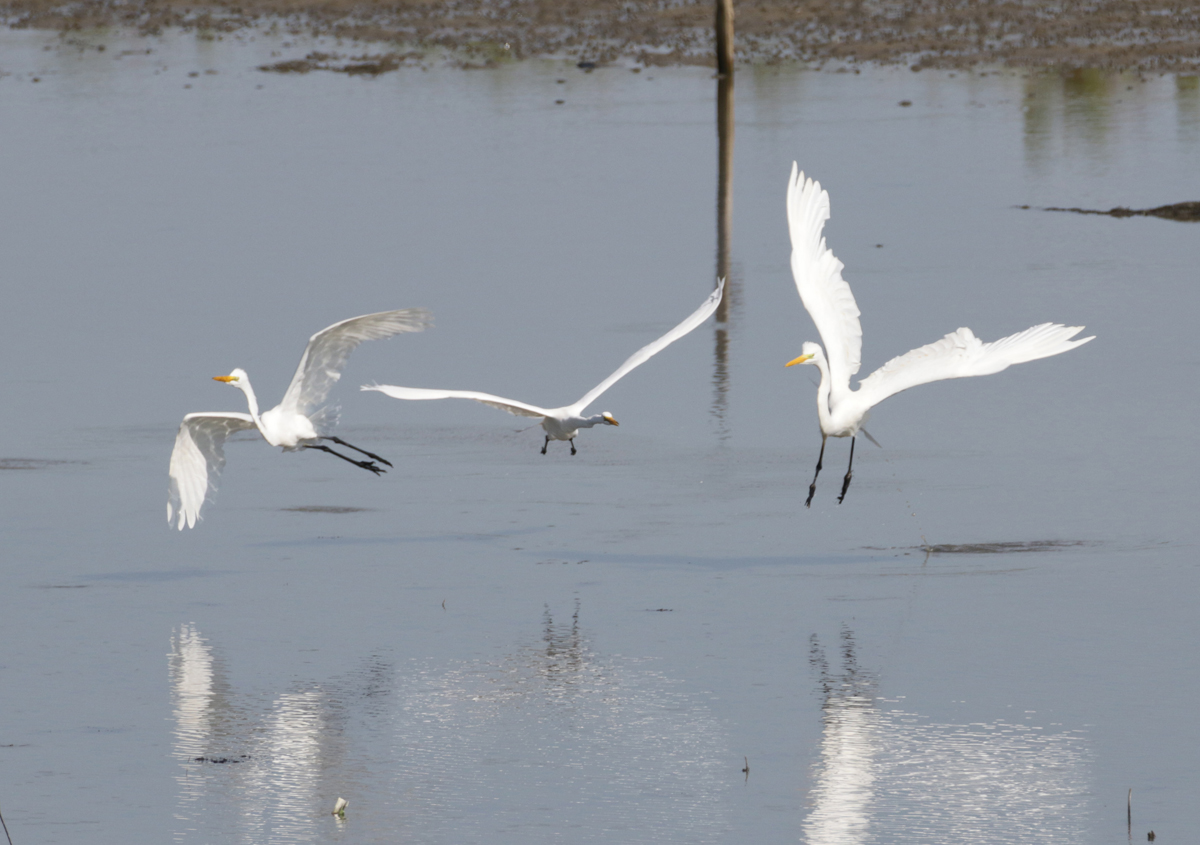
Then there were the dancing cra... er egrets...


Thursday, 2 June 2016

An albus Great White Egret in late May

I was out with a friend visiting from Australia the other day and we came across this albus Great White Egret; Rob's comment "It looks like a stork!" sums up its appearance nicely. There were about 50 modestus dotted around the fields and this bird was truly a giant amongst them.


I used to find the literature very confusing with regard to the status of albus Japan. However as I've never had more than two sightings of albus per winter, and there have been blank years too, it's most definitely a scarce winter visitor to Japan, and if it breeds I'd speculate that such instances are rare. Or in parts of the country I don't normally visit. I do also get the odd spring migrant on my regular trips to Mishima in the first week of May but this bird on May 26 is by far my latest sighting and because albus are so obvious I really don't think I've overlooked any.


Winter birds stand out because of their huge size and bulk of course, even lone birds tend to catch the eye, but this bird was even more obvious due to its yellow bill when all the modestus have had their completely black bill of the breeding season, and at close enough range beautifully offset by blue lores.


This bird is not only of interest to me because it's the latest I've come across but also because of that yellow bill. My understanding of albus is that it should also be black-billed in breeding condition or with a yellowish base, perhaps being out of its normal range has delayed the change but that's hard to reconcile with splendid set of breeding aigrettes, the lores which are more extensively green than in winter and the leg colour; pink tibia and a deeper rosy-pink tarsus. So I've gone through my older images checking as far as I'm able how bill and bare part colours change. Those of modestus seem fairly consistent in timing and appearance but my small sample of albus shows more variation. Is it possible that young adults don't acquire a black bill? Then why don't young adult modestus also have paler bills. Is it possible eastern albus less frequently acquire black bills when breeding? Before I get side-tracked into barepart variation, I'll just show the images of this splendid bird.


May 26: the latest date I've encountered albus in Japan.
There were three modestus on the same area of fields but none came close to the albus for a comparative size shot. Even at long range the black bill and legs are obvious, I'm yet to see a yellow-billed modestus in May.
The albus dropping in a little closer. It was quite mobile, frequently flying from field to field, plus we saw it later in the morning about 3km from the original location.


I sometimes feel albus has a proportionately bigger head with a higher crown, there is more of an angle between bill and forehead whereas a line drawn from bill tip to the rear of the crown would be straighter in modestus and if anything the peak is closer to the rear.


The bare parts colouration of breeding albus seems more subdued when compared to modestus; the green lores are paler than the blue of modestus, the legs are extensively pink whereas modestus has more contrast with deeper reddish tibia and black tarsus.

The flowing aigrettes suggest breeding condition. But what about the bare parts? The lores are more extensively green than in winter but not fully, very different to the bluish lores of modestus. The non-breeding yellow of the tibia has completely given way to pink and the black areas of the tarsus to a deep rosy-pink. So why the yellow bill?

Following are the only two shots showing direct comparison I've ever managed to get. In the first image the size difference is dramatic, similar to that show by the recent bird compared to the local modestus, while in the second it's still obvious yet without giving the impression of being a Great White with an Intermediate. 


3 May 2010, Mishima. The size difference looks so great it's hard to credit they are both Great White Egrets.


15 January 2012, Lake Biwa. The yellow legs of the albus are easy to see in this digiscoped image. The difference in bulk is obvious but the overall size difference is less striking than with the previous two, or the recent bird and modestus.
So coming back to bare part colouration from non-breeding to breeding and starting with the lores. Those of modestus are yellow with at most a hint of green whereas all the albus I've seen well enough show clear green around the eye. The legs of modestus are basically black, and though they can often be greyish there's never any suggestion of yellow while albus have largely yellow tibiae and black tarsi with varyingly prominent and extensive yellow sides and frequently yellow feet or toes.


So to immediately prove myself wrong, here's a modestus (18 October 2014, Kyoto) with extensive green on the lores. It seems too late to be a remnant of breeding colouration. 


A typical non-breeding modestus (December 29) in Kyushu, with lores concolourous with bill except for a hint of green around the eye.

An albus on the same day and in the same spot as the previous bird, this with partially green lores, more extensive and prominent than seems the rule with modestus.
Modestus (4 March 2012) in Kyoyo city. This greyish, lets call it lack of colour, across the lores isn't unusual and is similar to the greyish lack of colour that is often present on the legs.


This albus over-wintered (Lake Biwa, 2 February 2014), it had a narrow black line up the centre of the tibiae.


A two-albus month (25 February 2012, Hyogo). This was a much yellower-legged bird.


An albus in Shikoku 2 March 2014, a local birder told me that winter had been exceptional and that there had been two or three birds in the area. The visible lore is extensively green, the leg colour is typical and never seen on modestus.


A pair of modestus (May 1) on Tsushima, they are already in full breeding condition, black bill, blue lores and flowing aigrettes, which is typical for the date. The tibia is a deep, reddish-pink and the tarsus black.
An albus (May 1) on Mishima. The large size is impossible to judge of course but the yellow legs and bill stand out at a time modestus are already black-billed.

Something of a puzzle at the time (1 May 2010, Mishima), this bird had pale yellow tibiae, the tarsi (very muddy in this image) were dark with underlying yellow. The lores were yellow with extensive green around the eye. This all seems par for the course but the bill was a slightly yellowish-black (not due to mud). The aigrettes are rather under developed for the date. All other albus I've seen had fully grown aigrettes combined with a yellow bill by this time. Indeed the aigrettes are usually grown in February, hence the puzzle when I first saw this bird. Coming back to my clutching at young adult straws; might young adults develop a blacker bill and older birds retain yellow throughout the year? It seems counter-intuitive.