Showing posts with label Wagtail Grey. Show all posts

Sunday, 27 May 2018

Hegurajima bookends for May

Unbelievable, already the 27th... where did May go?


Well, wherever it went, Northern Hawk Cuckoo singing over my house a few nights ago spurred me to visit Ashyu Forest (central Kyoto prefecture) for the first time this spring as soon as I had time. Time turned out to be the weekend, when I also managed to get out to Hegurajima for only the second time of the season.


I didn't have any offshore plans for Golden Week this year but instead I had hoped to make day trips to Hegurajima. This isn't ideal for several reasons. First, the huge number of birders/photographers present during Golden Week means you're never alone on a trail, the best you can hope for is that you aren't part of a shuffling line spaced about 30 metres apart - that actually happened when I was there on May 1st, I almost felt I had to indicate and wait for a gap in the birder traffic when I exited woodland onto the main north/south trail. Second, the ferry only gives you the least optimal midday period on the island to find the birds. Finally, and worst of all, will the ferry even sail? Ferry cancellations aren't unexpected in autumn when the Japan Sea is less friendly, whereas spring is usually less risky. Of course 'usually less risky' doesn't mean sailings can be relied on as spring of last year proved and this year hasn't been any better, last week was the first time there were more sailings than cancellations.


My visit to Ashyu was really enjoyable, it was great to be in the field and not see another soul in 18 hours! Of course I heard many more birds than I saw but Grey Nightjars were good with two birds sitting on the road in the early hours and a third high overhead in display flight after first light. The heard only highlights were a Japanese Night Heron and a Japanese Scops Owl.


Ruddy Kingfishers were singing early in the morning but as it was sunny, apart from a few calls, it was as if they hadn't existed shortly after the sun crested the hills. Cuckoos, Northern Hawk, Oriental and Lesser vanished in the same way. One bird that never even appeared was Asian Brown Flycatcher, where were they? But a much bigger question was raised. I heard a Kamchatka Leaf Warbler singing in the forest and for an instant when it started singing I was delighted thinking it was Japanese Leaf. The only previous occasion I've heard 'Japanese Leaf' here was before the Arctic complex was split and now I wonder whether that too was a passage Kamchatka. It seems this area is just outside the Japanese Leaf range.


One of several Grey Wagtails around the car park in the forest. 'Car park' means a broad muddy turning area where the road finally ends.


On the not-a-bird front this monster earthworm was a stand-out.


At about 40cm long this would give any early bird pause for thought. Note the 10 Yen coin next to it for scale. 


Shortly after I saw this hummingbird hawk moth daylight was gone and a bigger surprise was an otherwise invisible bush across steep dark ravine lit up by glow worms like a ghostly Christmas tree.


After nightfall on the second day I drove north to Wajima as it seemed very likely the ferry would be operating the following morning.


There was a time, a long time in fact, I'd be out on the ferry deck from port to port but after multiple sailings each year, year after year, with very little to show for it I tend to catch up on sleep nowadays. Admittedly I visit the island more often in autumn than the more productive spring. When I went out on May 1st I did try for seabirds and the trip produced about 30 Ancient Murrelets in small parties, at least two Japanese Murrelets, ever present Streaked Shearwaters and the Pelagic Cormorants which are still around at that time of year. I had also hoped for good numbers of phalaropes, Red-necked can be common and usually there are a few Grey (Red) thrown in. In the event there were only a handful of Red-necked. This time, two days ago, I did sleep on the crossing but still managed a single Red-necked Phalarope through the window.


One of several small fly-by parties of Ancient Murrelets.


A few were slightly closer.


Red-necked Phalaropes with an Ancient Murrelet.


On the island at the beginning of the month this Sakhalin Leaf Warbler was the only bird of interest I managed good shots of. That was my first ever trip to Hegura when I was glad to be taking the ferry back to the mainland, I've never seen the place so birdless.


Strictly speaking I ought to call this a Sakhalin/Pale-legged Leaf as I didn't hear it but Sakhalin is the overwhelming favourite here.


I wasn't terribly optimistic about this trip, even though there have been some really good birds between my visits, because the weather hadn't looked too productive all week. However the hill behind Wajima harbour was thick with Kamchatka Leaf Warblers which put me in a much better frame of mind before the ferry left. Kamchatka were absolutely everywhere on the island, Asian Brown Flycatchers were pretty common too. No wonder there were none at Ashyu, they're all still on vacation!


Kamchatka Leaf Warbler


A clean looking Asian Brown Flycatcher, even paler in the sun. 


Asian Brown looking dark.


No amount of sun is going to make a Dark-sided Flycatcher look pale.


The best/rarest birds on the island were Black-naped Oriole, a flock of Common Crossbills and a Dollarbird; hmmm so okay, nothing major. But there were so many birds around, and such a variety of scarce stuff, there surely had to be something important waiting to be found. If there was, neither I nor anyone else found it during my four hours on the island.


Cuckoos were fairly obvious, Lesser and Common at any rate.


Lesser Cuckoo.


Black Woodpigeon is ever present but it's not often they sit about in the open like this.


Monday, 19 January 2015

Solitary Snipe... long overdue

My first Japan tick of 2015, Solitary Snipe. It could have been the first Japan tick of 2014 if it had been a bit more cooperative, I went for this bird five times last winter without connecting. But that's been par for the Solitary course. I've spent time looking for them on Hokkaido winter trips, wading through deep snow to reach favoured streams or pools, particularly on my first trip up there in 1987 when it would still have been a lifer. I've tried for them so many times in Kansai, where they are a scarce wintering species, but even the most nailed-on individuals temporarily vanish whenever I visit the stretch of river/stream that "they never leave".

I had planned to look for it on Saturday afternoon after work then spend Sunday in the mountains for winter woodland birds. However, when I finished work at noon it was pouring and because of my dreadful track record with the species I just went straight home. No sooner had I got there than my phoned tinged with a text that it was there... and not only had the rain stopped but the sky was a mocking blue. There was no longer time to get there in daylight and my lucky twitching T-shirt came off and hovered briefly over the bin.

My Sunday plan didn't hover, it was ripped up and unceremoniously dumped. The new plan entailed seeing the Snipe as early as possible (really!) followed by a three-hour drive to reach some good woodland birding further followed by a list of back-up places of decreasing distance and interest in case the bird slept late. Or whatever it is they usually do when I'm on my way. I was on site at first light, the bird wasn't. No surprise there. Time passed, hours and hours of it in fact, it was almost funny... almost. There were a few birds of interest around, an Eastern Buzzard flew by now and then and good views of the usual parkland and riverside birds were to be had to. Long-tailed Rosefinch was probably the pick of the bunch but the Grey Wagtail below was the most photogenic.


After seven and a half hours someone located it on a different stretch of river and I confess I ran as fast as tripod, scope, camera and bins would allow. Another birder thoughtfully gave me and a couple of others a lift to the spot and... there it was. I didn't get the usual feeling of excitement a new bird brings, it was more a sense of relief than anything else. It was about 90 metres away rather than the 15-20 metres it normally performs at, I didn't care. In five minutes the sun dipped behind a hill filling the valley with shade transforming my poor digiscoped shots into appalling ones. No matter.

Actually, it's such a beautiful and intricately marked bird that it does deserve better views and maybe I'll go back later this winter in the hope of getting some decent shots of it but for now I'm done with Solitary Snipe. Who knows, it might be one of those crazy cases where once seen, birds keep popping up unexpectedly left and right.

The following images are little more than record shots but for now I'm really happy with them!


Tuesday, 21 January 2014

wagtails


A disappearing Forest Wagtail at Miike (Kyushu), 4 January 2008. It was really tough trying to digiscope this bird dashing around among the trees. This is the best result I got!

Forest Wagtails have turned up and even over-wintered in Kansai, however they're rare anywhere in Japan. There has since been another wintering at the same spot as the bird I saw at Miike.

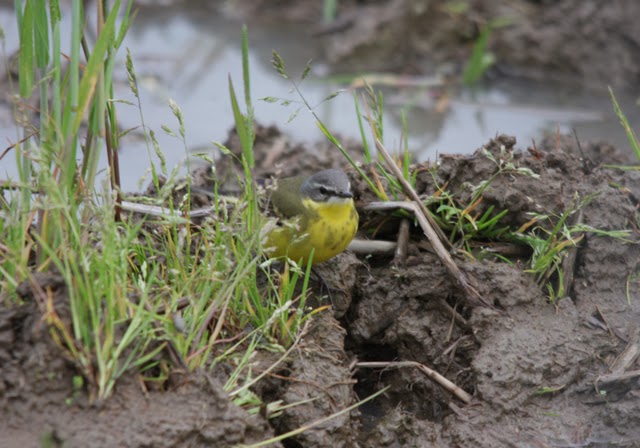
Eastern Yellow Wagtails are a fairly common migrant in southern and western Japan, particularly in spring on off-shore islands. I see many on Mishima and Tsushima when they don't present a serious identification problem but I usually visit Hegura in October where they are both uncommon at that time and far more challenging to identify. I've never seen one in Kansai and given their preference for open habitat and conspicuous appearance this says something about their status in this area.
I've never even heard of Citrine in Kansai but unfortunately missed one found by Gordon Hay (visiting from the UK) on Hegura last October (2013).
In Kyoto Grey Wagtail is quite common in winter and can be seen along the rivers or on various ponds. In summer they mostly retreat onto mountain rivers and are less obvious.
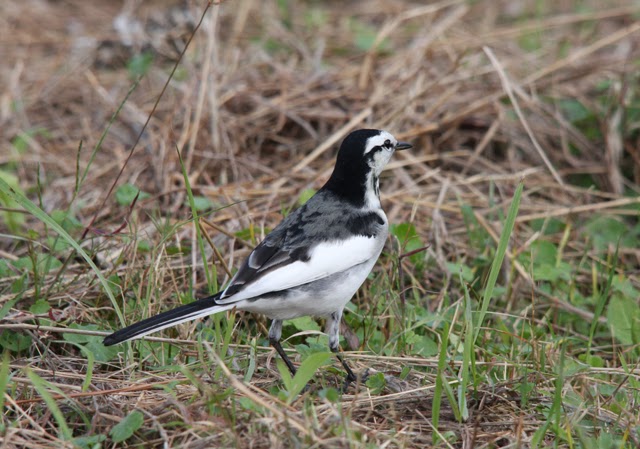
Japanese and White (lugens) wagtails are resident and the latter also a very common passage and winter visitor. Japanese seems to have a closer affinity to water and is the commoner of the two on rivers in the city. Large numbers of White Wagtails can gather on the fields at Ogura (and other arable areas, especially close to rivers) and pre-roost flocks of 50+ birds can be seen flying into many urban areas in the region. I've also seen ocularis (East Siberian Wagtail) in Kyoto but it's rare, whereas I see quite a few each spring on islands such as Mishima or Tsushima in western Japan. I haven't seen leucopsis in Kyoto but I have seen a very good contenders for leucopsis x leugens hybrids here.

In winter, even the casual visitor should see White, Japanese and Grey along the Kamo River in the centre of Kyoto.

An autumn Eastern Yellow on Hegura, 19 September 2006.

One of several tschutschensis on Tsushima, 30 April 2012.

This taivana, on the same date and Tsushima location has just a hint of grey on the fore crown.

Another bird on the same date showing far more grey on the forehead as well as extensively on the nape, the supercillium has a distinct yellow tint.

This wintering Eastern Yellow in Kyushu (January 2015) reminds me of Dusky Thrush in this shot. 

A much different grey and white Eastern Yellow in the same field as the previous bird.

A winter Grey Wagtail on the Katsura River (Kyoto), 20 October 2010.

Another winter bird, January 2015.

A summer Grey Wagtail on Mt.Misen (Nara), 28 June 2013.

A splendid post-breeding male lugens on Hegura, 9 October 2009.

An adult male with a yellowish face, this is meant to be a feature of first-winters as far as I'm aware. Katsura River (Kyoto), 3 October 2013.

Non-breeding adult lugens on the Katsura River (Kyoto), 30 December 2010. 

First winter lugens on the Katsura River (Kyoto), 15 October 2010.

M.a.ocularis (East Siberian Wagtail) on Mishima (Yamaguchi), May 2008. The conspicuously dark-centred coverts aren't typical and something of a puzzle.

A typical 'East Siberian' on Iriomote, 2 April 2013.

'East Siberian' first winter on Hegura, 7 October 2011.
 
Putative lugens x leucopsis hybrid at Seika (Kyoto), 30 October 2008.

Winter adult leucopsis in Kyushu, January 2015.

A scruffy-looking moulting adult Japanese on the Katsura River (Kyoto), 18 September 2013.

Fresh adult Japanese on the Katsura River (Kyoto), 8 October 2012.

Adult Japanese Wagtail, 25 October 2014.