Showing posts with label Stint Little. Show all posts

Wednesday, 24 April 2019

All four stints in one field on Yonaguni

On my only previous visit to Yonaguni, six years ago, I spent five nights on the island from April 5-9, this time I stayed from April 10-17. I didn't plan a contiguous time span but I was aware of the later timing wondering how this might affect the range of species I'd find. Of course with such a fine margin the weather can have a more significant influence, however the weather was basically the same on both occasions. Mild, largely overcast with frequent showers and with calm interludes between lengthy bouts of strong northerly winds. Not exactly what I might have expected.


I saw a slight increase in the number of wader species in 2019, perhaps not surprising give more field time, but missed out on two rarer birds Pec Sand (one 2013) and, the regions speciality, Oriental Plover (several 2013). Little Stint (two) was the only interesting species I picked up this time round that I'd missed on the previous visit.


On both occasions the same two areas were best for waders, flooded fields on the eastern outskirts of Sonai and at Hikawa. I wasn't too thrilled to see large scale development taking place at Hikawa and wonder whether those excellent fields may not be there much longer.


All the stints in this post were photographed at Hikawa where birds tend to be closer.


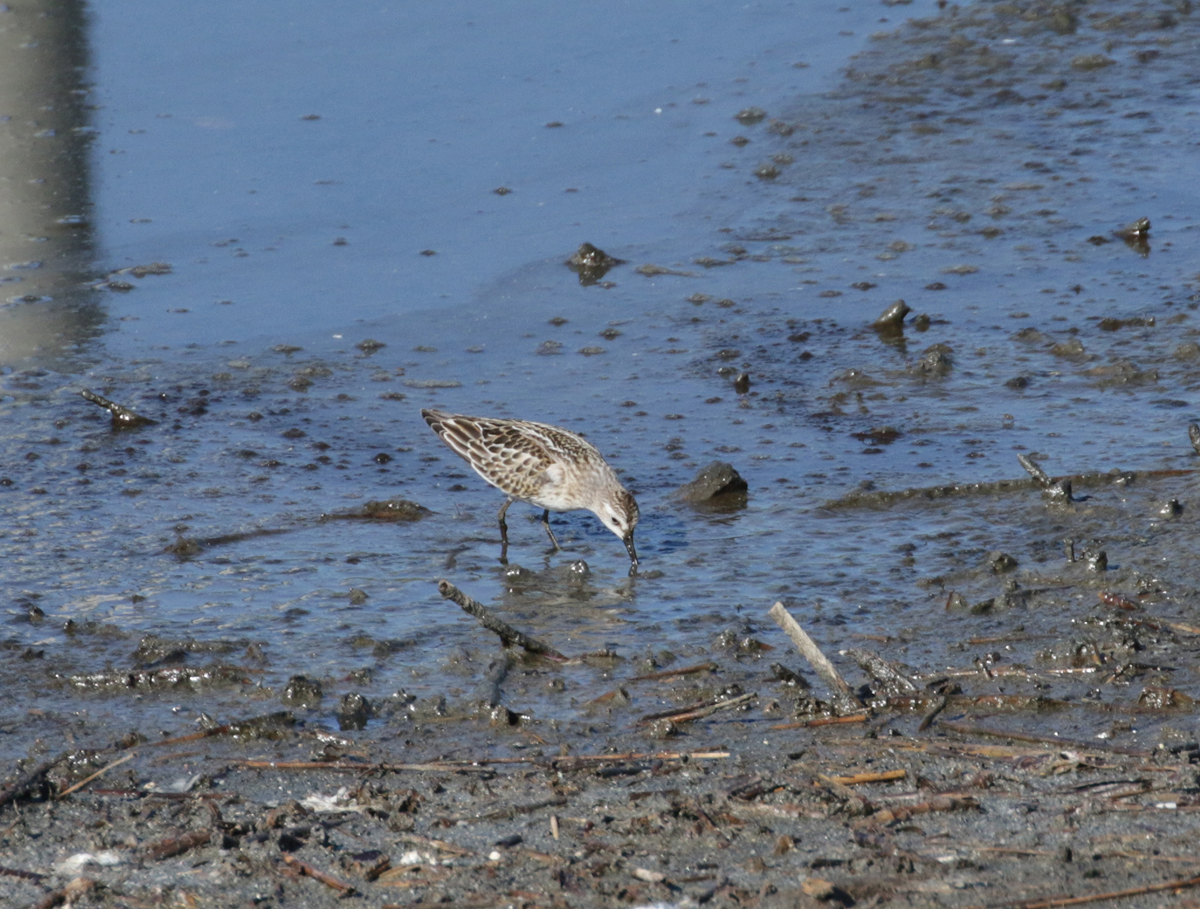
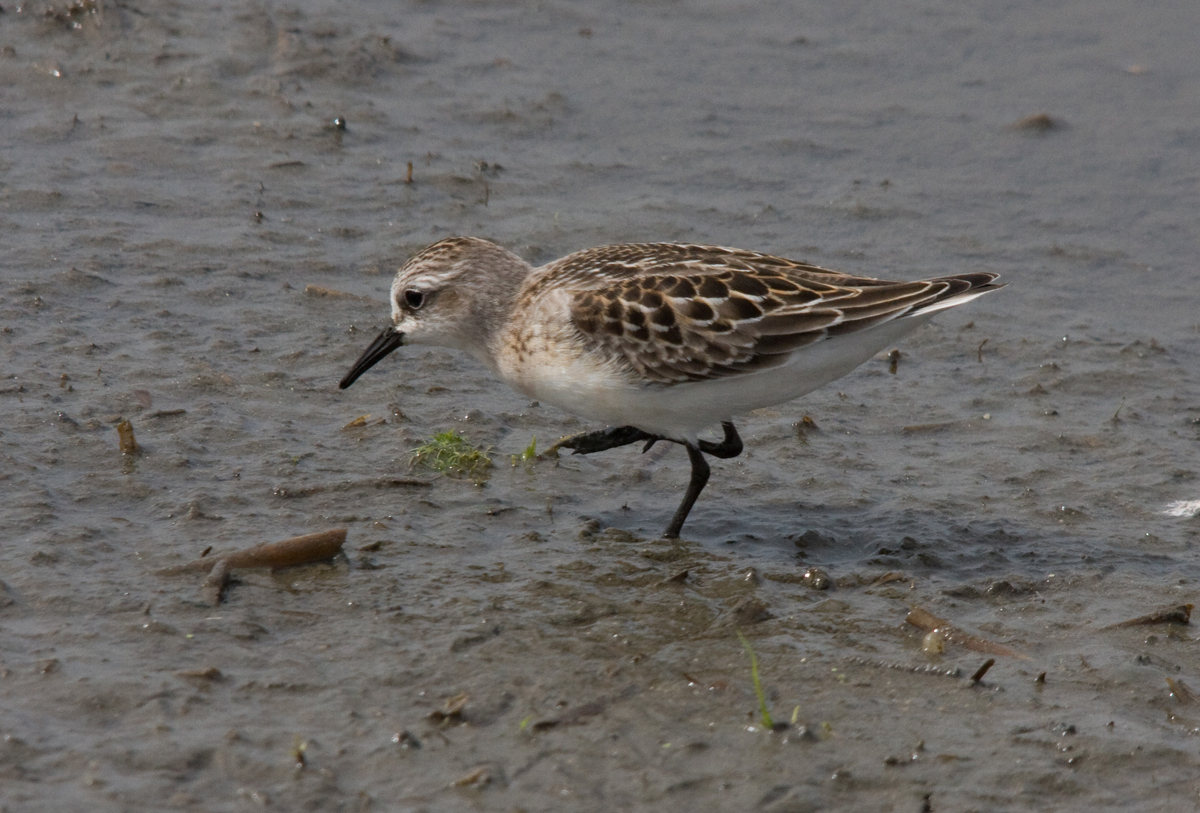
Little Stint...


Red-necked...


There were two Gulf of Thailand flagged birds.


Temminck's...


And Long-toed...


This bird gets the award for the drabbest Long-toed Stint I've seen.


And this one, with a Temminck's, wins the least obvious prize (no pun intended).


I was puzzled when I first saw this dumpy stint and I made a point of driving closer to get better shots, it took a few minutes for the penny to drop. Long-toed Stints invariably remind me of a long-sighted person struggling with a newspaper because of their upright gait on stretched legs and elongated neck, as if unable to focus on the mud when too close. To my shame I didn't even consider Least Sand until later in the day; oh that sinking feeling! Insert expletives of choice. I slammed on the brakes and stopped dead in the middle of the road (there isn't much traffic except between Sonai and Kubura, you'll see more military personnel jogging than cars), grabbed my camera and by pure luck I'd managed the middle toe money shot. Otherwise the whole trip could have been under a cloud because I never saw the bird again. The really stupid thing is that it's not unusual when I come across a Long-toed for me to wonder whether I'd totally overlook a Least if I ever saw one, and here I was totally deaf to any bell that might have rung.


Long-toed and Temminck's closer now and with a couple of Red-necked teaming-up.


Almost perfect line-up. The non-breeding Red-necked needs to work on its timing a little I think. And WHERE is the Little!!! The long middle toe is clearly visible here, no need to stress about the minutiae.


Saturday, 30 September 2017

Aggressive stints

A couple of weeks ago at high tide I noticed a party of Red-necked Stints feeding around a small pond just above the beach. One bird was behaving in a very aggressive manor, running at all the other birds with its tail held vertically, bill downward and wings slightly opened while calling loudly. This in itself wasn't so odd but after a few minutes most of the other stints began to adopt the same behaviour until there was very little feeding taking place at all. This wasn't the first time I've noticed this aggressive behaviour and it seems to be a response to insufficient 'personal space' at or around high tide. What I don't remember having seen before is the same behaviour when space is restricted on a muddy field or other similarly cramped inland area.


The following few shots were taken last weekend just as the tide began to drop and the first few exposed square metres attracted the stints. Nothing else arrived until the water dropped further, the stints always seem more impatient to get on with things!


A juvenile Red-necked getting ready to take on all comers.


This adult scores more highly for technical ability and artistic interpretation.


The posturing never has the slightest effect (why bother?) and is followed by the charge.


Later in the day with the mudflats exposed all was sweetness and light... almost.


They would never have co-existed like this earlier in the day. Just having the space available seems to do the trick as they roved this way and that. No need to get excited, the big bird facing away is a Dunlin.


The Little Stint (right) stuck like glue to that small penalty spot-sized puddle. When a Peregrine flushed everything off, it came back to its private pool. The Red-necked Stints, now amicably moving across the mud, little realise they are about to transgress.  


Any Red-necked that crossed the invisible line would cause the tail-up threat posture.


The Little was kept pretty busy.


I never saw the same posturing from the lone Temminck's Stint, it would only voice a warning.

Monday, 4 September 2017

Broad-billed Sandpipers and another Little Stint

I love wader passage season, there's always the chance of something really out of the ordinary turning up, it's on a par with a seabirding on the Pacific route ferries or an off-shore island stay. Except there's no need to invest as much time or money, it's so easily doable in a spare day.


Last Friday I did the rounds of the Matsusaka / Tsu wader spots, some of them at least. Driving across overnight I was in my usual state of expectation, running through the identification features to separate tricky specks miles out on the mudflats... Baird's and White-rumped, Semi-P and Western, Eskimo and Slender-billed. I know, I know, a tad over-optimistic when you consider Semi-P isn't even on the Japan list.


In the two weeks since my previous visit the place has changed almost beyond recognition, gone is the huge expanse of flooded rice fields, all is stubble now and bone dry. Birdwise there are pros and cons to the change, it suits Skylarks just fine but what about the Zitting Cisticolas, they were so common last time I was there and they've all but disappeared. Likewise I'm split, I miss the extensive greenery on one hand but on the other I feel it might be easier to find something unusual out in the open. Not that this makes any sense as previous years don't back it up the notion of better birds on the open fields, but anyway, a Dotterel would be nice!


Tides are really important of course and their timing dictates whether you'll have the light as a help or hinderance across this estuary of that tidal flat. But also water levels on ponds and on the fields are crucial and sometimes you can drive round all day without finding the sweet spot that's pulling in the birds. This visit was lucky in that regard and it was one of the standard must-visit sites that held a selection of twelve species. The highlights were the two Broad-billed Sandpipers and Little Stint of the title. The former is a scarce passage bird and I don't expect to see more than one or two per migration season and when numbers are that low it's possible to go a long time without a decent view. The latter I always regarded as a rarity in Japan but this is the fifth I've found here in about three years so I'm coming round to the idea that it's been long overlooked rather than rare.


The birds were at a nice distance for observation, unconcerned by my presence and near enough to see well, unfortunately just a little too far for photography with my kit so most of these images had to be cropped more heavily than I'd have wished.


Little Stint. This last shot was taken at midday, the bird was a little closer but the sun was less helpful. Interestingly the 20 something Red-necked Stints I saw were altogether on a different pond.


Like the Stint the two Broad-billed Sandpipers stuck to the same small section of mud throughout the day, other waders used the whole expanse of the pond, not that it was very large.


Other wader species included...


Black-tailed Godwit


Common Redshank, one of five, with Marsh Sandpiper.


Grey-tailed Tattler with Black-tailed Godwit.


Several Marsh Sandpipers showed a good range of plumage.


Wednesday, 16 November 2016

A snapshot of September stints

I've recently been going over my images of Little Stints taken over the past couple of years... images of Little as well as possible / probable Little to be more precise. September juveniles seem relatively easy, but there is the odd bird that isn't so straight forward. By mid-October ongoing moult to non-breeding plumage leads to even more reliance on structural differences when trying to pick one out from a flock of local Red-necked. My experience with Little in the UK is so long ago to be meaningless and I'm trying to identify these birds from an Asian standpoint with Red-necked as my baseline stint. However living inland, I don't see Red-necked as often as I'd like and still consider myself very much a beginner when it comes to birds that don't come up to field guide expectations.


All the following images (except one) were taken on September 15.


A trio of Red-necked. These birds are very typical; short-legged and and long-winged giving them a long and low appearance, steep forehead and stout bill, the golden tint of the scapulars, grey wing coverts (when visible) and smudgy breast markings.


Little Stint (right) and four Red-necked, though only two easily seen and relevant. A distant shot and not all the birds are but importantly it gives a good feeling for how strikingly different fresh Little and Red-necked can look in the field. The long-bodied, short-legged Red-necked and the longer-legged less attenuated Little. Typically distant Red-necked look rather sandy and uniform in mid-September but Little is much darker above and altogether more contrasty.


Now a few closer shots of typical Red-necked...


A standard Red-necked. Richly marked centre crown with greyer sides, greyish breast with ill-defined spots, golden-fringed upper scapulars, mainly grey lower scaps with blackish centre line expanding into a subterminal teardrop with white tip, grey wing coverts with dark centre line, similar tertials with slightly golden fringes.


A brighter bird than the first.


A bright but pale bird. On this date no birds had replaced any juvenile feathers and few had even dropped any. 

Another bird with gaps in the lower scaps. This bird is very pale overall and lacks the brighter golden tints.


Scapulars and coverts are variable, this bird has Semipalmated-like anchors in the lower scaps. One day I may find a Semip but this bird is a very standard Red-necked in all other features. (Sept 9)


Getting into trickier territory here. Blacker upper scapulars lacking prominent golden fringes, largely black and white-fringed lower scapulars as well as distinct rusty spots on the breast sides might all suggest Little Stint. Nevertheless I think this is a Red-necked with worn upper scapulars reducing the golden fringes, the lower scaps are maybe at the blacker end of the scale but not impossible for Red-necked. The coverts are contrastingly paler, basically grey with just a darker centre line (and pale fringes), typical of Red-necked. Structurally it looks bang on for Red-necked, the main points being the blunt-tipped bill, short legs and the primary projection. Ignoring the longest primary, which is just visible, there are two primary tips beyond the tertials the next longest falls easily short of the longest tertial; this is the gold standard of Red-necked in my, admittedly limited, experience. In earlier images you'll find one bird with the third visible primary tip level with the longest tertial this seems to be as long as it gets. Little has a much longer primary projection often, but not always, with three feathers projecting beyond the tertials and clearly longer spacings between the feathers.   

Another shot of the same bird. The bill looks slimmer-tipped from this angle and the coverts much darker. Additionally the crown is more uniform with a hint of a split supercilium and the breast sides are distinctly marked with warmer than usual spots. On this view alone I'd be very tempted to call this a dull Little but I'm sticking with my Red-necked identification until someone with plenty of experience tells me I'm wrong.


A real Little on the same day for comparison. Notice how the warm breast streaks (rather than spots) are on a much whiter ground. Even at this angle the legs look longer, as does the bill. 


A nice comparison despite the Red-necked being out of focus. Typical Red-necked is warmer and more uniform, fresh Little a far more contrasty black and white. Having said that the breast side markings of Little are warmer. The difference in primary projecton is apparent, both the greater overall length and longer spacings of Little. The longer legs of Little are also obvious.   


I think this is a quite good example of how misleading single images can be. This shot shows a typical comparison with a sandy (or golden) Red-necked in the foreground showing its grey wing coverts and dull breast band. Structurally it is short-legged and has a shorter, blunter-tipped bill. The long-legged, long, slimmer-billed Little is typically boldly marked with strong contrasts. The next image is of the same two birds.

Suddenly this Red-necked is looking as long-legged (note the ring) as the Little. After mentioning the difference in primary projection this Little has a wing structure in the overlap zone with longer-winged Red-necked. In this shot the Red-necked primary projection matches typical Little but this is largely due to it stretching forward and it didn't give this impression in the field. 


An unambiguous comparison.


The next comparison shocked me at the time; I was focused on the Little Stint and didn't notice the other bird in the background until I looked at the images. The bird is so strikingly different to the typical Red-necked that my first emotion was fear, dreading that I'd missed a Semipalmated Sandpiper. Fortunately (or unfortunately?) it's just a very different-looking Red-necked.


A mystery stint hove into view (finder), very thick billed, very uniformly dull, short-winged(?)...sadly that head pattern knocks any thoughts of Semip on the head. However I'm left with a very interesting and different Red-necked Stint.

Thank goodness I got a lucky second shot alongside the Little. I'd put this birds appearance down to being more worn than the other birds but it may be that the fringes are simply narrower than normal.


Little can look like a 'Stilt Stint' at times. 


Everything I'd hope for in a September juvenile Little Stint.


The third visible primary from the tip is conveniently fringed white, falling equal to the longest tertial it would be distinctly long for a Red-necked but is certainly within an overlap zone, and they do come even shorter.


The main reason I haven't shown any adults is because I didn't see any. However I seem to see only adults in August when they very dark in worn breeding plumage.


An adult Red-necked in early August.


Temminck's Stint is scarce in Kansai and I see more birds during winter or on spring passage than I do in autumn. Long-toed Stint is reasonably common at this time of year but they are more difficult to find tending to be in ones or twos on fields with more vegetation. In any case they don't present any identification difficulties... unless you're hoping for a Least Sandpiper, but that would definitely be another story.


Long-toed Stint, 10 August.

Long-toed Stint, 8 September.