Showing posts with label Duck Tufted. Show all posts

Sunday, 25 January 2015

Southern Lake Biwa

More often than not for me, birding at Lake Biwa means heading up to the north end and working my way south. I'll bird southwards as far as daylight allows, this normally means Lake Sainoko and harriers coming in to roost. One important reason for starting at the top end is to kick off proceedings in woodland to the north of the lake and increase the variety of birds I can see in a day.


Last Sunday was different, a throw back really to the way I used to bird there years ago, starting from the south. Or to be more precise focusing on the lake from Lake Sainoko southwards, the area I never usually get to cover nowadays. I've often felt that sacrificing the south could be costing me finding rare ducks. Apart from Baikal Teal (which only winters in numbers in the north) and Red-crested Pochard, I've never seen any rare ducks up there. Whereas I have seen Ring-necked, Lesser Scaup and Baer's Pochard, as well as Red-crested Pochard, in southern waters.


A key reason for covering the south this weekend rather than any other was the lack of recent snow and the prospect of reaching the hills close to Ashyu Forest. Since exceptional snowfall at New Year, the most in Kyoto city for 61 years, there seems to have been less than average throughout northern Kansai. The Meteorological Office website shows zero snow on the ground over large swathes of the region, though I sometimes think they assess the situation by looking out their office window.


Just a few kilometres north of Kyoto city Route 367 hairpins its way up to a short tunnel. From Kyoto to this point there wasn't even a suggestion there had been snow this winter then exiting the tunnel onto the Japan Sea watershed it was ploughed high on each side of the road, the villages were white in the headlights and the temperature dropped from an unseasonably mild midnight 6 to -2 degrees. Nevertheless the roads that wind up into the hills were largely snow-free and by only 2am I'd reached my intended dawn starting point.


It was wonderfully quite at dawn, perfectly still, and the reflecting snow hastened birding quality light except under the occasional clump of dense conifer here and there. Against a backdrop of drumming Great Spotted Woodpeckers on opposing hillsides I could hear roving bands of tits above and below, mainly Coal and Willow with a smaller number of Varied and the odd Great. Of more interest to me were birds I can't see in Kyoto city, Nuthatches which I've only seen twice here, and Treecreeper which I've never seen in the city.


I needed coffee and mid-morning I made my way to civilisation, the transformation from deep snow to zero from one end of the 100 metre tunnel to the other was even more striking in daylight. Down to the Biwako Ohashi (the large bridge that spans the neck of the lake), coffee, then up the east shore of the lake to Omihachiman where the first bird I saw was a White's Thrush in the garden of a lakeside cafe.


It isn't unusual to see White's Thrush in woodland edge or even parks on the lake shore.


Another lakeside bird was Elegant Bunting, easy to find around the northern half of the lake but an irregular species in Kyoto city.


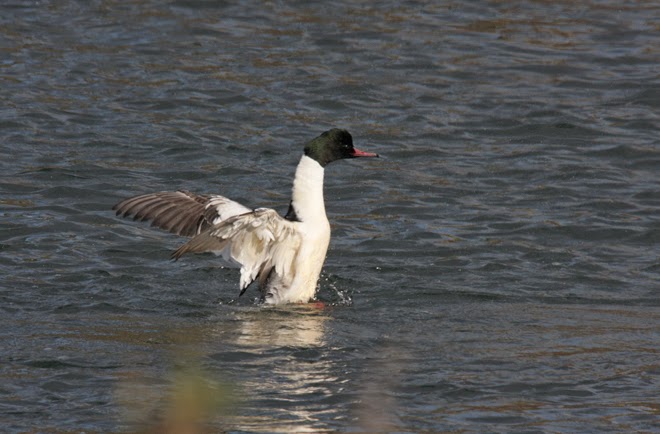
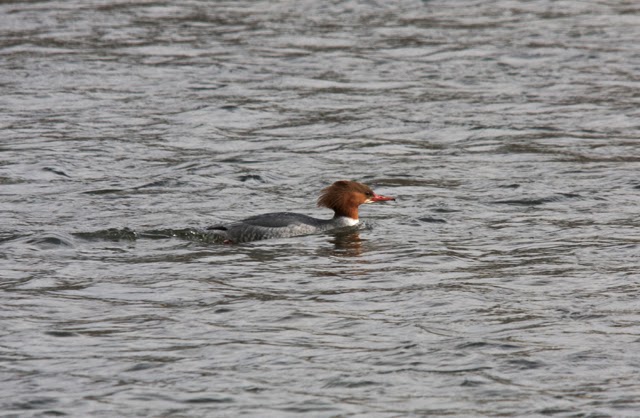
But ducks are the lake's big attraction and while some are evenly distributed others are not. The sawbills are a great example. In the north I might see a handful of Smew, almost always redheads, but in the south there are rafts of hundreds with an apparent majority of drakes, but they are invariably far out on the lake and because females are less conspicuous this many skew the seeming gender imbalance. Goosander (Common Merganser) on the other hand is a northern speciality, they are common at the north end but I never seen them down south. Red-breasted Merganser is less fresh water orientated than the other two and though I sometimes see odd ones at the north end the most reliable area is mid-lake. Strange.


Bean Geese and Tundra Swans are also northern specialities but there always used to be a small flock of Tundra at one location at the south end where people go to feed the ducks. These no longer seem to come to this area, though I'm not really in a possition to know for sure as I don't usually pass this area in daylight, but when I dropped in today there were two birds present. Day tick.


There was a Vega Gull in this area, an unusual bird on the lake, but the ducks take centre stage. There was a smallish feeding frenzy of aythya ducks in an inlet so even my small lens could get some semi-reasonable shots.


The only classic adult male Tufty in the group.


With another male that isn't qiute there yet.


A first winter male with a moulting adult.


Female Tufty.


Common Pochard.


Female Common Pochard.


A slightly more obvious blue band behind the nail on this female.


Exceptionally extensive male-type blue on this bill.


Northern Pintail.


LIST OF SPECIES SEEN
several: widespread in low numbers (should be seen) or localised (could be missed)
fairly common: seen in most or all locations in low numbers
common: easily seen in most or all locations
very common: easily seen in most or all locations, often in very large numbers

Tundra Swan   2
Gadwall   common
Falcated Duck   5-10
Eurasian Wigeon   common
Mallard   common
Eastern Spot-billed Duck   common
Northern Shoveler   8
Northern Pintail   only seen at one location, 200+
Eurasian Teal   fairly common, less obvious than species prefering open water
Common Pochard   very common
Tufted Duck   very common
Greater Scaup   common
Common Goldeneye   10-20
Smew   100s   south of Biwako Ohashi
Red-breasted Merganser   2
Little Grebe   fairly common
Great Crested Grebe   fairly common generally, very common south of Biwako Ohashi
Black-necked Grebe   Fairly common
Grey Heron   widespread in low numbers
Great White Egret   several
Little Egret   several around fish pens at one location
Great Cormorant   common
Eurasian Kestrel   1
Black Kite   common
Eastern Marsh Harrier   1
Eastern Buzzard   1
Moorhen   2
Common Coot   very common
Grey-headed Lapwing   2
Northern Lapwing   16+
Dunlin   c40
Common Gull   several
Vega Gull   1
Black-headed Gull   fairly common
Feral Rock Dove
Oriental Turtle Dove   widespread
Japanese Pygmy Woodpecker   several
Great Spotted Woodpecker   2 drumming
dendrocopos sp   1 calling
Bull-headed Shrike   7
Jay   6-8
Rook   250+
Carrion Crow   very common
Large-billed Crow   very common though less so than Carrion
Great Tit   several
Coal Tit   fairly common in the mountains
Varied Tit   ffairly common
Willow Tit   fairly common in the mountains
Long-tailed Tit   1 party
Japanese Skylark   fairly common
Zitting Cisticola   1
Brown-eared Bulbul   very common
Japanese Bush Warbler   3-4 heard
Japanese White-eye   fairly common
Nuthatch   2
Treecreeper   1
White-cheeked Starling   fairly common
White's Thrush   1
Pale Thrush   several
Dusky Thrush   fairly common
Red-flanked Bluetail   1 heard
Daurian Redstart   common
Brown Dipper   1
Eurasian Tree Sparrow   common
Grey Wagtail   1
White Wagtail   fairly common
Japanese Wagtail   fairly common
Buff-bellied Pipit   1 heard
Brambling   heard at the lake
Oriental Greenfinch   common
Eurasian Siskin   heard in the mountains
Long-tailed Rosefinch   1
Bullfinch   often heard in the mountains
Meadow Bunting   common
Rustic Bunting   5-6
Elegant Bunting   2
Black-faced Bunting   common
Reed Bunting   1 plus several heard


Tuesday, 5 November 2013

diving ducks

For the resident birder diving ducks offer more opportunity of finding a rarity but for the visitor to Kyoto city they're far less conspicuous than anas species, most local waters being shallow. A few Tufted duck on the rivers is the most that can be hoped for, astonishingly I've only encountered a single Goldeneye in over 20 years despite them being common in Kansai in general.


One of the most sought after species nowadays is Baer's Pochard, the shots below are of a bird that spent two winters (2009-'10 and 2010-'11) on temple ponds in the north west of the city. Aside from this bird the only others I've seen in Kansai were a bird I found on Lake Biwa that I failed to see on subsequent visits and a bird that wintered in Osaka. While the total population has decreased alarmingly the odd bird still manages to find its way to Japan each winter but it certainly can't be expected on a visit to Kansai.


Daigakuji temple Kyoto city, February 2010, the bird returned the following winter.


Male Baer's in Osaka, 21 December 2013.


A number of years ago I also found two Baer's x Common Pochard hybrids on the Yodogawa in Osaka city. Both were obviously hybrids, which isn't to say all cases will be as clear-cut, but is interesting in the light of recent doubt about some records in Japan.


A video-grab of two distant Baer's x Common Pochard hybrids.


Ferruginous Duck is another irregular visitor from the continent. The bird below wintered in a park in Osaka and soon joined the bread queues with the regulars. There was another male on Lake Biwa one winter but as with all the lake ducks it could be rather far out on the water. The same can be said of Red-crested Pochard however because it's so much larger it tends to stand out whatever the range. Also it occurs more frequently and is probably annual on Lake Biwa and though I don't recall hearing of them elsewhere in the region that may be because they're less newsworthy.


                                                       Riyokuchi park, Osaka city.


Like a battleship ship passing through aythya destroyers, it's hard to miss even way out on Lake Biwa.


The rarest duck I've seen in Kansai is Bufflehead, perhaps it's annual in northern Japan but this is the only record I've heard of down here. This immature male spent the winter on a country park lake near Sanda in Hyogo, though it could disappear for a day or two at a time. Where it went was never discovered but it did mean I needed to go there three times to catch up with it.


-align: center;">
Early sun beginning to cut through a layer of morning mist across the water.


White tips to the greater coverts indicate this is a male and by the time it left it looked like one too. 


The common wintering species in Kansasi are Common Pochard which is numerous suitable bodies of water usually deeper, tidal stretches of rivers in Osaka and there are large numbers and on Lake Biwa. Tufted Duck which is more widespread, seemingly happy on shallower waterways. Greater Scaup which occurs throughout Lake Biwa in low numbers as well as being common in coastal waters where it can combine into huge rafts with Common Pochard.


Pochard in Mie, January 2015.


                                                The only common aythya in Kyoto city.


A female Tufted with an extensive white base to the bill on the Kamogawa, Kyoto city.


Male and female Greater Scaup in Matsusaka harbour, Mie.
 
A female type (possibly a young male) Greater Scaup with very little white at the bill base, Hokkaido 2013.


A presumed 2CY male Greater Scaup with three females, Tsu city April 2012.


Greater Scaup in Mie, January 2015.


The shot below shows a Tufted Duck x Greater Scaup hybrid, a combination that occurs sometimes but obviously it'll only males that catch the eye.


Tufted x Greater Scaup hybrid, Lake Biwa February 2008.


Record shot of a female Ring-necked Duck through thick falling snow on Lake Biwa.


Goldeneye is another fairly common bird in the region. It's generally more coastal but it occurs on deeper inland waters too, on Lake Biwa numbers are usually larger at the north end. It's very common along the coast and river mouths around Tsu and Matsusaka cities in Mie.


Female with an all dark bill in January.


Female in Ishikawa, February 2014.


Male in Ishikawa, February 2014.


                                                       A male showing the scapular pattern.


Then there are the northern ducks, these are far more likely to be seen on the Japan Sea side of Kansai, particularly Black Scoter, which is unusual in the Inland Sea (Seto Naikai) on the Pacific side, while Stejneger's (White-winged) Scoter, Harlequin Duck and Long-tailed Duck probably aren't even annual. Of course news of scarce birds doesn't always reach a wider audience but either way the visitor to the region can't expect to see any of these species even though the scoters become abundant not much further north. The closest place to Kyoto worth checking would be Ise Bay because, as with northern gulls, the Kii Peninsula seems to present an what would seem an improbable barrier to southward movement.


Stejneger's Scoters along with several Black Scoters in Mie, January 2015. They were attracting a number of photographers as might be expected with such a scarce bird, there were also several in Osaka at the same time.


                                                                 Female Black Scoter.


Immature male Black Scoter.


Male Black Scoter, Hokkaido January 2013.


                                                      Harlequin Ducks, Hokkaido 2013.


                                                        Long-tailed Ducks, Hokkaido 2013.


And finally the sawbills. When I first came to Japan there were two or three Scaly-sided Merganser within easy reach of Kansai on the Kisogawa near Gifu city each winter. Since then occurrences in the region have been few and usually brief. Over-wintering birds have arrived either side of Kansai but no direct hits. Where birds might turn up is unpredictable but there's no shortage of suitable habitat in the region, even if coverage by birders might not 100%.


Red-breasted Merganser is common in coastal areas but with I wouldn't expect to see more than three or four at most on a visit to Lake Biwa. Goosander, on the other hand, is a common duck on the far north of the lake with numbers dwindling southwards. They can usually be found on the Katsuragawa in Kyoto city, the best area being between Matsuo and Arashiyama stations on the Hankyu Arashiyama line.


Red-breasted Merganser, easy to see on rivers in Tsu city, Mie.


Female Goosander in Kanazawa, February 2014. 


Male Goosander in Kanazawa, February 2014.


Smew is common on Lake Biwa but rafts of males are usually well off-shore south of the Rainbow Bridge, whereas females outnumber males in the north and can often be found in small harbours or small ponds near the lake. Some turn up on the Yodo and Katsura rivers in Kyoto city every winter but they don't usually stay long so a bit of luck is needed to connect with them.


Drake Smew on the Katsuragawa, Kyoto city.


Female Smew near Lake Biwa, February 2014.