Showing posts with label Pipit Red-throated. Show all posts

Monday, 9 November 2020

Tree and Red-throated Pipits

 It's been 16 years since I last saw a Tree Pipit in Japan, that also on Hegura, though I did manage to miss one by only seconds on Tsushima in spring. I almost missed this one too!

I came across a pipit in the morning on the open concrete area at the north end of the harbour and dismissed it as a first autumn Red-throated. In my defense it's a favourite spot for Red-throated Pipits, Tree Pipit superficially looks like a first autumn Red-throated and I was chatting at the time. Fortunately I got another chance when I ran into the same bird again in the late afternoon, this time at the opposite end of the harbour. It dropped down from one of the small ornamental pines onto the lawn at the ferry terminal and immediately vigorously pumped its tail. It had to be an Olive-backed Pipit, right? Getting my bins on it, the heavily streaked mantle immediately knocked that idea on the head but there was no thought of Red-throated this time; upgrade to Tree Pipit. What a difference a tail pump makes. Once on the deck I initially picked up a supercillium drop but then it seemed to disappear. It was very subtle and the same 'now you see it, now you don't' occurred in the photographs I took too.

The previous bird I'd found so long ago was instantly recognizable as something different because it was such a pale, almost sandy coloured bird, whereas this individual was much darker and made me  feel a little better about my misidentification earlier in the day.

Brazil's Birds of East Asia treats OBP as the potential confusion species with Tree, which is fair enough it being a common species across Japan as a whole. However the text completely ignores the far more similar first autumn Red-throated. 

I saw several first autumn Red-throated Pipits on Hegura mid-month but the only bird this trip was an unseen fly-over calling. So I'll compare this Tree Pipit with first autumns I've seen in this and previous Octobers.

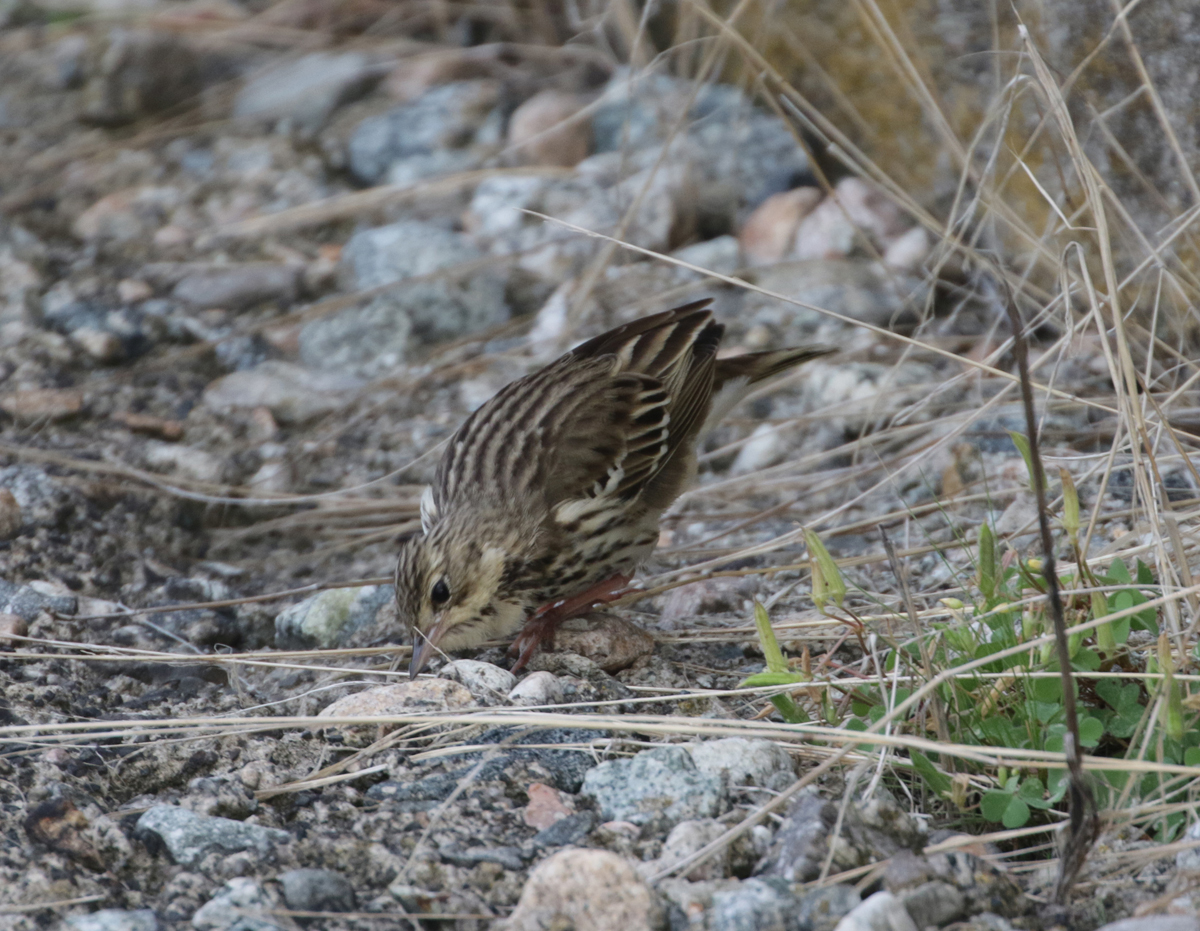
Tree Pipit. The contrast between heavy breast markings and fine flank dashes are distinctive however Red-throated does have fine streaks low on the flanks but also a bolder line higher on the flanks close to the wing. The very stout, deep-based bill is obvious here, the supercillium drop is far less so. 


Red-throated Pipit. Fine flank dashes low on the flanks but broad, heavy markings above. The bill is very fine compared to Tree, the ear coverts more uniform. This individual shows paler braces.

Tree Pipit. Lack of braces, stout bill and inconspicuous supercillium.


Tree Pipit. Rather plain rump and uppertail coverts.

Red-throated. Heavy flank streaking and plain ear coverts. Note the very dark-centred uppertail coverts and more distinctly marked rump.

Perhaps it's worth posting my old digiscoped image of the Tree Pipit I found 16 years ago to show how different Tree Pipits can appear first glance and more pertinently or how some might easily catch the eye while others could be overlooked. In fact, looking more closely, the markings are actually very similar and it's only a matter of colour saturation that gives the superficial appearance of being rather different.

Tree Pipit. An overall paler individual with unmarked rump and fine flank dashes. 


Saturday, 30 May 2020

Citrine Wagtails and Richard's Pipits on Tsushima

It wasn't until last spring, on Yonaguni, that I saw my first Japan Citrine Wagtails. That must have broken the drought because this spring almost any wet field anywhere seemed to have at least one. Yes, that is a gross exageration but four birds in two days after decades of zilch gave that impression at the time.


When I began this post I'd intended to include the various races of Eastern Yellow Wagtail but that would stretch it a little too far so instead I'll add the pipits.


Unlike the 'yellow wagtails' which piled in during the first week of May, the three Richard's Pipits were all in the back end of April. Only a week apart isn't much but it was noticeable, while Red-throated Pipits had a more even spread.


The two Richard's were on the same small field and looked strikingly different, raising hopes of something more exciting, however it turned out one was adult and the other a 2CY. Ah well, next time maybe, interesting nonetheless.


Lanky, long-tailed adult Richard's.


The same bird in a similar pose to the 2CY below.


This bird has a single median and greater covert as well as one tertial moulted into buffy-fringed adult type. 


Strikingly pale and bare-faced in profile.


Several Red-throated Pipits were pleasingly red-throated.


xxxxxxxxxxxxxxxxxxxxxxxxxxxxxxxxxxxxxxxxxx
Tsushima trip list
Chinese Bamboo Partridge
Ring-necked Pheasant
Tundra Bean Goose
Mandarin Duck
Falcated Duck
Eurasian Wigeon
Mallard
Eastern Spot-billed Duck
Garganey
Eurasian Teal
Pacific Diver
Streaked Shearwater
Little Grebe
Great Crested Grebe
Striated Heron
Chinese Pond Heron
Eastern Cattle Egret
Grey Heron
Great White Egret
Intermediate Egret
Little Egret
Great Cormorant
Temminck's Cormorant
Peregrine
Osprey
Oriental Honey Buzzard
Black Kite
Japanese Sparrowhawk
Eurasian Sparrowhawk
Grey-faced Buzzard
White-breasted Waterhen
Common Moorhen
Common Coot
Black-winged Stilt
Pacific Golden PLover
Little Ringed Plover
Solitary Snipe
Latham's Snipe
swintail Snipe (almost certainly Swinhoe's on combination of features)
Little Whimbrel
Whimbrel
Far Eastern Curlew
Common Greenshank
Wood Sandpiper
Grey-tailed Tattler
Terek Sandpiper
Common Sandpiper
calidris sp (a small species in flight)
Sharp-tailed Sandpiper
Oriental Pratincole
Black-tailed Gull
large white-headed sp (probably Taimyr)
Aleutian Tern
murrelet sp (very probably Japanese)
Feral Rock Pigeon
Oriental Turtle Dove
Northern Hawk Cuckoo
Oriental Cuckoo
Northern Boobook
Pacific Swift
Common Kingfisher
Hoopoe
Japanese Pygmy Woodpecker
Ashy Minivet
Brown Shrike
Black-naped Oriole
Eurasian Jay
Daurian Jackdaw
Rook
Carrion Crow
Large-billed Crow
Japanese Waxwing
Eastern Great Tit
Varied Tit
Chinese Penduline Tit
Sand Martin
Barn Swallow
Asian House Martin
Red-rumped Swallow
Zitting Cisticola
Light-vented Bulbul
Brown-eared Bulbul
Asian Stubtail
Japanese Bush Warbler
Korean Bush Warbler
Oriental Reed Warbler
Yellow-browed Warbler
Japanese/Kamchatka Leaf Warbler
Pale-legged Leaf Warbler
Sakhalin Leaf Warbler
Eastern Crowned Warbler
Warbling White-eye
Eurasian Wren
Chestnut-cheeked Starling
White-cheeked Starling
Siberian Thrush
White's Thrush
Grey-backed Thrush
Japanese Thrush
Pale Thrush
Brown-headed Thrush
Dusky Thrush
Japanese Robin
Siberian Blue Robin
Red-flanked Bluetail
Swinhoe's Robin
Stejneger's Stonechat
Blue Rock Thrush
Grey-streaked Flycatcher
Dark-sided Flycatcher
Asian Brown Flycatcher
Yellow-rumped Flycatcher
Narcissus Flycatcher
Mugimaki Flycatcher
Blue and White Flycatcher
Eurasian Tree Sparrow
Eastern Yellow Wagtail
Citrine Wagtail
Grey Wagtail
White Wagtail
Japanese Wagtail
Richard's Pipit
Olive-backed Pipit
Red-throated Pipit
Buff-bellied Pipit
Brambling
Oriental Greenfinch
Eurasian Siskin
Hawfinch
Japanese grosbeak
Meadow Bunting
Tristram's Bunting
Little Bunting
Yellow-browed Bunting
Rustic Bunting
Yellow-throated Bunting
Chestnut Bunting
Japanese Yellow Bunting
Black-faced Bunting
139 species in 11 days

Wednesday, 1 May 2019

Some migrants on Yonaguni

I've already posted regarding the most important migrants from a personal perspective, the Himalayan Swiftlet and Citrine Wagtail, but here are a few other migrants, some more to be expected than others.


There was only this one pair of Garganey during my stay. Last time there were quite a few on a tank favoured by Common Teal. These birds were on the pond/lake at Kubura.  


Grey-faced Buzzards are a daily occurrence, perhaps they are wintering birds rather than migrants, and often easily photographable on utility poles. I've gone with this poor, distant shot because this was such a striking bird, beautifully sandy above and mainly white below. 


There were a lot of Chinese Pond Herons on the island, though six was the largest group I saw they could be seen singly or in twos in many places.


This Whiskered Tern only spend about five minutes over the flooded fields at Hikawa before purposefully heading north over the island never to be seen again.


The only Oriental Cuckoo I saw perched, and the only non-hepatic.


Brown Shrikes are common and found in gardens, field edges and open scrubby areas.


Chestnut-cheeked Starling is a common spring migrant throughout Japan.


Daurian Starling on the other hand is not. There were at least three in the above flock of Chestnut-cheeked and I'd only previously seen a single bird on Mishima (Yamaguchi Pref).


Phylloscopus warblers were disappointingly scarce, I heard one Yellow-browed and eventually saw this Dusky Warbler which was singing from dense cover.


Stejneger's Stonechat is another common migrant throughout Japan and there were several dotted around the island.


The only Richard's Pipit of the trip, briefly on the school playing field. I saw several last time.


Red-throated Pipit could be seen daily, there were usually a few around the margins of flooded fields. 


I was surprised to see a Brambling but I came across two more singles on subsequent days.


Little Bunting is a fairly common migrant on migration islands but this was the only one I saw on Yonaguni. Masked was common and there were a few Black-faced but buntings, like warblers, were disappointing.


Perhaps it was a little early for some migrants even this far south? Perhaps a little late for others as I didn't see any Oriental Plovers or Upland Buzzard though I suspected I might miss these two Yonaguni specials before going.


One of the Oriental Plovers from my previous visit to the island, It's such a great bird I don't need much of an excuse to dig up an old shot.

Monday, 8 October 2018

Hegurajima: October 3rd-5th

I was delightedly surprised to be able to get reservations at the minshyuku Tsukasa at short notice. Four nights for the following week and two nights a week later, most early Octobers I can't get a room at such short notice. I was far less delighted... or surprised for that matter... to have one day cut off the beginning and end of my visit by ferry cancellations. A 50% cut, it could have been worse and I'm worried about the chance of a 100% cut later this week!


There had been a clear out the night before my arrival and though birding was good and the sense of expectation as high as ever when arriving on Hegurajima, it was a little slow. There were plenty of the commoner muscicapa flycatchers, a few Stejneger's Stonechats and Kamchatka Leaf Warblers, enough to keep you hopeful and on your toes.


Chestnut-flanked White-eye was the first good bird of the day in the early afternoon though I'd already seen a bird I thought was this species but hadn't been able to confirm it. Over the three days on the island I realised Chestnut-flanked was the default species present; at first I thought perhaps a highly mobile party was responsible for multiple sightings in different parts of the island but it soon became apparent that possibly all the white-eyes present were Chestnut-flanked, and there were many of them, all over the island. Ultimately I only saw two definite Japanese White-eyes during my stay!


The other species I was pleased to see was Brown Shrike. I seem to remember often seeing juvenile/first autumn Brown Shrikes on Hegura years ago but they had dried up until this trip when there were three birds (two juveniles) on the first day. Only one of them lingered beyond that first day.


The first bird, nice crisp markings throughout.


The second bird has already moulted come scapular and mantle feathers. This was the only bird that stayed throughout my stay and frequently perched on the overhead wires.


The third bird looks like an adult female. I'd have liked better views of this pale bird but I only saw it once, very briefly, at quite long range. 


As the afternoon wore on I picked up Middendorff's Warbler, the only one of the trip, then 'Gray's Warbler' which was a personal first for the island. As you might expect views weren't great or prolonged but I was happy enough to have been in the right place at the right time. I heard later that there have been several birds seen recently.


Even a poor record shot is a minor miracle, whether it could be the continental fasciolata Gray's Warbler or Japan breeding amnicola Sakhalin Grasshopper Warbler, I'll never know.


As light was beginning to fail I make my way towards the scrubby area in the harbour for a last scout around before dark. Suddenly a drongo dashed into view above the tree tops to my left, caught whatever it was after, then swung back out of sight! I rushed in the opposite direction to the edge of the quay to try to get a view of the area behind the first row of taller trees. As luck would have it the drongo was perched in one of the few spots that could be seen and I could make out it was... Ashy. I confess I was disappointed, it's a great looking bird, spectacular even, and of course a real rarity in Japan. But it's also my third Ashy on Hegura, Hair-crested would have been nice, really nice. I watched it making sorties from the same perch long enough to get record shots and went to get any birders who were already at the minshyuku. I was back with a couple of birders in less than five minutes and I pointed out the perch with the bird sitting in the same spot. Just as I lifted my binoculars the bird, actually birds, flew. A Brown-eared Bulbul had taken over the Drongos spot on the tree top and it flew conspicuously away while simultaneously the Drongo, which had moved lower in the tree, dropped straight down. This was a corner-of-the-eye view. The other guys' attention was drawn to the Bulbul and they didn't notice the diving Drongo. It was deep twilight by this time and hope was the Drongo would be easily seen in the morning, however it must have left overnight as it was never seen again. It's amazing to think I was the only person on the island who saw this striking and conspicuous species; we all know a large number of rares will go undiscovered but usually imagine they'll mostly be the skulkers. Yet drongos are, if anything, the antithesis of the skulker and still this one almost got away.


Ashy Drongo in the failing light. A good way to end the first day and build anticipation for the second.


It was clear from the get-go that there fewer birds on the island next day. I picked up a few things I'd missed or only heard yesterday, a Siberian Rubythroat, a couple of Yellow-browed Warblers, Black Woodpigeon and nine Little Buntings. The only birds that were new were two Dusky Thrushes that I heard overhead and two Buff-bellied Pipits were probably also just arrived.


Yellow-brows can be quite common but I only had three on this trip. They're more often heard than seen and can be difficult subjects to photograph, this was the best I managed. 


Little Buntings can also be common and tend to sit around for anyone to snap away at.


The final morning was pretty dead by island standards but by mid-morning it became obvious that birds were arriving in significant numbers. Bulbuls were becoming common, three conspicuous Blue & White Flycatchers where there had been none, my first Narcissus of the trip, an up-tick in muscicapa flycatcher numbers, the return of Stejneger's Stonechats after an absence yesterday, a Red-throated Pipit quickly became five and my first spodacephala Black-faced Bunting of the trip turned up. Unfortunately today would be the last chance to get off the island before the next typhoon arrived so I, along with everyone else, left.


A nice male spod Bunting.


One of the fresh-in Red-throated Pipits.


Male Stejneger's Stonechat.


Sunday, 15 October 2017

Pechora and Red-throated Pipits on Hegura this week

Pechora's silent and skulking nature will mask a few records no doubt but it is a genuine rarity in Japan. And that despite being a fairly common passage bird just across the water in Korea. I've had two or three frustrating October possibles over the years, all on Hegura, all in flight, but only one that gave sufficiently clear views to be sure of. So I was really really pleased to finally nail this one on the ground, or to be more accurate perched up on a stem. In accordance with the Pechora playbook it had flushed silently as I made my stumbling, staggering way through the invisible rocks beneath the tangle of clinging vegetation along the higher section of the beach. Instead of making directly for the horizon as most past possibles had done, it perched long enough for me to clinch the deal. Success at last! This was as good as a tick. Then it dropped back into the thick stuff never to been seen again.


Not so much tram lines as black and white stripes, exposed primaries, black looking coverts with bold white tips, inconspicuous supercilium and contrastingly streaky crown... what more could I want?


...well, mostly pink lower mandible and streaky ear coverts. 


It was worth visiting Hegurajima for the brief views of this fantastic bird alone!


The only bird that might cause confusion is Red-throated and the other side of breakfast I conveniently found the following bird for comparison. One of the features that the literature often mentions in the separation of Red-throated and Pechora is that the latter has dark lores and the former pale lores. This doesn't always seem to be the case, in fact Red-throated often seems to have a very distinct blackish loral line. Red-throated is common enough in Japan for me to see fairly regularly but uncommon enough for me to pay them special attention. I wonder what I would have made of a dark-lored bird had I discovered one in the UK. Of course there are plenty of other features to have pointed me in the right direction but this could have been a source of confusion.


A heavily cropped shot of the Red-throated showing the typical extent of white in t5.


This bird has a clear dark loral line and though this is often most obvious when birds are viewed head-on it's obvious from all angles in this case.


Another darkly marked bird from October a few years ago.


Again from a previous October, this bird has more suitably pale, unmarked lores.