Showing posts with label Goose Taiga Bean. Show all posts

Wednesday, 13 November 2019

Chasing geese in Miyagi

Back in the 80's I walked across the tarmac to transit in Samarkand Airport building on several occasions. Does this mean I've been to Uzbekistan? Well, politically no but geographically yes I suppose it does. Similarly I've stood on the deck of a ferry while docked in Sendai numerous times, almost touching distance to Miyagi but until last week it had remained one of two Japanese prefectures I'd never set foot in.


Miyagi is a bit out of the way if you're based in Kyoto, whenever I head north I drive the quicker Japan Sea route rather than along the Pacific side of the country. However I finally made the pilgrimage to see the goose flocks of Miyagi and ticked the prefecture off my list.


It's still rather early in the season to see the spectacle of the geese flying up from Lake Izunuma, there will be five times the current number of geese pretty soon. So why go now? One reason is that it's still shirt sleeve weather up there. Another being Japan's first record of Red-breasted Goose! This was a fairly open secret as I drove up but during the three days I was there it became increasingly obvious the news was already spreading rapidly even in the Kansai area. So I don't think it can be considered a secret any longer.


Even if the goose numbers haven't peaked, the sight is still very impressive. If Kyushu has the dawn flight of cranes at Arasaki and Hokkaido has the astonishing sight of flocks of sea eagles sitting like gigantic sparrows in the trees of Rausu town, then this must be Honshu's contribution to outstanding birding sights of Japan.


The geese start to lift from the lake pre-dawn and just keep on coming, wave after wave, throughout the sunrise.


The vast majority of the geese are Greater White-fronts, Taiga Beans are numerous enough to be found fairly easily but other species can take time depending on your luck. I was finding flocks of geese as far as 30km form the lakes and presumably they spread out in all directions, so that's a lot of ground to cover.


I arrived at midday Thursday after a 12-hour drive and I spent the afternoon around Lake Izunuma, where I'd been informed the Red-breasted is sometimes seen. No luck with that but an immature Snow Goose was the first of the possible species which, with luck/effort, can be seen here. Snow and Cackling are still extreme rarities in western Japan (I've only seen one of each down here), though records may increase as the wintering population of these two species is increasing in northern Honshu. Lesser White-front is rare but more frequent in western Japan and it also has a larger Izunuma population compared to the other two species.


The first of two Greater Snow Geese; this bird could be seen without much effort as it was always in the general Lake Izunuma area and of course because it stood out like a sore thumb.


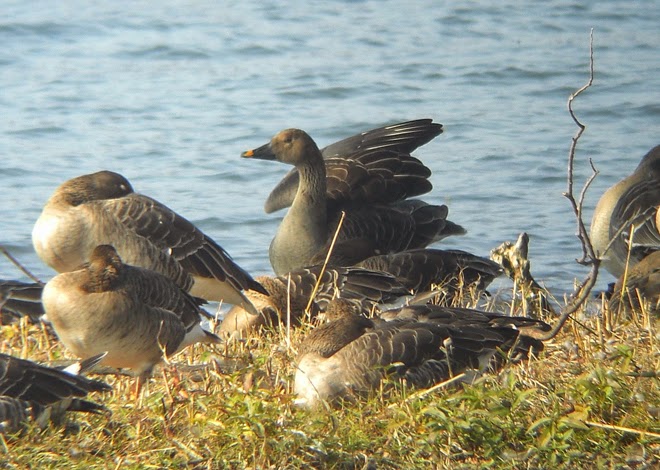
I had been curious whether I'd see any difference between the Miyagi and Shiga Taiga Bean Geese but the appearance of Miyagi birds was both very consistent and a good match for majority of the Shiga population.


On Friday morning I was positioned pre-dawn at the western end of Lake Izunuma with a crowd of photographers waiting for the geese to leave the roost.


I know I said shirt-sleeve weather... but this was early. Still, I think they it's a bit over the top, I thought a sweater quite enough. I can imagine it'll be pretty brutal in a couple of months though.


Most geese headed off north west and I followed hoping to find the Red-breasted. I didn't find it but I know now I was on the right track. Later in the day, and a good few kilometres away I came across this rather attractive Greater White-front. With my very limited knowledge of colour aberrations I think this is an example 'pastel' dilution.


A rather attractive ghostly Greater White-front.


On the same fields as light was failing I finally connected with my only Cackling Geese of the trip, unfortunately I couldn't get closer than this and they weren't in these fields the following day.


A record shot of my only Cackling Geese of the trip, found in the nick of time after the sun had set. 


I decided not to watch the post-roost dispersal on Saturday morning. There were other places I wanted to try, particularly the fields where the Cackling had been the previous day then further west beyond Lake Naganuma where I'd already found large concentrations of geese.


At the first port of call there were about 250 Whooper swans, the largest gathering I saw, and a Snow Goose close to the track (I think this was the same bird as yesterday), then more geese stretching away across the fields. This was so so enjoyable I spent about 2.5 hours watching these birds, far longer than I had intended, before making my way to Naganuma.


We get large numbers of Tundra Swans in western Japan but Whoopers aren't common. It's a pity really, I find the first winters very attractive, more so than either the adults or similarly aged Tundras.


After checking through the flocks near Naganuma I pushed further west and came across the only Lesser White-fronts of the trip. I counted 35 birds on the first sweep but I soon noticed more distant birds plus others flying over and it's probably no exaggeration to say there must have been 50 birds in small parties mixed in with the Greater White-fronts in that area. There was also another immature Snow Goose, this definitely was a different bird.


Six Lesser White-fronts with two Greaters (right).


Most Lessers were in fields with longer vegetation, coincidence or preference I don't know.


Their high-pitched flight calls made them easily recognisable at any distance.


At this point I had planned to head back to the Friday morning area and right on cue I received a message to say that's where the Red-breasted was! Sad to say, I never made it. Someone didn't stop at a crossroads (it was completely flat and completely open!), hit my van just behind the rear wheel and I went rolling down the road. Not long after I'd climbed up and out through the skyward passenger side door and dropped down to the road the ambulance arrived. That was fast! It seemed I had no option but to go to hospital, they were very insistent, which meant I left all my belonging, including phone and wallet inside the van.


After wasting time at the hospital... I was fine apart from my nose, the police kindly chauffeured me to the correct wrecker's yard, at the second attempt, where I could collect my money, phone and optical gear from the dead van, then sadly back to Tome to catch a bus to Sendai (that with the port I'm very familiar with, as mentioned earlier) and then shinkansen back to Tokyo/Kyoto. The policeman had suggested a taxi to Sendai... taxi to Sendai! good grief how much do they get paid.


So the upshot is my wife's new van is dead, my wife's angry... no no no... my wife's apoplectic, and I suffered a very painful dip.


And now, just one last Japanese prefecture to visit; I wonder what it has in store.

Monday, 17 December 2018

Odd moult timing for Eastern Marsh Harrier?

After birding in Mie the day before, I drove up to northern Lake Biwa and up one of the dead end roads into the forested hill to grab some sleep before dawn. Glum might be a fitting way to describe the morning; the hills were weighed down by low, immobile clouds that early light made very little effort to penetrate. Even the effervescent Bulbuls couldn't muster more than the occasional half hearted, dank-muffled shriek. I persevered in the growning silence, for a while. My mental image of the lake bathed in sunshine, however improbable I knew this to be, proved irresistable.


Once down on the lake the sky overhead was actually blue! I may not have seen the sun but sunlight did reach through the clouds. That was as far as the good news stretched. The backdrop was purples and blacks, sometimes the hills sometimes the sky, there seemed a fluid exchange of hues between the two. This wasn't at all what the forecasters had predicted (Well there's a surprise!) when I was in Mie.


I took advantage of this belated and probably false dawn to welcome back our wintering Steller's Sea Eagle, sitting in its customary spot overlooking the customary line of parked cars and tripods, then check the Taiga Beans on the lake for anything less usual. There wasn't even the usual (that's Gt White-fronts) let alone less usual - I live in hope that the third time a Greylag turns up I will see it. Never mind, the Beans are always spectacular enough without any distractions.


The first drops of rain sent me back to the car before I'd finished scanning for the Red-crested Pochard apparently in residence this winter. If it had been there at the time, it should have stood out like a sore thumb, or giant duck. As it didn't I can console myself that I still wouldn't have seen it had I decided to (be less of a wuss) wait out a potential downpour without protection for my camera and lens.


Two or three minutes further south under a compromise grey pall, no more siren blue interludes, no longer threatening purple and black, I spotted something which really was unexpected; the Harrier of the title. A kerfuffle of Black Kites seemed unsure about what, or even whether, they were mobbing but nevertheless vaguely occupied the same airspace as a juvenile Eastern Marsh Harrier which had no such doubts about chasing off said interloper. This other bird had a distinctly narrow wing tip and was much smaller than the juvenile, this without being sufficiently small to cause serious excitement it must be added. It quickly gained height above the confusion and made off. The juvenile dropped back into the reedbed and the Kites went back to aimlessly wafting around waiting for food to surrender.


Cropped view of the interesting pointy-winged harrier. This is how it actually looked, black against dark grey with a strikingly narrow wing tip. The views were very brief before it was driven off. So, a photographic identification and grit removed from my oyster. 


Heavy cropping (and lightening) reveals p9 is about half grown and p10 is just showing. I don't recall ever seeing an Eastern Marsh, of any age, not having a full set of primaries, hence they must moult remiges at a time of year I don't normally see them (ie summer/autumn).


Due to its small size compared to the juvenile I'm guessing it must be a male. Having discovered p9-10 are still growing it's even easier to to eliminate the miniscule, narrower-winged Montagu's, which has amazingly occurred in Japan in winter. Pallid has also occurred in winter but is just as easy to rule out. Though it might be a better structural match for Hen once fully winged, the underwing pattern visible in the lightened images puts and end to any such notion. Though I don't have experience of older immature female Pied, in gradual transition from juvenile to adult, the lower belly through to the undertail coverts looks too dark I think. It may sound strange to say considering total records but Pied is perhaps the least likely rare harrier to occur in Honshu in winter. And though Northern hasn't even qualified for this paragraph so far, it has to be a better winter bet too.


I confess I'm not one hundred percent sure I've never seen a Marsh Harrier with this moult but I certainly don't remember having seen one. I'd guess this stage of moult would be more likely in an older immature (clearly it isn't juvenile, which wouldn't have started moulting flight feathers yet) because I suspect an adult would have finished replacing its primaries much earlier than December?


In both these images bird's right wing gives us the clearest view of the leading edge of the primaries and it's possible to see alula, very short p10 and half grown p9 creating a stepped effect. Plumage-wise, there's nothing that suggests it isn't an Eastern Marsh Harrier but I wouldn't attempt to sex it if I hadn't seen it in direct comparison with a much bigger (presumed female) juvenile. 


Wednesday, 24 January 2018

A few geese at Lake Biwa

I already mentioned that the Cackling Goose was the big attraction at the north end of Lake Biwa when I posted about the swans at the weekend. It's only the second I've seen in Japan, and though numbers of wintering birds are increasing nationally it's still a rarity this far south. It's been present all winter but I'd actually forgotten about it till a second person emailed to say they'd seen it so I decided to get up there pronto remembering I blew the only the only opportunity I've ever had to see Greylag in Japan because I put off going to see a 'certainty' till too late.


The timing turned out to be very good, according to the Met Office there had been 75cm of snow just north of the lake a week earlier but this had entirely disappeared because of the unusual mild spell and persistent rain. Now, a week later, reports give a more normal snow depth of 66cm... there's even a rare covering in Kyoto city this morning!


As well as the Cackler there was also the usual contingent of middendorffii Taiga Bean and a few Greater White-fronts. The latter occurs in very small numbers considering the large flocks just over the prefectural border in Fukui, usually fewer than 20 here. Unfortunately I couldn't find any of the rarer Tundra Bean which may be annual but only in very small numbers.


More often than not views of the Bean are restricted to rather distant sleeping birds on the islands off the Wild Bird Center at Kohokucho but this was one of the few and far between occasions I see them in the fields at the opposite side of the lake. When they're on the water at the opposite side (as they were on Sunday) they are even more distant than at the usual spot.


The Cackling Goose dwarfed by the Tundra Swans.


Fortunately it kept coming closer until it was almost at the leading edge of the flock right under our noses.


You just can't ask for closer views than this!


There were nine rather distant Greater White-fronted Geese on Friday and 12 birds gradually coming closer in a different area on Sunday. I didn't hang around as they slowly marched across the field... it was just getting too cold and I'd come dressed for the much milder Friday weather.


The Taiga Bean were in a different area, at the north west corner of the lake. They were far more skittish and difficult to approach even inside the car.


A good example of the swan-like middendorffii bill. The only time I ever saw a Swan Goose in this flock it was smaller than many of these 'Middendorff's' Taiga Bean, they really are huge.


Friday, 28 November 2014

Taiga (Middendorff's) Bean & Tundra Bean Geese, Lake Biwa

I visited the north of Lake Biwa last weekend (Nov 23), the first trip up there this winter. Woodland birding at dawn was good with species like Nuthatch, Willow Tit and Elegant Bunting that I don't usually see around Kyoto all quite common and easily seen.

There was no sign of winter passerines flocks yet, there wasn't any sign of winter for that matter. It was very mild shirt-sleave weather on the mountain top. Next it was down to Kohoku-cho to check whether the Steller's Sea Eagle had arrived yet, still a little earlier than its average arrival date but it was here on the 23rd last year. No luck I'm afraid. Nothing lives forever of course and there's always the worry that this could be the year it doesn't come back, it'll be a big miss when that day does come and we lose such a fantastic bird from our list of regular winter visitors.

Drawing a blank on the Eagle I switched my attention from the hill behind the Kohoku Wild-bird Center to the lake shore in front for a quick scan through the ducks and geese. As things turned out the quick scan that I didn't think I needed my hat for stretched into a much longer stint than planned. By the time I left not only wasn't there enough daylight to visit any good areas further south but I as I was to discover when I jumped in the shower that evening I had a semi-sunburn. That's semi as in the south facing side of my head, rather than semi as in a barely noticable tingle.

There weren't any rare geese present, a Swan Goose put in a surprise appearance last winter and there was a Greylag the winter before, nor were there even any of the Greater White-fronts which have become a regular feature in increasing numbers. However the interesting variation within the usual flock of wintering Bean Geese was enough to keep me occupied.

I've already posted a little on the differing size of some of the Beans at the lake and their bill/head shape range Here. Most of the geese at Kohoku-cho are middendorffii Taiga (Middendorff's) Bean but there also seems to be a small number of Tundra Bean Geese, presumably serrirostris, mixing in with them.

The taxonomy of Bean Geese still leaves questions unanswered and a few images of birds of unknown origin aren't going to confirm racial identity but at least the following digiscoped shots show variation occurring here. It's worth stressing I'm focusing on distinctive individuals in the images I'm posting today, there are (presumed) Middendorff's that might be far more difficult to put a name to if seen out of normal range.

"Middendorff's" Bean Goose is a very large and heavily built bird, the bill is deep-based narrowing towards the yellow band with what almost seems a parallel-edged extension. This is the typical appearance I think of as middendorffii at Kohoku but there seems to be a lot of bill variation within the taxon.  

Another typical long-billed bird. This was one of only two birds I noticed with white at the base of the bill. 

Deep-based triangular bills lacking the elongated tip extension like the bird in the centre aren't uncommon and this was one of three such birds at the end of the flock. At some angles they can seem quite droop-tipped with the combination of arched grin line, straight culmen and bulging lower mandible with a distal kink giving a forward pointing tip. These bills are strikingly different to those of the earlier birds though they seem to be otherwise indistinguishable. Such large geese must be Taiga and presumably this is variation within middendorffii. The bird on the left shows far more yellow than the norm and shows middendorffii can have more than the usual narrow band of colour. 

Another of the group of three deep-based, stubby-billed geese. The grin line is prominent and the lower mandible bulging.

To give an indication of just how large these Taiga Bean Geese are this is an old shot (8 Nov 2013) of a Swan Goose at Kohoku with the local Beans. Of course it could be a small female but nevertheless the comparison is useful.

So there's quite a bit of variation without suggesting anything beyond "Middendorff's" Bean Goose. However the following birds would be very difficult to shoehorn into middendorffii. My understanding of Tundra Bean from a European context is that it has a shorter, deep-based bill compared to the nominate Taiga Beans however this may be misleading from the Japan perspective as middendorffii has a very deep-based bill with a prominent grin patch and some bills are also clearly short and thus triangular, so it's possible that serrirostris might not be so obvious if you're relying on stubbier bills as an initial indicator.

Japan's Tundra Bean Geese winter further north than Kansai and I never get to see those populations. Finding the few birds that may be mixed in with my local Taiga is my only hope of seeing any. But what might they be? The OSJ list states serrirostris (Hishikui in Japanese) and curtis (Hime-hishikui in Japanese) occur in Japan. The former is the common wintering taxon and the latter is rare, though as it may or may not be a valid taxon and may or may not be identifiable in the field I'm not sure how its status can be assessed.

The Tundra I see here are significantly smaller and lighter in direct comparison. The juveniles present this day looked dorsally compressed with a flatter back line, more arched in middendorffii, and the belly less heavy or baggy behind the legs (Taiga is more like a Slaty-backed Gull to reverse the usual comparison). Thus these young geese actually look proportionally longer-bodied, which might not be expected of Tundra. The neck is slightly shorter but the difference is only really apparent when fully extended. They don't look any shorter-legged to my eyes.

With hulking Taiga towering over them on all sides this discrete group of small geese really caught the eye.

Taiga is deep-bodied with a high arching back and low rear belly, hence they look less long in the body, compare with the shot below.

These Tundra Bean Geese have a flatter back and straighter keel compared to the local Taigas. 

The sitting Tundra between the two middendorffii almost disappears into the minimal grass (it's not in a depression) whereas the deep-bodied birds sit high.

The necks are somewhat shorter and proportionately thicker though this isn't especially obvious unless you're looking for it but it may contribute to producing the clearly longer, sleeker-looking carriage of this group.

The small size of the birds in this group was obvious but even more eye catching was how brown they looked compared to Taiga. These juveniles are very distinctive with their plain brown breast and flanks and mostly unmarked scapulars, the narrow tips have mostly worn away, while a couple of more advanced individuals have replaced some rear flank feathers with adult type barring as well as a few darker scapulars showing fresh pale tips. The interesting question is where are the obvious  juvenile middendorfii? There were no stand-out brown juvenile Taiga Beans in the flock of about 200 nor do I remember ever having seen any here. This suggests they could moult into first winter before arrival which might be possible with a more southerly (earlier?) breeding population. It's certainly intrguing and it may be a very good way of picking up juvenile serrirostris in flocks of middendorffii in this area early in winter before their moult progresses to first winter.

Juvenile Tundra with uniformly brown neck, breast and flanks. Scapular fringes worn away and upperparts plain brown. This was the only one of this group that has a slightly convex culmen but as I'm yet to see even a hint of a bulge on the middendorffii this seems significant.

The bird in the centre has the deepest bill with most prominent grin patch of this group. The moult is slightly more advanced with a small number of next generation scapulars and rear flank feathers easily visible. 


The juvenile with the slightly convex culmen again.

Throughout the late morning and afternoon groups of 3-5 geese, perhaps family parties, would fly in to join the main flock and at one point the following single adult came in and landed with the group I was watching. I didn't pay it much attention at the time because the camera was attached to the scope but the incidental images (most out of focus) suggest it is also Tundra.

Though it's a little heavier than the juveniles the size and structure are a good match. The bill is short in relation to the head and there's even a slight forehead stop. The head is chunky with a less rounded hind crown and the neck is short compared to middendorffii.

Dropping in next to the juveniles. 

Short bill compared to head length and the deep-based there's a suggestion of a forehead stop unlike the long straight bill/forehead slope of middendorffii.  

 
Out of focus but still good to compare size with the sitting serrirostris juveniles to the right and middendorffii behind and to the left. 

With the middendorffii more alert this bird's small size is more apparent here. 

As it walked in front of the group of juveniles there's little doubt about the size and structure being similar.