Showing posts with label Jay. Show all posts

Tuesday, 20 February 2018

Blakiston's Fish Owl at Yoroushi Onsen and Washi no Yado

I've only only been to see Blakiston's twice in winter, staying at Washi no Yado five years ago and this month at Yoroushi Onsen. The two experiences are very different in terms of accommodation but as the Owls are the important thing it might not matter too much for someone who has never seen these magnificent birds. I would just say Yoroushi is far more comfortable and I wouldn't hesitate staying more than one night if I wanted to give the area more time. Whereas one successful night at Washi no Yado would be enough, I'd look for alternative accommodation if I wanted to spend longer in the area. But, and it's a big but, the food was fantastic at Washi no Yado.


An Owl arrived during dinner at Washi no Yado and after eating more quickly than I'd have otherwise chosen I sat outside in my rental car to get a better view. This steep, narrow valley is cold, really cold, and the car needed a jump start the following morning. The owner told me the same had happened to another birder the day before. The local garage was doing good business. The small pool in the middle of the river is kept stocked with fish (at least as long as people are viewing it seems) so there's plenty of time to watch the Owls coming and going or just sitting in the snow. The problem is you are virtually sitting in the snow too and I'm not as tough as the Owls so there was a limit to how long I could sit motionless in the car with the windows open in minus (a large number) degrees. Of course you could watch from the minshyuku but that would double the distance to the birds.


Similarly the Yoroushi Owl arrived while we were still at the dinner table and caught me off guard. Stupidly I'd left my camera in my room and by the time I dashed to get it the window was already lined by (mostly) non-birders and I had to hand-hold the camera at the back of the group as a result. This would have been easily avoidable if I'd been aware of the feeding regime. Unlike the protracted viewing at Washi no Yado, with fish being put out as required, there were just two feeding sessions, one between 6-7pm as I recall and the other must have been between 5-6am. There's actually a calendar pinned up next to the office giving the times of daily sightings but the penny didn't drop that these neat clusters of sightings were dependant on when fish were put out. The result is that though the views are remarkably close, they are also relatively brief before the Owl polishes off the fish and disappears into the surrounding darkness along the river. It also resulted in me getting very few shots of the bird as I thought I'd have plenty of time after the crowd lost interest.


So which site is better for the Owls? The view is much closer at Yoroushi, maybe only eight metres, and the experience is slightly surreal from the warmth of the lounge. If you want a more authentic and slightly more distant, cold, freezing cold, really freezing cold experience then Washi no Yado wins hands down. If you intended to watch from indoors at Washi no Yado then I'd definitely recommend staying at Yoroushi.


I suppose the supporting cast needs to be considered too. Washi no Yado had Brown Dipper on the river in front of the minshyuku and common woodland birds in the surrounding woodland. Yoroushi had Solitary Snipe and Crested Kingfisher on the river in front of the ryokan and common woodland birds on the feeders right outside the window. Better for me, it also had Sable, a mammal tick, coming to the feeders too.


Kicking off with the Washi no Yado birds under the powerful spotlights...


In in reply, Yoroushi...


Coming back to the supporting cast...


sable


red fox


This Solitary Snipe was on the near bank of the river and as such wasn't visible from inside the minshyuku.


Great Spotted Woodpecker. Compared to woodpeckers in Honshu I always think that the Hokkaido birds are tripping over themselves to get in front of any camera. However this GSW was the only one to give itself up on this trip. Though admittedly we weren't really after any woodland species and didn't spend more than a daylight hour or two at this our only woodland stop on the trip.


Marsh Tits were common, a great little bird we can't see in Honshu.


The brandtii Jay of Hokkaido... I can't resist putting a comparative shot of the Honshu japonicus below. 


Probably the only thing their respective heads have in common is a bill. The pattern of white in the wing is quite different too.


Monday, 2 May 2016

A morning in the woods

I drove up into the forest north of Kyoto city at about midnight last night, my first nocturnal drive this spring. In the end it was a little disappointing, a single Japanese Marten and 26 Sika Deer were the only mammals I saw and a handful of Japanese (Collared) Scops Owls heard were the only birds I recorded. No night displaying cuckoos, no Ural Owls, not even any Grey Nightjars yet, and definitely no Japanese Night Herons.


Things picked up at dawn, first a Blue and White Flycatcher broke the absolute stillness as the outline of the hills began to appear, others soon chimed. The faint sound of an unseen plane floating down pulled me up short, not because the sound itself was intrusive but more because it brought home to me how rarely I experience such silence in Kansai. Not even the snarliest or whiniest motorbike engine can penetrate that far into the hills.


Soon I heard the first of several Oriental Cuckoos higher up the slopes, a Northern Hawk Cuckoo flew over singing and Narcissus Flycatchers were obviously fairly common in the guess at understory. Normally Grey Nightjars and Ruddy Kingfishers would be early voices but they can't have arrived yet.


Finally daylight caught up with the early risers.


A future split... Japanese Jay?


Almost everything else was collecting nesting material or singing!


A Narcissus Flycatcher taking a leaf out of the Blue and White song book? Or maybe it was a North American leaf warbler in a past life?


Would this make a good mystery photograph I wonder? It's surprisingly pigeon-like in the second shot. In fact it's a Northern Hawk Cuckoo displaying, something often heard through the night but usually only seen first thing in the morning.


Long-tailed Tit gathering wispy stuff.


Coal Tit gathering less wispy stuff.


This where I berate myself with a "You call yourself a birder?!". It's only now I see the Coal Tit is pulling material from a pellet which I wish I'd noticed at the time. And it doesn't get any better with the next shots of Asian House Martins collecting mud. Looking at these shots is the first time I've noticed the streaks on the rump, uppertail coverts and vent. No doubt contributing to the greyer appearance compared to Northern House Martin.


Monday, 23 December 2013

crows

When I first arrived in Kyoto Rooks weren't supposed to be wintering in this part of Japan so it came as quite a surprise to find large numbers at Ogura. I have seen as many as 2000 flying from hill roosts out onto the fields at dawn but numbers vary from year to year and are usually much smaller. In any case it's the Daurian Jackdaws that may be with them which will be of more interest to most visiting birders. Daurians occur at Ogura almost every year and when they do they are easy to find because of the limited area. They seem to be annual in Shiga east of Lake Biwa but the area is vast and finding Rook flocks there is more a matter of luck.
Large-billed and Carrion Crows are both common in Kyoto and throughout the region.
Jay is common on the surrounding hills and in forests throughout the region, an easy place to see them in Kyoto is Takaragaiike.
Two species that don't quite make it into Kansai are Azure-winged Magpie and Spotted Nutcracker, though the latter can wander into Shiga in winter. The nearest place I regularly see Azure-winged is along the Ishikawa coast.

The glaring-eyed japonicus Jay can be found in the hills around Kyoto but is more numerous in winter, this one at Takaragaiike, Kyoto, 24 November 2012. It's likely this will be split from the continental forms including brandtii found in Hokkaido.

Brandtii, he race found in Hokkaido, is an altogether softer, more gentle looking bird.

Nutcracker does wander into the mountains of northern Kansai, just. I've never seen one there, but I have been looking in the wrong direction when one came by! These birds are in Akita, August 2013.

Daurian Jackdaws in northern Shiga, December 2013.

Rook at Ogura, 8 January 2011.

Adult Rook, the bill shape may be distinctive but the darker base is perhaps odd to European eyes. Shiga, December 2013.

Immature Rook, they can look very much like Carrion Crow. Shiga, December 2013.

Immature Rook in moult, Tsushima, 30 April 2012.

Carrion Crow on the Katsura River, Kyoto city, 1 March 2012.

Carrion Crow on the Katsura River, 6 February 2009.

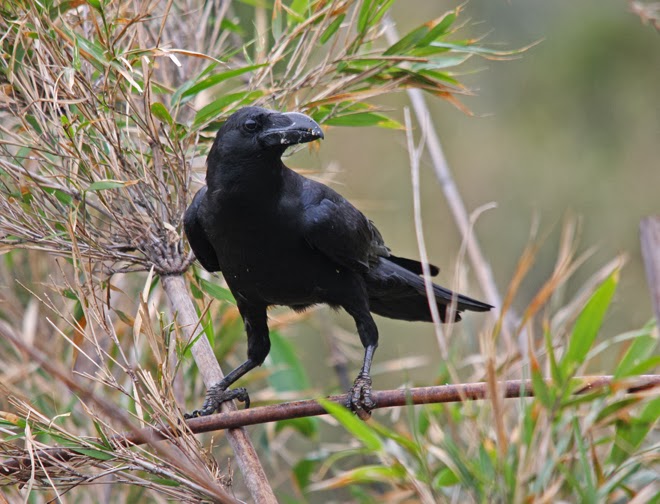
Large-billed Crow on the Katsura River, Kyoto city, 7 October 2010.

Large-billed Crow on Mishima, Yamaguchi, 4 May 2009. This bill is bordering on the ridiculous.

Subspecies Osai on Ishikagi, April 2014. An awful shot but with limited time there are bigger fish to fry down there.

Subspecies connectens in Okinawa, August 2011.

Northern Raven is a Hokkaido winter speciality. Probably the best place to see them has always been the Shiretoko Peninsular but apparently more birds are stopping off in central Hokkaido nowadays due to an increase in food courtesy of hunters. The Peninsular is still likely to be the best place to try despite the lower numbers.

This Northern Raven dropped down to the river mouth very briefly in Rausu before heading back into the hills. 29 December 2012.