Showing posts with label Duck Eastern Spot-billed. Show all posts

Sunday, 4 May 2014

Green Pheasants and a mosquito

Continuing my stuck-at-home week I made a couple of local trips, the first an early morning jaunt down to Yawata just south of Kyoto. Early morning because I was woken by mosquito bites at 4am. Living in the city centre mosquitoes are never much of a problem even in mid-summer, but at this time of year the thought of closing the one bedroom window without a screen hadn't even crossed my mind.

I caught the first train and arrived at Yawata at 6am, first walking down one of the spits at the confluence of three rivers, often a good spot to find migrants but today nothing. Quite a few newly arrived singing Oriental Reed Warblers were still a novelty... but not a migrant in sight. Before I'd even reached the first river I could heard the two species that really marked the morning, Green Pheasant and Long-billed Plover. There were pairs of noisily displaying Plovers over all the sandy or shingle islands along the 12 kilometres of river I walked. All these islands will be submerged with just moderate rainfall so they'd better get on with the more serious business. And Green Pheasants, male Green Pheasants everywhere. Displaying males were spaced about every 100 metres along the river, since some of the riverbanks were stripped of all vegetation last year there's still very little cover and the birds are very easy to see now.

While the loss of ground cover made seeing Pheasants easy, the removal of the riverside trees has made the area far less attractive to birds passing through and the only obvious migrants I saw all morning was a flock of about 100 Chestnut-cheeked Starlings hurrying up-river.

At this particular extremely popular cherry blossom viewing spot the "natural" riparian habitat is managed to prevent it reverting to woodland. Thus at this time the vegetation is still low and these popular display mounds haven't disappeared behind emergent spring growth, while still retaining a natural feel which has been lost along the bulldozed lengths of river. 

Seen well, they are stunning birds. 


I wondered if this Eastern Spot-billed Duck was sheltering a brood of ducklings on the way to the river. A problem at this site is the huge number of feral cats, there were several at the foot of the slope between the duck and thicker cover.

In the late afternoon I took a JR train on the Sagano line and got off at Hozukyo station just north west of the city. It isn't the typical Japanese station with people hurrying in and out of various exits. The platform runs the full length of a arching bridge over the Hozokawa rushing below, it's a great spot, the train exits one tunnel onto the bridge, stops to let you off (it's unlikely anyone else gets off) then dives directly into the next tunnel. There's nothing else there, you're standing high above the river on what seems a floating platform wedged between two forested hills in the middle of nowhere. The train was crowded, hardly any standing space, and as I was pushing my way to the opening door I could already hear Blue and White Flycatcher singing. Just step off the train into the sunshine, wait a few seconds till the train busies its way off the bridge, sight and sound gone in the blink of an eye, and be in the still centre of a sphere of bird song, above, below and all around. Magical. Or you could try it in winter when wind whistling in from any direction manages to hit the bridge square on and the mild winter sun over Kyoto, only 10 minutes down the line, has been replaced by a sodden blanket of cloud that would be obscuring the hills if the sleet hadn't got there first.

Today it was really nice, there were six singing Blue and White Flycatchers within a short walk from the station but as I headed up hill they were replaced by singing Narcissus Flycatchers. Now much as I'd like to be building up slowly towards some fantastic sightings and great shots of them the sad fact is the two flycatchers were the only summer visitors I saw/heard. In fact, Willow Tit (heard) was the only species I couldn't have seen had I visited a park in the city centre. But for only 480 Yen round trip train fare it was a beautiful walk and, in a perverse sort of way, all the more so because of the lack of exciting birds.

Sunday, 3 November 2013

dabbling ducks

The only common resident duck in Kansai is the Eastern Spot-billed, though there are a few Mallard, even if the appearance of some suggests questionable genetic heritage, and also a small number of Mandarin Ducks in the hill forests though these require a great deal of luck to see and they are much easier to find in winter. The region does well for dabbling ducks in winter, Ruddy Shelduck and Green-winged Teal are the only rarities we get. I've only heard of one Green-winged in Kansai but they may be both under-recorded and under-reported, Kanto has far more reports which may indicate it is commoner further north.


Baikal Teal and Falcated Duck, the species most visitors will be interested in are both easily found. One problem with Baikal Teal is that the largest wintering flock, at Kohoku-cho north east Lake Biwa, is always rather far out on the lake. The birds are invariably hidden by vegetation on some artificial islands with, at best,  just a few males identifiable at that distance. I've seen a flock of 2000 flushed by a harrier when moments earlier none had been in view. Because Kohoku-cho is good for so many interesting birds this is still a good place to catch up with them but for better views Katano Kamo Ike in Ishikawa, just outside Kansai, is a much better bet. They tend to be irregular elsewhere,  if you're lucky you might even see them on the back pond at the Golden Pavilion in Kyoto, but don't bank on it.


Falcated is altogether more cooperative and can easily be found in Kyoto city. There are always some at Midoragaiike, a pond just north of the botanical gardens and it's often on rivers, particularly the Katsuragawa. It's a great looking duck and by anas standards a frequent diver. The drake in the shots below spent the winter on a small pond in the botanical gardens, seeming to enjoy a diet of bread rather than aquatic plants.


The female is also a distinctive bird even if it can't compete with the male when it comes to looks. The following shot was taken at Midoragaiike, Kyoto city.


Also at Midoragaiike was the following Falcated Duck x Eurasian Wigeon hybrid, the only one resulting from this pairing I've ever seen. There could never be any doubt about its parentage with obvious features from each progenitor species. The tertials aren't falcated, it lacks the black division through a larger white rear flank patch and the breast is obviously Wigeon pink. The head pattern is more subtly different with the red stronger than on Falcated and without the long, sweeping nape feathers. The bill is an interesting pattern; a great duck.


     Despite the mixed parentage there doesn't seem to be any doubt in the bird's mind which species it belongs to.


Even with the oddly marked wings and underparts it still has a Falcated feel to it, albeit a compact version.


When I first came to Japan Common Shelduck wasn't a species I'd expect to see in Kansai, I've still only seen one in Kyoto city but then they are a coastal bird. Now, it's no surprise to run into then on the Japan Sea coast of the region in winter and they became quite regular in the Osaka area though on going habitat loss is making them more unpredictable again. The place to find them in Kansai is the Tsu city/Matsusaka city area of Mie Prefecture where they are reasonably common on the extensive tidal flats.


                                            Common Shelducks moved off the tidal flats at high tide.


A bird in a muddy field giving much better than usual views.


Much rarer is Ruddy Shelduck, and not just in Kansai. They do crop up on the Japan Sea side of the region, this bird was a total surprise one day when birding near Katano Kamo Ike in Ishikawa.


                                               A poor quality video grab of a fantastic bird.


While Mandarin Ducks are very difficult to find in summer, winter is an entirely different matter. However they are remarkably faithful to their regular wintering ponds or lakes and it's unusual to see them away from these favoured spots. In Kyoto city there's only one guaranteed location, the International Conference Center lake at Takaragaiike. Typical of Mandarins, they're usually lurking under overhanging bushes below the path but of course they do swim out onto open water and even wander around in surrounding woodland like the birds below.


They are also easy to find in Nara city, if going public transport check the ponds near the site of the original palace complex.


Eurasian Wigeon is possibly the commonest duck in the region, they occur on rivers, ponds, tidal areas and there are vast numbers ringing the shores of Lake Biwa.


American Wigeon is sufficiently numerous to bump into here and there over the course of a winter but there are far more individuals of with mixed genes, some of which can be very close in appearance to one or the other species. The male below showed no sign of Eurasian in its ancestry though several birds on the same lake in Hyogo prefecture clearly did.


Another good looking male on the Kamogawa outside the botanical gardens in Kyoto city, it differs in having more extensive fine black flecking on the face creating a more clearly defined comb between eye and bill. Of interest is the female type next to it. Both it and the Eurasian in the foreground are conveniently showing their greater coverts with the mainly whitish, black-tipped feathers of American very different to the mainly blackish, white-tipped feathers of Eurasian.


                                                    Male and female American Wigeon.


                                        Greater coverts of female American Wigeon; mainly whitish with black tips.


Of course if males can be difficult to be certain about because of introgression then having confidence a female American doesn't have any Eurasian influence in its family history is next to impossible here. The bird below was in the same flock of Eurasian as the above birds. At times it stood out with a very grey head and ghost of the male head flash, at other times I couldn't find it. Light conditions and viewing angle played a big part.


Head patten and greater coverts markings both indicate American, as did the underwing.


I was never a big duck fan in the UK and regrettably hardly ever gave Wigeon a second look. Now I'd really like to know how much individual variation they show where hybridisation isn't so prevalent. I lean strongly towards a bird like the one below having mixed genes and they do come even closer to Eurasian than this while still arousing suspicion.


As a self-confessed former duck neutral I can state with absolute certainty that Mallard would have been overlooked on every waterway I ever visited. However, now that it's no longer the default querulous, bread-eating park duck it's shot up the duck league table in dramatic fashion. I really never noticed what a smart-looking bird it is. Of course it isn't uncommon here, there can be some good concentrations at some locations on Lake Biwa and estuaries in Mie, nevertheless numbers are much lower than those of several other species.


As both Mallard and Eastern Spot-billed breed in the region it's unsurprising hybrids occur, such as the one below. Saddly it isn't as attractive as many hybrids can be.

Eastern Spot-billed Duck x Mallard hybrid.

                                                               Eastern Spot-billed Duck.


Other widespread and common species that can be easily found in Kyoto city include Northern Pintail, Gadwall and Common Teal.


                                                            Kamogawa, Kyoto city.


                                                           Midoragaiike, Kyoto city.


Male Green-winged Teal, Nagoya February 2014. I suspect this rare visitor is slightly more regular further north in Japan, there are very few Kansai records I've heard of. 


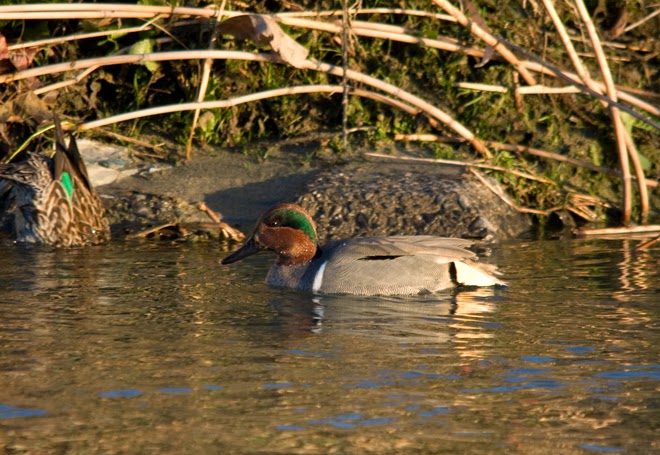
Adult breeding male Eurasian Teal.


                                                                First winter male.
 
Eclipse male.


                                      Eclipse male (centre right) and female (centre left).


Northern Shoveler is also widespread but more localised. It occurs at Lake Biwa but usually either on well vegetated nearby ponds or in the only location shallow and sheltered enough for the water to be covered with lotus. Oddly it is also quite common on the tidal, bare river banks at the mouth of the Yamatogawa in Osaka.


                                                             Yamatogawa, Osaka.


Male and female Northern Shoveler.


Garganey are the surprise package in Kansai and can turn up anywhere during spring and autumn migration. I've seen larger parties elsewhere 13-15 is the largest party I've met with in Kansai, ones and twos are the norm. This male and female appeared in spring on the Katsuragawa in Kyoto not far from my home.


Friday, 4 October 2013

City parks

Kyoto's a very compact city, hemmed in on three sides by forested hills, so it doesn't take too long to get out into the hills, though most of them are covered with established secondary growth or plantations - extensive conifer and localised bamboo. It's only in temple and shrine precincts that old-growth trees remain. While being able to get out of the city with ease can be a big plus, visitors would be as well to stick to the city parks, the Kamogawa and two or three good spots abutting the hills. Unlike the large parks in the vast urban sprawl of Osaka, which routinely concentrate an amazing range of migrants, the close proximity of the forests around Kyoto probably lessens the pull of its parks, nevertheless they're the best bet to see the commoner birds in a short time.


Some migrants, flycatchers such as Grey-streaked, Asian Brown and Narcissus are common enough, reflecting their status generally. However I've never seen some scarce migrants such as Paradise Flycatcher in the city, they do occur but but seem easier in the surrounding hills provided you have the time to put in. Likewise Siberian Blue Robin and Japanese Robin, views can be great if you're lucky enough that your visit coincides with a migrant in the park but there are more of them in the surrounding hills. Similarly, in winter there's a greater range of species on the surrounding hills but not only can they take longer to find depending on the species but they tend not to give the great views wintering park birds very often do; Red-flanked Bluetail and Pale Thrush would be obvious examples of birds that can be surprisingly confiding in the city but are more difficult to see well in the forests.


If any duck can be classed as a park-duck then it has to be the Eastern Spot-billed.


There are two important parks in the city, the botanical gardens and the Imperial Palace, both easily  reached by subway. Years ago I was told the Palace was better during migration and the gardens in winter. There's some truth in that, in winter at least, but I'm not sure all the migrants know where they're supposed to be.


Imperial Palace Park
The park is basically a large area of cropped grass covered mainly with mature pines and maples which in itself isn't terribly attractive except to Dusky Thrushes and Olive-backed Pipits in winter. However it's fringed with huge broadleaf trees, the width of the band varies but the southern, northern and eastern edges are best. The north east section is set aside as a "natural" area and the surrounds of ponds in the south east corner (just north of the tennis courts) and mid-way along the north side can be excellent.


Apart from being good for migrants, it's a great place to see breeding Brown Hawk Owls, the pair towards the north east corner are easiest to see and the nest boxes set out for them are easy to find.


It can be reached from the Karasuma line of the subway from Marutamachi station (exit 1) at the south west corner or Imadegawa station (exit 3) at the north west corner.


botanical gardens
The botanical gardens has the same common resident species as the Imperial Palace Park, Japanese Tit, Varied Tit, Japanese Pygmy Woodpecker and so on, it's smaller and much easier to cover thoroughly. It's well worth a visit in winter or during migration. Flocks of Japanese Grosbeak are often very approachable here in winter, as are Pale Thrushes and even Red-flanked Bluetail. In waxwing years there's a good chance of seeing Japanese in the general area around the gardens.


The gardens are located next to the Kamogawa and a walk along the river is also an excellent way to see dabbling ducks, the local wagtails and possibly Long-billed Plover if you're lucky. The Uji River and Katsura River are much better for the latter.


The easiest way to reach the gardens if not walking along the river is Kitayama station (exit 3) on the Karasuma subway line.