Showing posts with label Hawfinch. Show all posts

Tuesday, 1 November 2016

Taiga Flycatcher and Yellow-breasted Bunting

If the Hegura littoral had good birds (they don't get much better than Bearded Tit), so too did the interior woodland. In one area I heard the unmistakable sound of a Taiga Flycatcher. As I moved towards the sound it perched up in front of me. They really aren't normally so easy, and then they tend to disappear in a twinkling; this was how it should be. The bird called again, but still from the original place, it seemed there were two. Or could this one be Red-breasted? Helpfully, this second bird responded, though only once, so there were no concerns about identification; there were indeed two Taiga Flycatchers.


Strange as it may seem, I've yet to see Red-breasted Flycatcher on Hegura though no doubt it must occur. All the birds I've been able to identify so far have been Taiga, though there have been several occasions when views were too brief to make an identification. That ability to disappear in a twinking. Whereas all the wintering birds I've seen in Honshu have been Red-breasted. A clear case of passage migrant and scarce winter visitor, at least in my experience.


Not the best shot I got but it is possible to see a moult contrast here; the innermost four or five greater coverts are longer unfringed adult type whereas the rest are narrowly fringed juvenile feathers. Red-breasted retains juvenile greater coverts through the winter but Taiga, it would seem, moult at least some in autumn. That alone must clinch identification.


Although I identified it by call first, the plumage features are all shown to good advantage in these images I think. The following shot isn't great but it provides an excellent comparison with an over-wintering Red-breasted in Osaka a few years ago.


The Taiga: note the cold grey upperparts contrasting with the warmer brown cap, the tertials and greater coverts are narrowly and evenly fringed a cold greyish-white with no conspicuous 'thorn' at the tips.


A Red-breasted at a similar angle shows prominent 'thorns' at the tertial tips and greater coverts, the latter creating a distinct wingbar. Red-breasted looks less capped as the supercilium is concolourous with the crown, unlike Taiga which has a grey supercilium. The upperparts are also warmer though lighting can affect warmth or lack thereof. The bill has an extensive pale base to the lower mandible.


The grey is apparent above the eye here, contrasting with the browner crown. The bill is completely black. The throat is white framed by a greyish breast with limited buffish on the belly before white undertail coverts. The very small pale tips to the greater coverts don't create a prominent wingbar.


Again the capped effect is striking against the colder upperparts, the insignificant wingbar and moult contrast can be seen, as can the evenly fringed colder tertials lacking a terminal 'thorns'.


An often mentioned feature of Taiga is uppertail coverts, blacker than the tail, but wear often makes this less obvious and other features seem more useful, especially the wingbar of first autumn birds.


I spent the night in Wajima, undecided whether to go back to Hegura in the morning to try again for the Bearded Tit and hopefully get a photograph of it. The weather didn't hold out much hope though, heavy rain was forecast from about the time the ferry would arrive.


I birded the hill behind Wajima harbour from dawn. There were a few Daurian Redstarts around, a Dusky Thrush flew over and there were a handful of Elegant Buntings. Nothing to get too excited about. So I finally made up my mind to give Hegura another shot, or at least check if the ferry was operating. I'd only driven a snail's pace 30 metres down the car park road below the lighthouse when an eye-catching bunting flew up from the road onto the bushes steeply sloping up to my left. It was a large bunting and perched facing me the slight yellow below ruled out the resident Meadow Buntings as well as the newly arrived Elegant. Because of the angle through the windscreen the was nothing for it but to carefully open the door a crack and slither out. The bird flew a little and was now facing away, I managed a few shots before it disappeared. Yellow-breasted! This is quite a rarity nowadays, I don't even see it every year, so this was a real treat.


Unfortunately, after slithering out of the car the I ended up on the wrong bird and the following images I originally claimed to be of the Yellow-breasted aren't. This bird was sitting roughly in the spot the Yellow-breasted flew to and  I quickly got the camera on it managed these images before it disappeared. I remember thinking as I looked through the lens that it looked surprisingly like a Meadow Bunting from this angle but dismissed the thought, I was sure after all that this was the bird with yellow underparts. I owe thanks to Nial Moores for getting in touch to diplomatically ask whether I'd posted the correct images.


While waiting for its (non-)reappearance a couple more buntings flew into the same bushes and I was able to see the distinctive head pattern of a male Tristram's through the upper stems before they too dropped down and disappeared into the inaccessible undergrowth. Not bad few minutes after three hours of seeing very little, but by this time the chance to getting back out to Hegura had disappeared too and I could only listen to the sound of the ferry's engines as it pulled out of the harbour.


A final couple of shots. Hawfinches always seem much easier to approach on Hegura than back home, these ones were next to the photographers' platform the previous day.


Saturday, 16 January 2016

Chinese Penduline Tits and Red-billed Starlings

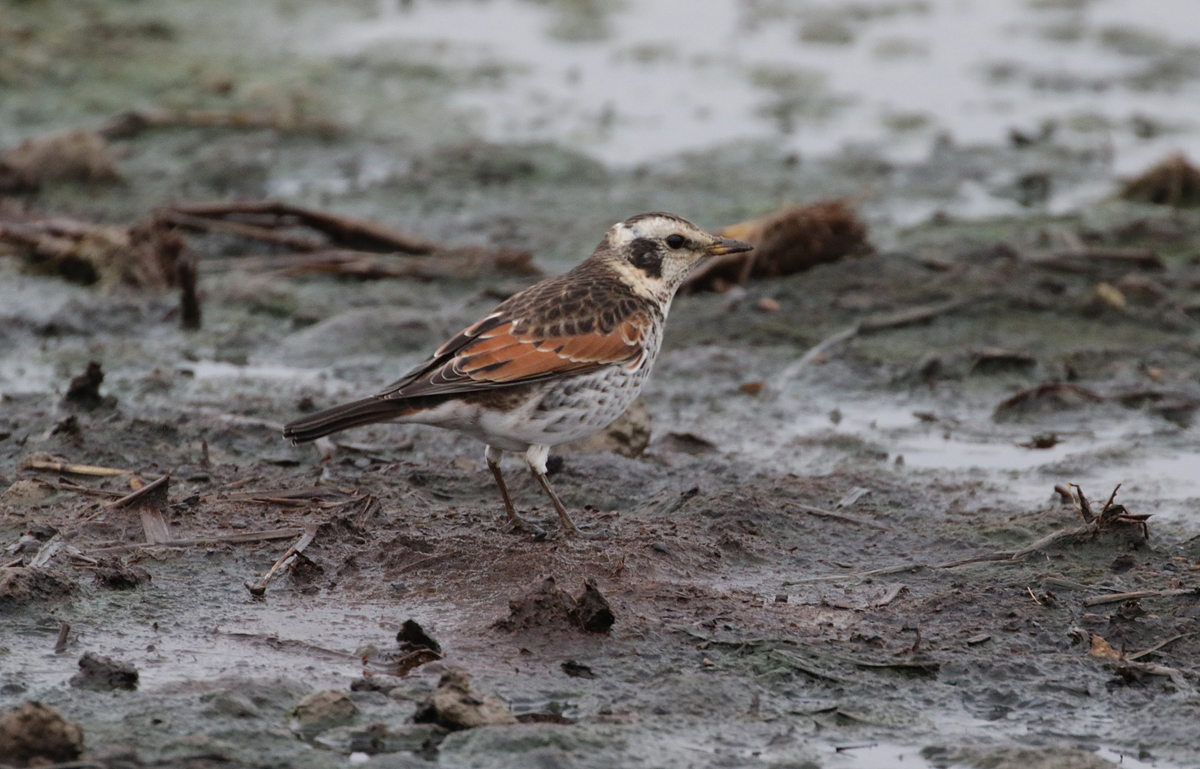
A quick drive round the fields on my final morning at Arasaki produced the usual birds; the two Whooper Swans in winter residence, a few Common Shelducks, many Dusky and Pale Thrushes and plenty of Russet Sparrows.


Large flocks of Russet Sparrows are a common sight on the wires.


Less often seen are Hawfinches and, surprisingly, Kestrel. They were far more common at Isahaya Bay.


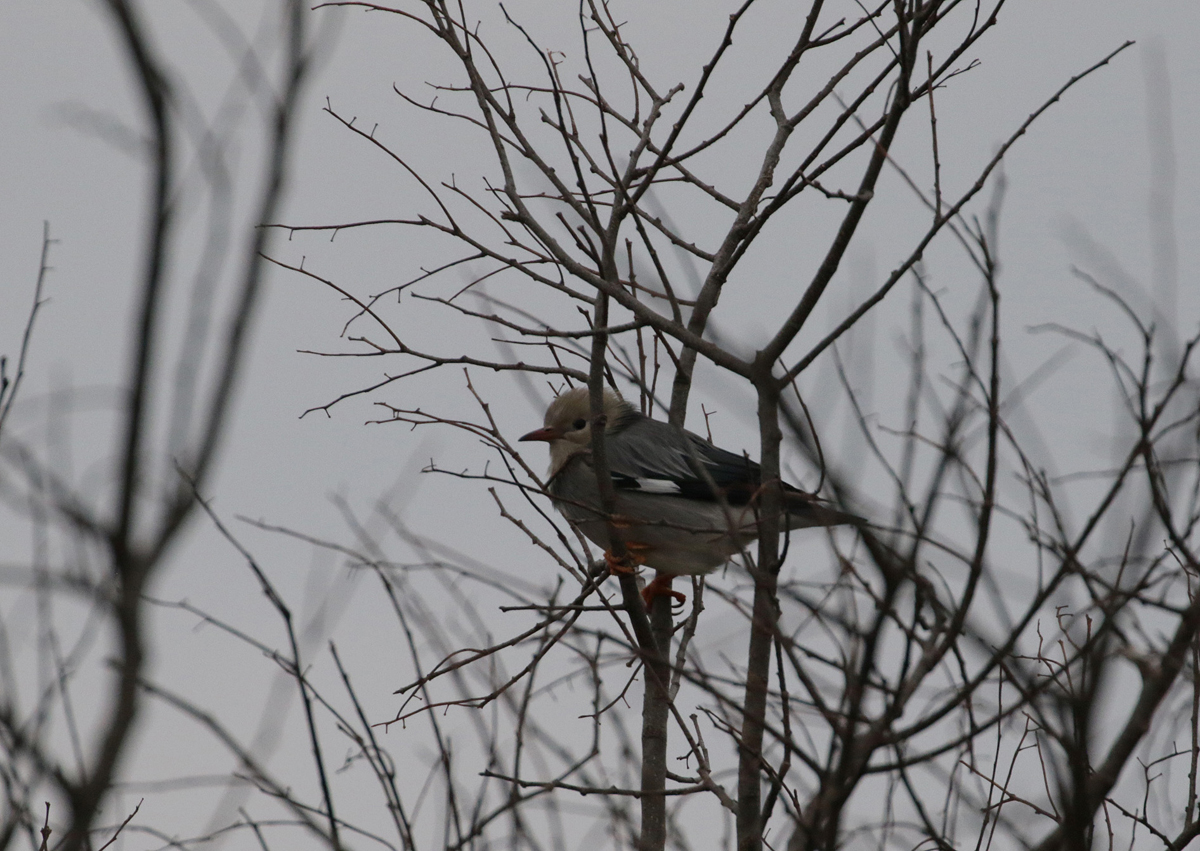
The best encounter of the morning was a party of Red-billed Starlings with the Common and White-cheeked by the pig farm.


Common Starling.


The first two Red-billed Starlings were a surprise but as I walked into the pig farm I found many more. 


A single Commom (top) with Red-billed.


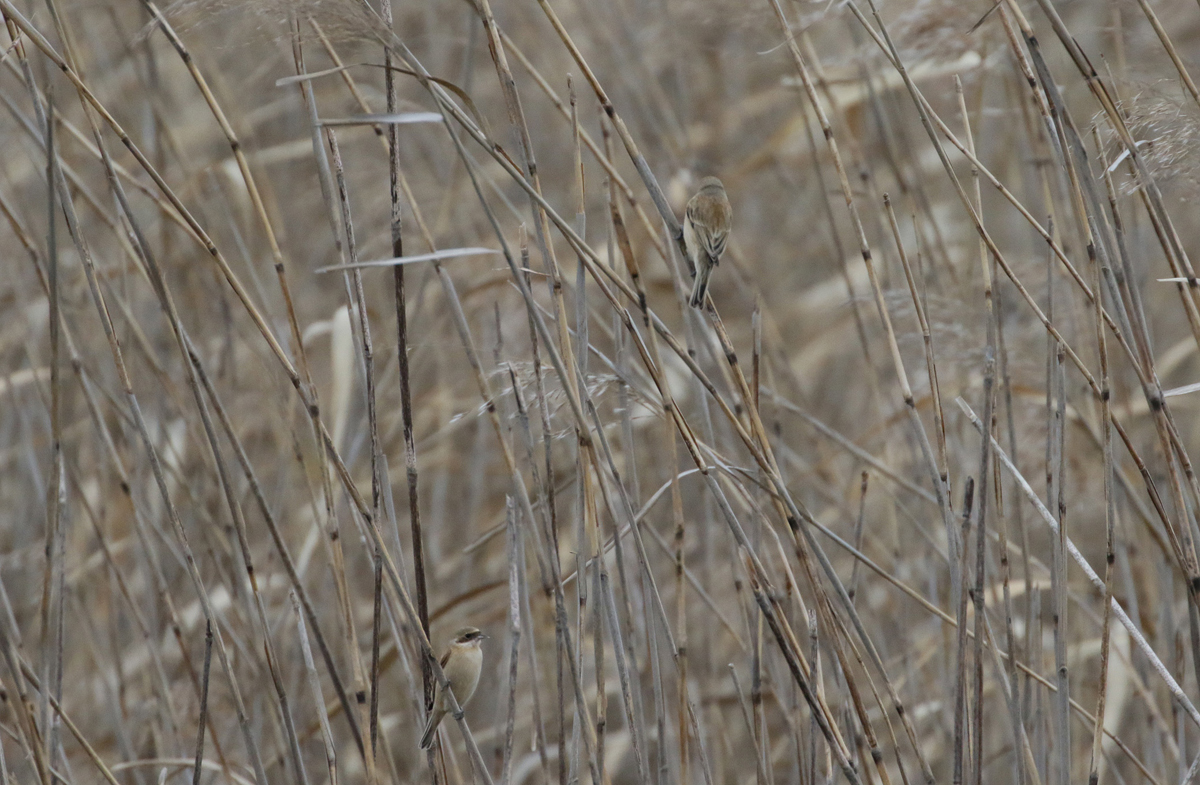
With some time left before having to start the long drive back to Kyoto I decided to have one last try for Penduline Tit. I'd heard them several times, both here and at Isahaya Bay but so far one brief flight view was all I'd managed. Fortunately conditions were very calm this morning and it didn't take long to find small groups flying this way and that across the reeds. about 40 birds was the biggest group I saw in flight but there were obviously a lot more birds present judging by the calls in both directions along the river.


They sometimes came quite close but were hidden, low in thick reeds. The only photographic opportunity was slightly further away where there was a break in the reeds and I could get these more distant shots.


On one of the occasions a party crashed into the reeds close by they flushed a Dusky Warbler! It flew up and called dropping back into the reeds four or five metres on but continued to call for a short time. I've no idea how many Duskys may winter in this part of Japan but this is my second at Arasaki, after one seen well with Sean Minns and Mark Carmody in 2008.


And one other bird along the river... spot the Hen Harrier.


The list of 119 species recorded during the week-long Kyushu trip:-


Whooper Swan
Common Shelduck
Mandarin Duck
Gadwall
Falcated Duck
Eurasian Wigeon
Mallard
Eastern Spot-billed Duck
Northern Shoveler
Northern Pintail
Eurasian Teal
Common Pochard
Tufted Duck
Little Grebe
Great Crested Grebe
Eurasian Spoonbill
Black-faced Spoonbill
Black-crowned Night Heron
Grey Heron
Great White Egret
Little Egret
Great Cormorant
Eurasian Kestrel
Merlin
Peregrine
Osprey
Black Kite
Eastern Marsh Harrier
Hen Harrier
Eurasian Sparrowhawk
Northern Goshawk
Eastern Water Rail
Ruddy-breasted Crake
Common Moorhen
Common Coot
Sandhill Crane
White-naped Crane
Common Crane
Hooded Crane
Eurasian Oystercatcher
Northern Lapwing
Grey plover
Long-billed Plover
Little Ringed Plover
Kentish Plover
Common Snipe
Eurasian Curlew
Common Greenshank
Green Sandpiper
Terek Sandpiper
Common Sandpiper
Dunlin
Black-tailed Gull
Common Gull
Vega Gull
Mongolian Gull
Slaty-backed Gull
Taimyr Gull
Black-headed Gull
Saunder's Gull
Caspian Tern
Rock Dove
Oriental Turtle Dove
Ural Owl
Long-eared Owl
Short-eared Owl
Common Kingfisher
Crested Kingfisher
Japanese Pygmy Woodpecker
Great Spotted Woodpecker
Japanese Woodpecker
Ryukyu Minivet
Bull-headed Shrike
Daurian Jackdaw
Rook
Carrion Crow
Large-billed Crow
Eastern Great Tit
Varied Tit
Chinese Penduline Tit
Barn Swallow
Long-tailed Tit
Japanese Skylark
Zitting Cisticola
Brown-eared Bulbul
Japanese Bush Warbler
Dusky Warbler
Japanese White-eye
Eurasian Nuthatch
Red-billed Starling
White-cheeked Starling
Common Starling
Pale Thrush
Dusky Thrush
Red-flanked Buletail
Daurian Redstart
Blue Rock Thrush
Brown Dipper
Russet Sparrow
Eurasian Tree Sparrow
Forest Wagtail
Eastern Yellow Wagtail
Grey Wagtail
White wagtail
Japanese Wagtail
Olive-backed Pipit
Red-throated Pipit
Buff-bellied Pipit
Brambling
Oriental Greenfinch
Long-tailed Rosefinch
Hawfinch
Japanese Grosbeak
Meadow Bunting
Chestnut-eared Bunting
Rustic Bunting
Elegant Bunting
Black-faced Bunting
Common Reed Bunting


Thursday, 15 October 2015

hegurajima October 14

I was hoping to spend three days on Hegura this week but just as last week it was impossible to get accommodation at such short notice. If most guest were fishermen last week, the island was certainly jumping with birders this week. The weather charts for the two days preceding my visit had looked very promising to bring birds in and so it proved; there were far more present this time.


Perhaps the two most striking changes were the arrival of Daurian Redstarts, which are now flaunting the presence around the island, and a huge number of buntings; buntings at every turn. Much more like mid-October in other words.


It wasn't difficult to resist the temptation to photograph the Daurians, they are after all a very common bird in Japan and there's no need to go to Hegura to get frame-fillers. The only Daurians I'd photograph there are birds that are of special interest for some reason, he said pompously. I often grumble inwardly when people are messing around on Hegura photographing common birds rather than getting on trying to find something. So let me first of all confess my own sins...


One of many Bramblings on the island.


Do they come much more common than Brambling? Well how about this...


One of two Great Spotted Woodpeckers I saw (and yes, I even got shots of both).


Well one excuse could be the Woodpeckers could be an interesting race; or how about they're damn difficult to get even half decent shots of in Kyoto. I know, clutching at straws. But why is it that Hokkaido woodpeckers always throw themselves at the camera while elsewhere they do their best to be on the wrong side of the tree. I'm still struggling for a Brambling excuse though.


Another bird that isn't exactly rare is Hawfinch but again it's a species I never normally get close to so...


An unusually confiding Hawfinch.


For many people Elegant Bunting would be another common winter species but it's something I rarely see in Kyoto, though they do winter elsewhere in Kansai.


Elegant Bunting was suddenly one of the commonest species on the island, there had been none a week earlier.


Last week I had my first Yellow-browed Bunting for Hegura and the following bird may even be the same individual as it was only 50 metres from that sighting. A cracking bird though and these better shots were worth a little stalking to get.


Yellow-browed Bunting; a very uncommon, dare I say rare, autumn migrant.


And sticking with Yellow-browed, the next one's a warbler. I saw nine Yellow-brows in my brief visit, no doubt there could have been many more.


This shot of Yellow-brow was taken by accident while trying to photograph a Willow Warbler!


There were two interesting clusters of birds. The first was in the strip of dense, low, tangled woodland running through the centre of the southern half of the island. I found a Willow Warbler and while driving myself nuts trying to get a decent shot of it I also saw two Yellow-brow, single Mugimaki and Narcissus Flycatchers as well as several Pale Thrushes, an irritating flock of Japanese White-eyes (irritating because they made it so difficult to follow the Willow Warbler), quite a few Goldcrest (they didn't help much either) and a handful of Coal Tits. Just last week I said I don't often see Coal Tits on the island, had I known they would suddenly appear in bigger numbers I'd have made the comment about something a bit more exotic. A Eurasian Sparrowhawk put in two appearances which was very nice though as I'd already found three piles of Pale Thrush feathers on my way through the trees I doubt any of the thrushes still present felt the same way.


Coal Tit.


If you're thinking "Another common species!", this is because I was hoping for Yellow-bellied Tit and even though this doesn't look anything like a Yellow-bellied Tit it was good camera practise just in case...


Mugimaki Flycatcher.


The second good-bird cluster was in a little grassy bay near the north end. I was staggering and stumbling through the hidden rocks and grassy tussocks when in fairly quick succession a large silent pipit, a large silent bunting and a small silent bunting flew up and perched on the rocky shore. In the end the large bunting turned out to be Pine which is good but expected in October and the pipit was a Richard's which may be the first I've seen on Hegura. I normally see Richard's either as spring migrants on other islands or as wintering birds further south. The small bunting I dismissed as a Reed in the excitement but grabbed a couple of quick shots to check later as I hadn't seen Reed this trip yet. With the big things sorted and the little thing gone I looked at the two images and was puzzled; I still am. It looks as though it's going to be easy to identify but looking closer it's almost as if it's made of old left over bunting bits, it's not a Reed. The small conical bill with the pale lower mandible could fit on a Pallas's Reed okay, there are bits of washed out Little and of Rustic too but neither seem perfect. This is killing me. Surely the answer is so obvious it's staring me in the face but I'm just not getting it!


A bunting on some colourful but not pleasant to walk over rocks...


A couple of people have commented saying this looks like a Pine Bunting. Indeed it does, the answer really was staring me in the face. Pine was the only streaky bunting (within reason) I never considered, simply because there was a Pine Bunting a few rocks over and this bird looked about 30% smaller hence my mind was focused on something small.


Having a last look around the harbour before boarding the ferry two guys came up and told me there was a Schrenck's Bittern at the hospital. My first reaction was hospital! What hospital? Anyway I thought right, two minutes up to the docs, two minutes back, 15 minutes till the ferry's official departure time. This has to be the only public transport in Japan that often leaves a few minutes early. Fortunately the bird really was just sitting in the "garden", a quick series of shots and back just as they shutting up shop, raising the gangplank or whatever, and we were out of the harbour five minutes ahead of schedule.


This reminded me of the time I was going to the ferry and someone told me he'd just found a Spotted Flycatcher! Still Japan's one and only record. Why didn't I just let the ferry go and stay on the island another day?! In that light even a Schrenck's pales. Another puzzle; why do I always get cracking views of Schrenck's Bittern (okay not always, but three of them have been point-blank range) and Yellow is always (always) a distant speck flying over some enormous reedbed?


Garden gnome or Schrenck's Bittern.


Species recorded:-
Eurasian Wigeon   1
Streaked Shearwater   common from the ferry
Schrenck's Bittern   1
Grey Heron   1
Great Cormorant   1 Wajima harbour
Black Kite   2
Eurasian Sparrowhawk   1
Black-tailed Gull   c200
Slaty-backed Gull   several Wajima harbour
Oriental Turtle Dove   1
Great Spotted Woodpecker   2
Coal Tit   c10
Red-rumped Swallow   1
Brown-eared Bulbul   c15
Japanese Bush Warbler   fairly common
Willow Warbler   1
Dusky Warbler   1
Yellow-browed Warbler   9
Kamchatka Leaf Warbler   1 heard
Japanese White-eye   c10
Goldcrest   several
Pale Thrush   several
Siberian Rubythroat   2
Daurian Redstart   common
Stejneger's Stonechat   3
Narcissus Flycatcher   1
Mugimaki Flycatcher   1
White Wagtail   2
Richard's Pipit   1
Olive-backed Pipit   1
Red-throated Pipit   1
Buff-bellied Pipit   2
Brambling   common
Eurasian Siskin   c30
Oriental Greenfinch   5
Hawfinch   3
Pine Bunting   1
Little Bunting   1
Yellow-browed Bunting   1
Rustic Bunting   several
Elegant Bunting   common
Yellow-breasted Bunting   1 seen by others
Black-faced Bunting   common
Lapland Bunting   1 seen by others