Showing posts with label Waxwing Bohemian. Show all posts

Friday, 27 March 2015

Japanese Waxwings and Spotted Redshanks...

I got back from a two-day trip to Mie yesterday evening and fell straight into bed to make sure I got up for an early start at work today.


I spent Wednesday and Thursday mornings wandering along the seawalls around Matsusaka, checking the fields, rivers, pools and ditches to one side or the flats on the other depending on the height of the tide. In the afternoons I moved up the coast a little to just north of Tsu city and sat on the beach looking at the gulls. Though I never think we've seen the back of winter until the cherry blossom has come and gone the total of three days I've spent in Mie this week certainly give the impression that spring is well on the way. Sitting on the beach for 2-3 hours isn't something I'd have considered even a couple of weeks ago with snow still falling but the weather has been great this week. Well, apart from the sandblasting I was on the end of during Wednesday's strong wind; I was still trailing sand behind me when I arrived home last night.


Wednesday morning got off to a great start with a small group of waxwings breakfasting on berries in a tree rising above the seawall, this before the wind got up. Five Japanese and a lone Bohemian, possibly the Bohemian was blown away as it wasn't with the Japanese on Thursday morning.


Japanese Waxwings.


The lone Bohemian.


The waxwings weren't the only birds attracted to the berry feast, two or three Dusky Thrushes came and went and there was a constant Brown-eared Bulbul presence. Where isn't there? Sea level to mountain top, trust Brown-eared Bulbul to be either the noisiest bird on the block or the one that flits tantalisingly away through the trees time and time again. Somehow they know which will be the more irritating. That said I always think they are a really attractive bird when seen well and in good light.


Brown-eared Bulbuls taking a breather between bouts of obstreperousness.


Not quite there yet but some Duskies are starting to look the business.


So onto those Spotted Redshanks. There have been a couple of Common Greenshanks here all winter, odd ones often over-winter, but not Spotshanks. These were the first sign of wader passage this spring and on Thursday they were joined by a couple of Wood Sandpipers. As usual the Long-billed Dowitchers managed to avoid being photographed, or photographed well, this time they were much closer but always with the sun behind them. A party of nine Black-winged Stilts appeared on Thursday too, the first I've seen here for a while.


Two of the five Spotshanks. They were very mobile moving around the pools behind the seawall and out onto the mudlats at low tide.


Two Long-billed and a Very-Long-billed Dowitcher?


Finally I can't resist posting these digiscoped shots of this distant but striking immature Great Cormorant. With exceptionally white underparts, mottled breast and neck and a sharply demarcated pec band, it was very eye-catching. The upperparts are as adult with a strong metalic green sheen and this combination is not something I can recall having seen before.


More typical immature Great Cormorants are browner below like the following three individuals (also distant digiscoped birds).


Tuesday, 10 March 2015

Ishikawa trip last weekend

While the Hoopoe I wrote about a couple of days ago was the highlight of the trip to Ishikawa last weekend, the aim was to see the Scaly-sided Merganser on the Saigawa in Kanazawa. And just like last winter I failed miserably.

I started on the Saigawa at the usual (?) spot and though there were 11 Goosanders on the river at first light there was no sign of the Merganser. Here we go again I thought, but hey, there was plenty of river still to check, still plenty of optimism... still plenty of misplaced optimism as it turned out. The Goosanders were expected here but a Bohemian Waxwing wasn't. A splendid adult hanging on the fringe a group of about 20 Hawfinches, not quiet sure if it should join those seed eaters. I suppose if you're a Waxwing being on your own is an odd experience.

I gave up on the spot far more quickly than last winter, no more walking up and down, and drove up river stopping everywhere the road touched the river, at every vantage point giving a view along an unreachable stretch. There were no more Goosanders, nothing to keep my hopes up, where does it go? Or maybe it had gone, it is March after all.

I saw no more sawbills up river, but a couple of Crested Kingfishers in riverside trees and a Brown Dipper were reward enough. Or at least that's what I told myself, I could maybe have seen them without the four-hour drive. Returning for a quick look back at the starting point where there were now only four Goosanders convinced me to give up and trawl the fields to the north of the city for anyhting else of interest.


Two of the Goosanders just after dawn. 


The lonely Bohemian Waxwing, a cracking adult.

It seemed a day for disappearing birds so it was somehow appropriate that I could hear invisible Tundra Swans calling on the fields. They didn't sound too far away but I couldn't find them, they weren't overhead either. Fail to find a Scaly-sided Merganser on a long and difficult river is one thing but audible Tundra Swans on open fields is an entirely different matter. The fields weren't a total bust though, I did find three Daurian Jackdaws in one of the Rook flocks, all dark birds though one had ghosted white underparts. I have a soft spot for Daurians and these were really were worth the trip as there haven't been any close to home this winter. Or none that I've seen anyway. Unfortunately, unlike many I've seen, I couldn't get creep up on them as the flock wasn't settled enough. The muddy fields they were feeding in resulted in many of the Carrion Crows having whiter-based bills than I'd expect from Rooks in Europe let alone the less white-based eastern birds.

White-billed Carrion Crow. 

The real deal, an obvious Rook.

The Daurians weren't the only good crows in the area. This is Azure-winged Magpie country, a fairly common species along the coast near Kanazawa but one I can't see in Kansai. The first ones I came across were in a tiny scrubby area in the docks and for a change I was able to get a couple of shots off before they managed melt away into what little undergrowth there was. Another disappearing bird.


Two of half a dozen Azure-winged Magpies.

I intended to go down to Katano Kamo-ike and almost didn't drop into Kenmin Kaihin Park before heading south. Fortunately I did and hence ran into the Hoopoe, suddenly things were really looking up and Merg or no Merg coming to Kanazawa now seemed a smart choice.

Baikal Teal and Taiga Bean Geese always leave early and I wasn't surprised there were none at Katano Kamo-ike. Nevertheless it was worth dropping in to connect with the only Falcated Ducks of the day. Then it was just a short trip to the coast in the hope of seeing a few divers and auks. There weren't any auks but three species of diver were excellent and on rocks off Kasano Misaki were Temminck's and Pelagic Cormorants.


A breeding Great Cormorant in the harbour.

Nearby, in the harbour were hundreds of gulls. Sadly the light was going and and most gulls were out on the breakwater. I was torn; stay here overnight and check the gulls in the morning or keep heading south and start Sunday at Biwako. A small harbour on a Sunday? I doubted there'd be much gull action in the morning so down to Biwako it was. It was on the dive south I paused in a convenience store car park I posted the Hoopoe shots.

Monday, 23 December 2013

waxwings & tits

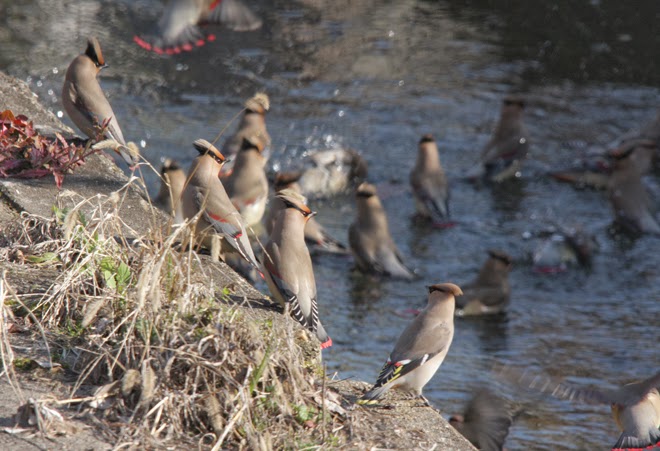
Japanese Waxwing is irregular in Kyoto, some winters they can arrive in large flocks and disperse into smaller parties as berry supplies are exhausted. In other years they are totally absent. In waxwing years there is usually a small number of Bohemian amongst them. Where they may fetch up is unpredictable but the botanical gardens area is fairly reliable as there are a number of good berry trees in the area. The shots below are of two flocks that were faithful to some excellent berry bushes in the respective winters of 2011 and 2013 but in both locations the bushes were removed the following spring. I suspect the residents didn't appreciate the impressive mess that can be made by a few hundred waxings with a large supply of purple berries.

This flock of Japanese Waxwings remained in this location for over a week to my knowledge. Spot the lone Bohemian in the line up! 9 February 2013.

A flock near the botanical gardens 6 January 2011. In this case the size difference between these first winter  Japanese and Bohemian seems extreme.

Adult Japanese and Bohemian in the foreground, looking much closer in size.

First winter Japanese, near Kyoto city 9 February 2013.

Spread wings of adult (bottom) and first winter (Top), the first winters have a white dash towards the tip of the outer web of the primaries whereas the adults have a broad white tip to the inner web and a small spot on the tip of the outer web that can be red or white but is often a compromise pink.

All the breeding Honshu tits occur in Kansai but Willow is only a winter visitor to the hills immediately surrounding Kyoto, though it does breed quite commonly at higher elevations in the region. Eastern Great, Varied and Coal can all be found in the city parks as well as the surrounding hills, all are common but the former two are conspicuously so.
Chinese Penduline Tit used to be regular in the reedbeds along the Uji/Yodo River but I haven't seen any for several years. If this is only due to the massive reduction in suitable habitat they might still be expected in the area but I suspect they aren't wintering here as frquently as they were a few years ago.

Eastern Great Tit in the botanical gardens, Kyoto city 10 January 2014.

Eastern Great Tit along the Katsura River in Arashiyama, Kyoto city 17 January 2011.

Southern Great Tit on Iriomote, Yaeyama Islands. 3 April 2013.

Coal Tit in the botanical gardens, Kyoto city. 15 March 2013.

Coal Tit in the hills west of Kyoto city, 30 March 2013.
 
Juvenile Coal Tit on Mt.Misen, Nara. 28 June 2013.

Varied Tit in the botanical gardens, Kyoto city. 15 March 2012.

Varied Tit near Kyoto city. 30 March 2013.

Marsh Tit is restricted to Hokkaido in Japan so that's one fewer identification problem to worry about in Kansai. This bird near Abashiri, 19 August 2012.

Willow Tit near Ashyu Forest. 19 July 2009.

Willow Tit on Mt.Misen, Nara. 28 June 2013.