Showing posts with label Thrush Dusky. Show all posts

Saturday, 10 December 2016

A few interesting birds in Mie

As I mentioned in the last post I went to Mie after seeing the Bluethroat in Nagoya and the following morning I had a good session south of Matsusaka.


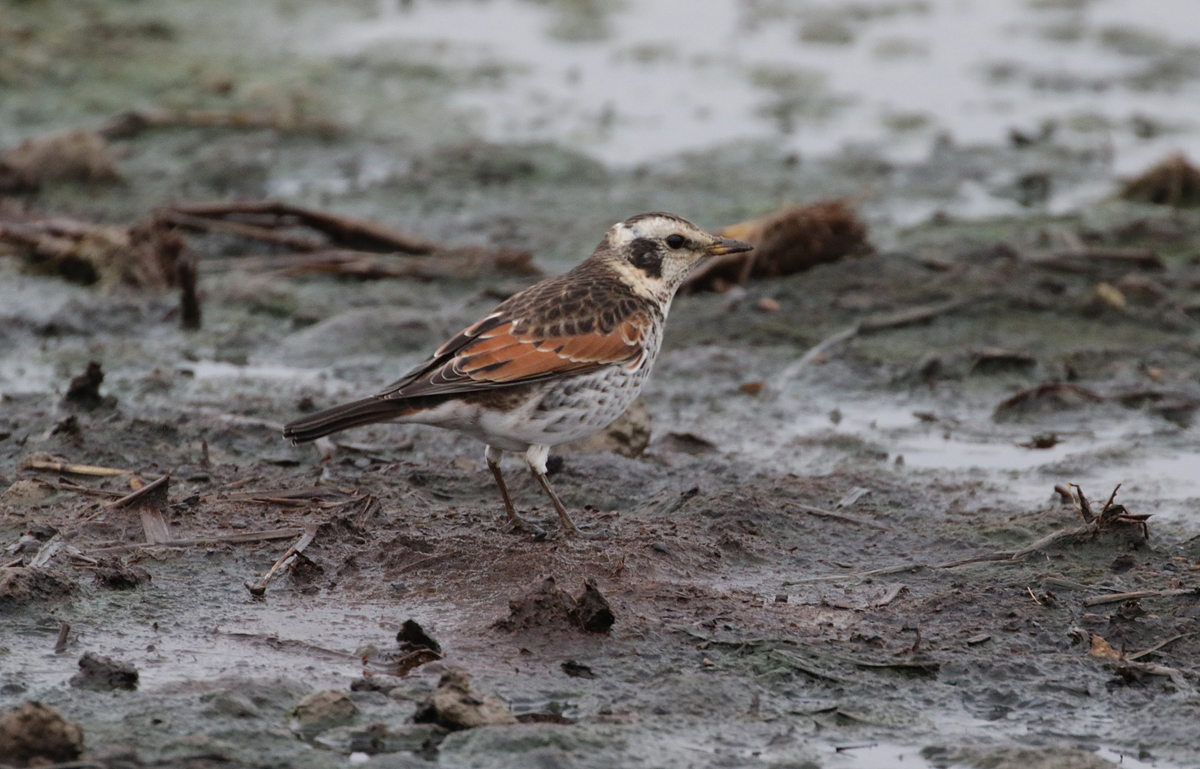
Dusky Thrushes are common in winter but normally there aren't so many good looking males this early in the season so the bird in the following images was a stand out.


But when it comes to early breeding plumage, this striking Great Cormorant takes the biscuit. There are thousands of Great Cormorants in this area but not one other bird showed even a smidgen of breeding plumage.


The breeding plumage Great Cormorant again, here with a bird typical for this time of year.


There were a couple of Pelagic Cormorants too. This is a common species in Japan but scarce in this area.


Pelagic Cormorant and Great Cormorant.


I'm not sure which is more surprising, that I saw three Temminck's Cormorants or that I've never seen them here before.


Two Temminck's Cormorants.


The right hand of the two previous Temminck's.


Another Temminck's further along the beach.


I don't see many Pacific Reef Egrets here either but this one was notable in that I first saw it in an 'inland' ditch. Admittedly only about 100 metres inland but that's enough for a bird I associate with coastal rocks.


The Pacific Reef Egret after it moved downstream to a small harbour.


Then it was off to the sea, its inland adventure over.


There were 10 Brent Geese on the sea just off one of the estuaries, this is a regular wintering species but only in these low numbers.


Two of the Brent Geese in with an assortment of duck species. I always expect geese to stand out because of their size but the Brents aren't so much bigger than the larger duck species and the duller hatch-year birds blend in remarkably well.


In the same flock were several Baikal Teal. This was another personal first for this stretch of coast.


The two females here catch the eye more than the two males!


Two more males.


And yet another.


Birds of prey featured well with Peregrine, Eastern Buzzard, Black Kite, Osprey, Eurasian Sparrowhawk, Northern Goshawk and Eastern Marsh Harrier all putting in appearances. As well as this bird again...


Our local Turkey Vulture on the look out for a seafood snack.


Far far more expected, at least for anyone who doesn't know there's a lurking Turkey Vulture, is Eastern Buzzard. The Buzzard was trying out a bit of lurking of its own when I first noticed it but it soon moved to a typical perch. I think the lurking idea seems pretty good on the face of it but Buzzards have been making a success out of sitting on exposed perches so long, why fix it if it ain't broke?


Saturday, 16 January 2016

Chinese Penduline Tits and Red-billed Starlings

A quick drive round the fields on my final morning at Arasaki produced the usual birds; the two Whooper Swans in winter residence, a few Common Shelducks, many Dusky and Pale Thrushes and plenty of Russet Sparrows.


Large flocks of Russet Sparrows are a common sight on the wires.


Less often seen are Hawfinches and, surprisingly, Kestrel. They were far more common at Isahaya Bay.


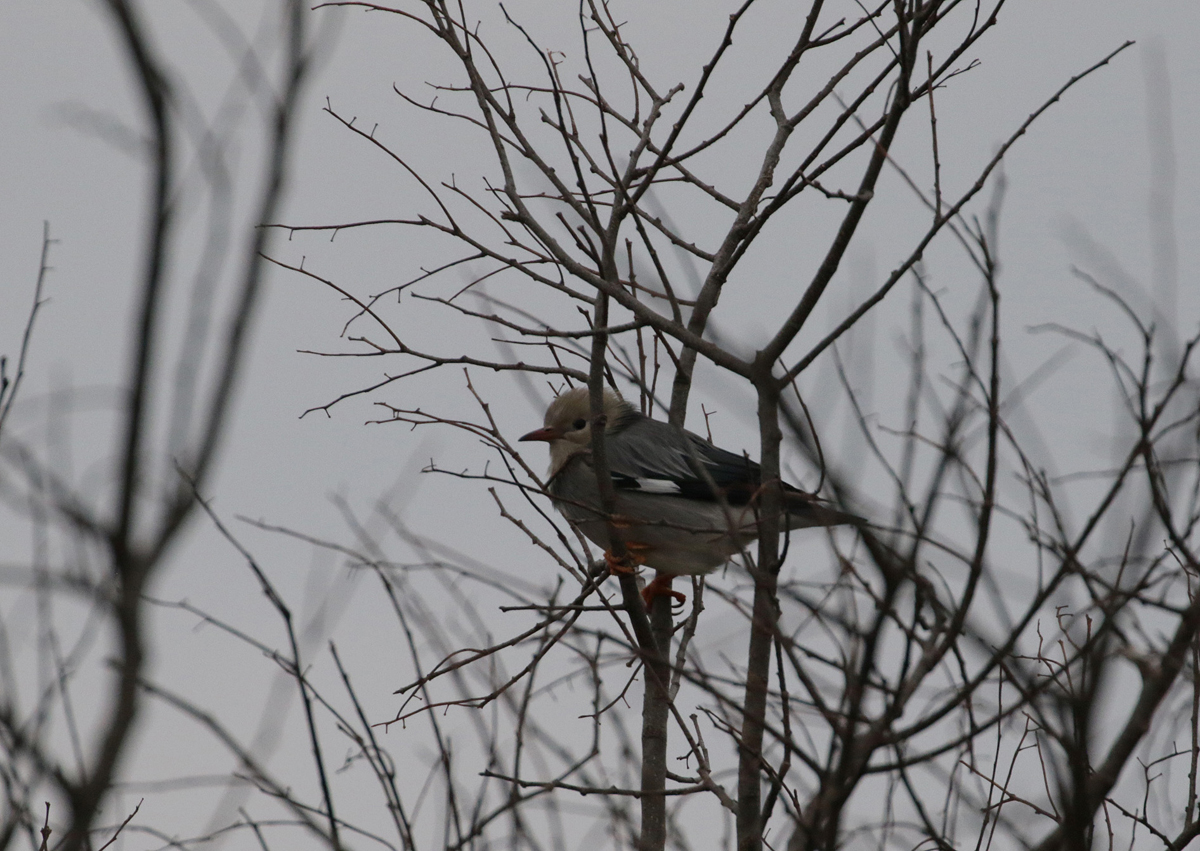
The best encounter of the morning was a party of Red-billed Starlings with the Common and White-cheeked by the pig farm.


Common Starling.


The first two Red-billed Starlings were a surprise but as I walked into the pig farm I found many more. 


A single Commom (top) with Red-billed.


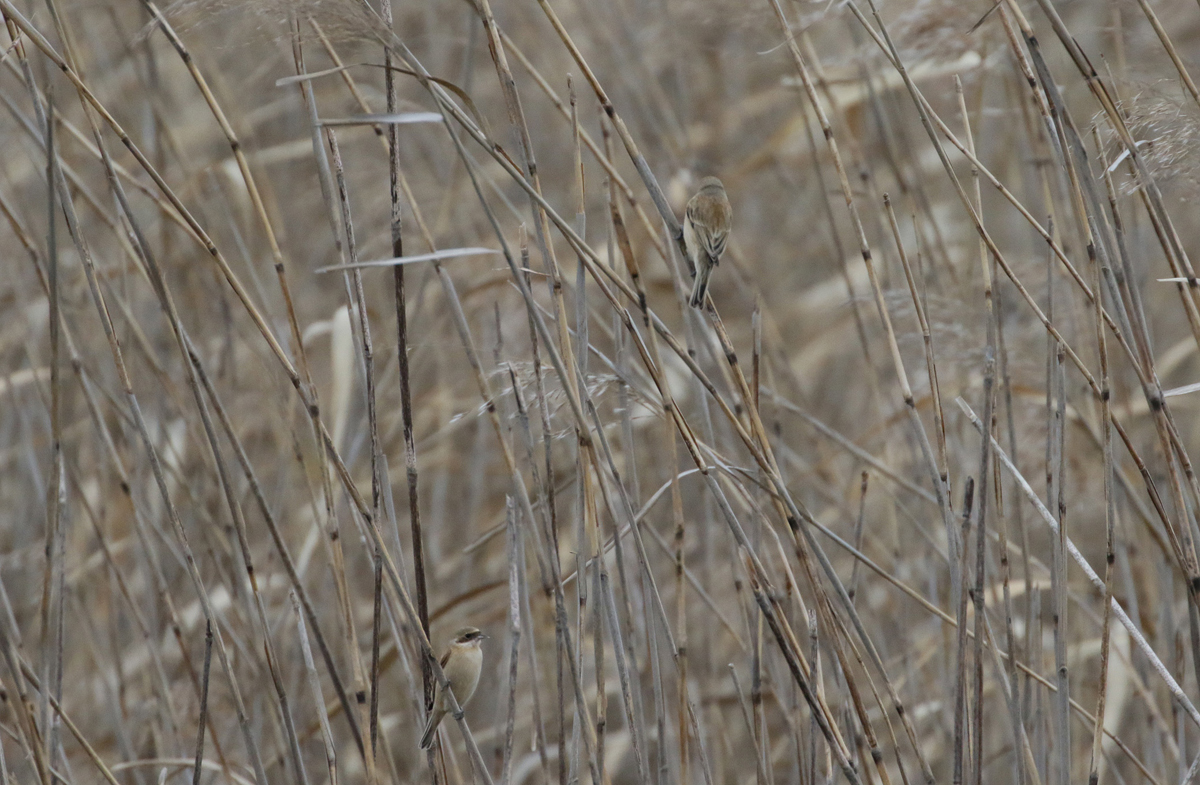
With some time left before having to start the long drive back to Kyoto I decided to have one last try for Penduline Tit. I'd heard them several times, both here and at Isahaya Bay but so far one brief flight view was all I'd managed. Fortunately conditions were very calm this morning and it didn't take long to find small groups flying this way and that across the reeds. about 40 birds was the biggest group I saw in flight but there were obviously a lot more birds present judging by the calls in both directions along the river.


They sometimes came quite close but were hidden, low in thick reeds. The only photographic opportunity was slightly further away where there was a break in the reeds and I could get these more distant shots.


On one of the occasions a party crashed into the reeds close by they flushed a Dusky Warbler! It flew up and called dropping back into the reeds four or five metres on but continued to call for a short time. I've no idea how many Duskys may winter in this part of Japan but this is my second at Arasaki, after one seen well with Sean Minns and Mark Carmody in 2008.


And one other bird along the river... spot the Hen Harrier.


The list of 119 species recorded during the week-long Kyushu trip:-


Whooper Swan
Common Shelduck
Mandarin Duck
Gadwall
Falcated Duck
Eurasian Wigeon
Mallard
Eastern Spot-billed Duck
Northern Shoveler
Northern Pintail
Eurasian Teal
Common Pochard
Tufted Duck
Little Grebe
Great Crested Grebe
Eurasian Spoonbill
Black-faced Spoonbill
Black-crowned Night Heron
Grey Heron
Great White Egret
Little Egret
Great Cormorant
Eurasian Kestrel
Merlin
Peregrine
Osprey
Black Kite
Eastern Marsh Harrier
Hen Harrier
Eurasian Sparrowhawk
Northern Goshawk
Eastern Water Rail
Ruddy-breasted Crake
Common Moorhen
Common Coot
Sandhill Crane
White-naped Crane
Common Crane
Hooded Crane
Eurasian Oystercatcher
Northern Lapwing
Grey plover
Long-billed Plover
Little Ringed Plover
Kentish Plover
Common Snipe
Eurasian Curlew
Common Greenshank
Green Sandpiper
Terek Sandpiper
Common Sandpiper
Dunlin
Black-tailed Gull
Common Gull
Vega Gull
Mongolian Gull
Slaty-backed Gull
Taimyr Gull
Black-headed Gull
Saunder's Gull
Caspian Tern
Rock Dove
Oriental Turtle Dove
Ural Owl
Long-eared Owl
Short-eared Owl
Common Kingfisher
Crested Kingfisher
Japanese Pygmy Woodpecker
Great Spotted Woodpecker
Japanese Woodpecker
Ryukyu Minivet
Bull-headed Shrike
Daurian Jackdaw
Rook
Carrion Crow
Large-billed Crow
Eastern Great Tit
Varied Tit
Chinese Penduline Tit
Barn Swallow
Long-tailed Tit
Japanese Skylark
Zitting Cisticola
Brown-eared Bulbul
Japanese Bush Warbler
Dusky Warbler
Japanese White-eye
Eurasian Nuthatch
Red-billed Starling
White-cheeked Starling
Common Starling
Pale Thrush
Dusky Thrush
Red-flanked Buletail
Daurian Redstart
Blue Rock Thrush
Brown Dipper
Russet Sparrow
Eurasian Tree Sparrow
Forest Wagtail
Eastern Yellow Wagtail
Grey Wagtail
White wagtail
Japanese Wagtail
Olive-backed Pipit
Red-throated Pipit
Buff-bellied Pipit
Brambling
Oriental Greenfinch
Long-tailed Rosefinch
Hawfinch
Japanese Grosbeak
Meadow Bunting
Chestnut-eared Bunting
Rustic Bunting
Elegant Bunting
Black-faced Bunting
Common Reed Bunting


Friday, 27 March 2015

Japanese Waxwings and Spotted Redshanks...

I got back from a two-day trip to Mie yesterday evening and fell straight into bed to make sure I got up for an early start at work today.


I spent Wednesday and Thursday mornings wandering along the seawalls around Matsusaka, checking the fields, rivers, pools and ditches to one side or the flats on the other depending on the height of the tide. In the afternoons I moved up the coast a little to just north of Tsu city and sat on the beach looking at the gulls. Though I never think we've seen the back of winter until the cherry blossom has come and gone the total of three days I've spent in Mie this week certainly give the impression that spring is well on the way. Sitting on the beach for 2-3 hours isn't something I'd have considered even a couple of weeks ago with snow still falling but the weather has been great this week. Well, apart from the sandblasting I was on the end of during Wednesday's strong wind; I was still trailing sand behind me when I arrived home last night.


Wednesday morning got off to a great start with a small group of waxwings breakfasting on berries in a tree rising above the seawall, this before the wind got up. Five Japanese and a lone Bohemian, possibly the Bohemian was blown away as it wasn't with the Japanese on Thursday morning.


Japanese Waxwings.


The lone Bohemian.


The waxwings weren't the only birds attracted to the berry feast, two or three Dusky Thrushes came and went and there was a constant Brown-eared Bulbul presence. Where isn't there? Sea level to mountain top, trust Brown-eared Bulbul to be either the noisiest bird on the block or the one that flits tantalisingly away through the trees time and time again. Somehow they know which will be the more irritating. That said I always think they are a really attractive bird when seen well and in good light.


Brown-eared Bulbuls taking a breather between bouts of obstreperousness.


Not quite there yet but some Duskies are starting to look the business.


So onto those Spotted Redshanks. There have been a couple of Common Greenshanks here all winter, odd ones often over-winter, but not Spotshanks. These were the first sign of wader passage this spring and on Thursday they were joined by a couple of Wood Sandpipers. As usual the Long-billed Dowitchers managed to avoid being photographed, or photographed well, this time they were much closer but always with the sun behind them. A party of nine Black-winged Stilts appeared on Thursday too, the first I've seen here for a while.


Two of the five Spotshanks. They were very mobile moving around the pools behind the seawall and out onto the mudlats at low tide.


Two Long-billed and a Very-Long-billed Dowitcher?


Finally I can't resist posting these digiscoped shots of this distant but striking immature Great Cormorant. With exceptionally white underparts, mottled breast and neck and a sharply demarcated pec band, it was very eye-catching. The upperparts are as adult with a strong metalic green sheen and this combination is not something I can recall having seen before.


More typical immature Great Cormorants are browner below like the following three individuals (also distant digiscoped birds).