It feels a bit odd posting in reverse chronological order but on my way north to Hegurajima last week I stopped off at Kenmin Kaihin Park in Ishikawa. The same place I already posted Lesser Cuckoo shots from on the return southward drive.
On the way up muscicapa flycatchers were better represented with at least 15 Asian Brown, a Grey-streaked and 2-3 Dark-sided. I was particularly pleased with the latter as they are surprisingly uncommon, bordering on rare, in the Kyoto area. To see fewer Grey-streaked than Dark-sided was a novelty.
Asian Brown is the only one of the trio that breeds locally and it isn't difficult to get reasonable shots of them from spring onwards but I'll post a few of the better images anyway to contrast with the Dark-sided.
Of course I was far more interested in getting shots of the Dark-sided, this may well be the first opportunity I've had in fact.
Unfortunately I couldn't get any shots of the thrushes, an altogether trickier proposition but I did get good views of Japanese, Brown-headed and Pale rather than the usual tail disappearing through the foliage. Equally disappointing was a juvenile Goshawk, presumably a female going by its enormous size, which didn't sit still long enough for me to get the camera on it. My first reaction is still to go for the bins first.
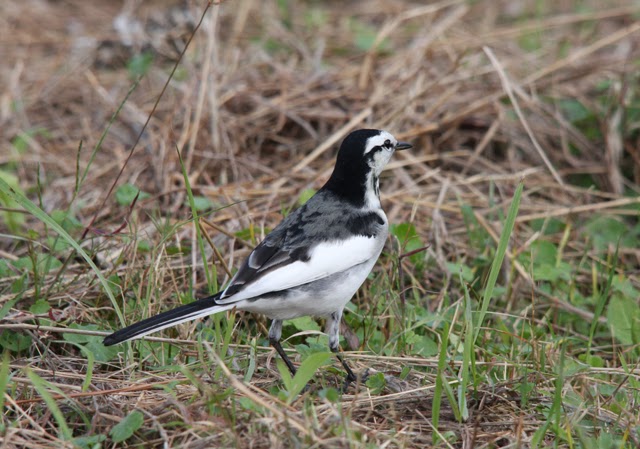
The only other bird I was tempted by was an obliging Japanese Wagtail.
Once at Wajima waiting for the ferry the following morning I had quite good comparative views of paler and darker 1CY Slaty-backed Gulls. The Black Kites were as photogenic as usual.
Species in or near the park:-
Green Pheasant 1
Mandarin Duck 9
Eastern Spot-billed Duck 9
Eurasian Wigeon 3
Mallard 1
Northern Pintail c100
Common Pochard 1
Tufted Duck 3
Great Crested Grebe 2
Grey Heron 2
Great White Egret c20
Little Egret c15
Great Cormorant 1
Eurasian Kestrel 2
Osprey 2
Oriental Honey Buzzard 1
Black Kite c15
Northern Goshawk 1
Common Coot 2
Black-tailed Gull c20
Vega Gull 5
Black-headed Gull several
Rock Dove c30
Oriental turtle Dove c15
Lesser Cuckoo 1
Japanese Pygmy Woodpecker c8
Great Spotted Woodpecker 1 heard
Bull-headed Shrike 12
Carrion Crow
Large-billed Crow
Great Tit common
Varied Tit 1
Sand Martin c50
Long-tailed Tit several parties
Skylark 3
Brown-eared Bulbul common
Kamchatka Leaf Warbler common
Japanese White-eye several
Chestnut-eared Starling 1
White-cheeked Starling c20
Japanese Thrush 2
Pale Thrush 1
Brown-headed Thrush 1
Blue Rock Thrush 3
Grey-streaked Flycatcher 1
Asian Brown Flycatcher 15
Dark-sided Flycatcher 2-3
Narcissus Flycatcher 1 heard
Blue and White Flycatcher 4
Eurasian Tree Sparrow 3-4
Grey Wagtail 1
White Wagtail c10
Japanese Wagtail 2
Oriental Greenfinch fairly common
Eurasian Siskin 5 plus a flock heard
Hawfinch c25
Meadow Bunting 2 heard
Showing posts with label Wagtail Japanese. Show all posts
Tuesday, 13 October 2015
Tuesday, 28 October 2014
Wryneck aside a less than exciting week
Earlier in the week my wife's job took her to the botanical gardens where she ran into a frenzy of photographers. Her phoned description of the bird's call suggested Japanese Woodpecker to me, which let's face it isn't the first name that springs to mind in connection with a frenzy but even though they aren't rare in the hills surrounding the city birds don't normally turn up in the parks.
So a couple of days later when I had some free time mid-morning I went to the botanical gardens. Not opening 9am it's often a better bet for a late start than the Imperial Palace Park which would usually be my early morning choice in the city if looking for migrants.
The weather was beautiful so the place was really busy, finding birds was slow and there would always be a someone wandering along to flush whatever might be on view. Passage migrants of interest were single Narcissus Flycatcher and Kamchatka Leaf Warbler and early winter birds included three Daurian Redstarts and the odd Pale Thrush but the first Bramblings of the season were pick of the bunch.
After a couple of hours I heard a slightly distant single woodpecker call, over before I realised and not enough to determine which species it had been. Almost simultaneously a shout went up and photographers were running. The call was from the direction I'd been headed so I was witness to an amazing scene that must have prompted my wife to phone me a couple of days earlier. A crowd of photographers tail-like followed the green comet or like bees behind their queen they'd cluster under the tree in a rush and off the bird would go again. Back and forth from tree to tree, over the pond and across it again. I doubt the bird had entertainment in mind but if I'd been in charge of auditions for a latter day Keystone Cops movie those photographers would have been signed up on the spot.
Bird photographers get a bad press everywhere but I think in Japan most came to birds late without the benefit of a lifetime's experience and lacking basic fieldcraft don't realise that they're doing anything wrong and the culture being what it is no one see going to take them to task over it. I must just add that on my recent trips to Hegurajima everyone I encountered was wonderfully well mannered and behaved.
With the Japanese Woodpecker confirmed as the cause of the frenzy, I could go to work content I hadn't missed anything spectacular.
A couple of days later on Saturday morning I was working in Hirakata and took the opportunity to check the Yodo riverside in the afternoon. The large close-cut grass area is usually good for wagtails and Japanese Skylark and that day was no exception.
I walked two or three kilometres up stream through a more wooded area but there there was nothing but Brown-eared Bullbuls, a few Bull-headed Shrikes and the other usual suspects in the trees while the river was equally disappointing with a handful of Eurasian Wigeon and the odd Grey Heron.
I made my way back towards the station and at the last clump of scrub before reaching the manicured grass again a Wryneck flew up from my feet and perched in the closest bush. It was too close to focus on so grabbed my camera but through the twigs I needed to switch to manual focus and by the time I fumbled with that the Wryneck had slipped into the reed beyond. I say reeds but it's an impentratable wall, the tallest are four-metre giants with a tangled mass of bindweed running through them.
A metaled track encloses this small rectangle, at one end these dense reeds which give way to thickening into scrub and finally a few stunted trees poke through at the other end. It's all over in 100 metres. And not for the first time it was the last place tried that held all the birds. Apart from the Wryneck and the typical birds of the area of course, Japanese Pygmy Woodpecker, Great Tit, Long-tailed Tit, Japanese White-eye and a year's supply of Bulbuls, there were a couple of Daurian Redstarts, a male Narcissus Flycatcher, a Kamchatka Leaf Warbler and one or two Pale Thrushes. The dense nature of the vegetation meant the idea of getting photographs was a joke but because birds came and went, some not to be seen again, there was a great sense of expectation that something of more interest could have been lurking in there.
If there was something good lurking, I never did find it.
So a couple of days later when I had some free time mid-morning I went to the botanical gardens. Not opening 9am it's often a better bet for a late start than the Imperial Palace Park which would usually be my early morning choice in the city if looking for migrants.
The weather was beautiful so the place was really busy, finding birds was slow and there would always be a someone wandering along to flush whatever might be on view. Passage migrants of interest were single Narcissus Flycatcher and Kamchatka Leaf Warbler and early winter birds included three Daurian Redstarts and the odd Pale Thrush but the first Bramblings of the season were pick of the bunch.
One of a party of about 15 Brambling.
After a couple of hours I heard a slightly distant single woodpecker call, over before I realised and not enough to determine which species it had been. Almost simultaneously a shout went up and photographers were running. The call was from the direction I'd been headed so I was witness to an amazing scene that must have prompted my wife to phone me a couple of days earlier. A crowd of photographers tail-like followed the green comet or like bees behind their queen they'd cluster under the tree in a rush and off the bird would go again. Back and forth from tree to tree, over the pond and across it again. I doubt the bird had entertainment in mind but if I'd been in charge of auditions for a latter day Keystone Cops movie those photographers would have been signed up on the spot.
Bird photographers get a bad press everywhere but I think in Japan most came to birds late without the benefit of a lifetime's experience and lacking basic fieldcraft don't realise that they're doing anything wrong and the culture being what it is no one see going to take them to task over it. I must just add that on my recent trips to Hegurajima everyone I encountered was wonderfully well mannered and behaved.
With the Japanese Woodpecker confirmed as the cause of the frenzy, I could go to work content I hadn't missed anything spectacular.
A couple of days later on Saturday morning I was working in Hirakata and took the opportunity to check the Yodo riverside in the afternoon. The large close-cut grass area is usually good for wagtails and Japanese Skylark and that day was no exception.
Japanese Skylark
White Wagtail, the local lugens, this a presumed adult female
Japanese Wagtail
I walked two or three kilometres up stream through a more wooded area but there there was nothing but Brown-eared Bullbuls, a few Bull-headed Shrikes and the other usual suspects in the trees while the river was equally disappointing with a handful of Eurasian Wigeon and the odd Grey Heron.
I made my way back towards the station and at the last clump of scrub before reaching the manicured grass again a Wryneck flew up from my feet and perched in the closest bush. It was too close to focus on so grabbed my camera but through the twigs I needed to switch to manual focus and by the time I fumbled with that the Wryneck had slipped into the reed beyond. I say reeds but it's an impentratable wall, the tallest are four-metre giants with a tangled mass of bindweed running through them.
A metaled track encloses this small rectangle, at one end these dense reeds which give way to thickening into scrub and finally a few stunted trees poke through at the other end. It's all over in 100 metres. And not for the first time it was the last place tried that held all the birds. Apart from the Wryneck and the typical birds of the area of course, Japanese Pygmy Woodpecker, Great Tit, Long-tailed Tit, Japanese White-eye and a year's supply of Bulbuls, there were a couple of Daurian Redstarts, a male Narcissus Flycatcher, a Kamchatka Leaf Warbler and one or two Pale Thrushes. The dense nature of the vegetation meant the idea of getting photographs was a joke but because birds came and went, some not to be seen again, there was a great sense of expectation that something of more interest could have been lurking in there.
A selection of peek-a-boo shots, Kamchatka Leaf at the top (really), a couple of the Narcissus, Pygmy Woodpecker (usually much easier) and a couple of White-eyes. Even the normally brazen Daurian Redstarts were skulkers.
If there was something good lurking, I never did find it.
Tuesday, 21 January 2014
wagtails
A disappearing Forest Wagtail at Miike (Kyushu), 4 January 2008. It was really tough trying to digiscope this bird dashing around among the trees. This is the best result I got!Forest Wagtails have turned up and even over-wintered in Kansai, however they're rare anywhere in Japan. There has since been another wintering at the same spot as the bird I saw at Miike.
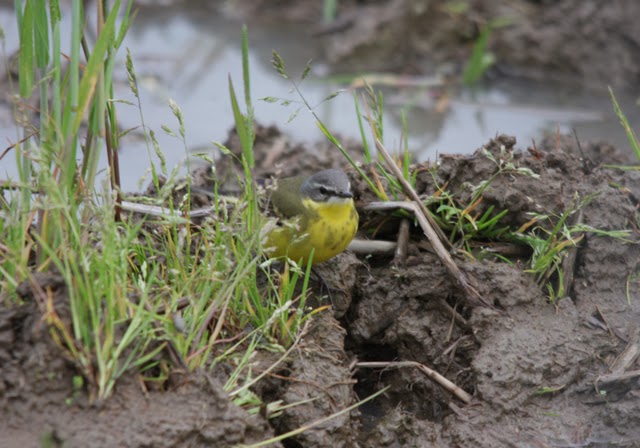
Eastern Yellow Wagtails are a fairly common migrant in southern and western Japan, particularly in spring on off-shore islands. I see many on Mishima and Tsushima when they don't present a serious identification problem but I usually visit Hegura in October where they are both uncommon at that time and far more challenging to identify. I've never seen one in Kansai and given their preference for open habitat and conspicuous appearance this says something about their status in this area.
I've never even heard of Citrine in Kansai but unfortunately missed one found by Gordon Hay (visiting from the UK) on Hegura last October (2013).
In Kyoto Grey Wagtail is quite common in winter and can be seen along the rivers or on various ponds. In summer they mostly retreat onto mountain rivers and are less obvious.
Japanese and White (lugens) wagtails are resident and the latter also a very common passage and winter visitor. Japanese seems to have a closer affinity to water and is the commoner of the two on rivers in the city. Large numbers of White Wagtails can gather on the fields at Ogura (and other arable areas, especially close to rivers) and pre-roost flocks of 50+ birds can be seen flying into many urban areas in the region. I've also seen ocularis (East Siberian Wagtail) in Kyoto but it's rare, whereas I see quite a few each spring on islands such as Mishima or Tsushima in western Japan. I haven't seen leucopsis in Kyoto but I have seen a very good contenders for leucopsis x leugens hybrids here.
In winter, even the casual visitor should see White, Japanese and Grey along the Kamo River in the centre of Kyoto.
An autumn Eastern Yellow on Hegura, 19 September 2006.
One of several tschutschensis on Tsushima, 30 April 2012.
Another bird on the same date showing far more grey on the forehead as well as extensively on the nape, the supercillium has a distinct yellow tint.
An adult male with a yellowish face, this is meant to be a feature of first-winters as far as I'm aware. Katsura River (Kyoto), 3 October 2013.
Non-breeding adult lugens on the Katsura River (Kyoto), 30 December 2010.
First winter lugens on the Katsura River (Kyoto), 15 October 2010.
M.a.ocularis (East Siberian Wagtail) on Mishima (Yamaguchi), May 2008. The conspicuously dark-centred coverts aren't typical and something of a puzzle.
A scruffy-looking moulting adult Japanese on the Katsura River (Kyoto), 18 September 2013.
Fresh adult Japanese on the Katsura River (Kyoto), 8 October 2012.
Subscribe to:
Posts (Atom)