Showing posts with label Egret Great White modestus. Show all posts

Wednesday, 16 May 2018

Spring mix

I heard a singing Lesser Cuckoo from my bedroom a couple of nights ago, a sure sign that local summer visitors are arriving. It isn't unusual to hear their nocturnal song flight as they circle over the city at this time of year and it's a great reminder that we're never far from birds, even the ones we don't see so often.


Another recent arrival in full voice is Oriental Reed Warbler. I photographed this one at the weekend because I wanted to catch it with some of its crown feathers raised which created the effect of distinct lateral crown stripes, something Oriental Reed doesn't share with some of the other acros in the region... not that it's ever likely to be confused with them.


A resident bird in the area that I almost never try to photograph is Oriental (Grey-capped) Greenfinch. It's so common that it can be a minor irritation at times. How often do we catch a flash of something flying through the trees when walking in woodland... all the time right? I always thing that if something perches visibly it's 99% certain to be a Brown-eared Bulbul but fortunately as it's so distinctive that there's no need to focus on it to check. Oriental Greenfinch on the other hand is rather different, it also frequently catches the eye, in a wide range of habitats, but unlike the very distinctive Bulbul which doesn't demand further attention, the Greenfinch does. Just in case. In fact it can be more than a little irritating at migration hot-spots. So finally I am posting a picture of Oriental Greenfinch, but only because it's a particularly striking male.


Next a passage bird, Grey-tailed Tattler. There are huge numbers passing through at the moment and on the Pacific coast of Japan May is the time to look for Wandering Tattler. I know there are spots in Tokyo Bay that get them every year and Aichi seems to get quite a few records too. Who knows how many turn up at unremarkable and unwatched spots elsewhere along the coast. So far I haven't found one in Ise bay, though not for lack of trying.


So that's Resident, summer visitor and passage migrant in the spring mix. As for lingering winter visitors the only thing I could categorically say is a winter at the weekend was Black-headed Gull, there are still a handful around. There were a few ducks still present, notably five Falcated, but there are always a number of Northern Pintail, Eurasian Wigeon, Tufted Duck and Greater Scaup that don't make the journey back to the breeding grounds. This was the first time I've been birding this spring when I didn't record a single Dusky Thrush which is normally the greatest winter lingerer in this area as far as passerines are concerned.


A few other birds from the weekend included the following...


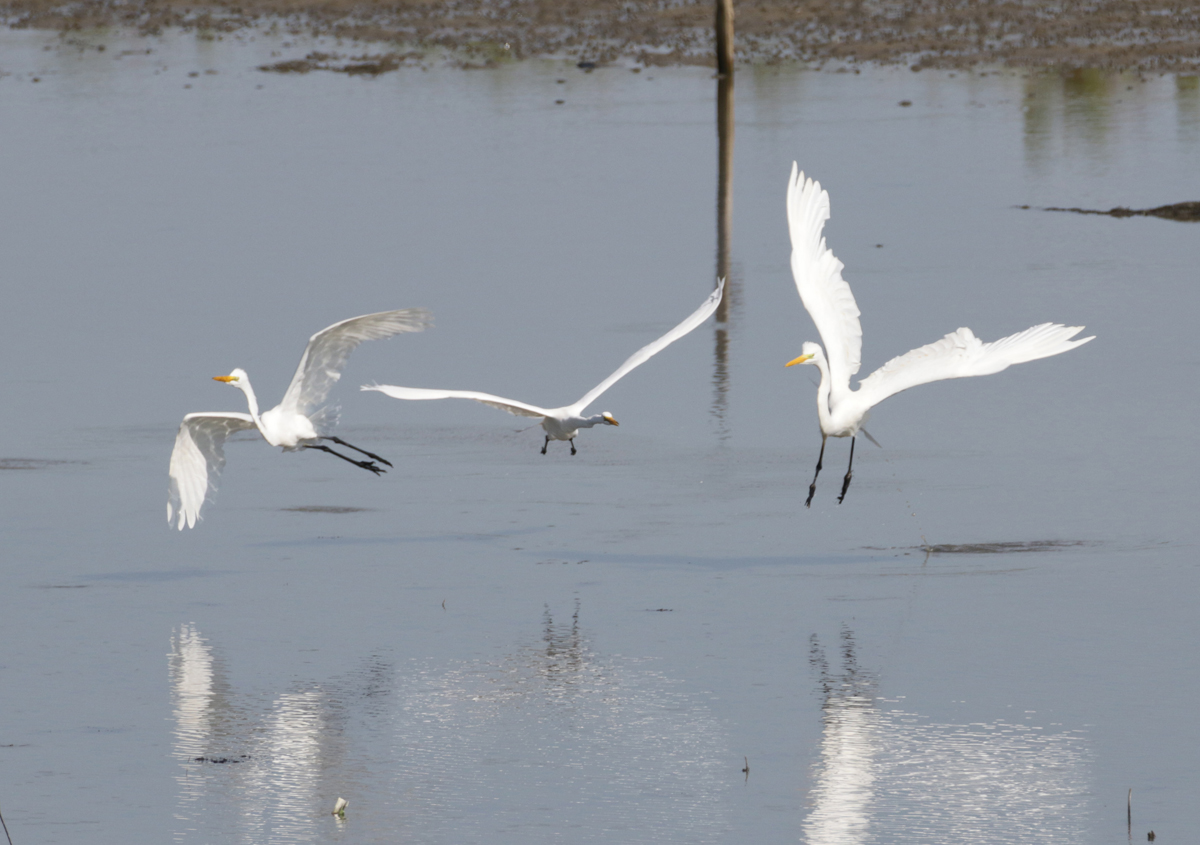
Nice breeding condition bare parts on this Great White Egret. This a local modesta, the wintering alba appear to have cleared out. 


Two Grey-headed Lapwings on the beach were totally out of the blue. I never expect to see them on the beach like this, especially at this time of year.


The main reason this time of year is even more surprising than usual.


This is where I'd expect to see them.


Thursday, 28 September 2017

Those alba Great White Egrets again!

I feel I keep banging on about how the status of Great White Egrets seems to have changed in Japan. I'm suddenly seeing so many alba, where are they coming from and why? If this increase is real rather than just being my impression then presumably something at their continental point of origin is driving the dramatic uptick in numbers I'm getting.


It wasn't until early 2012 I saw an alba in Kansai, an alba and modesta side by side; they looked so different! I'd had an eye out for them for years and thought I was probably overlooking very similar taxa but after that I was sure I couldn't have been overlooking them, at least not totally. I didn't see any the following winter then found three in the 2013-14 winter, one of these was in Shikoku where a local birder told me it had been a good winter for them there. There were no more blank winters but numbers remained low. I saw my first summer bird in June of last year then in the winter 2016-17 they seemed to be popping up all over the place. Nevertheless a flock of about 40 in Mie came as a shock. It probably came as a shock to the lone modesta on the lagoon to find so many 'monsters' that were oblivious to its best efforts to drive them off.


Last week I saw my first here since spring, again in Mie, and it stood out like a sore thumb as they always do. As there were four modesta on the same tidal inlet and I was able to get a few good comparative shots.


A sore-thumb alba, it isn't necessary to have direct comparison to see how much more massive they are.


One of  the four modesta sharing the tidal inlet.


These three images give a good indication of just how much bigger and bulkier alba is.


When it comes to seeing who's boss there's just no contest...


Check out the thickness of the tarsus and tibia, the size of the feet, the thickness of the toes... these birds are chalk and cheese.


A couple of old images showing the respective appearance in (presumed) breeding condition.


May 5th modesta with rosy-pink tibia and (mainly) black tarsus, green lores and black bill. This looks the deepest bareparts flush of the courtship period.


May 26 alba with legs fully flushed pink, tibia and tarsus, pale green lores and yellow bill. The intensely pink legs suggest this bird is in breeding condition yet that the bill hasn't begun to turn seems very odd unless this population doesn't become black in breeding condition. Perhaps this is an exceptional individual and perhaps age could play a part. The several early May birds I've seen on Mishima have a very dull (not blackish) tarsus and the bill varies from bright yellow with just a darker tip to the upper mandible (not unlike modesta later in summer as the black of breeding condition disappears) to what I'd describe as a golden-brown at any distance, as if a first coat of dark paint was failing to mask the yellow beneath. 


Saturday, 3 December 2016

Great White Egret... a flock of alba!

It's good to know there are some constants in life. There was a time, long long ago, when I didn't have any idea of the status of alba Great White Egrets in Japan. I never saw one. It wasn't until I was taking an Aussie birder around Lake Biwa six years ago and he asked "What are those egrets?" that I connected with my first. Those egrets were both Great White but due to the striking size difference they could easily have been two species.


I saw another that winter then others irregularly during subsequent winters. I probably see two to four per winter nowadays and increasingly I feel able to pick out lone birds on size rather than looking for yellow in the legs. It sounds like I've got my eye in now, doesn't it? Well, I thought so until yesterday when I came across a flock of 42 plus a few others later in the day. I like, or liked, to think that I was always keeping an eye out for alba, and had a reasonable notion of their status in this part of Japan. It seems I still don't have any idea of the status of alba Great White Egrets in Japan - or I ought to say in Kansai.


Is Mie a hot-spot for them or have I just not paid sufficient attention to Great Whites when I go there? The latter is possible because there's always so much else to look at. I only remember seeing one there, a spring bird coming into breeding condition, could I really have been missing so many for so long?


The Birds of Japan (Brazil 1990) gives the status of alba as a 'casual winter visitor' to Japan. Whereas the more recent Birds of East Asia states "Winters increasingly from Hokkaido south, but mainly from C Honshu to Kyushu..." So maybe there is a real increase in the number of birds wintering and it isn't simply that I was missing them until six years ago. I like to think that's the case. Nevertheless a flock of 42, that's some increase!


Is there any surprise I've been able to pick up lone birds purely on size difference? I think not, take a look at the comparisons below.


Part of the alba flock, note the single modesta (left at the back) looking as though it could be Intermediate compared to the other birds. 

The alba body looks similar in bulk to Grey Heron but the neck is slightly longer (and thinner) and the legs appear longer too giving it a slightly larger appearance overall, modesta on the other hand is slightly but distinctly smaller than Grey Heron. The slimmer head and long bill of alba also add to larger appearance. The modesta is at the rear in this shot; it seemed it couldn't drive the flock off its lagoon so keeping them contained was the next best option.


The extent of yellow on alba legs is variable, sometimes just a narrow stripe on the inside of the tibia, at the other extreme most of the legs and even feet can be yellow. Modesta is usually black-legged but the upper tibia can be a 'colourless' grey in non-breeding condition.  


I've never seen so many yellow legs in one place; more than a year's quota just in this shot.


There were two interesting things going on with this flock, other than the fact that the flock even exists, one was the behaviour of the single modesta towards these 'interlopers' and the other was interaction between the alba reminding me of dancing cranes. 


Local (modesta) egrets can be quite territorial away from roost sites and they often expect a whole small lagoon or ditch to themselves. The modesta on this lagoon was doing his best to police an impossible situation, my interpretation was that it couldn't chase off the entire flock so it was trying to keep them contained in one corner. Whenever one of the alba began walking out of the 'containment zone' the modesta would fly at it giving the usual deep almost staccato growl.


An alba (foreground) pushing the bounds of toleration, whether it knows it or not.


Chasing alba...


and another...


In this shot, though not others, the modesta seems to have a hint of bluish at the top of the tibia. Maybe breeding hormones are kicking in already which could account for its aggression.


and they just keep on coming...


This alba got lucky, another modesta dropped in and that got the full get-off-my-lagoon treatment.


Then back to containment... what a long day this must have been.


A hint of bluish tibiae again here...


Then there were the dancing cra... er egrets...


Tuesday, 8 November 2016

Early November in Mie

The day before I drove to Saitama to see the Wood Warbler I was birding in Mie, the usual Tsu / Matsusaka area. Since my previous visit a couple of weeks earlier duck numbers were up but still well below winter peaks. Perhaps sea ducks are a little slower arriving but this isn't an important area for them and numbers never impressive. I didn't see any Red-breasted Mergansers, Common Goldeneye or scoters, the former is common in winter, Goldeneye is only ever present in low numbers and the scoters aren't even regular. The first Eastern Buzzard had arrived, Northern Goshawk and Eurasian Sparrowhawk both put in an appearance adding to the sense of seasonal change. Daurian Redstarts were common and there were even a few Dusky Thrushes. Dusky Thrush is never occurs in big numbers until later in the winter, presumably they drift in as the real winter weather bites elsewhere. On the wader front wintering Long-billed Dowitchers were in (only three but that's as good as it usually gets), Northern Grenshanks can be seen throughout winter but a Spotted Redshank was the first for a while, likewise three Wood Sandpipers. A couple of lingering Barn Swallows were keeping low as if not wanting to advertise they weren't where they ought to be by now.


The first Eastern Buzzard I've seen in the area this "winter".


Juvenile Northern Goshawk.
Lunchtime; the agony of choice.


Northern Lapwing; part of a flock of 31.


Northern Greenshank; numbers vary winter to winter but their favourite high-water roost site doesn't seem to.


Short- and medium-billed Far Eastern Curlews, no monsters today.


Wood Sandpipers.


Heading out with the tide; the birds too.


Great White Egret numbers seem a little down and Little on the up, more of a balance. Cattle were still present on 8 Oct but none by the 21st, Intermediate are still hanging. I've only ever seen one mid-winter Cattle but Intermediate is more likely.


Great White Egret.


Intermediate Egret.


So often spoonbills either have their bill hidden under their wing or under the water. So it was nice to see this one catching the evening sun as it flew in.


Immature Eurasian Spoonbill.