Showing posts with label Harrier Eastern Marsh. Show all posts

Monday, 17 December 2018

Odd moult timing for Eastern Marsh Harrier?

After birding in Mie the day before, I drove up to northern Lake Biwa and up one of the dead end roads into the forested hill to grab some sleep before dawn. Glum might be a fitting way to describe the morning; the hills were weighed down by low, immobile clouds that early light made very little effort to penetrate. Even the effervescent Bulbuls couldn't muster more than the occasional half hearted, dank-muffled shriek. I persevered in the growning silence, for a while. My mental image of the lake bathed in sunshine, however improbable I knew this to be, proved irresistable.


Once down on the lake the sky overhead was actually blue! I may not have seen the sun but sunlight did reach through the clouds. That was as far as the good news stretched. The backdrop was purples and blacks, sometimes the hills sometimes the sky, there seemed a fluid exchange of hues between the two. This wasn't at all what the forecasters had predicted (Well there's a surprise!) when I was in Mie.


I took advantage of this belated and probably false dawn to welcome back our wintering Steller's Sea Eagle, sitting in its customary spot overlooking the customary line of parked cars and tripods, then check the Taiga Beans on the lake for anything less usual. There wasn't even the usual (that's Gt White-fronts) let alone less usual - I live in hope that the third time a Greylag turns up I will see it. Never mind, the Beans are always spectacular enough without any distractions.


The first drops of rain sent me back to the car before I'd finished scanning for the Red-crested Pochard apparently in residence this winter. If it had been there at the time, it should have stood out like a sore thumb, or giant duck. As it didn't I can console myself that I still wouldn't have seen it had I decided to (be less of a wuss) wait out a potential downpour without protection for my camera and lens.


Two or three minutes further south under a compromise grey pall, no more siren blue interludes, no longer threatening purple and black, I spotted something which really was unexpected; the Harrier of the title. A kerfuffle of Black Kites seemed unsure about what, or even whether, they were mobbing but nevertheless vaguely occupied the same airspace as a juvenile Eastern Marsh Harrier which had no such doubts about chasing off said interloper. This other bird had a distinctly narrow wing tip and was much smaller than the juvenile, this without being sufficiently small to cause serious excitement it must be added. It quickly gained height above the confusion and made off. The juvenile dropped back into the reedbed and the Kites went back to aimlessly wafting around waiting for food to surrender.


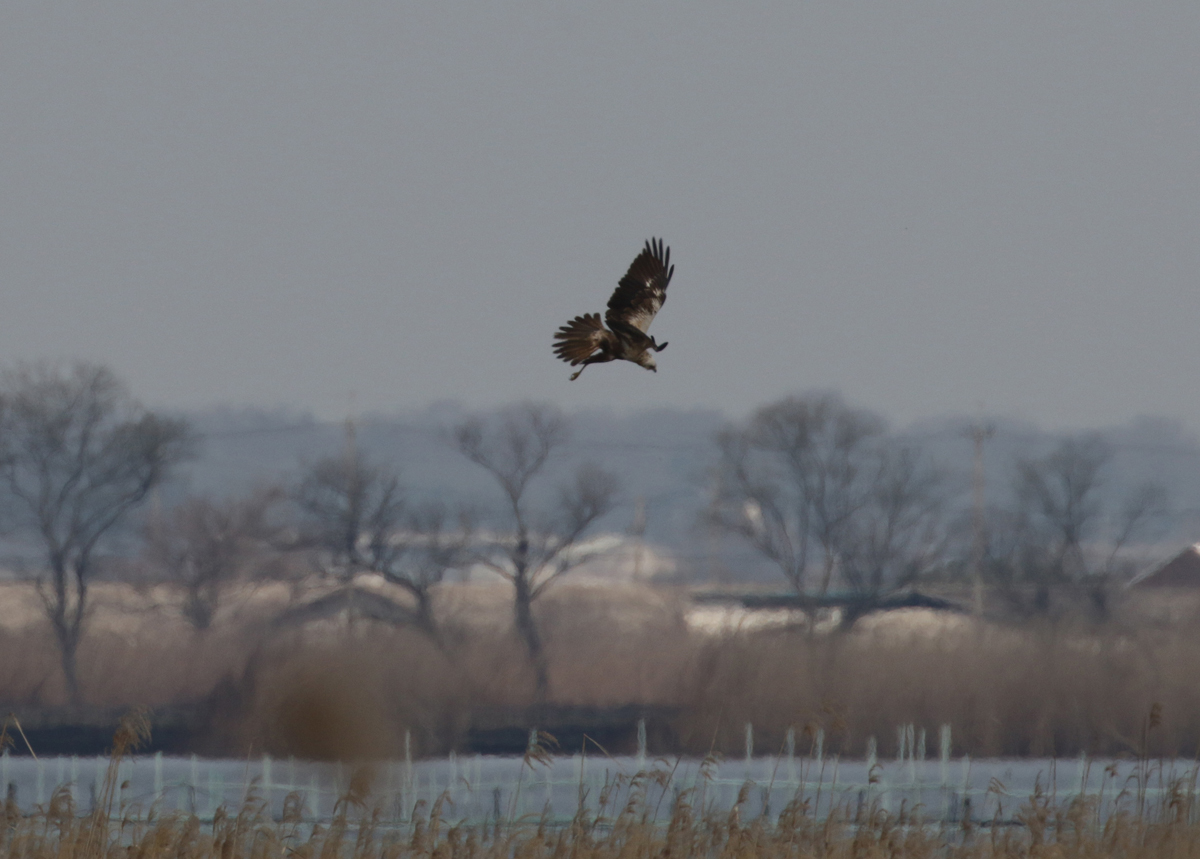
Cropped view of the interesting pointy-winged harrier. This is how it actually looked, black against dark grey with a strikingly narrow wing tip. The views were very brief before it was driven off. So, a photographic identification and grit removed from my oyster. 


Heavy cropping (and lightening) reveals p9 is about half grown and p10 is just showing. I don't recall ever seeing an Eastern Marsh, of any age, not having a full set of primaries, hence they must moult remiges at a time of year I don't normally see them (ie summer/autumn).


Due to its small size compared to the juvenile I'm guessing it must be a male. Having discovered p9-10 are still growing it's even easier to to eliminate the miniscule, narrower-winged Montagu's, which has amazingly occurred in Japan in winter. Pallid has also occurred in winter but is just as easy to rule out. Though it might be a better structural match for Hen once fully winged, the underwing pattern visible in the lightened images puts and end to any such notion. Though I don't have experience of older immature female Pied, in gradual transition from juvenile to adult, the lower belly through to the undertail coverts looks too dark I think. It may sound strange to say considering total records but Pied is perhaps the least likely rare harrier to occur in Honshu in winter. And though Northern hasn't even qualified for this paragraph so far, it has to be a better winter bet too.


I confess I'm not one hundred percent sure I've never seen a Marsh Harrier with this moult but I certainly don't remember having seen one. I'd guess this stage of moult would be more likely in an older immature (clearly it isn't juvenile, which wouldn't have started moulting flight feathers yet) because I suspect an adult would have finished replacing its primaries much earlier than December?


In both these images bird's right wing gives us the clearest view of the leading edge of the primaries and it's possible to see alula, very short p10 and half grown p9 creating a stepped effect. Plumage-wise, there's nothing that suggests it isn't an Eastern Marsh Harrier but I wouldn't attempt to sex it if I hadn't seen it in direct comparison with a much bigger (presumed female) juvenile. 


Saturday, 1 April 2017

Biwako & Matsusaka, a two-day trip

I hadn't been up to the north end of Lake Biwa in ages, all winter in fact. Which is surprising considering winter is the best time to go and as a result I haven't even seen Steller's Sea Eagle this winter. I was hoping to get (good if possible) views and maybe even photos of Copper Pheasant but in the event I didn't even hear a displaying male.


Because there's a cell tower at the top of my usual hill there is an access road, well that's why it is 'my' hill in the first place of course, and this access road has been snow-ploughed allowing anyone daft enough to drive to the top the freedom to do so. However it also meant all bar one of my usual pull-offs were blocked by snow. By day the road becomes a shallow stream as snowmelt finds the easiest route downhill between the walls of snow on either side, but at dawn a steeply-angled ice-rink would be a better description of the road as it nears the top. Going upward, be it driving or on foot, always seems safer than going down to me, so I stopped at the summit rather than drop down the final 100 metres to the car park. I nevertheless still had to walk it. If I tried to stand still on the road I began to move down the slope, slowly at first. Gingerly I had to edge my way down trying to get purchase on a litter of pine needles frozen into the paved edge before it disappeared under the snow. Trying not to pick up speed! And all the while wishing I'd actually gone and bought new boots when I'd planned to rather than keep putting it off.


Like a lot of winter woodland birding much of the ridge was, well not birdless exactly but... you know. A few invisible tits calling somewhere off the trail, occasional Grosbeaks overhead. Then, again like so often, all the birds were back at the start point, by the car. Three species of woodpecker, Nuthatch, five species of tit, Jays, Red-flanked Bluetail, three species of bunting, five species of finch and so on.


Red-flanked Bluetail.


As I said, all my usual pull-offs along the road were blocked by snow except for one, the lowest good stop on the way back down. There were two clear signs spring is here...


Bear art? I often come across conifers with huge sections of bark ripped off, it comes away in huge chunks as if it had been badly-fitted to the tree. This hardwood presents a much better canvas.


Bullfinches feasting on new buds; this male (and female below) the expected rosacea.


Lake Biwa itself is a vast expanse of water, the winter panorama without exception broken by countless rafts of countless ducks, as well as more modest numbers of geese and swans. But hardly surprising given the date most of the wildfowl has gone and the drive southward was consequently a rapid one despite the best efforts of some serious road works. I reached Lake Sainoko far earlier than usual. Far too early for any harriers there may be in the area coming in to roost. However I did see five different Eastern Marsh Harriers in the time I spent there. I also had my first Barn Swallow of the year and little did I realise then, that by the same time a day later they would be common.


As usual the harriers were more often than not distant, at their closest they weren't great to photograph.


After a convenience store dinner and a nap it was off to Matsusaka. The route was simple according to the map; pretty much a straight line to Route 1 and I could take it from there. A straight line on major roads but a lot of jinks and route numbers so I let the satnav take the strain. She found an even more direct route! However this involved sticking to a road atop the river embankment; sometimes single track, sometimes very rough, but it was more direct. I don't know if it was any quicker in the end, especially at that time of day as it entailed cutting across several major roads with no signals during rush hour.


The main purpose in Mie was to look for immature Taimyr Gulls but there were a few other things of interest. First and foremost was a Japanese Scops Owl calling at 04:10 in an industrial area at Matsusaka port! It was very close but I didn't see it and it quickly moved further off onto private land.


Another point of interest I'd never seen before was seaweed harvesting by boat...


A seaweed harvest boat. at first I though being in the boat might be the better option but I'm no longer sure.


Simply line the boat up at the end of the row...


...and go!


Long-billed Dowitchers were fairly close for a change but the gulls will have to wait for another post.


Tuesday, 10 January 2017

Barn Swallow yes, Japanese Murrelets... no

After a final morning around Arasaki I drove inland to Satsuma for yet another pointless crawl along the river, checking every view point for miles looking for the mythical Scaly-sided Mergansers. I've lost count of how many times I've done this but, finally, with darkness fallen and duty done I was free to continue across the island to my next port of call; Kadogawa harbour for Japanese Murrelet.


The best views I usually get of Japanese Murrelet are on the return leg of the Hagi-Mishima ferry but my hope in Kyushu was to find an easily photographable bird in the harbour. Perhaps a long-shot on a calm morning but worth a try. I was positioned on the end of the harbour wall before sun-up and was disappointed, though hardly surprised, to find the harbour empty of Murrelets. Pretty much empty of anything in fact. There were plenty of birds on the sea side of the wall Great Crested and Black-necked Grebes, some quite close. Two species of cormorant, the usual gulls of course and way out towards the reddening horizon a tiny speck which the scope revealed to be a small alcid. This tiny silhouette against the rising sun can only realistically have been Japanese Murrelet but being unable to even get a certain identification is a far cry from the aim of getting a decent photograph of a bird in the harbour, so this visit will have to go down as another missed bird.


By the time I got back to the car the sun was brighter and early morning dog-walkers were up and about. So too was my first flock of Barn Swallows for the trip. I was a bit surprised not to have run into any thus far but today was to make up for lost time; in addition to the 16 birds on the wires next to the harbour there was another flock of about 20 in Kadogawa town as well as numerous birds, singles or parties, as I travelled south once again along the coast in the direction of Miyazaki city.


Barn Swallows in the early sun.


The next stop was Greater Spotted Eagle, another bird I'd seen before so there was no pressure, no fear of dipping. Just as well. What was it about this trip? Black Storks, Scaly-sided Mergansers and Greater Spotted Eagle, a total failure with the returning rarities this time. I don't know whether there was Forest Wagtail at Miike this winter but on this form I'm pleased I gave the place a miss.


Though I failed with the Eagle, I did get pretty good views of a female Eastern Marsh Harrier. It's a puzzle to me why the vast majority I see in Kansai, certainly at Biwako, are juvenile/first winter birds while there are plenty of adults (as you might expect really) elsewhere. This trip has been adults 4 - juveniles 0, a convincing result.


Female Eastern Marsh Harrier.


Despite missing the returning rares I really enjoyed my time in Kyushu, there are so many birds I hardly ever see in Kansai, if at all. I saw five Eastern Yellow Wagtails which I've never seen in Kansai, there were parties of Chinese Penduline Tits which I used to see regularly near Kyoto but no longer (that way simply be down to habitat loss at the site I visit), I mustn't forget masses of cranes and also Caspian Tern at the same place for the second winter in a row... that was a Japan tick for me at this time last year! Big flocks of Common Starlings and a Brown Booby and even unusually good views of Daurian Jackdaws add both to the sense of the exotic and the feeling that a major rarity could be waiting to be found somewhere, anywhere, in this exciting part of Japan.


And is it possible to see these returning rarities? Well yes, I've seen them in the past...


Forest Wagtail


Black Stork

The original Black Stork post is here


Greater Spotted Eagle

The original Greater Spotted Eagle post is here

Thursday, 13 October 2016

Eastern Marsh Harrier

I was in Mie on Saturday (Oct 8) and one of the highlights was a fly-by Eastern Marsh Harrier. My personal experience suggests Eastern Marsh, or any harrier for that matter, is surprisingly unusual in the Tsu / Matsusaka area. In fact I don't recall ever having seen one there off the top of my head. Perhaps it's a absence of suitable roost sites within easy flying rather than a shortage of habitat to hunt across.


Aging and sexing immature Eastern Marsh is a total mystery to me. Primarily because I don't see them often enough or well enough and no two birds seem to look the same to my unattuned eye. All a bit off-putting. Thank goodness the only Pied I've seen in Japan was an adult male! However these few images of yesterday's bird, flying below the seawall, allow a better appreciation of the markings and structure than my usual blurred, against the light attempts.


There really isn't much help in the literature that I have access to but I'll put my head on the block and say this is a 2CY male.


A wonderful surprise to have a bird come by just below eye level. By the time I jumped out of the car it was already slightly behind me but fortunately it swerved and dropped towards the field before resuming its course.


That the flight feathers have been replaced is one obvious reason here why it isn't a juvenile and the very extensive brown on the underparts leads me to doubt it could be as old as third calendar year; hence the 2CY theory. Of course I could be wrong and even if I'm right it's probably just a lucky guess. Why male? On this view the almost plain bases to the outer primaries suggest male to me, I suspect that a female would have fairly prominent barring across the bases of the outer primaries much as on the secondaries and inner primaries. I'm even more likely to be wrong on this point.  


Luckily for me something caught its eye at this point, it twisted sharply and swooped towards the field providing an excellent opportunity to see more features.


It's easy to read too much into a single image but this shot captures the slight build indicative of male. The thin tarsai and bill also suggest male.


Friday, 25 March 2016

Copper Pheasant purple patch

After flushing three female Copper Pheasants and hearing a drumming male three days earlier I was really keen to get back to the same area in the hope of managing a photograph of them. I ought to say it was a very optimistic hope, this is a species I've never been able to get a shot of. I used to see them regularly in fact, often very well at that, behind a house I lived on Mt Inari in Kyoto city. That was a good few years ago now, in pre-camera times, and those Pheasants have long since been extirpated from that location. They can still be found on other hills close to the city but I prefer going further north where there are additional species such as White-backed Woodpecker that I'm not likely to see close to home.


In the end I was successful, well partly successful, and managed to get a couple of blurred shots of a male as it ran up a hillside. Nevertheless I'm delighted to have even these blurred images to show for my first ever attempt to target this species.


Copper Pheasant: not great shots but it's a start.


I arrived well before dawn, stopping in exactly the same spot as the previous visit. Still no Ural Owl but where there'd been just a single Japanese (Collared) Scops Owl "singing" now there were six. A week prior to this there hadn't been any; spring has clearly arrived as far as the local Scops Owls are concerned.

Heading into the woodland I ignored the throb of Copper Pheasant display coming from the same direction as on the last two visits. It simply isn't possible to make a stealthy approach through deep leaf litter on these vertiginous slopes, but instead of immediately repeating the ridge top trail walk that's proved quiet productive recently I detoured down a steep side path. I soon heard, almost felt, the resonant throb of another male Copper Pheasant displaying. The sound of its beating wings continued intermittently from the same general area as far as I could judge but after a while it fell silent so I sat and waited in case it came creeping along the slope below. 

The patient approach didn't pay dividends so I retraced my steps up the hill then along the ridge trail. It was rather quiet, no sign of the recent Common Crossbill, no roving parties of tits, not even flocks of Siskins which have been such a constant of late. I did hear a Japanese (Eurasian) Skylark passing overhead which must have been migrating and likewise a party of White Wagtails that crossed the ridge. Disappointing; even the usual persistent Pheasant had stopped displaying as I made my way back to the van.

As I approached the small car park at the end of the service road up the mountain a Japanese macaque slipped easily off the pavement onto the steep downward slope. It was part of a small troop moving through the forest, well spaced and calling as they went, contact calls I imagine. I've never seen macaques here before and these were wilder than any macaques I've seen in Japan. At best the macaques I usually encounter are so habituated to people they can suggest a visit to the zoo, at worst they can be an absolute menace because they associate humans with food. These were different, aware of my presence they bolted across any open spaces to and from cover calling loudly each time. Though I only saw eight animals in total, they took almost as many minutes to pass. The subdued vocalisations as they moved steadily along the hillside added to their purposeful, even predatory air. This seemed an authentic encounter, how very different to sometimes needing to step around animals on the path in the Kyoto area.


I'd driven about half a kilometre and reached my early morning owl spot when something else seemed to catch my eye, I wasn't even certain if it was real or imagined, just a hint of something pouring itself over the lip of the road. I suspected a smaller, stealthier animal, perhaps a Japanese marten, but I couldn't see anything when I got there. Martens are usually bolder than this. As happens so often in this sort of situation just as I began to relax thinking "it's gone" or "it was nothing" a female Copper Pheasant burst out of the only scrap of vegetation just below me. It blazed across the narrow valley, rounded a crag and vanished. A spectacular but unphotographable experience. It was only then I noticed the male Pheasant, the one that allowed me to snatch a couple of blurry shots, standing at the foot of the crag. A half-hearted, silent wing flap was his undoing, if he'd remained motionless I'd probably never have noticed him. But as soon as he was aware I had, he scurried up the bare slope beside the rocky outcrop, found cover, then he was gone. All the way to the top as a burst of full-blooded wing throbbing display attested - it seemed like unwarranted defiance to me. 


The next male I came across was lower down the mountain. I was intent on a pair of displaying Japanese Woodpeckers putting on a great show when it flew from the track ahead of me. A full 100 metres and round a curve ahead of me! I'd never have seen it if not for the explosive burst of wing beats as it launched off the hillside. As it was I just glimpsed it through the crowns of the cedars, so steeply does the hillside fall away that after only 20 metres of direct flight it was already in the canopy of lower trees.


Willow Tit: a bird I infrequently see around Kyoto city in winter is quite common here.

Coal Tit: along with Eurasian Siskin this is one of the most obvious species on the mountain.


The morning had been excellent but towards noon it was time to head down to Lake Biwa.


Neither the Smew nor Eurasian Spoonbill I'd seen three days earlier were present on the pond near Lake Biwa so I made my way south to Saino-ko, another lake close to Biwa. This has a winter harrier roost, good numbers of Eastern Marsh and Hen. When I arrived my expectations were deflated by extensive reed cutting underway. The reeds on my local marsh in Kyoto are cut in December, then burnt off to promote new growth in spring. I suppose this later cutting at Saino-ko allows the harrier roost to go undisturbed throughout winter but that it is cut at all is a pity. Not really encouraging for breeding bitterns prospects.


Eastern Marsh Harrier.


I was far too early for harriers coming in to roost but while I was there two Eastern Marsh Harriers and one Hen did fly by. Another fly-by was my first Kansai Barn Swallow of spring, on schedule I'd say. I heard both Eastern Water Rail and Ruddy-breasted Crake, the later singing, and a striking male Long-tailed Rosefinch at a feeding station was good. A Siberian weasel was having noisy fun under the van but views through the windscreen were brief when it finally came out because another car happened along and stopped just at the wrong moment. Yet another point of interest was watching a Little Grebe struggling with a fresh water shrimp of some kind. It was thrashing its prey around for a couple of minutes then I got distracted when a male Merlin dashed by and perched briefly so I never got to see whether it actually ate this shrimp or not.


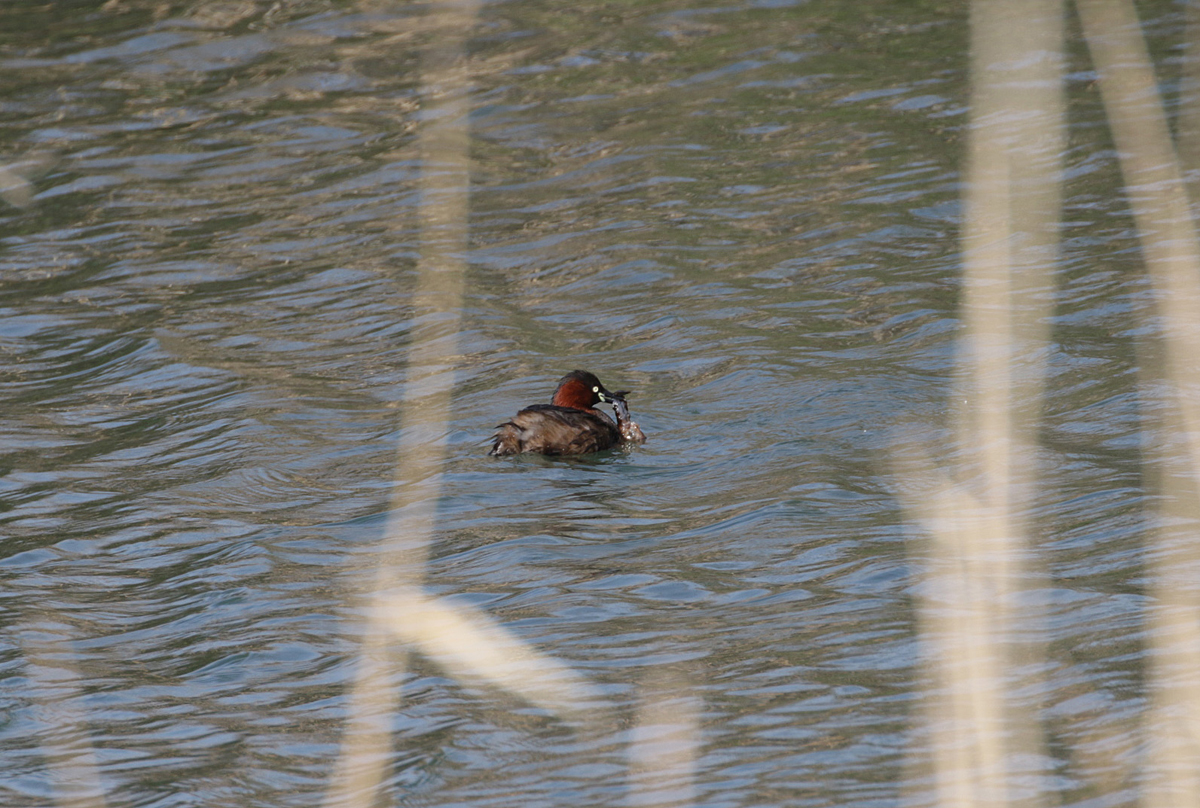
Little Grebe with shrimp. Breeding plumage accentuates the stunning white eye of poggei.


List of species recorded:-
Copper Pheasant   2 males plus 2 others heard, 1 female
Gadwall   15+
Falcated Duck   6
Eurasian Wigeon   common, though numbers greatly reduced
Mallard   30+
Eastern Spot-billed Duck   fairly common
Northern Shoveler   25-30
Eurasian Teal   c15
Common Pochard   1
Tufted Duck   c100
Little Grebe   several
Great Crested Grebe   10+
Grey Heron   several
Great White Egret   5
Little Egret   1
Great Cormorant   common
Merlin   1 male
Osprey   1
Black Kite   common
Eastern Marsh Harrier   4
Hen Harrier   1
Eastern Buzzard   1
Eastern Water Rail   1 heard
Ruddy-breasted Crake   1-2 heard
Common Coot   very common
Grey-headed Lapwing   1 heard
Long-billed Plover   1 heard
Common Gull   c10
Black-headed Gull   1
Rock Dove   c40
Oriental Turtle Dove   several
Japanese (Collared) Scops Owl   6
Common Kingfisher   1 heard
Japanese Pygmy Woodpecker   common
Great Spotted Woodpecker   1
dendrocopos sp   several heard
Japanese Woodpecker   2 plus 1 heard
Bull-headed Shrike   3
Jay   c6 heard
Carrion Crow   common on arable
Large-billed Crow   common, especially in forest
Great Tit   common, the only tit common along the lake side as well as in the mountains
Coal Tit   common
Varied Tit   fairly common
Willow Tit   common
Barn Swallow   1
Long-tailed Tit   common
Japanese (Eurasian) Skylark   several
Brown-eared Bulbul   several
Japanese Bush Warbler   many singing
Wren   2-3 plus many heard
White-cheeked Starling   common
Pale Thrush   c10 including 1 singing
Dusky Thrush   common on arable land
Daurian Redstart   1
Blue Rock Thrush   1
Eurasian Tree Sparrow   common
White Wagtail   fairly common
Japanese Wagtail   1heard
Buff-bellied Pipit   several
Brambling   2-3 heard
Oriental Greenfinch   common
Eurasian Siskin   common
Long-tailed Rosefinch   1
Eurasian Bullfinch   3 parties heard
Japanese Grosbeak   3 heard
Meadow Bunting   common
Rustic Bunting   4
Black-faced Bunting   fairly common
Reed Bunting   common


Tuesday, 15 March 2016

Northern Lake Biwa

It was minus two degrees as I drove towards the hills north of Lake Biwa, after recent warmer weather I was glad I'd re-packed my winter gear. Not only has it been a mild winter but there's been very little snow so it's possible to drive to the top of the hill I was aiming for. Usually huge mounds of snow cleared from the car park at the foot of the ski slope linger well into spring preventing easy access but this year there's a clear run to the top.


At 6am it was dead calm and the air crystal clear. To the northeast were taller snowy peaks and not far to the south Lake Biwa was gleaming in the early light. I parked and began walking along the ridge. The throb of a displaying Copper Pheasant's wings drew me forward but it was too far below on the steep fall-off from the track to see. I had more luck with a Japanese Serow that leapt off the track and paused to stare back at me until I raised my camera. Maybe the sight of something long and cylindrical being levelled at it was asking too much... maybe my much smaller white beard didn't offer much competition.


The first good bird I connected with was a cracking male Common Crossbill. I've seen flocks of them here in eruption years but a single bird during such a mild winter was a total surprise. From a different angle it might have made a great subject catching the rising sun but unfortunately it was more silhouetted against the bright blue sky from the ridge top track.


This great start to the day wasn't to be maintained. Late morning saw me down on the lake and it was immediately obvious that huge numbers of wintering wildfowl had departed in the 20 days since my last visit. All the geese had gone, duck numbers were drastically reduced with no Goosanders or Smew present. The regular Steller's Sea Eagle had returned north too but surprisingly the Tundra Swans were still present; I could pick out one of the two Whistling amongst the Bewick's.


Though most ducks had moved out the wonderful light made photographing the closer birds irresistible.


Greater Scaup.


Common Pochard.

The afternoon was definitely an anticlimax and I decided to re-locate to Mie which despite it's more southerly position still had plenty of winter birds three days earlier. The last unexpected find was two Kentish Plovers on a gravel shoal where I'd normally expect to see Long-billed Plover! What were they doing so far inland? And as I wasn't intending to hang around for harriers coming in to roost, I was pleased to get a good view of an immature Eastern Marsh along the same river as the Plovers.


I'll add a combined list of species recorded (101) with the Mie section to follow.