There are those who are so rigorously scientific in their approach to birding that the word scrupulous is almost an insult, falling so far beneath their admirable standards. These birders don't even have a cupboard let alone a skeleton stashed away. At the other extreme there those who might be labeled stringers, usually, but not always, due to a lack of care rather than scruples, and are probably also blissfully skeleton-free. Then there's me, and if we're totally honest then there's probably most of us, falling somewhere between the two ends of this large and somewhat elastic scale.
Do I have a cupboard? I do.
There have been various times over the last 50-60 years when mysterious scratchings and scrapings have led to uneasy nights. If ignored, I can attest, these will row into soft rapping and muffled thuds and eventually escalate to outright banging. Those earlier nights of unease will be as nothing to the inevitable tortured tossing amidst tangled sheets. Two birds that were once on my Japan list had to come off to preserve my sanity. It's not that I'm sure the identifications were wrong, more I'm unsure the identifications made at the time were right. I'm not referring to the ridiculous newbie stuff, the basic errors that anyone could make coming to a new country with no prior knowledge about its avifauna. Yes, I'm looking at you Black Woodpigeon in Kyoto city.
There has been another skeleton, one of a rather different sort, that has persisted for years, dare I say it... decades! How often have I nervously shuffled my feet or tried to quickly re-direct a conversation? Why do I always fail to mention a couple of birds when someone asks whether I've seen all Japan's breeding species?
Why indeed.
Just as it took me 10 years to visit Nara, a must-see destination for overseas visitors which is less than an hour away by train, I haven't, sorry hadn't, scaled anything over a handful of metres high in the Japan Alps. Just like Nara, Mt. Tateyama isn't a million miles up the road but that's just the thing, isn't it? It's the proximity that makes some things so easy to put off. As a master of deferment it's always been a case of "next year"... "well definitely next year!" You may have noticed the use of the verb 'scale' earlier, I'm going to leave that hanging.
Unlike the impalpable tomorrow, next year has finally come... it came this week in fact! Not only that but the two toe-curlingly postponed Japan ticks duly came along too. At long last I have Alpine Accentor and Rock Ptarmigan on my list. No more embarrassed shuffling of feet, no more ham-fisted attempts to steer the conversation elsewhere. And yesss, no more sleepless nights, my cupboard has been vacated.
As an utter alpine novice, I was surprised to have absolutely fabulous weather. Two completely calm, cloud free days is surely strange, isn't it? Or is it? I wouldn't know but what should have been more predictable I suppose was the number of people up there. Yet I was taken aback that every distant ridge was lined with pilgrims, each far-flung peak clustered with adherents and all the steep zig-zagging paths crawling with uniformly ascending or descending humanity depending on the time of day.
Okay, the birds. My mate wanted to get Japanese Leaf Warbler for his trip list but I told him they'd be really difficult by now as they wouldn't still be singing. No prizes for guessing what the commonest species was then, the commonest and most vocal. Japanese Leaf Warblers were singing everywhere from dawn to dusk!

Japanese Leaf Warbler: the unexpected element referred to in the title. These birds were singing everywhere but tended to remain concealed in the haimatsu except in the early morning or late evening.
If the Jp Leaf was unexpected then juvenile Daurian Redstart wasn't even on the long distance radar. We glimpsed a bird diving into cover before we'd reached our accommodation just after arriving up there on the first morning. We looked at each other both thinking but hardly daring to suggest we'd just seen a Daurian Redstart. On the 4th of August... impossible! The next day, about 150m from that sighting we had an indisputable juvenile Daurian Redstart. It seems that, unknown to me, there have been breeding records in Japan in the last few years so a juvenile at this upland location at this time of year must prove another example.


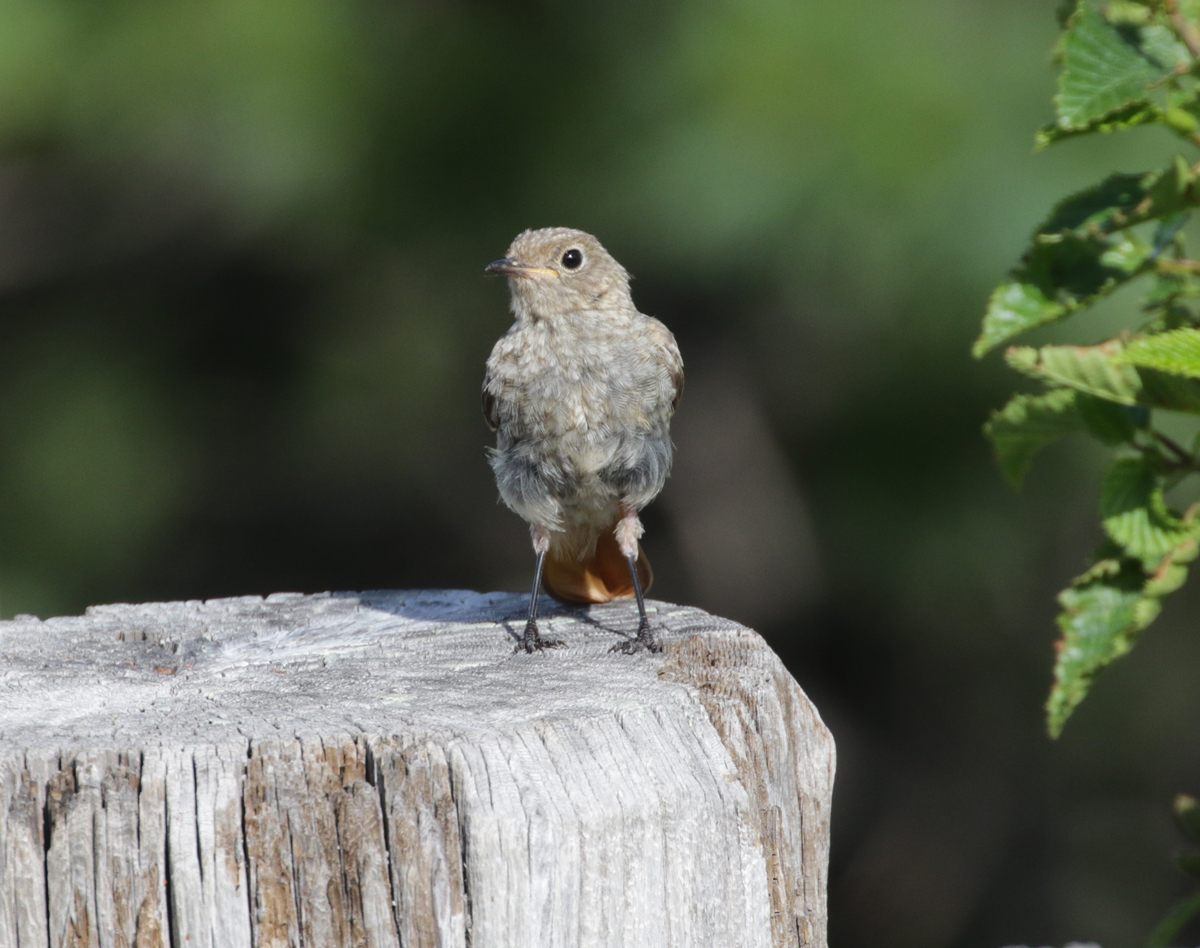
A totally unexpected juvenile Daurian Redstart. If it weren't for the two new birds I saw, this would have been the bird of the trip.
The expected birds of the title were Japanese Accentor and Nutcracker, both of which I've seen many times before though the latter is rare in Kansai.

Japanese Accentor was singing throughout areas covered by haimatsu but it wasn't always easily seen. I wonder had the weather been less calm, warm and sunny this, and the Japanese Leaf Warbler, might have been far more elusive.

Nutcrackers are such great birds and seen infrequently enough, from the Kyoto perspective, to ensure they stay that way.
So I've covered the expected and unexpected birds, now it's the hoped for. Ptarmigan was tough, the weather was too good for them I suppose. The only two (plus two chicks) we saw were on the evening of the first day and though we had surmised the following morning was going to be our best bet to connect with them, we drew a total blank then. The trip could have been oh so different had we not caught up with these birds when we did. If the Ptarmigan were difficult, the Alpine Accentor couldn't have been more obliging, I saw my first sitting on a fence post surrounded by milling tourists before I'd left the bus terminal. Compared to the Japanese Accentors, they were far more mobile but tended to be in more open situations and along with being very approachable meant they were easily seen well.


Not exactly the point blank views many people are lucky enough to get with this confiding species, but good enough for me! Truth be told everything up there was confiding, it was simply a matter of luck how close a bird happened to be.


Despite having spent a total of about five months trekking in the Nepal and Indian Himalayas, not to mention trips to the European Alps, Alpine Accentor was a lifer!