Showing posts with label Pochard Baer's. Show all posts

Sunday, 3 January 2021

Baer's and Ferruginous, plus hybrids on Lake Biwa

 Apart from the Kanto tick-fest in December, my last five birding trips have all been to Biwako - four of them, unusually, to the south end. Mie has certainly taken a back seat this winter; so far.

In the dim and distant past I made regular visits to the south end of Lake Biwa, often working my way north, layby by layby, checking the ducks for as long as daylight would allow. Over time my MO changed, instead I'd head to the north end overnight and bird my way south. The reason for the strategic shift being that a wider range of habitat at the top end would equate to better birding. That there is a wider range of habitat up there still holds true. But is the birding always better? One unintended consequence of the shift was that I largely ignore the ducks, there isn't enough time if I want to cover all that additional habitat, woodland alone knocks three hours off the day. Missing out on ducks is strange indeed since if there's one thing Lake Biwa is associated with, it's seeing vast, vast numbers of wintering ducks.

This snapped into sharp focus with the recent December visits, the first of them to help a mate see a couple of duck targets still outstanding for his 2020 year list. Our first objective was a Ferruginous Duck we knew to be present in a particular area. 

We pulled into the first parking area, kitted-up and started to scan the visible flock. One of the first birds in the scope was a Baer's Pochard! Well that was unexpected. After a 400-metre walk along the shore, the target Fudge Duck was in the bag. That's 30 minutes sifting and two rare ducks seen, one of them a global mega no less. "Ducks - one,  'wide range of habitat' - nil". As it happened there was also a Red-crested Pochard less than 1km further up the lakeside, not a bad stretch of water. We could have packed up and gone for second breakfast. 

So, I've been spending time looking at ducks recently. I've never thought of myself as much of a duck person to be honest, but the style of birding is right up my street; immobility. None of this crashing through trackless forests or stomping over mountain ranges. For me, you can't beat sitting on a cliff top sea-watching, letting the birds put in the effort, or on ferries, I'm equally happy with that, and of course relaxing on the beach sifting through gull flocks. Sitting and sifting; my kind of birding. 

A word (or two) of advice to any would-be sit-an-sifter. The cliff-tops aren't always quite as balmy as you might picture in your mind's eye, be prepared to leave the parasol and sunscreen at home. If, on the ferry, sea-spray freezes instantly on contact with your clothing, don't take your gloves off to help locate that ridiculously tiny shutter-release button on your camera because your camera will already have packed-up. Oh and don't touch the rail to steady yourself, even with gloves on. The ideal conditions for sitting on the beach are when there are no joggers, dog walkers or sundry others to disturb the gulls, you don't want to have to keep relocating to follow the flock, obviously. Unfortunately at such times 90 percent of the beach tends to be airborne somewhere between ground level and knee-height, the remaining 10 between knee and waist, so best not sit. 

Back to ducks; the success with sifting hasn't stopped with Baer's and Fudge. My first foray of 2021 netted 12 Baikal Teal on a small satellite pond, the Red-crested Pochard (which still won't even come within record shot range) and the big prize of a Baer's hybrid, as well as my second Fudge hybrid in as many weeks. The Fudge could be the same bird relocated to a different area, I can't be sure as the first sighting was against the sun so hardly ideal to see the fine details. 

It's an unfortunate situation that such a rare species as Baer's Pochard manifests such a high rate of hybrid offspring sightings, I've probably seen more Baer's x Common Pochard hybrids over the years than any other duck combination (except Eurasian x American Wigeon which wins by a country mile, they just can't keep their feathers off each other). But from the sifters' perspective it's an indisputably good find. 

As the hybrids are arguably of more interest than the real deals (we know what they look like), I'll start with the them; Baer's first.  


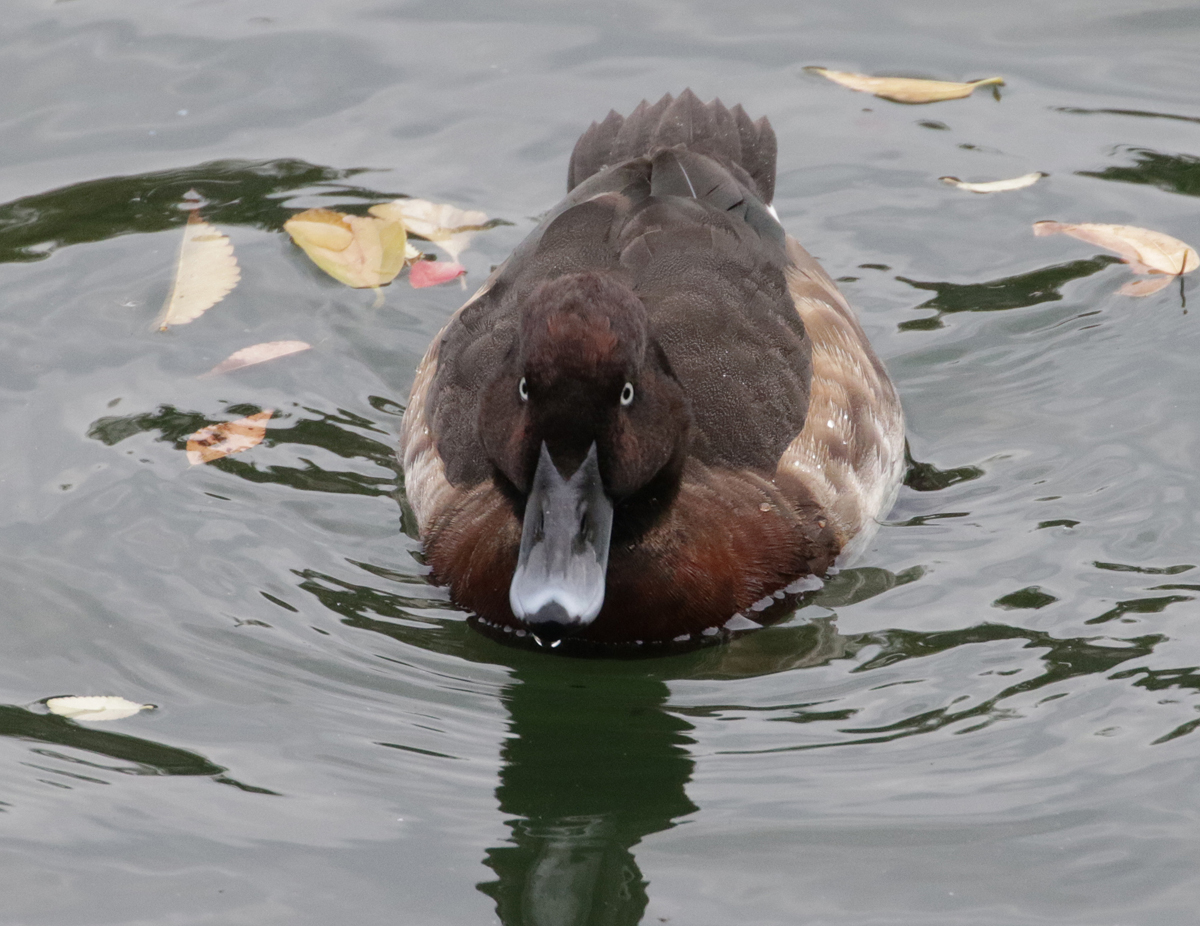
Nice it has a full green head, no doubting what one half of the progenitor pair was. I've noticed in the past that, though Baer's will be green-headed at this time of year, they can still show distinctly reddish hues into December, indicating head moult hasn't been completed at that time. So red on the head in early December isn't reason to doubt the authenticity of a bird. The Fudge hybrid, below, is no less distinctive as far as head colouration goes. Both have eyes that must be influenced by their Common Pochard side.




The Fudge tended to stay reasonably close to shore and sooner or later would have been close enough to get good shots of. The Baer's on the other hand, not unlike the Red-crested Pochard, seemed to prefer staying well out on the water. So a couple of Fudge shots and a record shot of the Baer's...


Thursday, 1 December 2016

Baer's Pochard x Ferruginous Duck... or x Common Pochard hybrid?

Earlier this week I heard there was a Baer's Pochard at Osaka Castle. Always great birds to see, I took the first opportunity to get myself down there to have a look. I didn't know where on the various sections of moat the bird was supposed to be but I didn't foresee any great problems finding a Baer's.  I entered the castle park from the south west, arriving in Osaka by Keihan train, and as luck would have it the bird was on the very first stretch of water. I at least I imagine it was; a funny thing, is luck. I can only imagine it was so close under the trees that I didn't notice it, I would also add in my defence that the very small section of moat it was on was directly into the sun and the vast majority of ducks were in the opposite direction. Well, whatever the reason, I missed it and off I went on what was probably a four or five kilometre walk around the different sections of inner and outer moats.


Eventually I arrived back where I'd started. There were about 10 Common Pochard in that quite corner, and I suddenly felt with absolute certainty that it was going to be there with them... and that it had been there all the time. And sure enough there... there it wasn't. This couldn't be the bird, could it? So I was left wondering had there been a Baer's as well as this hybrid? Had this originally been mistakenly identified as a Baer's? Had there simply been a communication mix up somewhere between the initial sighting and me getting word of it? No idea. Not that it matters too much to me, if I'd known it was a hybrid I'd have been every bit as keen to get down there and see it. I've seen two Common Pochard x Baer's hybrids but this was my first Ferruginous cross.


Having said that, after posting and looking again at the closer images there seems to be a hint of Common Pochard on the upper parts, very fine grey speckling across the scapulars. A Ferruginous hybrid wouldn't... shouldn't, have this. Also perhaps there's slightly too much red in the crown. I didn't think Baer's had quite so much white in the out primary which made me think of Ferruginous at first, plus the generally chestnut head. Also this early in the winter it's possible a Baer's wouldn't yet show much green in the head. Perhaps a month from now there'll be some areas of green alongside reddish patches on the head? Hmmm, I'm persuaded; another Baer's x Common Pochard hybrid looks more likely.


The bird came quite close to the edge of the moat and though it was three or four metres down to the water from my position I was able to get some reasonably good images.


Perhaps at first glance, and at a distance, it might suggest Baer's but even at moderate distance its cover wouldn't stand closer scrutiny.


Sunday, 15 March 2015

Baer's Pochard hybrids (old images from Osaka)

There has been a lot of discussion about hybrid Baer's recently and this is only likely to intensify as the Baer's population dwindles leading, potentially at least, to an increase in hybridisation as individuals are less able to find same taxon partners and a greater scrutiny of birds in the field as Baer's climbs birders' wish-lists.


There's no doubt that hybrids are turning up in Japan, with both Common Pochard and Ferruginous Duck. Recent debate on the Kantori mailing list has highlighted how important it is to discover how much minor variation may exist within pure Baer's (turning up in Japan and elsewhere) or to what extent a diluted gene pool is responsible for the appearance of some individuals. Obviously this question is relevant to assessing the true status of the species. The discussion has focused on birds with relatively minor plumage anomalies, which makes me wonder why I see so few images of obvious hybrids compared to slightly anomalous individuals. Particularly when the risk of mixed pairing may be on the increase. Well, one reason might be that many bird photographers here won't get as excited about obvious hybrids which won't get the same level coverage as birds which are, or are very like, Baer's. Nial Moores has written this note http://www.birdskoreablog.org/?p=14726 on the Birds Korea blog with an excellent series of images mainly provided by Pete Morris.


I've seen four different Baer's and two apparently first generation hybrids in Japan. Three of the former looked good but the fourth seemingly good bird was only seen briefly at about 100m in very windy conditions which made observation difficult, certainly too difficult to assess the minutiae. At the time I didn't give this much thought as it basically looked like a Baer's and there was no opportunity to look for any subtle signs of introgression. If we need to scrutinise each out of range individual carefully to make sure it is of classic appearance or to assess how much variation is permissible then it would seem even more important that birds within the core area are given the same level of attention. It might also be instructive pay closer attention to Ferruginous Ducks in areas of potential sympatry too.


I've only seen two obvious hybrids (presumably F1), both on the Yodogawa in Osaka, Japan. Interestingly these two birds were in close association when I first found them on 29 December 2001 then again on 11 January 2002. Even more interesting, one suggested a Ferruginous hybrid while the other was clearly a Common Pochard hybrid. Perhaps their common Baer's heritage drew them together and though both were males the implication is that hybrids from different progenitor pairings could be drawn together producing even more mysterious appearances than back-crossing. Unlikely as it may seem that hybrids would find each other on the breeding grounds these two males show there is an affinity and the possibility exists.


The birds were distant and in those days I used to hand-hold an old camcorder against the telescope to get a closer look at distant gulls and ducks. The resulting video grabs are very low quality showing neither the fine detail nor with the faithful colour rendition which would be needed to assess the birds had they not been such obvious hybrids. However these images are adequate to give a general idea of their overall appearance. So apologies for the dreadful quality but they may nevertheless be of interest.


As it isn't possible to determine the colours from these grabs I'll just add that the larger of the two had pale grey flanks and darker brownish-grey, vermiculated upper parts becoming darker and more uniform aft. The head could look Baer's green or reddish-brown depending on the angle and light and the breast dark brown. The vent was black with white restricted to the undertail coverts. The smaller bird was brown above with paler brownish flanks. The head and breast were rich brown and the vent was conspicuously white bordered with blackish-brown. Both had pale fore flanks behind the breast recalling Baer's. Both also had very pale eyes.


The first image shows both birds together with Common Pochards followed by two images of the Ferruginous-type bird and finally several of the Common Pochard hybrid which did come closer on the second occasion I saw them.


Both birds together with Common Pochards.   


Two grabs of the smaller, more Ferruginous-like of the two.


The bird looked very green-headed in the part of the video this final grab was taken from.


As a matter of interest the most recent Baer's I saw was a bird in Osaka in December 2013 which returned to the same site, at least briefly, in December 2014. When I first saw it on 1 Dec it showed a distinct brownish tinge to the cheeks but seeing it again on 21 Dec the head was wholly green.


1 Dec 2013, a distinct brownish cast on the cheeks looks anomalous and might well arouse suspicion. 


21 Dec 2013, the bird looks far more convincing with no hint of brown remaining, the head was glossy green.


21 Dec 2013.

Sunday, 22 December 2013

Baer's Pochard Osaka (again)

The hills around the city must have had their first dusting of snow this morning as I headed off gulling in Osaka, and I didn't even notice. Osaka was having a clean air day because the first inkling our first snows had arrived was seeing white caps on the usually obscured mountains of Hyogo to the west and Nara to the east.


There were very few gulls present, numbers on the Yamatogawa are always unpredictable, and the only birds of real interests were a possible Glaucous x Slaty-backed hybrid and an almost dark-eyed sub-adult Slaty-back. If there aren't gulls there isn't much chance of seeing anything apart from a few common dabbling ducks, the odd heron and White Wagtails, or if you're lucky a Peregrine coming down to bathe. If you're unlucky, the Peregrine will stick around and everything else is likely to leave. Today the non-gull highlight was a group of three Buff-bellied Pipits flying over... as if there'd even been a gull highlight.


I stopped off at Suminoe Park in the morning to have another look at the Baer's and see if the head was any greener since my last visit three weeks ago. It has sharpened up nicely, whereas last time there were brownish patches (which might have suggested this wasn't a pure Baer's) and just a hint of green gloss as the sun caught it, this time the whole head was obviously green and those areas of brown had disappeared.


If anyone's hoping for a Baer's for Christmas, I suggest you get your note up the chimney right now because Santa only seems to have one left!


Below are just a few of a huge number of shots I got before heading down to the river to freeze my bum waiting for gulls to come in.