Early in the winter the few Mongolian Gulls I see really stand out being so white-headed. Because there are so few of them and as other taxon not having acquired basic head pattern would be equally uncommon I don't feel that I overlook any birds. However by this time of year some Vegas are becoming white-headed and picking out a possible Mongolian requires far more care. Or luck. A lot of gulls are moving through this area in March and early April and I often wonder how many Mongolians I could be missing.
I was delighted to find an adult Mongolian yesterday (April 2) that really stood out from the crowd. I still don't know how many I might be missing but this one was a classic. I must just say I don't like the expression 'a classic', it seems to carry the implication that it's a representative example of the taxon whereas in terms of numbers it could be a minority appearance and it might be better to say a more readily identifiable example of the taxon... but it's easy to see why 'classic' has gained common currency!
The weather had been beautiful in the morning, calm, blue skies and the sea was a millpond. When it began to cloud over a little at midday I drove a few kilometres north to a gull spot thinking the light would be improving from a gulling perspective. By 2 o'clock the wind was too strong to handhold the camera without bracing it against my knee. It was almost too dark to get any decent shots, the sea was raging and sand and sea spray were blasting me, my bins and camera. I gave up 30 minutes later when rain threatened to throw its hat into the ring.
These are a few shots of the Mongolian and a comparison with equally white-headed Vega.
Seeing a white-headed gull at this time of year isn't a surprise but some are just whiter than white and this one screamed Mongolian as soon as I took a closer look.
A combination of subtle features instantly pointed to Mongolian and with a little patience each feature I checked served to confirm my snap judgement. Mongolian is a longish-necked gull hence it is proud-chested at rest and often looks deep-bodied too which serves to produce a small-headed appearance compared to Vega. The A-spots are also often small by comparison.
Though they can look small-headed the bill is frequently large and it's a powerful looking gull. The chest doesn't just push forwards (Vegas often does too) but it doesn't immediately curve away into the belly which enhances the deep-bodied look and gives the impression that the small head sits further back.
Head-on the head often looks narrow, laterally compressed as here.
This bird has a deep, powerful bill with a deep loral area.
Here (on the left) with a very white-headed Vega.
Mongolian.
The Vega with the cleanest head on the day.
The above Vega with another very white-headed individual.
The Mongolian taking off over what had been a calm blue sea. The wing tip pattern isn't obvious here.
Once airborne the primary pattern is more distinctive. There's only a single visible mirror (that on p9 is typically small) and the black cuts almost square across the wing.
A better angle shows black from the outer web of p7 outwards reaches the coverts (to all intents and purposes anyway) with only the p7 tongue intruding into an otherwise enlarged Kittiwake-like black tip.
The same white-headed Vega (above and below) showing the expected primary pattern; black down the leading edge but not reaching anywhere near the coverts on p7-8. The p10 mirror sometimes breaks through to the tip on Mongolian but only rarely compared to Vega, Mongolian can also have equally prominent p9 mirrors but not usually.
Mongolian underwing exposes more of the tongues so looks less eye-catching then the upperwing but it is extensively black nevertheless.
The Vega underwing for comparison.




 First bird of the morning, immature male Blue Rock Thrush. That light reflecting off the water is from harbour lights not sun, it's amazing what a decent camera and lens can achieve pre-dawn.

 Saunder's Gulls weren't being cooperative, they often cruise over the mud at the roadside but today they were way out in the middle of the river. Now that the adults have full breeding hoods they're playing harder to get. It must reflect Saunder's more southerly breeding range that all the adults (about 10) were in full breeding plumage whereas not one single Black-headed Gull (about 2000) was even close.
 When I was last here in mid-November I was surprised there were no Common Gulls but there were many today. This first winter is at the light end of the colour spectrum; some birds are hanging on to a lot of juvenile plumage, particularly on the underparts.

 Greater Scaup is prbably the most numerous bird around, there must be tens of thousands in the bay. There are usually a few in harbours.
 Gadwall are really common here too but it's difficult to get close enough to appreciate their subtle beauty. This pair was on a drainage canal but they were very nervous and flew off onto a larger body of water before I could get any closer than this.

 Chestnut-eared Buntings are quite common, far more so than around Kyoto.


 Common Reed Buntings.
 Eastern Buzzard, easy to see but another species which can be difficult to photograph well. They have clear views on boundaries.
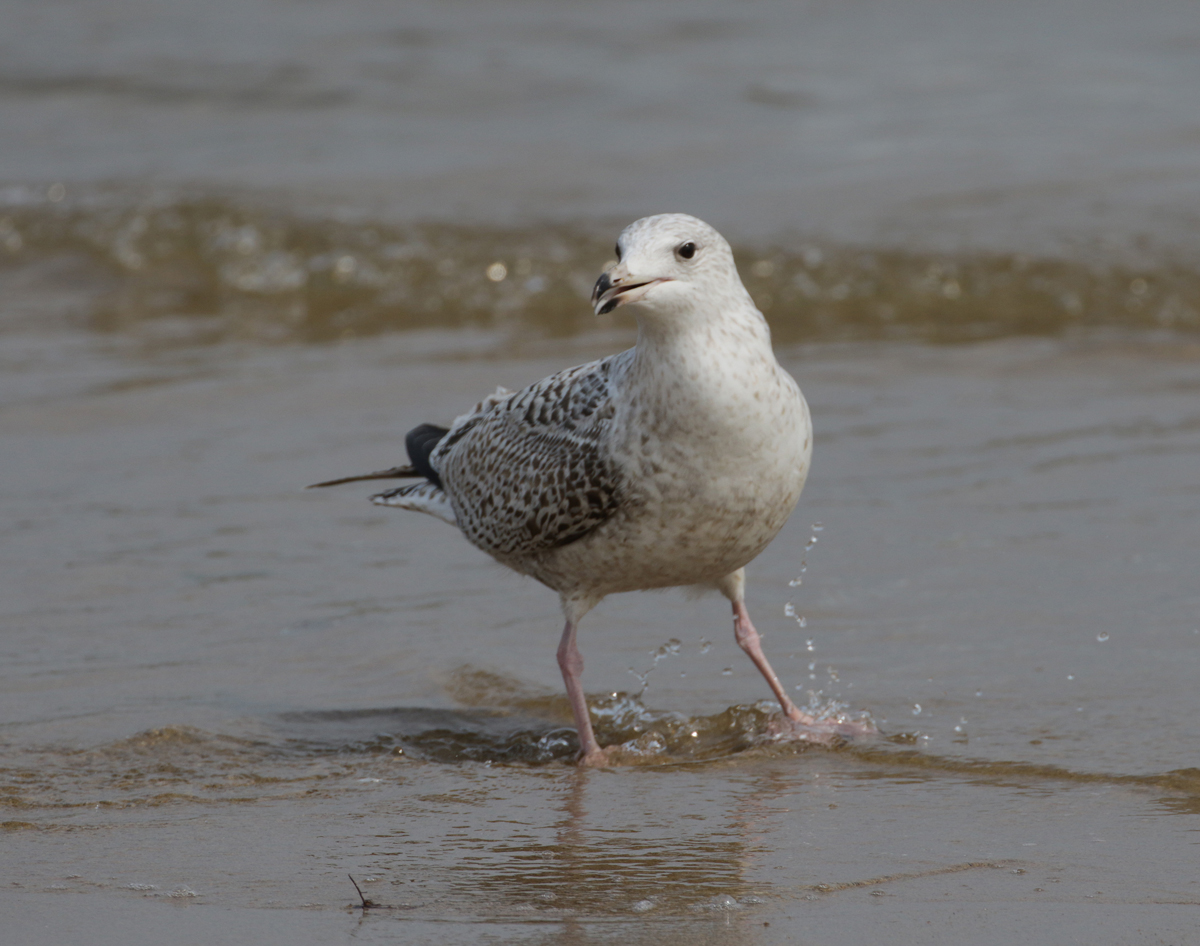
 First winter Mongolian Gull.
 This leucistic Vega has been around for several winters.


