Showing posts with label Lapwing Grey-headed. Show all posts

Wednesday, 16 May 2018

Spring mix

I heard a singing Lesser Cuckoo from my bedroom a couple of nights ago, a sure sign that local summer visitors are arriving. It isn't unusual to hear their nocturnal song flight as they circle over the city at this time of year and it's a great reminder that we're never far from birds, even the ones we don't see so often.


Another recent arrival in full voice is Oriental Reed Warbler. I photographed this one at the weekend because I wanted to catch it with some of its crown feathers raised which created the effect of distinct lateral crown stripes, something Oriental Reed doesn't share with some of the other acros in the region... not that it's ever likely to be confused with them.


A resident bird in the area that I almost never try to photograph is Oriental (Grey-capped) Greenfinch. It's so common that it can be a minor irritation at times. How often do we catch a flash of something flying through the trees when walking in woodland... all the time right? I always thing that if something perches visibly it's 99% certain to be a Brown-eared Bulbul but fortunately as it's so distinctive that there's no need to focus on it to check. Oriental Greenfinch on the other hand is rather different, it also frequently catches the eye, in a wide range of habitats, but unlike the very distinctive Bulbul which doesn't demand further attention, the Greenfinch does. Just in case. In fact it can be more than a little irritating at migration hot-spots. So finally I am posting a picture of Oriental Greenfinch, but only because it's a particularly striking male.


Next a passage bird, Grey-tailed Tattler. There are huge numbers passing through at the moment and on the Pacific coast of Japan May is the time to look for Wandering Tattler. I know there are spots in Tokyo Bay that get them every year and Aichi seems to get quite a few records too. Who knows how many turn up at unremarkable and unwatched spots elsewhere along the coast. So far I haven't found one in Ise bay, though not for lack of trying.


So that's Resident, summer visitor and passage migrant in the spring mix. As for lingering winter visitors the only thing I could categorically say is a winter at the weekend was Black-headed Gull, there are still a handful around. There were a few ducks still present, notably five Falcated, but there are always a number of Northern Pintail, Eurasian Wigeon, Tufted Duck and Greater Scaup that don't make the journey back to the breeding grounds. This was the first time I've been birding this spring when I didn't record a single Dusky Thrush which is normally the greatest winter lingerer in this area as far as passerines are concerned.


A few other birds from the weekend included the following...


Nice breeding condition bare parts on this Great White Egret. This a local modesta, the wintering alba appear to have cleared out. 


Two Grey-headed Lapwings on the beach were totally out of the blue. I never expect to see them on the beach like this, especially at this time of year.


The main reason this time of year is even more surprising than usual.


This is where I'd expect to see them.


Sunday, 20 August 2017

Nesting Little Grebes and a few bits and pieces across the fields

It's rare to see a wild bird actually lay an egg. Usually laying takes place out the sight of prying eyes, whether in a deep-cupped or domed nest, a tree cavity, high overhead in a tree or on a cliff ledge. Even ground nesters tend to select a site with surrounding cover. Grebes are some of the few birds which can sometimes have more exposed nest sites but it still takes luck to be in the right place at the right time; luck or more patience than I have.


Last week I was in the right place at the right time as my attention was caught by a pair of trilling Little Grebes swimming quickly in my direction towards some sparse reeds. To my surprise one of them leapt out of the water onto a nondescript soggy patch of waterlogged vegetation and promptly laid an egg. This female then slipped off, dived and I didn't see her again while the male floated around occasionally slapping more gloopy material to the morass. Just before I left the male climbed onto the platform and began fanning the egg with rapid wingbeats, presumably because of the midday heat though I'd have thought that it was sitting in a puddle would have been doing the job just fine.


The weight of the female was enough to tilt the platform causing water to spill across. The male on the right is bringing more material to add to the 'structure'.


The male remained in attendance during the 10-15 minutes I was present.


About 30 seconds of rapid wingbeats was presumably to cool the egg.


And even a little backward fanning.


Little Grebes may build a number of trial platforms before selecting one for the nest but it seems this pair may have been a tad behind on the construction front.


When I returned three days later the premature excuse for a nest, and its egg, was abandoned and in even worse condition than it had been. However after a few minutes I spotted another platform, actually worthy of the name nest, containing two eggs.


The three-day-old egg slowly sinking into the fly-covered mess.


And this is how it should be done.


Egrets were definitely on the move, both Eastern Cattle and Intermediate have reappeared across the fields and were taking advantage of widespread grass cutting around the berms. Another migrant coming through now is Pacific Golden Plover but they can be far more difficult to find as suitable fields are far fewer. However there were pretty good numbers last week, I saw even more of them than the ever present Grey-headed Lapwing. The most unexpected sighting in the rice fields was a Ruddy-breasted Crake. On the rare occasions I see them, or more often hear them, they're in more marshy areas with reeds and pools. This individual crossed the narrow farm road in front of me but despite it being fairly close I could only manage a poor quality shot through the windscreen.


A luck shot through the windscreen of a Ruddy-breasted Crake just before it disappeared into the rice crop.


In contrast to the Crake, Eastern cattle and Intermediate Egrets are conspicuous throughout the area.


Pacific Goldies were in reasonably good numbers last week, I found small parties on several fields.


Grey-headed Lapwings are a fixture here but I never tire of seeing them.


Thursday, 21 April 2016

A few spring migrants

I arrived in Mie yesterday hopeful of seeing a wide variety of waders; that didn't happen. In part because I spent hours trying to get good views of a couple of snipe, one clearly Swinhoe's but the other less easy to separate from the much less common Pin-tailed, but mainly because there doesn't seem to have been a massive change since my last visit 10 days ago. A few Wood Sandpipers and Whimbrel are the only signs on new arrivals apart from the migrant Swinhoe's Snipe. However the Spotted Redshanks and Long-billed Dowitchers are looking much closer to breeding plumage now.


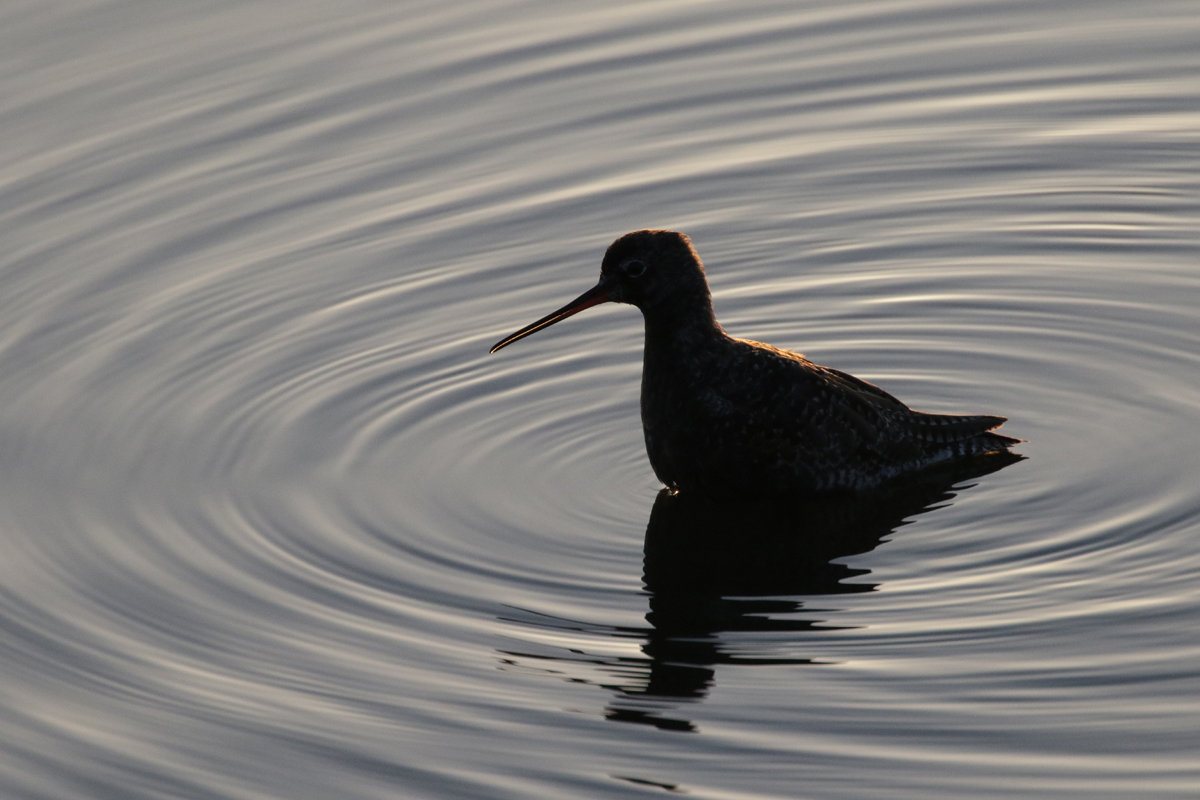
First up was a Spotted Redshank backlit by the first morning sun.


Two of seven Common Greenshank.


Long-billed Dowitcher with Wood Sandpipers.


The Long-billed Dowitcher relocating to a quieter pile of rocks away from the Wood Sandpipers.


Jousting Wood Sandpipers.

Elsewhere it was business as usual with the Wood Sands.


Spotted Redshanks with Long-billed Dowitchers and Black-winged Stilts.


Very few Sanderling were coming into breeding plumage, this was the most advanced I saw.


Grey-headed Lapwing.


List of species recorded:-

Green Pheasant   4 plus several heard Gadwall   100+
Falacted Duck   17  
Eurasian Wigeon   low 1000s
Mallard   10s
Eastern Spot-billed Duck   fairly common
Northern Shoveler   c60
Northern Pintail   c40
Eurasian Teal   100s
Common Pochard   40-50
Tufted Duck   c200
Greater Scaup   1000+
Red-breasted Merganser   c20
Little Grebe   common
Great Crested Grebe   5
Black-necked Grebe   7
Black-crowned Night Heron   1 heard
Cattle Egret   1
Grey Heron   common
Great White Egret   common, numbers clearly up
Little Egret   c20
Great Cormorant   common
Peregrine   1
Osprey   2
Black Kite   2-3
Ruddy-breasted Crake   1 heard
Common Moorhen   1
Common Coot   c40
Eurasian Oystercatcher   49
Black-winged Stilt   4
Grey-headed Lapwing   c10
Grey Plover   c40
Little Ringed Plover   3-4 plus several heard
Swinhoe's Snipe   2
Common Snipe   8
Long-billed Dowitcher   3
Bar-tailed Godwit   c15
Whimbrel   3
Far Eastern Curlew   2
Far Eastern or Eurasian Curlew   1
Common Greenshank   7
Spotted Redshank   7
Wood Sandpiper   8
Sanderling   60+
Dunlin   100s
Black-tailed Gull   1
Common Gull   4
Vega Gull   c40
Taimyr Gull   6-7  
Black-headed Gull   c400
Rock Dove   c8
Oriental Turtle Dove   several
Japanese Pygmy Woodpecker   1 heard on drive to Ishikawa
Bull-headed Shrike   5
Jay   1 on the drive
Carrion Crow   common
Large-billed Crow   a few
Varied Tit   several heard on drive
Long-tailed Tit   several heard on drive
Barn Swallow   only a few passing through
Japanese (Eurasian) Skylark   common
Zitting Cisticola   3 plus 4-5 heard
Japanese Bush Warbler   2-3 heard on drive
Oriental Reed Warbler   2 heard
Japanese White-eye   several on the drive
Wren   1 heard on the drive
Chestnut-cheeked Starling   1
White-cheeked Starling   widespread in low numbers
Dusky Thrush   still common
Blue Rock Thrush   1
Brown Dipper   1 on the drive
Eurasian Tree Sparrow   common
Grey Wagtail   2 on the drive
White Wagtail   c6
Japanese Wagtail   1 on the drive
Oriental Greenfinch   fairly common
Japanese Grosbeak   1 on the drive
Meadow Bunting   several
Chestnut-eard Bunting   several
Common Reed Bunting   4

On the way there:-
racoon dog   1
Sika Deer   2


Tuesday, 10 December 2013

... to pluvialis

There are so few tidal flats remaining in the region looking for waders isn't a casual business. On the Pacific side, just fragments are left of what must once have been extensive habitat in Osaka and Hyogo, though Mie is slightly better off in that respect. I can't really speak for the Japan Sea side as I've never been there looking for waders but I don't think it's much better. The region isn't only about coastal areas though. Waders fall into two groups, those that occur widely across wet inland fields and more strictly coastal species occurring at few remaining suitable locations. The big problem with inland passage is finding suitable fields at the right time, a good location one year probably won't be the next. Finding waders is often just a matter of stumbling across good fields. Though small, insignificant looking spots can be remarkably productive.

Arguably, the best sites in the Osaka area are reclamation areas. Unfortunately access is a problem and the one that we could enter (Sundays only) no longer has the habitat to attract birds. This leaves Nanko Bird Sanctuary in Osaka and Koshienhama in Amagasaki (Hyogo). Both of these areas can be very good. With a car Mie is the place to try, it has a number of good estuaries, tidal flats and with luck flooded fields.

Mie is the only location to find Oystercatchers in Kansai, wintering birds can be found from Tsu city southwards along beaches or on estuaries to neighbouring Matsusaka city a few kilometres away. They arrive in August and are still present in May, so for a winter visitor they're around a long time. They may need a bit of driving round to find.

1 April, 2008.

10 April 2014.

Black-winged Stilt is a fairly common passage bird, usually found on ponds or paddy fields. They are quite widespread inland as well as at coastal sites. Finding them at Ogura depends on whether there are suitable fields at the right time, unfortunately fields usually aren't flooded in spring until after birds have moved through (unlike in Mie) so Nanko Bird Sanctuary in Osaka or the Tsu/Matsusaka area in Mie are best.

Male on Yonaguni, April 2013.

White-headed male with juvenile Mie, September 2013.

Female Yonaguni, April 2013.

Juvenile Mie, September 2013.

Pied Avocet is fairly a rare winter visitor to Japan and I've specialised in just missing them, two or three in Mie, another in Shimane and also in Kyushu. They can turn up anywhere but apparently always somewhere I'm not.

Northern Lapwing is another winter visitor but fortunately for me a reasonably common one, fortunately because this is probably my favourite wader. What a great looking bird. Groups can be found throughout Kansai on arable land whether expansive as in Shiga or more limited areas such as Ogura.

The Mandarin Duck of waders, what a stunner.

Birds near Lake Biwa, it would be unusual not to find at least a few in a day birding in suitable habitat.

For many birders visiting Kansai, Grey-headed Lapwing will be a greater priority and this is one of very few species which are far easier to see here than elsewhere in Japan. They are a common breeder on paddyfields and occur in some tiny scraps even in urban areas. They're almost impossible to miss even from the train and I often see non-breeding gatherings on factory roofs or car parks. It doesn't get much stranger than seeing birds in pachinko parlour car parks.

Along the Katsura River in the Kyoto suburbs.

Moulting adults and first winter birds can look very plain though not often as drab as this. December 2012, near the Uji River, Kyoto.

The striking wing pattern normally so eye-catching becomes interestingly inconspicuous in winter. This bird near northern Lake Biwa.

Pacific Golden Plover can turn up anywhere on wet or dry fields on passage, it isn't uncommon but you often need luck to connect with them. This is even more true in winter as there are very few birds remaining this far north.

Newly arrived spring migrants on Mishima (Yamaguchi), May 2010.

Breeding plumage at dawn.

Post-breeding August 2014, Mie.

Grey Plovers are coastal and are fairly easy to find in Mie and it can also often be found at Nanko Bird Sanctuary in Osaka. No doubt they will be equally easy to find in suitable habitat on the Japan Sea coast but the Mie area is more convenient to cover from a Kyoto/Osaka base.

Grey Plover Tsu city, Mie. April 2014.

Mie, August 2014.

Different degrees of moult August 2011, Mie.