Showing posts with label Bulbul Chinese. Show all posts

Monday, 8 June 2020

The rarest bird of the Tsushima trip?

There aren't too many records of Light-vented Bulbul north of Okinawa, though perhaps more records can be expected as the race sinensis expands its range northward on the continent.


This bird suddenly popped up on a post in a tiny garden right in front of us as we were dropping steeply down off the river embankment. It perched on a post only long enough to get this shot before taking flight and rather than make the expected move to the next bush/shed roof/post, or whatever, it kept on going across the gardens, over the paddies and out of sight towards the wooded hills bordering Sago Valley. Lucky timing I suppose.


Note the tail, or near lack thereof. I don't view this as a sign of captive origin because the bird is otherwise in excellent condition and it's likely a lucky escape from a predator rather than a cage. Perhaps that's why it was so keen to move on.


Another contender might be Tundra Bean Goose, May is getting seriously late for them, but it isn't exactly a rarity.


This bird came as a surprise. We first (and often) saw it by the rivermouth but it frequently visited the nearby paddies.


Brown Shrike is hardly unexpected either so I was a little surprised to only get this one individual.


Brown Shrike


One other contender was Tree Pipit, really the only serious contenter other than the Bulbul in fact. Unfortunately I didn't see it... even though it was probably more difficult to miss it than see it! Apparently it was flying round in circles just over my head before dropping into the rough grass near the cliff edge a few metres behind me. I was looking something else at the time, don't remember what, but it was assumed I was looking at the bird. Aren't pipits supposed to call when they're flying overhead?


Monday, 29 April 2019

A few Yaeyama natives

I've already mentioned in a previous post that Iriomote offers a more enjoyable away-from-it-all experience than Ishigaki, the only downside being there aren't any convenience stores providing round the clock coffee. And on the bird front, breeding Black-shouldered Kites are the only birds that can't be found on Iriomote. 


There doesn't seem to be any competition between the Kites and the abundant local Large-billed Crows, they seem to ignore each other, but on this occasion a Crow trying to share a favourite tree of this Kite was pushing the envelope a little too far.


Ruddy Kingfishers of the race bangsi are more numerous and easier to see than the migratory major we get further north. Catching up with Ruddy Kingfisher in Honshu usually means a trip to well established forest but in Yaeyama the can be found in village gardens and relatively insubstantial belts of trees. Typically most vocal activity is at dawn (in particular) and dusk but bangsi does sing throughout even sunny days which I wouldn't expect of major.


To my ear bangsi sounds obviously different to major, akin to a distinct regional dialect. Major gives an explosive but harmonious descending trill, a single entity, whereas the song of bangsi is three or four rapid, descending individual notes, the last of which reverberates.


It came as a surprise then, while watching the Kites, that a very obvious major-type song chimed in with two bangsi that were singing from the dense scrub and low trees beside the airport. I can only suppose this was a northward bound migrant major. If bangsi can also sing in this way, it's the first time I've heard it.


Though Yonaguni is more important as place to see rare migrants than Yaeyama/Ryukyu endemics I do always find it easier to see Barred Buttonquail here than anywhere else in it's range. Just lucky, or are they more numerous here?


A female Barred Buttonquail crossing the road. Chance encounters are reasonably frequent on Yonaguni but I've never seen the species elsewhere despite patiently staring down row after row in cane fields.


The other bird of interest is the nagamichii race of Brown-eared Bulbul which has a toehold in Japan here.


What were these two birds up to? I might have thought anting if they were on the ground, it was very overcast but not raining so not bathing. Perhaps they'd been watching a documentary on birds of paradise?


Quite an attractive bird.


The other bulbul and Zitting Cisticola are probably the two most common birds on the island apart from ubiquitous Brown-eared.


Zitting Cisticola


Chinese Bulbul


Purple Herons are common of Ishigaki and Iriomote but this was my first on Yonaguni, I came across it in the afternoon and it was gone next day.


Purple Heron


I saw three Emerald Doves on Yonaguni this trip and got this photo tick. Previously I've only ever seen one on Iriomote and, as with this trip, heard them on Ishigaki. I managed to creep up on this bird but unfortunately it was about 08:30, less somnambulant hour, and one of that particular road's 4-5 cars per hour came past and flushed it.


Wednesday, 25 December 2013

larks to bulbuls


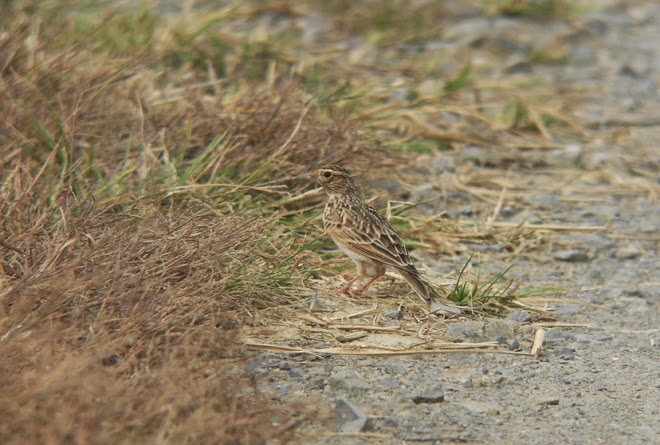
Japanese (Eurasian) Skylark Alauda (arvensis) japonicus is a common breeder and winter visitor in Kansai and it's the only lark likely to be seen here. From late autumn onwards Skylark numbers build in open country, the weather playing a big part in how many may winter in the region. These birds aside, I've seen one Shore Lark in Mie and I heard of a party of a short-toed lark sp close to Ogura.

Greater Short-toed Lark on Mishima, Yamaguchi, 3 May 2009. This species is reasonably regular, though not annual, on the island in spring. 

Adult japonicus feeding juvenile along the Yodo River in Osaka, April 2007. I don't often get to see the short-lived juvenile plumage.

Ogura, Kyoto city, 22 October 2010.

A worn bird in Mie, 7 January 2012.

One of a party of fresh plumaged birds on Hegurajima, 12 October 2011. This bird stood out because of broader paler fringes producing a much frostier than usual appearance and in keeping with the overall paleness the breast was only very lightly buffish. Nevertheless it looked otherwise identical to the other birds. 

The taxonomic status of japonicus is unclear and birds I see are quite variable in plumage terms. The only lark I've seen well which really stood out as something different was a bird on Hegurajima. Even at a glance it was eye-catching, larger and heavier, as it flew over with 4-5 other larks. Fortunately  they came down onto the short grass in the harbour where it lost nothing of its larger, bulky appearance. I didn't have a camera in those days and a few digiscoped images below are all I could get of it. Later some Japanese birders came along and called it O hibari, so they recognised it as a continental taxon. The images below don't convey how outstanding it was in the field.

Apart from being a stronger looking bird it differed slightly in plumage but I'm wary of relying on plumage features alone. Though the breast sides were more heavily marked than usual, flank streaks were more prominent and the lesser coverts were greyer.
As well as overall size the bill was longer and more powerful and the primary extension was longer with different spacing.

Powerful bill, heavy breast and flank streaking.

Long primary extension with p3 clearly beyond p4, and the visible length of p4 more than half that of p5. Compare with the  japonicus below, in my experience they show a less conspicuous p3 tip and the exposed length of p4 is half or less that of p5, irrespective of age/wear.  
 
 
The different angles and stance nothwithstanding the japonicus (left) looks smaller and slighter of build.

Shore Lark on Hegurajima, 14 October 2011.

Zitting Cisticola is fairly common year round in the Kyoto area. They are less conspicuous in winter but they will display on calm sunny days. They are frequent in riparian grassland and overgrown fallow fields, walking through will often flush one.

A brightly marked bird in an overgrown fallow field at Ogura, 8 January 2011.

By contrast to the previous fresh bird, this is a very worn, dark individual on Okinawa, 3 August 2011.

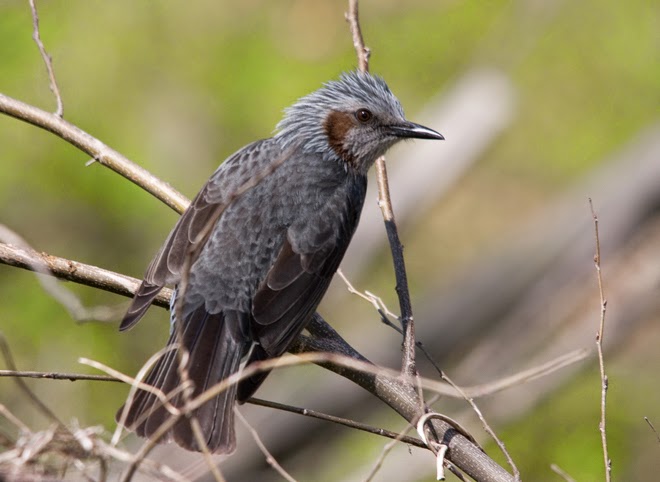
Brown-eared Bulbul is extremely common in Kansai, from hill forests to city parks, it's impossible to miss. Even if sometimes you wish you could.

Not something you'll see in Kansai, this Chinese Bulbul was on Yonaguni, 5 April 2013.

Brown-eared Bulbul Hirakata, Osaka 21 March 2014.

A typical Brown-eared Bulbul in the botanical gardens Kyoto, 3 February 2013. Quite drab at first glance but they're actually quite attractive in an understated way.

Ogasawara race squamiceps.

A couple of presumed stejnegeri on Iriomote, 2 April 2013.