Showing posts with label Lark Greater Short-toed. Show all posts

Saturday, 23 April 2016

Hegurajima: April 22 day trip

After spending a day and a half in Mie I made my way slowly to Ishikawa. The weather was dreadful, heavy rain throughout and a diversion due to a bad traffic accident didn't help. Of course I didn't mind in the slightest what the conditions were like on a relocation day and all that rain followed by forecast patchy fog over the sea the following morning had me rubbing my hands at the thought of all the migrants that might have made landfall on Hegurajima.


I picked up a few birds on the way, Brown Dipper was the only one I was unlikely to see elsewhere. I was curious what kind of bird list I could build driving round compared to my usual week spent on an off-shore island at this time of year. I was confident I could do better with numbers but could I get the quality?


The ferry to the island is usually an anticlimax, I rarely see much on this route, however there were a few things this time. An Arctic Skua was a first for me on this stretch of water, though I did once have a South Polar. Two groups of presumed Japanese Murrelets I saw turned out to be Ancient when I looked more closely. Two very distant parties of waders flying in close proximity, birds in one group slightly larger, were probably Red-necked and Grey Phalarope as both parties settled on the sea. Streaked Shearwaters were as common as ever.


Morphing murrelets; these expected Japanese turned out to be Ancient.
 

One of the second group of four which was closer.


A Streaked Shearwater letting its inner Colonectris really shine through; it could almost be a Cory's.


Approaching the island Pelagic Cormorant became common, I only saw one Temminck's out there.


Once on the island it didn't take long to see there were plenty of birds around. There were two or three Daurian Redstarts in the harbour, it's about three weeks since I saw my last around Kyoto, and Bramblings were everywhere, some looking very smart now. They've already disappeared from my usual haunts too. On the incoming side of the balance, Stejneger's Stonechats were very common on the island. Surprisingly I hadn't seen any prior to these this spring, they're usually one of the earlier passage birds on a broad front through my region.


A smart looking Brambling.


Stejneger's Stonechat was possibly the commonest migrant on the island, certainly the most conspicuous.
It didn't take long to find the first non-common bird, well Hoopoe is hardly rare, on the lawn behind the doc's. I bumped into it again later and heard it several times on my for-hour dash to cover as much of the island as practical before the ferry went back. In fact I hardly scratched the surface.


Hoopoe isn't a big rarity but they're always nice to see.
From there I quickly had a look at the coast and found a Swinhoe's Snipe on the grassy path to one of the headland shrines, then into the woodland where I flushed a Woodcock. There were plenty of Great and Coal Tits about, the odd Eastern Crowned Warbler, a Goldcrest and three or four Japanese Robins, heard only of course. A Long-tailed Rosefinch was a surprise, I've seen far more Common Rosefinch on islands in this season over the years.


No mega then; time to move on. Just as I was coming out of the trees I noticed a Japanese Sparrowhawk mobbing a Goshawk, or so it seemed at first glance judging by size but when I got the bins on them I was surprised to see a Northern Sparrowhawk mobbing a smallish harrier. Was this going to be the mega?! No, a Hen. I should have guessed, why do I get so excited over every bird? Because it's Hegura I suppose, it could have been a Pallid...


A mega approaches?


It's almost as if it sees me watching so closes its fingers to keep me guessing.


I wasn't fooled for a moment.

Next stop the harbour edge, it always holds something of interest. On the way I noticed there were no photographers at the hide, platform I should say, overlooking a shallow pool constructed to attract whatever is lurking in the undergrowth. It's funny really, two other people had taken the same ferry out in the morning and I only saw two others on the island. Great season, great weather, loads of birds and the place is all but deserted. Yet in a week, the Golden Week holiday, I bet the place will be packed to the gills. It's so difficult to book accommodation then which is fair enough with so many birders having inflexible work schedules but a good few of the visitors are retired. Why aren't they there now? The birding is fantastic and I very much doubt the Japanese national holiday will loom large in the birds' migration strategy. But as I was saying, the observation platform, I'm glad I stopped to take a peek. There was nothing rare but there were tons of birds flitting around, the best for me was an Asian Stubtail. Stubtails were singing all over the place, they're a common summer visitor around Kyoto, but they aren't the easiest thing to photograph.


Asian Stubtail: a photo tick.


One of 12 Blue and White Flycatchers I saw on the island (nine were males).


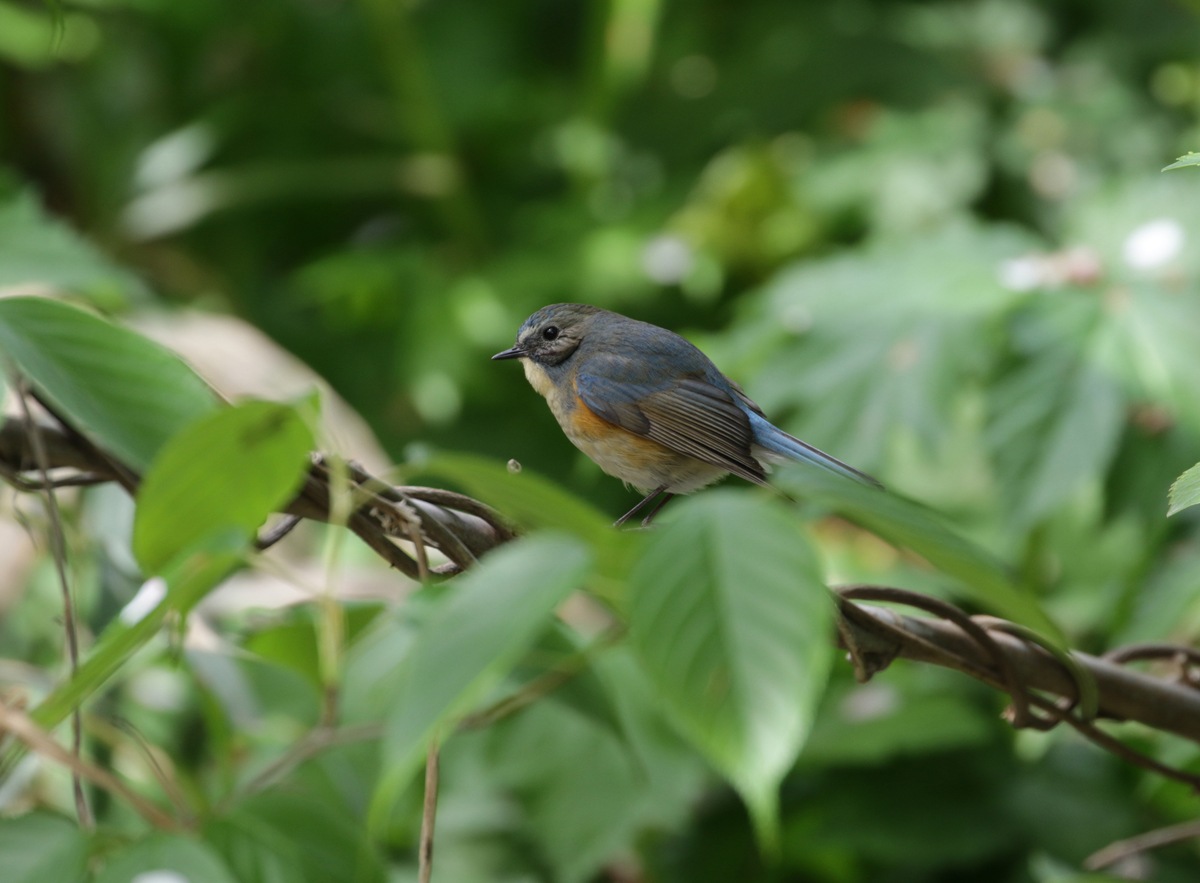
Red-flanked Bluetail.


Presumably a 2CY by the look of it.

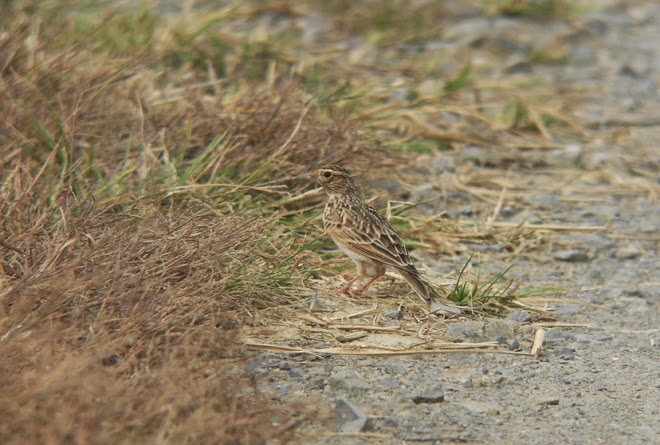
I finally got down to the harbour area where the highlight was a party of three Greater Short-toed Larks. I see this species every spring, but three, I've never seen a flock of them before!


Red-throated Pipit with Greater Short-toed Lark.


A "flock" of Greater Short-toed Larks.


Then it was ferry back, a bite to eat behind the wheel and check out some fields further up the coast for waders to make use of the remaining day light. This wader checking idea was on the strength of having heard a Greenshank's chu-chu-chu behind Wajima that morning but apart from a snipe (I suspected Latham's) that crept off through the grass and into thicker cover before I could get down to the serious business of identification there was nothing.


So the wader idea was a bust but it had been an enjoyable day. In terms of quality I'd come up with a few species I don't see very often and in the numbers game, after 2.5 days in the field, I was on 123. This was definitely better than being based on an off-shore island. One more day to go.


List of species recorded today:-
Green Pheasant   2 plus 2 heard
Eurasian Wigeon   2 NP (Noto Peninsular)
Eastern Spot-billed Duck   7 NP
Eurasian Teal   c40 NP
Streaked Shearwater   100s
Little Grebe   1 NP
Grey Heron   3-4
Great White Egret   5 plus 7 NP
Little Egret   1 plus 4 NP
Great Cormorant   2 Wajima harbour
Temminck's Cormorant   1
Pelagic Cormorant   c50
Osprey   1 NP
Black Kite   2
Hen Harrier   1
Northern Sparrowhawk   1
Woodcock   1
Swinhoe's Snipe   1
snipe sp   1 NP
Common Greenshank   1 Wajima
phalarope sp   two small flocks seemed to be one of Red-necked, the other Grey
Black-tailed Gull   common, c1000 on flooded fields NP
Vega Gull   5
Slaty-backed Gull   1
Arctic Skua   1
Ancient Murrelet   8
racing pigeon   1 the pigeons on Hegura are always kitted out in racing legwear
Rock Dove   several NP
Oriental Turtle Dove   several
Common Kingfisher   1 NP
Hoopoe   1
Bull-headed Shrike   1 heard NP
Carrion Crow   c50 NP
Large-billed Crow   1
Great Tit   several
Coal Tit   several
Barn Swallow   3-4, several NP
Asian House Martin   c20 NP
Greater Short-toed Lark   3
Brown-eared Bulbul   fairly common NP
Asian Stubtail   2 plus many heard
Japanese Bush Warbler   common
Arctic Warbler complex   1
Eastern Crowned Warbler   c10
Japanese White-eye   common
Goldcrest   1
Chestnut-cheeked Starling   3 NP
White-cheeked Starling   1
White's Thrush   1
Japanese Thrush   1 plus 1 heard
Eyebrowed Thrush   1
Pale Thrush   common
Dusky Thrush   common
Japanese Robin   5 heard
Red-flanked Bluetail   1
Daurian Redstart   8
Stejneger's Stonechat   common
Blue Rock Thrush   1
Dark-sided Flycatcher   1
Asian Brown Flycatcher   1
Narcissus Flycatcher   1
Blue and White Flycatcher   12
Eurasian Tree Sparrow   several NP
Grey Wagtail   1 plus 2 NP
White Wagtail   several
Japanese Wagtail   several NP including a juvenile
Olive-backed Pipit   2
Red-throated Pipit   2
Buff-bellied Pipit   1 plus c10 NP
Brambling   30+
Oriental Greenfinch   common
Eurasian Siskin   1
Long-tailed Rosefinch   1
Hawfinch   1
Meadow Bunting   sev NP
Elegant Bunting   1
Japanese Yellow Bunting   1
Black-faced Bunting   common plus 1 spodocephala and 1 possible sordida (this isn't on the Japan list according to the most recent OSJ list, more of this later)



Thursday, 30 April 2015

Mishima: bad weather, good birds!

The sky was very overcast when I woke this morning but it didn't look like there'd been any of the forecast rain. No sooner had I got outside than it started. There was drizzle and heavier showers throughout the day with the sun just starting to show as it was setting.

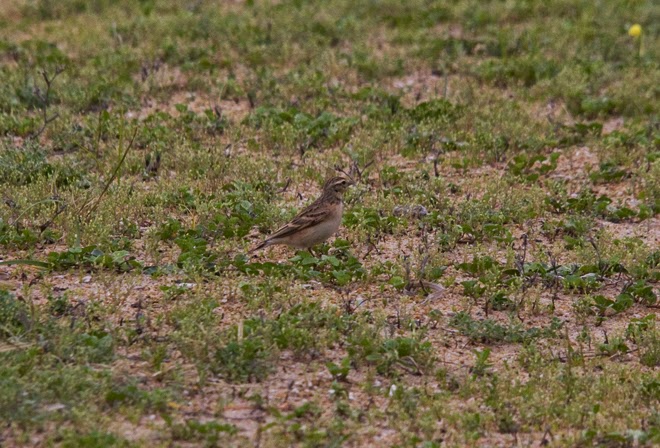
My camera stayed in the bag most of the day but it was bright enough for the bird of the day, a Greater Short-toed Lark I found at about 4:30. Unfortunately it was quite nervous, unlike the White Wagtails it was with (also new in) and these shots were the best I could muster. At least it's identifiable.


Downtown Utu witht the ferry arriving. The Lark was on the strtch of short grass behind the beach.

The day started slowly but by late morning things began to pick up, birds were obviously arriving. The thrushes were the first indicator and by day's end I'd added Siberian, Grey-backed (the other star bird of the day), Brown-headed (very common) and Pale to the trip list.


This pair of Ospreys, the smaller male with a fish, were the only birds I got a shot of in the morning before the rain began and the helicopter was leaving the radar station on top of the highest hill. I was once trying to digiscope a Wryneck through the fence of the small hilltop base and before long a military vehicle arrived and I wasn't surprised they told me I could stand there with my scope and camera peering through the fence... I'd have to stand on the other side of the road! So I moved four metres back and they were quite satisfied with that, bizarre.


The Short-toed Lark and Grey-backed Thrush may have been the best birds of the day, but they weren't the high point. That came in early afternoon with an amazing congregation of birds, or flocks of birds. Along a 50 metre stretch I estimated there were about 30 singing Eastern Crowned warblers, a few Sakhalin Warblers, 23 Ashy Minivets, 150 Bramblings, 20 Siskin, a lone Japanese Grosbeak, a huge number of White-eyes, three Blue and White Flycatchers, uncountable Narcissus Flycatchers
and a Lesser Cuckoo. They weren't passing through in waves, the finches were sitting about being finchy and the rest were dashing madly around without going anywhere. Only the Cuckoo didn't hang about. There wasn't much point in using the binoculars to go through them all, it was really a stand in awe moment. The Minivets below were part of a different flock.


Yesterday Sakhalin Leaf Warblers had been far more common than Eastern Crowned. Of course Eastern Crowned are usually silent unless singing whereas Sakhalins call frequently which can skew perception of numbers, two of the three I recorded yesterday were singing birds, it's no exaggeration to say there were hundreds singing today.

After leaving the Lark by the beach in Utu village I bumped into another good bird, a great bird, and the sun was just coming out to try to do it justice. A wonderful Broad-billed Roller. I can't bring myself to say Dollarbird, it sounds too cheap for such a cracking bird. As a kid European Rollers and Hoopoe were the two most exotic birds I'd dream of seeing.


We'll probably be getting clear skies again tonight and tomorrow so I can only hope there are still some good birds that arrived today waiting to be found. Though as I was writing that I heard a Pacific Golden Plover flying over, we're due a few waders.

Wednesday, 25 December 2013

larks to bulbuls


Japanese (Eurasian) Skylark Alauda (arvensis) japonicus is a common breeder and winter visitor in Kansai and it's the only lark likely to be seen here. From late autumn onwards Skylark numbers build in open country, the weather playing a big part in how many may winter in the region. These birds aside, I've seen one Shore Lark in Mie and I heard of a party of a short-toed lark sp close to Ogura.

Greater Short-toed Lark on Mishima, Yamaguchi, 3 May 2009. This species is reasonably regular, though not annual, on the island in spring. 

Adult japonicus feeding juvenile along the Yodo River in Osaka, April 2007. I don't often get to see the short-lived juvenile plumage.

Ogura, Kyoto city, 22 October 2010.

A worn bird in Mie, 7 January 2012.

One of a party of fresh plumaged birds on Hegurajima, 12 October 2011. This bird stood out because of broader paler fringes producing a much frostier than usual appearance and in keeping with the overall paleness the breast was only very lightly buffish. Nevertheless it looked otherwise identical to the other birds. 

The taxonomic status of japonicus is unclear and birds I see are quite variable in plumage terms. The only lark I've seen well which really stood out as something different was a bird on Hegurajima. Even at a glance it was eye-catching, larger and heavier, as it flew over with 4-5 other larks. Fortunately  they came down onto the short grass in the harbour where it lost nothing of its larger, bulky appearance. I didn't have a camera in those days and a few digiscoped images below are all I could get of it. Later some Japanese birders came along and called it O hibari, so they recognised it as a continental taxon. The images below don't convey how outstanding it was in the field.

Apart from being a stronger looking bird it differed slightly in plumage but I'm wary of relying on plumage features alone. Though the breast sides were more heavily marked than usual, flank streaks were more prominent and the lesser coverts were greyer.
As well as overall size the bill was longer and more powerful and the primary extension was longer with different spacing.

Powerful bill, heavy breast and flank streaking.

Long primary extension with p3 clearly beyond p4, and the visible length of p4 more than half that of p5. Compare with the  japonicus below, in my experience they show a less conspicuous p3 tip and the exposed length of p4 is half or less that of p5, irrespective of age/wear.  
 
 
The different angles and stance nothwithstanding the japonicus (left) looks smaller and slighter of build.

Shore Lark on Hegurajima, 14 October 2011.

Zitting Cisticola is fairly common year round in the Kyoto area. They are less conspicuous in winter but they will display on calm sunny days. They are frequent in riparian grassland and overgrown fallow fields, walking through will often flush one.

A brightly marked bird in an overgrown fallow field at Ogura, 8 January 2011.

By contrast to the previous fresh bird, this is a very worn, dark individual on Okinawa, 3 August 2011.

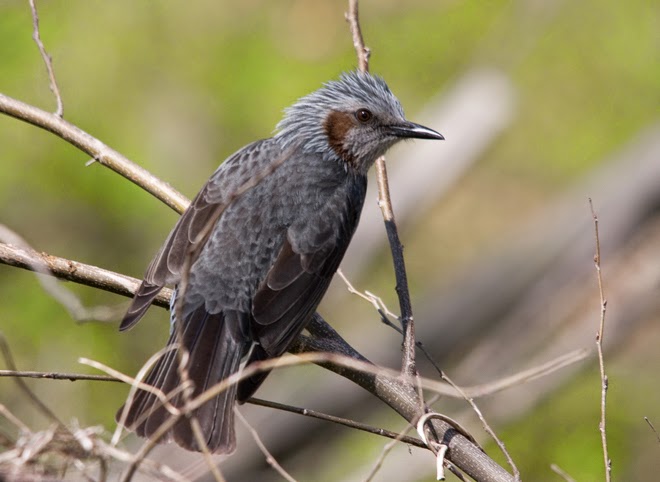
Brown-eared Bulbul is extremely common in Kansai, from hill forests to city parks, it's impossible to miss. Even if sometimes you wish you could.

Not something you'll see in Kansai, this Chinese Bulbul was on Yonaguni, 5 April 2013.

Brown-eared Bulbul Hirakata, Osaka 21 March 2014.

A typical Brown-eared Bulbul in the botanical gardens Kyoto, 3 February 2013. Quite drab at first glance but they're actually quite attractive in an understated way.

Ogasawara race squamiceps.

A couple of presumed stejnegeri on Iriomote, 2 April 2013.