Showing posts with label Martin Asian House. Show all posts

Monday, 2 May 2016

A morning in the woods

I drove up into the forest north of Kyoto city at about midnight last night, my first nocturnal drive this spring. In the end it was a little disappointing, a single Japanese Marten and 26 Sika Deer were the only mammals I saw and a handful of Japanese (Collared) Scops Owls heard were the only birds I recorded. No night displaying cuckoos, no Ural Owls, not even any Grey Nightjars yet, and definitely no Japanese Night Herons.


Things picked up at dawn, first a Blue and White Flycatcher broke the absolute stillness as the outline of the hills began to appear, others soon chimed. The faint sound of an unseen plane floating down pulled me up short, not because the sound itself was intrusive but more because it brought home to me how rarely I experience such silence in Kansai. Not even the snarliest or whiniest motorbike engine can penetrate that far into the hills.


Soon I heard the first of several Oriental Cuckoos higher up the slopes, a Northern Hawk Cuckoo flew over singing and Narcissus Flycatchers were obviously fairly common in the guess at understory. Normally Grey Nightjars and Ruddy Kingfishers would be early voices but they can't have arrived yet.


Finally daylight caught up with the early risers.


A future split... Japanese Jay?


Almost everything else was collecting nesting material or singing!


A Narcissus Flycatcher taking a leaf out of the Blue and White song book? Or maybe it was a North American leaf warbler in a past life?


Would this make a good mystery photograph I wonder? It's surprisingly pigeon-like in the second shot. In fact it's a Northern Hawk Cuckoo displaying, something often heard through the night but usually only seen first thing in the morning.


Long-tailed Tit gathering wispy stuff.


Coal Tit gathering less wispy stuff.


This where I berate myself with a "You call yourself a birder?!". It's only now I see the Coal Tit is pulling material from a pellet which I wish I'd noticed at the time. And it doesn't get any better with the next shots of Asian House Martins collecting mud. Looking at these shots is the first time I've noticed the streaks on the rump, uppertail coverts and vent. No doubt contributing to the greyer appearance compared to Northern House Martin.


Thursday, 26 December 2013

hirundines to Long-tailed Tit

Four hirundines can be seen in Kyoto depending on the season and three of them breed in Kansai. Barn Swallow is a common and widespread breeder in urban as well as rural areas. It's not unknown for the race tytleri to occur in northern Shiga in mid-winter, I've seen a flock of about 30 in late December one year and a single in January in a subsequent winter. The flock were moulting primaries so presumably unlikely to travel far. It's strange to see Swallows flying low over a snow covered landscape as though it were a summer meadow.
Red-rumped Swallow only breeds at a couple of locations in Kyoto city and compared to Barn is also more localised as a breeder throughout the region. It's a common migrant over the city rivers, passing through later than Barn in autumn, there can be large numbers well into October.
Asian House Martin is a common breeder usually in association with rivers in forested areas and frequently nests under road bridges. The only urban colony I know of near Kyoto is under an elevated stretch of railway between here and Osaka. Sometimes parties can appear in in the city in mid-winter but they never linger long.
Sand Martin is purely a migrant and in autumn it can pass through over quite a protracted period. Again it can be seen along all the rivers and often over the fields at Ogura.

These Sand Martins were photographed on their breeding grounds in Hokkaido in August 2012.

Barn Swallow at Ogura, 18 August 2011.

These two are Pacific Swallow photographed in Okinawa, 2 August 2011.

Asian House Martins gathering nest building mud in a village near Ashyu Forest, 13 May 2012.  

This was another of the birds I photographed near Ashyu. I was puzzled by the dark patch on its breast side and when I cropped the image I was amazed to find another wing.  A heavily cropped version showing more detail is repeated below. As looks perfectly healthy and was gathering mud the supernumerary limb mustn't impare it in any way. Not having noticed this in the field, I'm left wondering whether it has a matching pair.


Red-rumped Swallow over the Katsuragawa at Arashiyama, Kyoto city 29 October. It isn't unusual to see birds as late as this, long after Barn Swallow has disappeared.

Some of a flock of about 150 migrant Red-rumped Swallows in Ishikawa in October 2014.

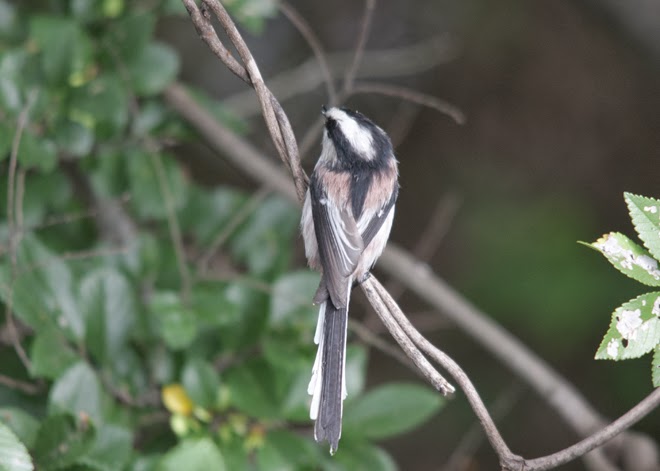
Long-tailed Tits are very common in and around the city as well as throughout Kansai in general. They can be found in woodland, in riverside scrub and city parks.

Long-tailed Tits along the Katsura River in Kyoto, 3 October 2010.

Adult caudatus in Hokkaido, 31 December 2012.

A juvenile caudatus in Hokkaido, 12 August 2012.