Showing posts with label Swallow Barn. Show all posts

Tuesday, 23 April 2019

Himalayan Swiftlets on Yonaguni


I made my first trip to the Yaeyama Islands six years ago and my initial impression still holds true: Yonaguni is a rarity hotspot and not really worth considering if looking for Yaeyama specialties, Ishigaki's saving grace is Banna Park which has a fantastic network of quiet footpaths allowing easy access to the forest but on the whole it's not worth spending much time there as Iriomote is a far better for both native birds and a far superior away-from-it-all experience. That said, Ishigaki now has breeding Black-shouldered Kites... but they can be seen without actually leaving the airport.


After about three months of zero birding my schedule suddenly opened-up allowing me nine days of uninterrupted birding. Heaven. With just a couple of days notice I didn't think I'd be able to make reservations for a repeat of my previous trip covering all three main islands. So it proved, but with flights and Yonaguni car rental confirmed it didn't matter too much as I was quite happy to spend the whole time on Yonaguni. I'd day dreamt about finding Himalayan Swiftlet for ages, and now I'd have the chance to give it a good go. Though car rental on the island was no problem, the only accommodation I could find was for the first two and last three nights. So I was facing three nights in the car but as luck would have it my Ryokan had a cancellation resulting in only one uncomfortable night. One uncomfortable night, good grief I must be getting soft in my old age!


The ryokan only provided breakfast, no dinner, which was a bit of a concern because on my previous stay the shops weren't that well stocked and according to the ryokan owner the few local places to eat required pre-booking. However things have changed and it's quite easy to get a wide range of food in the shops now, there was even fresh fruit daily throughout my time there.


There are only two ferry sailings per week to the island so to get around all the last minute planning problems I chose to give sea-birding a miss and fly this time. I arrived on Ishigaki in the morning and had booked on the last flight to Yonaguni to give me time to look for the Black-shouldered Kites. It took 35 minutes to locate a rather distantly perched bird from the airport car park but after a few further minutes another bird gave excellent fly-by views. I'd actually allocated the final night of the trip to on Ishigaki just in case the Kites had been harder to see than I imagined. At least this would give me the opportunity to get a photo tick and visit Banna Park for owls.


The additional time I'd budgeted between outward flights meant I arrived on Yonaguni in the late afternoon and by the time I'd sorted out the car and found my accommodation there was no light for birding. Well, just enough to make out Common Mynas coming to roost on the cell tower outside my room. Day one and already the second Japan tick of the trip, I'd only managed two in the whole of 2018!


The weather was overcast next morning, indeed that was true of almost the whole time on the island, overcast with plenty of light rain. This was great, great for bringing in birds and keeping temperatures down. I spent the morning as much refamiliarising myself with the island as doing any serious birding. The first place I stopped and took a walk was at the eastern headland. On returning to the car I found the car lock didn't work. Really! The key may as well have been for a different vehicle, and of course my phone was inside the car. I once locked myself out of a rental car in the freezing pre-dawn of the eastern Turkish mountains, I was able to take out the windscreen on that occasion but cars are far more difficult to break into for a non-professional nowadays. There was nothing for it but to walk back to town, I was now even more pleased the weather was overcast. My car rental man wasn't a professional car thief either. Despite picking up the necessary tools to do the job at another garage he finally had to resort to a trusty hammer that he'd brought along from his own garage. Hammer and glass, only one winner there.


Not the greatest start to my time on the island I'd have to say, but unbeknown to me it wasn't all the doom, gloom and exasperation it seemed at the time... a Himalayan Swiftlet was on its way.


At some point in the afternoon I was at the opposite end of the island, not far from the island's, large pond. The number of hirundines was amazing, mainly Barn Swallows but also Red-rumped (c30), as well as Asian House (1) and Sand Martins (c10). There were also House (c12) and Pacific Swifts (2) zooming around too. This was what I wanted, this was surely my chance to find a Himalayan Swiftlet! Thinking something is so and it actually being so are more often than not two entirely different things but on this occasion... BOOM! There it was! At once obvious even to the naked eye, a bit like a martin with House Swift wings. It was fairly high and would often disappear for a few minutes but always came back. After the shock had worn off I set about getting the photographic evidence. This wasn't quite as straight forward as it might sound, now because it was quite high it wasn't too difficult to follow with the camera but the downside was the resulting images would never show any detail. The following two images is the most compelling of the evidence as gathered on that first afternoon...


It would sometimes fly below the line of hills in the centre of the island allowing a better appreciation of how remarkably nondescript the plumage was. Basically greyish-brown with a slightly paler rump but I could never get an in focus shot.


At some point I must have lost the bird and picked up a head-on House Swift by mistake because when I later checked the shots on the back of the camera, there was a good shot of a black-looking swift with a bold white rump. Cue self-doubt. It didn't matter how well I'd seen the bird in life, immaterial how plain the plumage had been; I was worried. How could I possibly have photographed a House Swift if this Swiftlet had been half as as eye-catching as I'd felt?


Needless to say I was back in the same area promptly next day, the weather was showery, drizzly, wet and grey. Terrific. There weren't any hirundines sailing round higher up, everything was close to ground level and in no time I'd found my Swiftlet again. Just as obvious as it had been yesterday though the small size was even more apparent. How could I have doubted this? With the bird dashing around so low my lack of photographic skills were about to face a much tougher challenge. Thankfully I was able to get a small number of shots which proved to myself it wasn't a House Swift and is in fact basically a martin with House Swift wings just as I'd first thought.


The question I now asked myself was whether I'd seen one Swiftlet or Two. It was clear on the second day that many birds had moved on. Barn Swallows were still present in huge numbers, as they were on all but the penultimate day of the trip, but lower numbers of Red-rumped Swallows and martins fluctuating daily throughout the trip were easy to keep tabs on and suggested there was a continuous passage of birds through Yonaguni. Barn Swallows were common throughout the island, in the lee of any shelter, but there were no other massive build ups elsewhere, no other locations regularly held Red-rumped Swallows or martins and this was the only site I ever saw either of the two Swift species. The penultimate day of the trip (April 16) was the first hot sunny day and Barn Swallow numbers dropped very noticeably, as if there were few lingering birds and onward movement was continuous. The final day (April 17) was again overcast with showers and either a huge new build up of birds suggesting passage had stalled once more. Not only were Barn Swallow numbers back up but Red-rumped and both martins had their respective highest totals of the eight-day visit.


No sooner had I realised the need to check through the flocks again than another Swiftlet flew past, below eye-level over a marshy overgrown cane field! Unfortunately this one didn't even pause let alone linger. At least I didn't need to embarrass myself with the camera. So definitely two and possibly even three Himalayan Swiftlets in the space of a week. That with just one pair of eyes looking for them.


Two dense wind-break hedges provided shelter for flying insects and immense numbers of Barn Swallows flew back and forth in the lee of each, testament to their aerial maneuverability. There were usually birds resting on the roughly ploughed field between the two hedges and in wetter conditions the field was carpeted with Swallows. I was surprised to see how many of them appeared to be in moult judging by what appear to be feather gaps creating white patches on the upperparts.


One of the far fewer Red-rumped Swallows present.

Tuesday, 10 January 2017

Barn Swallow yes, Japanese Murrelets... no

After a final morning around Arasaki I drove inland to Satsuma for yet another pointless crawl along the river, checking every view point for miles looking for the mythical Scaly-sided Mergansers. I've lost count of how many times I've done this but, finally, with darkness fallen and duty done I was free to continue across the island to my next port of call; Kadogawa harbour for Japanese Murrelet.


The best views I usually get of Japanese Murrelet are on the return leg of the Hagi-Mishima ferry but my hope in Kyushu was to find an easily photographable bird in the harbour. Perhaps a long-shot on a calm morning but worth a try. I was positioned on the end of the harbour wall before sun-up and was disappointed, though hardly surprised, to find the harbour empty of Murrelets. Pretty much empty of anything in fact. There were plenty of birds on the sea side of the wall Great Crested and Black-necked Grebes, some quite close. Two species of cormorant, the usual gulls of course and way out towards the reddening horizon a tiny speck which the scope revealed to be a small alcid. This tiny silhouette against the rising sun can only realistically have been Japanese Murrelet but being unable to even get a certain identification is a far cry from the aim of getting a decent photograph of a bird in the harbour, so this visit will have to go down as another missed bird.


By the time I got back to the car the sun was brighter and early morning dog-walkers were up and about. So too was my first flock of Barn Swallows for the trip. I was a bit surprised not to have run into any thus far but today was to make up for lost time; in addition to the 16 birds on the wires next to the harbour there was another flock of about 20 in Kadogawa town as well as numerous birds, singles or parties, as I travelled south once again along the coast in the direction of Miyazaki city.


Barn Swallows in the early sun.


The next stop was Greater Spotted Eagle, another bird I'd seen before so there was no pressure, no fear of dipping. Just as well. What was it about this trip? Black Storks, Scaly-sided Mergansers and Greater Spotted Eagle, a total failure with the returning rarities this time. I don't know whether there was Forest Wagtail at Miike this winter but on this form I'm pleased I gave the place a miss.


Though I failed with the Eagle, I did get pretty good views of a female Eastern Marsh Harrier. It's a puzzle to me why the vast majority I see in Kansai, certainly at Biwako, are juvenile/first winter birds while there are plenty of adults (as you might expect really) elsewhere. This trip has been adults 4 - juveniles 0, a convincing result.


Female Eastern Marsh Harrier.


Despite missing the returning rares I really enjoyed my time in Kyushu, there are so many birds I hardly ever see in Kansai, if at all. I saw five Eastern Yellow Wagtails which I've never seen in Kansai, there were parties of Chinese Penduline Tits which I used to see regularly near Kyoto but no longer (that way simply be down to habitat loss at the site I visit), I mustn't forget masses of cranes and also Caspian Tern at the same place for the second winter in a row... that was a Japan tick for me at this time last year! Big flocks of Common Starlings and a Brown Booby and even unusually good views of Daurian Jackdaws add both to the sense of the exotic and the feeling that a major rarity could be waiting to be found somewhere, anywhere, in this exciting part of Japan.


And is it possible to see these returning rarities? Well yes, I've seen them in the past...


Forest Wagtail


Black Stork

The original Black Stork post is here


Greater Spotted Eagle

The original Greater Spotted Eagle post is here

Saturday, 30 May 2015

A new camera and a few minutes in the field

After I'd bought my first cheap digiscoping set-up a birder laughingly told me that I'd never be satisfied with it and one day I'd be hooked on taking bird photographs. Utter stuff and nonsense I told him, my digi-gear was purely for gulling and that was the limit of my photographic aspirations. However in 2008 I saw a Eurasian Crag Martin out on one of the islands during spring migration, I believe this would have been the first record for Japan if I'd had a camera to document its occurrence, so I felt investing in some hand-holdable photographic gear was necessary and I bought in a D40 and and Sigma lens. This in no way compromised my previous stand, it was a perfectly practical step. How else could I support claims of any future rares I might find? The recent upgrade to a 7Dii and Canon lens is less easy to justify, in fact I have to confess it's impossible. Ingo was right all along, that digiscoping set-up was no more than the top of a slippery and expensive slope.

I had hoped to get my hands on this kit before my Mishima trip at the end of April but it wasn't to be, even the major Japanese retailer I bought it from doesn't stock the gear. I finally got notification from the shop on Thursday the week before last and my hands on it the following day.

March and April had been pretty quiet months for me work-wise but from mid-May I hardly have a spare moment, nothing surprising about the timing of the camera's arrival I suppose. During the first two frustrating weeks of ownership the only free day I've had corresponded with the one and only day of serious rain, nothing surprising there either really. But I did manage to get out for a couple of hours at lunch time last Friday and along with a painfully sunburned head I got a few shots of the only summer visitor it's easy to see in Kyoto; Oriental Reed Warbler.

I have an awful long way to go getting the hang of this camera, of how to keep my glasses handy to change settings and of using unfamiliar processing software. But these are my first results...


Other shots I liked were of the Carrion Crow at the bottom and this Barn Swallow gathering mud, the rear flank patch is so bold and extensive that the underparts remind me of a White-bellied Storm Petrel!


Thursday, 26 December 2013

hirundines to Long-tailed Tit

Four hirundines can be seen in Kyoto depending on the season and three of them breed in Kansai. Barn Swallow is a common and widespread breeder in urban as well as rural areas. It's not unknown for the race tytleri to occur in northern Shiga in mid-winter, I've seen a flock of about 30 in late December one year and a single in January in a subsequent winter. The flock were moulting primaries so presumably unlikely to travel far. It's strange to see Swallows flying low over a snow covered landscape as though it were a summer meadow.
Red-rumped Swallow only breeds at a couple of locations in Kyoto city and compared to Barn is also more localised as a breeder throughout the region. It's a common migrant over the city rivers, passing through later than Barn in autumn, there can be large numbers well into October.
Asian House Martin is a common breeder usually in association with rivers in forested areas and frequently nests under road bridges. The only urban colony I know of near Kyoto is under an elevated stretch of railway between here and Osaka. Sometimes parties can appear in in the city in mid-winter but they never linger long.
Sand Martin is purely a migrant and in autumn it can pass through over quite a protracted period. Again it can be seen along all the rivers and often over the fields at Ogura.

These Sand Martins were photographed on their breeding grounds in Hokkaido in August 2012.

Barn Swallow at Ogura, 18 August 2011.

These two are Pacific Swallow photographed in Okinawa, 2 August 2011.

Asian House Martins gathering nest building mud in a village near Ashyu Forest, 13 May 2012.  

This was another of the birds I photographed near Ashyu. I was puzzled by the dark patch on its breast side and when I cropped the image I was amazed to find another wing.  A heavily cropped version showing more detail is repeated below. As looks perfectly healthy and was gathering mud the supernumerary limb mustn't impare it in any way. Not having noticed this in the field, I'm left wondering whether it has a matching pair.


Red-rumped Swallow over the Katsuragawa at Arashiyama, Kyoto city 29 October. It isn't unusual to see birds as late as this, long after Barn Swallow has disappeared.

Some of a flock of about 150 migrant Red-rumped Swallows in Ishikawa in October 2014.

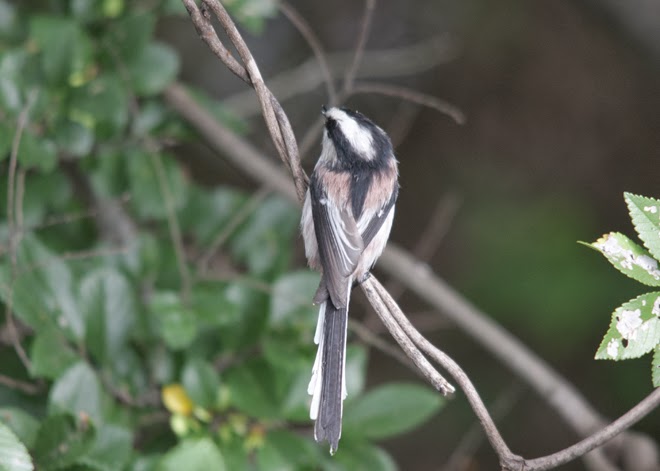
Long-tailed Tits are very common in and around the city as well as throughout Kansai in general. They can be found in woodland, in riverside scrub and city parks.

Long-tailed Tits along the Katsura River in Kyoto, 3 October 2010.

Adult caudatus in Hokkaido, 31 December 2012.

A juvenile caudatus in Hokkaido, 12 August 2012.