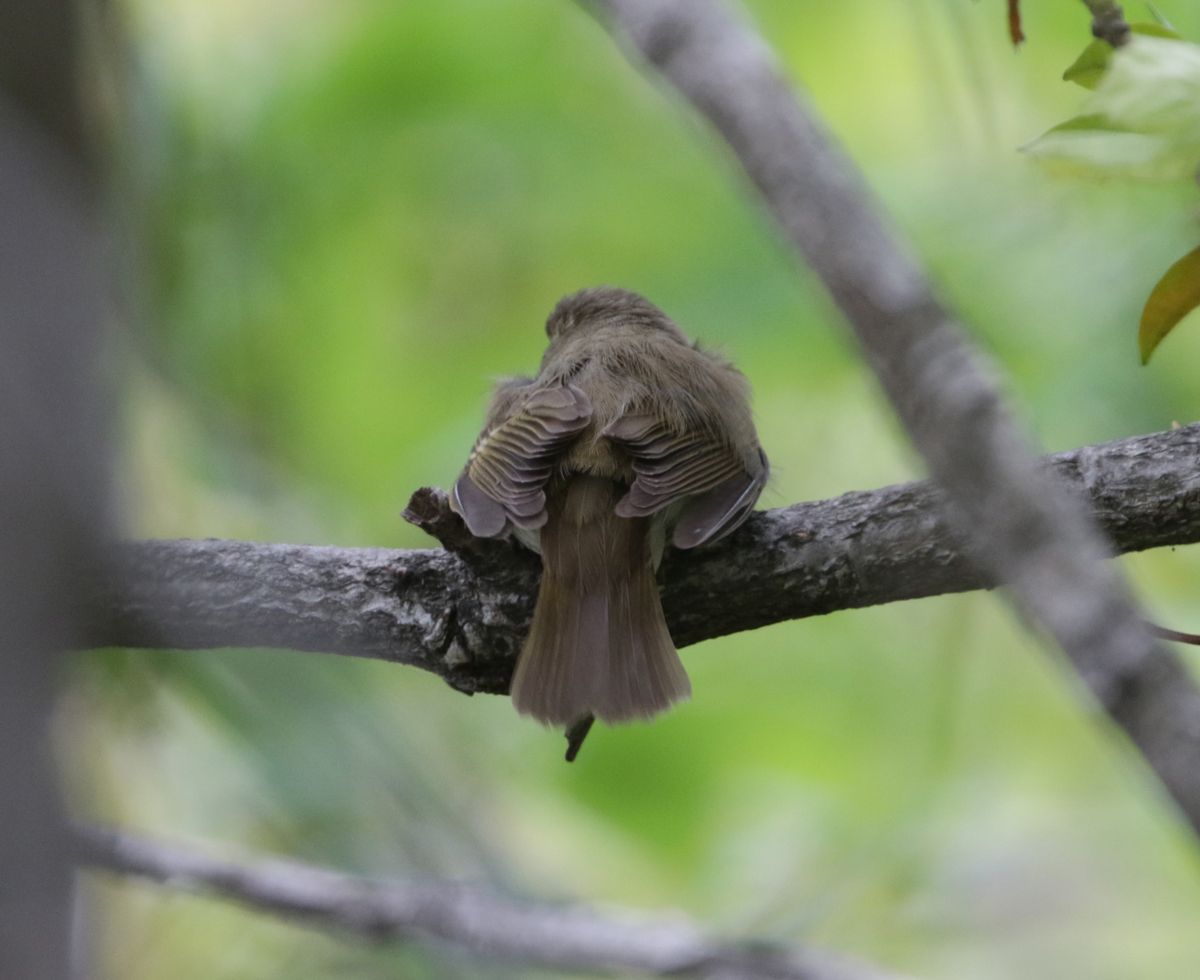
Showing posts with label Warbler Sakhalin Leaf. Show all posts

Saturday, 24 October 2020

A few warblers on Hegura last week

It's possible to visit Hegura in October and find the place swamped with Kamchatka Leaf Warblers but not this time, there were surprisingly few considering the numbers of birds passing through. That said the selection of warblers, whether phylloscs or otherwise, was pretty good with eight (probably nine) species seen.

The 'probable' mentioned was a Middendorff's flushed from the track side and glimpsed diving into cover, everything about it fit the bill but I wasn't able to get a confirming view. Middendorff's is a species which can occur in good numbers on occasion... or so I suspect. There have been times over the years when I've seen several individuals in a single day which must translate into great many more of this skulker on the island. 

Pallas's Grasshopper Warbler is even more of a skulker and, unlike Middendorff's, I've yet to see one sit up. I lucked into a very typical sighting on this trip, flushed from rank grass in a favourite cove of theirs. Stumbling through the tussock grass and overgrown rocks, trying to avoid sudden pools, this is where I've flushed all but one of my PG Tips on the island. This one flew a full 20 metres (a record?) before arrowing directly into cover. Normally they drop sooner into what might seem like less substantial cover but they're never to be seen again. This bird made directly for the type of cover their whole world population could have disappeared into. Why did I even bother to follow?

Black-browed Reed Warbler, on the other hand is an amateur skulker by comparison, I was able to see two birds quite well.

And that brings us to the phylloscs. The first day on the island the Kamchatkas were keeping close to or on the ground, yet despite my human sensibilities being unable to detect any significant change in weather they were up in the trees, but nevertheless still silent, by the third day. 


I only had one Dusky Warbler during my stay (usually a few) though I know from other birders there were certainly more on the island. Perhaps, like the other phylloscs, they were less vocal than usual and therefore less obvious. 

Returning to the minshyuku one evening I became aware of two small birds creeping through the sparse vegetation poking through the pebbles next to the path on the seaward side of the harbour-front houses. One of them flew across the path and down the side of a house. It was clearly either a Radde's or Dusky, fortunately the other bird stayed in the open giving itself up as the sole Radde's of the trip. It's likely the other bird would also have been Radde's but it'll have to go down as Radde's/Dusky.


Sakhalin Leaf Warbler may never be as common as Kamchatka Leaf but the single bird I saw was also an unexpectedly low count, even if most will have already passed through. Strictly speaking I suppose this bird should be considered either Sakhalin or Pale-legged, who knows how many, if any, Pale-legged pass through Japan in Autumn; and which part of Japan if they do. I had three Pale-legged on Tsushima in spring this year and I've had a couple of spring birds on Mishima in the past too. Clearly they are scarce but regular in western Japan in spring, when singing birds are easily found. 

This bird never called whereas in most years they call freely and are easy to locate but then the Kamchatka Leaf are also very vocal normally yet I didn't hear a single call this year; very strange. The weather really didn't seem as though it would keep birds quiet and the Yellow-brows were all as vocal as ever, half the birds I recorded were heard only. The bush warblers, thrushes, etc were also as vocal as ever. Inexplicable.


Oddly, considering how remarkably low phylosc numbers were in general, Yellow-browed weren't too far below par and I had four individuals on two of the days I spent on the island.


The big surprise was a Pallas's Leaf Warbler. I really don't think Pallas's Leaf is considered a rare migrant in Japan but I hardly ever see them. I honestly don't even remember the last one I saw and it's not as though they're inconspicuous, is it?


Thursday, 9 July 2020

Unusual behaviour of a Sakhalin Leaf Warbler - presumably health related

Of the huge number of Sakhalin Leaf Warblers on Tsushima this spring, the behaviour of this bird stood out and remains a bit of a puzzle. I can only imagine it wasn't healthy but I've no idea what could have been wrong with it.


It was present on two consecutive days but apparently gone on the third after a general clear-out of warblers. It was very approachable on the ground but when it flew it did so strongly giving no hint of any problem. It occasionally flew up into overhanging bushes but mostly it sat somewhere along a 100 metre stretch of roadside verge. We saw it several times that day as the road, along a steep hillside, was an excellent birding spot which we returned to regularly. The bird was always easily picked up on arrival because it was so vocal, which isn't something I'd normally associate with sick individuals. The second day it was mostly in the trees on the downward slope from the road and seemingly feeding well abundance of caterpillars. Looking at the images I have of the bird, I'm now struck that none show legs, it's always sitting. If it had a problem with feet/legs, this may account for it nevertheless being vocal, feeding well and flying strongly.


However, it also had a colour aberation which I presume was due to the onset of whatever health problem it was suffering from. At a glance it could give the impression of having a narrow white rump patch but as can be seen in the following images there was also a faint greyish wash on the back and some lesser wing coverts suggesting perhaps that pigmentation production ceased as these feathers were growing.


It almost looks like a ground nester here, in the leaf litter it habitually kept its tail cocked like this.


In a more open situation it fanned and pumped its tail. Of course Sakhalin do pump their tails anyway but this was very pronounced.


Just once it flopped down in this abnormal position revealing the 'white rump' and pigment deficient feathers on back and lesser wing coverts.


The second day it was in the trees the whole time, and feeding well, but the continuous, vigorous tail pumping was only more apparent in that situation.


Periods of sitting still on a branch vigorously pumping its tail was very different behaviour to the many other Sakhalin Leaf which were very active.

.


The next couple of images have nothing to do with this post but I want to tag them on anyway. The former I want to post because it's my best ever shot of this heron species and the latter because the nest is such an amazing structure.


Probably my best ever shot of this rather scarce heron. This is only the second Striated I've seen this year.


Perhaps a case of an ever-growing nest crushing the bush beneath it but I prefer to think this is a very traditional Osprey site which over time is creating its own micro-environment on top of the bare off-shore stack. 

Sunday, 27 May 2018

Hegurajima bookends for May

Unbelievable, already the 27th... where did May go?


Well, wherever it went, Northern Hawk Cuckoo singing over my house a few nights ago spurred me to visit Ashyu Forest (central Kyoto prefecture) for the first time this spring as soon as I had time. Time turned out to be the weekend, when I also managed to get out to Hegurajima for only the second time of the season.


I didn't have any offshore plans for Golden Week this year but instead I had hoped to make day trips to Hegurajima. This isn't ideal for several reasons. First, the huge number of birders/photographers present during Golden Week means you're never alone on a trail, the best you can hope for is that you aren't part of a shuffling line spaced about 30 metres apart - that actually happened when I was there on May 1st, I almost felt I had to indicate and wait for a gap in the birder traffic when I exited woodland onto the main north/south trail. Second, the ferry only gives you the least optimal midday period on the island to find the birds. Finally, and worst of all, will the ferry even sail? Ferry cancellations aren't unexpected in autumn when the Japan Sea is less friendly, whereas spring is usually less risky. Of course 'usually less risky' doesn't mean sailings can be relied on as spring of last year proved and this year hasn't been any better, last week was the first time there were more sailings than cancellations.


My visit to Ashyu was really enjoyable, it was great to be in the field and not see another soul in 18 hours! Of course I heard many more birds than I saw but Grey Nightjars were good with two birds sitting on the road in the early hours and a third high overhead in display flight after first light. The heard only highlights were a Japanese Night Heron and a Japanese Scops Owl.


Ruddy Kingfishers were singing early in the morning but as it was sunny, apart from a few calls, it was as if they hadn't existed shortly after the sun crested the hills. Cuckoos, Northern Hawk, Oriental and Lesser vanished in the same way. One bird that never even appeared was Asian Brown Flycatcher, where were they? But a much bigger question was raised. I heard a Kamchatka Leaf Warbler singing in the forest and for an instant when it started singing I was delighted thinking it was Japanese Leaf. The only previous occasion I've heard 'Japanese Leaf' here was before the Arctic complex was split and now I wonder whether that too was a passage Kamchatka. It seems this area is just outside the Japanese Leaf range.


One of several Grey Wagtails around the car park in the forest. 'Car park' means a broad muddy turning area where the road finally ends.


On the not-a-bird front this monster earthworm was a stand-out.


At about 40cm long this would give any early bird pause for thought. Note the 10 Yen coin next to it for scale. 


Shortly after I saw this hummingbird hawk moth daylight was gone and a bigger surprise was an otherwise invisible bush across steep dark ravine lit up by glow worms like a ghostly Christmas tree.


After nightfall on the second day I drove north to Wajima as it seemed very likely the ferry would be operating the following morning.


There was a time, a long time in fact, I'd be out on the ferry deck from port to port but after multiple sailings each year, year after year, with very little to show for it I tend to catch up on sleep nowadays. Admittedly I visit the island more often in autumn than the more productive spring. When I went out on May 1st I did try for seabirds and the trip produced about 30 Ancient Murrelets in small parties, at least two Japanese Murrelets, ever present Streaked Shearwaters and the Pelagic Cormorants which are still around at that time of year. I had also hoped for good numbers of phalaropes, Red-necked can be common and usually there are a few Grey (Red) thrown in. In the event there were only a handful of Red-necked. This time, two days ago, I did sleep on the crossing but still managed a single Red-necked Phalarope through the window.


One of several small fly-by parties of Ancient Murrelets.


A few were slightly closer.


Red-necked Phalaropes with an Ancient Murrelet.


On the island at the beginning of the month this Sakhalin Leaf Warbler was the only bird of interest I managed good shots of. That was my first ever trip to Hegura when I was glad to be taking the ferry back to the mainland, I've never seen the place so birdless.


Strictly speaking I ought to call this a Sakhalin/Pale-legged Leaf as I didn't hear it but Sakhalin is the overwhelming favourite here.


I wasn't terribly optimistic about this trip, even though there have been some really good birds between my visits, because the weather hadn't looked too productive all week. However the hill behind Wajima harbour was thick with Kamchatka Leaf Warblers which put me in a much better frame of mind before the ferry left. Kamchatka were absolutely everywhere on the island, Asian Brown Flycatchers were pretty common too. No wonder there were none at Ashyu, they're all still on vacation!


Kamchatka Leaf Warbler


A clean looking Asian Brown Flycatcher, even paler in the sun. 


Asian Brown looking dark.


No amount of sun is going to make a Dark-sided Flycatcher look pale.


The best/rarest birds on the island were Black-naped Oriole, a flock of Common Crossbills and a Dollarbird; hmmm so okay, nothing major. But there were so many birds around, and such a variety of scarce stuff, there surely had to be something important waiting to be found. If there was, neither I nor anyone else found it during my four hours on the island.


Cuckoos were fairly obvious, Lesser and Common at any rate.


Lesser Cuckoo.


Black Woodpigeon is ever present but it's not often they sit about in the open like this.


Saturday, 10 June 2017

Two-barred Greenish Warbler? How about Arctic (borealis ssp)?

Last Sunday (June 4) was the first chance for the ferry to get out Hegurajima after a productive-looking low pressure system over the Sea of Japan had created a strong three-day airstream from the continent. There were no photographers with bazooka lenses staking out likely spots, just seven or eight birders scouring the place actually looking for stuff, which probably indicates a perception amongst some that spring migration is over. Well, it ain't.


My first and lasting impression out there was that island was alive with Kamchatka Leaf Warblers. A week earlier there had been a huge number on a wet morning in Kanazawa, harder to see but calling and singing constantly, this time round they were far more visible in the sun but less vocal; you can't have it all I suppose. Because the birds quieter could mean that even more went unnoticed and it would be interesting to know how many were on the island; hundreds I have no doubt. Just to be clear, all the birds I did hear were Kamchatka Leaf.


With about an hour and a half left till the return ferry departure time I learnt that a 'Tickell's' Leaf Warbler had been heard in the morning and I made my way in that direction without much hope of finding it, largely because of the general lack of vocalisation. So of course it came as no surprise that I couldn't find it. But... I did come across a couple of interesting, stubbornly silent, phylloscs in with a crowd of Kamchatka Leaf in a loosely isolated clump of trees. Both seemed smaller and more active than the many Kamtchatka Leaf present and were easily picked up each time they ventured into the open. Not to mention separable from each other, as one had two prominent wing bars and the other didn't. However all warblers collectively were only visible sporadically as they moved above or below a dense foliage line across the copse, about five metres up. The lower trees were impossibly leafy but protruding pines offered a clearer view when warblers 'surfaced', though it was a lottery where and when a given bird would next flit into view. Because of this it was frustrating trying to get or confirm details on these two birds when, as often as not, the 'other' bird would appear.


Once back on the ferry I told someone that I'd had a possible Two-barred Greenish and their unexpected reply was that they had heard a Two-barred about 300 metres from the spot I'd seen this bird!


Though I considered it a good contender for Two-barred Greenish in the field, I've since had doubts after reviewing the images but it's an interesting bird nevertheless and worth posting I think. It was clearly smaller and less heavily-built than the Kamchatkas, cleaner below and more active. So it drew attention to itself from the outset and was easily picked up every time it appeared above the dense foliage line. It was generally faster moving, less deliberate and more likely to hover than Kamchatka; it would suddenly emerge from the dense foliage into the pines flit quickly through the branches or simply hover briefly before dropping directly back into the thick stuff below.


The light was bright and in such conditions care is needed judging colouration, particularly differing greens or subtle shades on the underparts which are easily 'lost' in direct sun, this is even truer where images are concerned. However I did get a small number of reasonable shots of this bird out of the direct sun. Kamchatka Leaf was never a cause of identification concern as this bird stood out so clearly from them. The other common spring warblers here are Eastern Crowned and Sakhalin Leaf. The former is a relatively substantial and deliberate warbler to my eye, mostly bright greens and yellows and it shouldn't ever be suggestive of the Greenish complex given a reasonable view, however brief. With the views I had eliminating it was straight forward and in any case the bulk of them come through a month earlier. So that leaves Sakhalin Leaf Warbler, a separation which doesn't sound too difficult on the face of it, however Sakhalin does bear some similarity and looking at the images I wondered whether this bird may have been no more than a unusually bright, fresh-looking individual at a time most are worn and dull in appearance. Though I'd also expect Sakhalin Leaf to be on the breeding grounds by now and haven't seen one since mid-May when they were still reasonably common passing through.


The two most obvious plumage features when I first saw this bird, even more than the generally pale underparts, were two prominent wing bars and strikingly plain, hollowed-out white ear coverts, the latter outstanding viewed from any angle. On closer inspection the long supercillium was just as broad over and behind the eye as across the lores and the eye-stripe was distinctly narrow across the lores, giving a totally different impression to spring (worn) Kamchatka. The lower mandible looked entirely yellow in the field but the images consistently show a slightly dusky 'keel' so possibly this isn't an artifact and I simply missed it while watching the bird.


I've dismissed Kamchatka Leaf but why? At this time of year Kamchatka invariably lacks a median coverts bar (even fresh birds tend to have a relatively inconspicuous bar), though the lower bar is frequently broad. The ear coverts are more evenly mottled lacking a bold whitish crescent below the eye and therefore duller and less contrasting with the eye-stripe, the ear coverts often (not always) look open without a distinct border with the throat. The supercillium is prominent and usually blunt-ended mid-lores but becoming narrower over the eye and extending well back on the head without expansion, effectively a long slash from eye to nape side. Sometimes it will look broader and looser but this is probably temporary and dependant on feather position. More importantly perhaps the eye-stripe is of more or less even depth before and behind the eye and doesn't narrow markedly across the lores. On this bird it was narrow on the central lore and further pinched before the eye and base of the bill.


Sakhalin Leaf might seem a surprising contender for confusion however, like this bird, has a smaller feel and also tends to be quite active. Sakhalin has a greyish head and neck contrasting with brighter upperparts, this is quite distinct, by contrast this bird had only a slight suggestion of a greyish cast so the comparison doesn't hold too well on that point. Sakhalin's head pattern is basically similar to this bird, it has a greyish centre crown and is greener laterally, the supercillium is equally broad behind the eye where it is also whiter than before the eye. However the cheeks are usually mottled, looking duller and more uniform overall, thus the lower portion of the eye-ring is normally readily apparent. Sakhalin's bill is rather fine, though to be honest I'd have expected the Two-barred bill to be no different, yet this bird frequently gave the impression of being rather large-billed. Sakhalin's lower mandible seems remarkably variable, ranging from almost unmarked yellowish to almost completely dark; a match for anything it would seem. The tarsus can be very pale especially at the rear, almost whitish in some cases, but it is often similar to this bird, a purplish- to pinkish-brown at the front and only pale at the rear. However in my experience the feet are much paler and, if seen well, the claws invariably look whitish. Though it wouldn't surprise me if this feature weren't a constant either. Can Sakhalin can still have two prominent wing bars at this time of year? I'd guess this would be quite exceptional however I remember seeing two birds on Mishima one year, the first I actually identified as Two-barred at first but then changed my mind finding another double wing-barred bird the following day. Both were in early May when Sakhalin are passing through in large numbers and I assumed I had misidentified the first and put them both down as Sakhalin. Because the Sakhalin passage is largely over by now (at least I haven't seen one since mid-May) and as they don't breed in my area I don't really know first hand whether worn Sakhalin can still have two distinct wing bars by June.


Kamchatka Leaf is the only member of the Arctic Warbler complex I've heard in Ishikawa Prefecture this spring and as I mentioned there were huge numbers both calling and singing a week earlier, as well as quite a few calling birds on this visit too. As Arctic Warbler and Japanese Leaf Warbler are said to be inseparable from Kamchatka Leaf other than by voice I've discounted them as possibilities for the moment. Arctic Warbler, both borealis and kennicotti could possibly, or are even likely, to occur in Japan during migration. Perhaps wholly or in part at different times due to their respective breeding ranges. I have to say I'm not entirely happy to blithely rule these taxa out because they're said to be morphologically inseparable from Kamchatka Leaf Warbler in the field.


I'll briefly describe this bird then show the images.
Structure:
A comparatively small warbler, rather plump and dumpy-bodied. Unfortunately I couldn't judge primary projection because of the viewing angle.
Plumage:
Crown, nape and hind neck green with a slight greyish cast only lacking on the greener sides of the crown. Eye-stripe darker green, broad behind eye but narrow across the lores. Supercillium long, reaching the nape, and arching prominently over the eye. Equally broad before and behind the eye where somewhat untidy. Slightly yellowish-white before and over the eye becoming clean white behind. Ear coverts with a conspicuous whitish crescent below the eye, rather extensive and high on face before eye because of narrow eye-stripe. Greenish, fairly uniform lower ear coverts forming a second and larger crescent. Coverts partly enclosed by a narrow darker green border, very conspicuous along the leading edge from the base of the bill, cutting through an area of white. Side neck pale greyish-green behind the ear coverts.
Upperparts green from base of neck to tail but with slight greyish cast on mantle. Wings brighter green lacking the greyish cast. Median coverts with fairly broad yellowish-white tips, duller than greater coverts bar. Greater covert tips whitish forming a bold oblong across the wing. Tertials dark brown with pale green fringes, flight feathers slightly darker. Secondaries and inner primaries fringed bright green. Tail dark brown with broad and rather diffuse bright green edges on proximal half of outer feathers (number unknown).
Underparts:
Upper throat white below eye-stripe and bill with a yellow suffusion from mid-throat, quite a clean break between the two. Breast whitish with faint yellowish tint, delicate pale grey wash at sides around bend of wing. Lower fore-flanks with with subtle greyish cast but faint yellowish cast bordering folded wing. Belly whitish with faint yellow suffusion similar to upper flanks. Vent and undertail coverts white. Undertail feathers with pale fringes (how many unknown).
Bareparts:
Bill dark horn upper mandible with paler cutting edge, lower mandible yellow. Front of tarsus pinkish- to purplish-brown darkest towards knee. Feet paler and pinker, claws dark.


A striking head pattern; the combination of broad supercillium behind the eye, narrow eye-stripe before the eye and plain whitish ear coverts extending high in front of the eye is strange for an Arctic complex warbler. Hind neck and crown greyish-green, greener on sides of crown. Wings also brighter green. Underparts clean whitish in this shot with just a little grey around the bend of the wing, though yellowish suffusion just visible on upper flanks and belly. Yellow lower mandible looks slightly darker here due to shadow, both Kamchatka Leaf and Sakhalin Leaf can also lack any trace of dark colouration on the lower mandible. Feet pinkish, tarsus darker.


Two prominent wing bars, the upper less white. The face is strikingly white because of the crescent under the eye and the white upper throat forcefully interrupted by the narrow leading border of the ear coverts which stands out as a prominent dark line. In fact when I first saw the bird I was struck by a distinct spectacled effect because of this. At this angle a better appreciation of the underparts is possible; the upper throat and vent are white the lower throat is suffused yellow as are the remainder of the underparts to a lesser extent however there is a soft, uniform greyish area around the bend of the wing which dissipates across the fore-flanks. To me this shot conveys a sense of the bird's small size and dumpy body but that may be purely subjective because I actually  watched the bird in the field.


In this image the hollowed-out ear coverts given an indication of how conspicuous the white crescent looked in the field. Also the white band below the lores/bill contrasting with the yellowish throat is again prominent in this image.


Finally a heavy crop of the first image giving a clear view of the head with the whitish crescent below the eye and a pale greenish or yellowish-green crescent below that. The bi-coloured supercillium, yellowish-white in front and over the eye becoming clean white to the rear.


Below are some comparative spring shots of Sakhalin Leaf taken on May 16th and 5th respectively.


A worn Sakhalin Leaf with little remaining of the wing bars. The cheeks are pale but more evenly mottled and open compared to last Sunday's bird, the lower eye-ring stands out. The bi-coloured supercillium is very similar, and the eye-stripe only slightly thicker before the eye. Flanks greyish without yellow suffusion. The bill looks proportionately smaller and note the almost completely dark lower mandible as well as very pale claws. 


A fresher-looking bird but still primarily greyish and white below without yellowish suffusion. Narrow eye-stripe across the lores (like the recent bird) but again the cheeks are very open and more uniformly mottled contrasting with the eye-ring. The lower wing bar is very distinct with the feathers tight together at this angle. The feet and claws are whitish. As all these birds are adept at hiding their median coverts I've added another image of this bird below, the greater coverts bar is more broken up here and the median bar, though present, is very indistinct. I suspect it can be more conspicuous than this even at this time of year, but quite how much more I don't know. The lower mandible is more visible in this second image and seems to lack any dark colouration, very unlike the previous Sakhalin. Perhaps the bill gives the impression of being slightly larger in this image compared to the previous bird (to me at least) but it still looks more delicate than Sunday's bird.    


I've never seen Two-barred Greenish however I do have a fair amount of experience with the phylloscs occurring regularly in Japan and I find it difficult to reconcile this bird's appearance, the combination of size, behaviour and plumage, with any species I'm familiar with. So though I said at the outset this bird may be no more than an exceptionally fresh-looking Sakhalin Leaf (for want of any other plausible possibility), I doubt it. Indeed I'd find it far more difficult to support a claim of Sakhalin Leaf if it were the rarity in Japan. The big problem was not being able to get enough on this bird, neither call or wing structure to confirm or disproved a claim of Two-barred.


At the risk of making this identification more difficult than it already is, there is another potential piece in this puzzle; the other small warbler in the same group of trees. This other bird was every bit as lively as the other as well as being a compulsive wing-flicker as it moved quickly through the trees. In fact it was so mobile I wasn't able to get a single clear shot. Apart from size and behaviour it also shared the rather uniformly pale underparts with the above bird but the similarities stopped there.


In the field I had the clear impression this was an Arctic complex warbler, structure and plumage patterns were straight off the Arctic production line. The question I faced then hasn't changed; if the Arctic complex warblers aren't identifiable in the field why does this bird stand out so markedly in a group of Kamchatka Leaf Warblers? I couldn't help but wonder about Arctic Warbler. I'll post the best of the images I was able to get, most are heavily sharpened.


Most images of it are in strong light and subtle details are difficult to see, this one is slightly better to assess plumage. The head is Arctic complex to a tee; uniform green crown, broad pre-ocular supercillium stopping well short of the bill and becoming a long thin slash behind the eye, evenly broad eye-stripe not contrasting too strongly with the mottled ear coverts. The underparts however were strikingly paler and more uniform compared to the Kamchatka Warblers under the same conditions in the same trees. Unfortunately a direct comparison, like size and gestalt, is impossible to convey in images. In the next image it almost gives me the impression of a Barred Warbler Sylvia nisoria it looks so large and static!


Upperparts uniformly green, long thin supercillium, narrow greater coverts bar and primary projection midway between tertial tip and tail tip. Everything looks Arctic here. It also has a deeper, less spiky bill in this shot.


In summary, both these warblers stood out from the crowd as lively smaller-looking birds sharing overall paleness. However that one looked a classic Arctic complex bird only serves to emphasise that the other did not. So ultimately the question is whether my impressions in field were correct or not.


Friday, 19 May 2017

Two one-day trips to Hegura... part one

After bad weather has prevented me from getting out to the island on each recent occasion I've had the free time to go, the forecast finally looked promising for a sailing last Friday. After working till 8pm on Thursday I hurried home and prepared for the drive up to Wajima... by all accounts birding had been great on all the Japan Sea islands a few days earlier, but how much would still be there?


I arrived in Wajima later than usual so couldn't get in any local birding before heading for the ticket office, and once there it was pretty obvious the ferry was running. The car park was packed and nearby roads lined with birders' cars. This was the first time I've had to go to one of the big car parks across the river and walk back.


Once on the ferry I took the opportunity to grab some sleep rather than hang on the rail as there's often little more than Streaked Shearwaters to show for the effort. I find it difficult to get excited about this ferry route to be honest. The crossing was calm and the visibility encouragingly poor with the Japanese mainland quickly disappearing from sight, there might even be the odd new arrival.


I wasn't one of the first off the ferry for a change and was a little surprised to see a knot of people hurrying off towards the centre of the island and decided to follow just in case. It turned out they were headed for a Black-naped Oriole vigil so I dropped out of the race about half way but this quick march in that direction turned out for the best. Some way along the central track I heard a singing Rufous-tailed (Swinhoe's) Robin in the undergrowth to my left, a bird often heard but rarely seen on the islands in spring. Not 50 metres further I paused to check a Narcissus Flycatcher (there's always a chance of Yellow-rumped) lurking down a narrow cut into the sassa, where photographers will often display Olympian patience while tempting skulkers into the open with mealworms, and just below the Flycatcher another Rufous-tailed Robin hopped into my field of view! It posed on a stone for about three seconds then flitted into thick cover on the other side of the cutting. Three seconds... what a view! Though I've heard countless over the years this was only the second I've seen. What a great start to the day!


Yellow-browed Warblers were everywhere, fantastic little birds, but they can be tough to photograph. Sakhalin Leaf Warblers weren't far behind in number judging by all the calls but surprisingly I didn't hear a single Japanese Leaf Warbler. There weren't many Eastern Crowned Warblers around either but as they aren't as vocal as the other phylloscs present it's possible to underestimate their number. These are a few of the warbler shots I managed.


Radde's Warbler... one day there'll be a Yellow-streaked.


Radde's again, that bill looks brutal.


Radde's again.


Sakhalin Leaf.


Sakhalin Leaf.


Japanese Bush Warbler with three more shots below.


It might make a mystery photograph challenge but it's actually one of the few Eastern Crowned I saw that day.


Siberian Rubythroat can be hard to see let alone photograph, I had reasonable views of three birds while I was there.


Not everything was skulking in nature, quite a few things were happy to perch up. None more so than this rather out-of-place Cattle Egret...


This Brown Shrike stayed far enough away to prevent a medium-sized lens like mine making much of it, I should have brought my scope.


More heavily cropped and from a different position.

This bird is confusus I'd guess, but that looks like a black tail through the twigs. Perhaps I shouldn't have taken people's word for this being Brown.


A Bull-headed was more obliging, the Tiger Shrike present was far less so... I didn't even see it.


There are often Siskins on the island and they tend to be far more easily photographed than in the forests in Kyoto.


Female Siskin.


Before I knew it my time on the island was up and it was back to a crowded ferry. I was surprised how many of the same faces were heading back after day-tripping.


Originally my plan had been to head up the coast to the end of the peninsula the following day to see what might be about there. However the forecast insisted there would be heavy rain from midnight to well past dawn. I couldn't make up my mind what to do; if there was going to be filthy weather I'd rather be on flat Hegura than slithering on the steep slopes up the coast. The soles of my boots are worn smooth; I've been meaning to get new ones for ages but when there's a choice between birding and shopping there really isn't a choice at all. Because slithering means at least one eye on the terrain rather than looking for birds Hegura was clearly the better option but this only held true if the ferry sailed. Ultimately, after prolonged dithering, there wasn't enough time to get up the coast before first light so I had to hope the ferry was going. Which turned out very well indeed.