Showing posts with label Crane Common x Hooded. Show all posts

Saturday, 7 January 2017

Arasaki cranes

There were no rare cranes at Arasaki this year, it's over 20 years since I saw Demoiselle Crane there and I've never seen Siberian or Red-crowned at Arasaki. It hardly matters because Arasaki is more about the spectacle than the individuals. That said, trying to capture the magic of the early morning crane flights, the sight, the sound, the ever-changing backdrop, in photographs is possibly even more difficult than trying to convey the depth and splendour of a mountain range. So in the end it comes back to trying to catch a special individual image.


This year I promised myself I wouldn't spend any time trying to photograph the cranes and, apart from a few shots of Sandhill Cranes I stopped to look at, any crane shots were purely incidental to some other bird I was watching at the time.


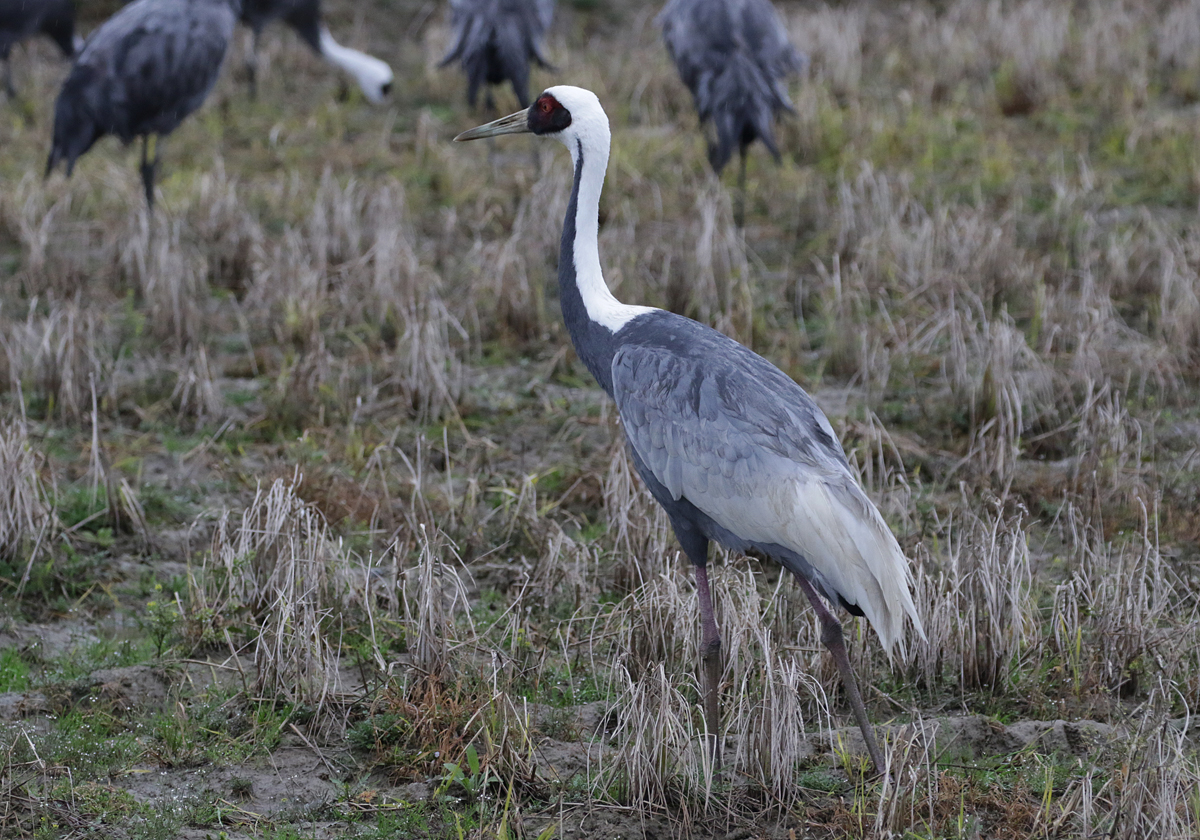
White-naped Crane; the most elegant and photogenic of the Arasaki regulars.


Hooded; by far the most numerous of the crane species.


There is a marked difference between the lightest and darkest Hooded Cranes. Immatures are always dark, adults vary from immature blackish-grey to Common Crane-grey. These two provide a good example of light and dark.


The less common light grey and usual dark grey Hooded, at a distance the lighter birds can raise hope of Common or Sandhill. Birds like this might raise the question whether they are hybrids with Common Crane but there seem to be too many of them and they don't show other features that would indicate hybrid origin.


I'm not in a position to know what is and is not a hybrid Hooded x Common Crane but the following images I've taken in the past show birds I believe are hybrids.


To me this is an obvious hybrid, it's distinctly larger than Hooded and has clear intermediate plumage features.


Two shots of a bird which looks closer to Common.


Another closer-to-Common bird. But can they also look closer to Hooded like the pale grey Hooded above? As I said there seem to be too many pale Hooded Cranes whereas the number of these more obvious hybrids are more in keeping with the number of Common Cranes occurring at Arasaki.


Perhaps because I wasn't actually looking for them, I only saw single Common Cranes on two occasions on this trip. The first was a flight view only as it was heading away so I couldn't categorically rule out a hybrid. Below are images of the second bird.


Common Crane.


Part of the early morning gathering. Three Sandhill Cranes were conveniently at the roadside edge of the flock.


The following morning four Sandhills were right by the road through the net fence as I was driving by and I had to wait for them to walk away far enough to get a shot over the top of the net.


My best ever shots of Sandhill.

Friday, 8 January 2016

Arasaki January 6th

The 6th was my first full day in the area and a priority for anyone coming here has to be the cranes. Obviously that's how my day began, watching thousands of cranes on Higashi Kantaku, but because I'd heard the Scaly-sided Mergansers were back on the upper reaches of the Sendai River a lot of the day was spent in a fruitless search for them.


I first saw Scaly-sided back in 1988 - and I walked 50km that day to do it - but I haven't seen another since. It's not that I haven't tried, believe me I have. Let's just say if you want to see Scaly-sided, don't come birding with me. And lookout for my forthcoming publication "Viewpoints Along Hard To Access Rivers In Japan", it's sure to be a best seller... aren't tricky species supposed to get easier once you've finally connected with one?


Back to Arasaki where at least the cranes are hard to miss.


It's sometimes said that less is more and this is my attempt to prove it... a nice solitary Hooded Crane. Solitary Hooded Cranes are a great rarity here.


I don't know who said that though, so down to business...


...cranes as far as the eye can see. Add to these the flock in front of the crane centre plus all the birds that don't make this their first port of call and we're talking serious crane numbers.


Below is the second (and closer) of the two Common Cranes I saw that morning but looking at the images now I'm wondering if it isn't a Hooded hybrid. The other Common Cranes I saw didn't have the suspicious darker grey patches on the back and the head markings don't look as clear-cut as "real" Common Cranes. I'll have to look into it when I get back. Nice bird though.


Our Hoodies also come in a fetching range of greys...


From a distance I thought the pale bird in these shots was going to be my first Sandhill of the trip. Most birds seem to vary from mid- to blackish-grey but this was by far the palest bird I saw and by the final day of the trip was still an outlier.


Speaking of Sandhill...


...five was the most I ever saw together.


While Hooded come in a convenient frame filling size and Sandhill are positively dinky, White-naped is heading in the other direction. They're absolutely huge, well, as long as there aren't any Siberian White around.


And just to show it's not all larger-than-life glitz and glamour I'll end this with a couple of Little Ringed Plover shots before starting my (I'm guessing) 14 hour drive back to Kyoto.


Sunday, 10 November 2013

crakes to cranes

Eastern Water Rail and Ruddy-breasted Crake can both be found in the region, they're widespread but local. The latter likes reedy streams and ditches or small ponds with well vegetated surrounds. The Rail can be in similar locations but is often associated with larger marshes or woodland with standing water. It is quite common at a series of ponds and marshy wooded fringes of Lake Biwa just south of the Kohoku Wild Bird Center in winter. They can even be heard in the narrow strip of reeds in front of the center but they are next to impossible to see there.

Lake Abashiri, Hokkaido, August 2012.


Juvenile phaeopyga, Ruddy-breasted Crake at Kijyoka, Okinawa 2011.

Watercock is a rare visitor to the region, one spent some time in marshes at the Uji River in Kyoto a few years ago. White-breasted Waterhen is less rare but not to be expected, they are however very common in the southern islands and sometimes turn up on Hegurajima.

White-breasted Waterhen at Kijyoka, Okinawa August 2011.

White-breasted Waterhen on Iriomote where they are very common, April 2013.

Though with absolutely no connection with Kansai whatsoever I can't resist including Okinawa Rail, once so difficult for visiting birders to see it no longer seems to present any problems.

Okinawa Rail at the roadside August 2011.

Moorhen is very common in the region, as is Common Coot in winter with 10,000s on Lake Biwa though numbers are very low in summer.

Juvenile Moorhen, August.

Worn adult, August.

Fresh adult, December.


Common Coot on Lake Biwa, February 2014.

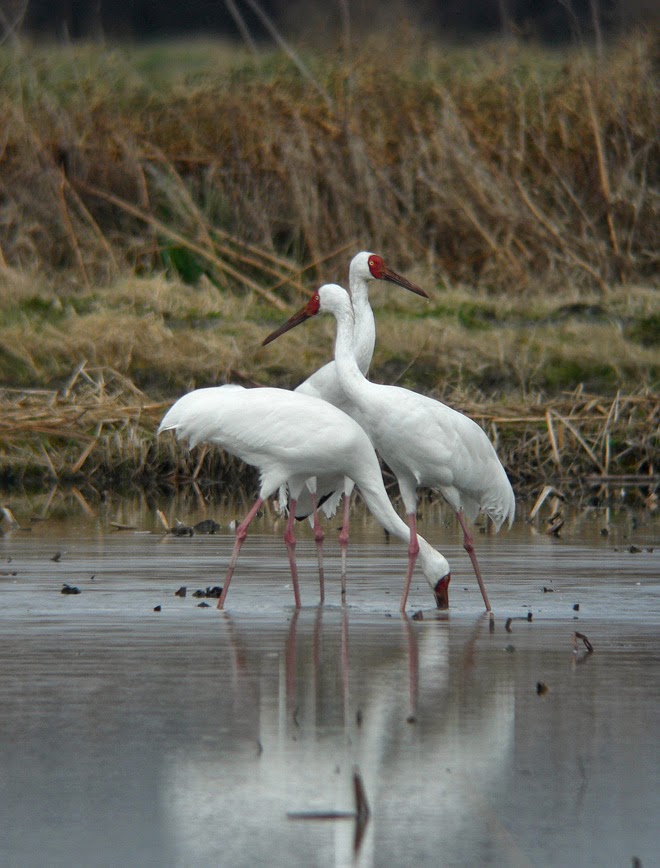
The only crane that occurs in the region is Hooded, but that only rarely. A few years ago one wintered at Lake Biwa and a small group passed through southern Osaka. There's been one in Hyogo this month (November 2014). Of course no one comes to Kansai looking for cranes and Arasaki is one of the most famous sites in the country, a must go to location. Watching thousands of cranes flighting in each morning is a true birding spectacle, the shots below were all taken there except the Japanese in Hokkaido and Siberian White in Shikoku.

A trio that wintered in Kochi, Shikoku. Here photographed in the north east of the island on their way north 2 March 2014.

Hooded Cranes packed in at the feeding site early in the morning.

Hooded and White-naped.

A distant Sandhill.

Hybrid Hooded x Common.

I've seen Demoiselle at Arasaki but haven't been there during a "Siberian winter". Red-crowned seems to be the rarest of the species visiting the area but as most visitors will want to head up to Hokkaido that isn't a problem.

                                              Red-crowned Cranes, Hokkaido January 2013.