After flushing three female Copper Pheasants and hearing a drumming male three days earlier I was really keen to get back to the same area in the hope of managing a photograph of them. I ought to say it was a very optimistic hope, this is a species I've never been able to get a shot of. I used to see them regularly in fact, often very well at that, behind a house I lived on Mt Inari in Kyoto city. That was a good few years ago now, in pre-camera times, and those Pheasants have long since been extirpated from that location. They can still be found on other hills close to the city but I prefer going further north where there are additional species such as White-backed Woodpecker that I'm not likely to see close to home.
In the end I was successful, well partly successful, and managed to get a couple of blurred shots of a male as it ran up a hillside. Nevertheless I'm delighted to have even these blurred images to show for my first ever attempt to target this species.
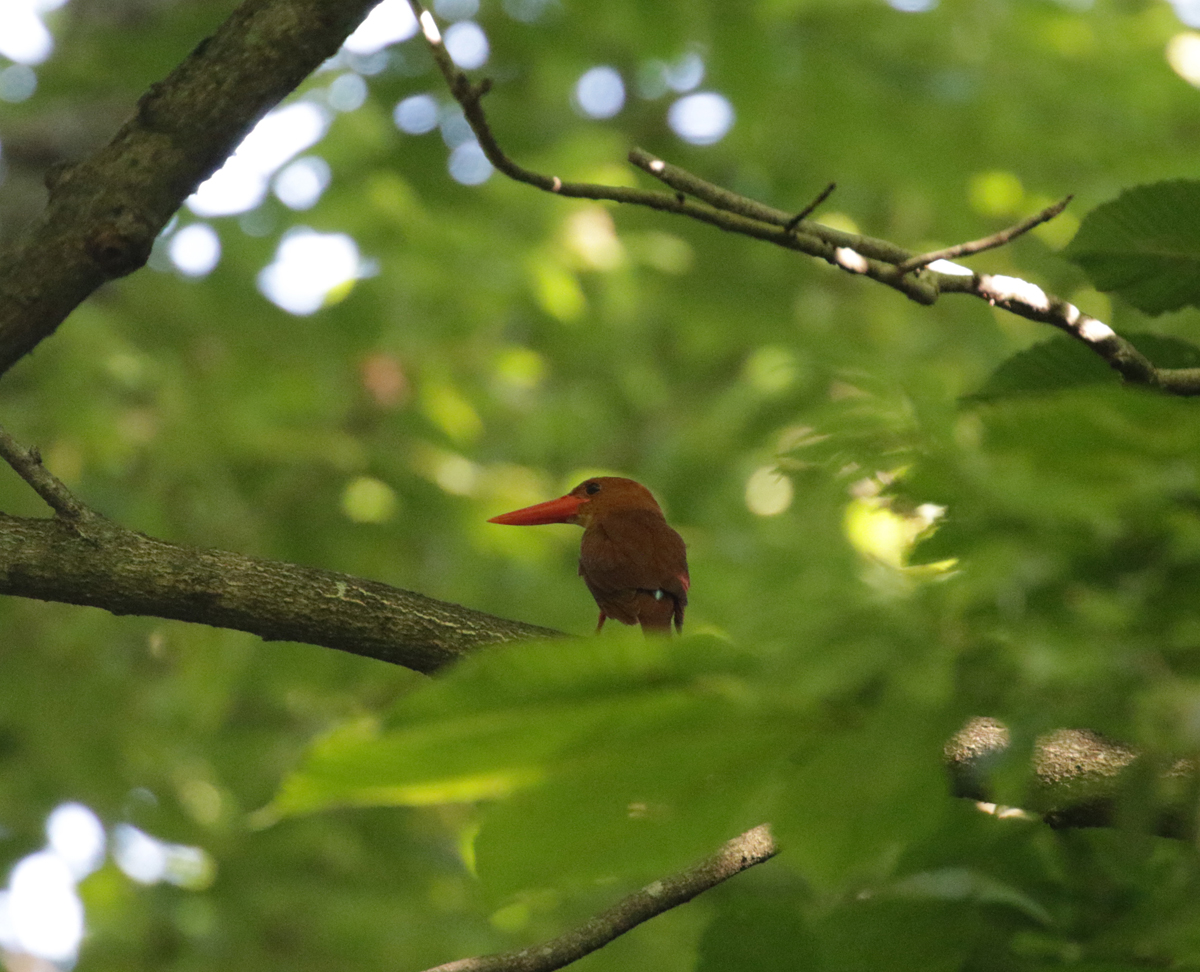
Copper Pheasant: not great shots but it's a start.
I arrived well before dawn, stopping in exactly the same spot as the previous visit. Still no Ural Owl but where there'd been just a single Japanese (Collared) Scops Owl "singing" now there were six. A week prior to this there hadn't been any; spring has clearly arrived as far as the local Scops Owls are concerned.
Heading into the woodland I ignored the throb of Copper Pheasant display coming from the same direction as on the last two visits. It simply isn't possible to make a stealthy approach through deep leaf litter on these vertiginous slopes, but instead of immediately repeating the ridge top trail walk that's proved quiet productive recently I detoured down a steep side path. I soon heard, almost felt, the resonant throb of another male Copper Pheasant displaying. The sound of its beating wings continued intermittently from the same general area as far as I could judge but after a while it fell silent so I sat and waited in case it came creeping along the slope below.
The patient approach didn't pay dividends so I retraced my steps up the hill then along the ridge trail. It was rather quiet, no sign of the recent Common Crossbill, no roving parties of tits, not even flocks of Siskins which have been such a constant of late. I did hear a Japanese (Eurasian) Skylark passing overhead which must have been migrating and likewise a party of White Wagtails that crossed the ridge. Disappointing; even the usual persistent Pheasant had stopped displaying as I made my way back to the van.
As I approached the small car park at the end of the service road up the mountain a Japanese macaque slipped easily off the pavement onto the steep downward slope. It was part of a small troop moving through the forest, well spaced and calling as they went, contact calls I imagine. I've never seen macaques here before and these were wilder than any macaques I've seen in Japan. At best the macaques I usually encounter are so habituated to people they can suggest a visit to the zoo, at worst they can be an absolute menace because they associate humans with food. These were different, aware of my presence they bolted across any open spaces to and from cover calling loudly each time. Though I only saw eight animals in total, they took almost as many minutes to pass. The subdued vocalisations as they moved steadily along the hillside added to their purposeful, even predatory air. This seemed an authentic encounter, how very different to sometimes needing to step around animals on the path in the Kyoto area.
I'd driven about half a kilometre and reached my early morning owl spot when something else seemed to catch my eye, I wasn't even certain if it was real or imagined, just a hint of something pouring itself over the lip of the road. I suspected a smaller, stealthier animal, perhaps a Japanese marten, but I couldn't see anything when I got there. Martens are usually bolder than this. As happens so often in this sort of situation just as I began to relax thinking "it's gone" or "it was nothing" a female Copper Pheasant burst out of the only scrap of vegetation just below me. It blazed across the narrow valley, rounded a crag and vanished. A spectacular but unphotographable experience. It was only then I noticed the male Pheasant, the one that allowed me to snatch a couple of blurry shots, standing at the foot of the crag. A half-hearted, silent wing flap was his undoing, if he'd remained motionless I'd probably never have noticed him. But as soon as he was aware I had, he scurried up the bare slope beside the rocky outcrop, found cover, then he was gone. All the way to the top as a burst of full-blooded wing throbbing display attested - it seemed like unwarranted defiance to me.
The next male I came across was lower down the mountain. I was intent on a pair of displaying Japanese Woodpeckers putting on a great show when it flew from the track ahead of me. A full 100 metres and round a curve ahead of me! I'd never have seen it if not for the explosive burst of wing beats as it launched off the hillside. As it was I just glimpsed it through the crowns of the cedars, so steeply does the hillside fall away that after only 20 metres of direct flight it was already in the canopy of lower trees.
 Willow Tit: a bird I infrequently see around Kyoto city in winter is quite common here.
 Coal Tit: along with Eurasian Siskin this is one of the most obvious species on the mountain.
The morning had been excellent but towards noon it was time to head down to Lake Biwa.
Neither the Smew nor Eurasian Spoonbill I'd seen three days earlier were present on the pond near Lake Biwa so I made my way south to Saino-ko, another lake close to Biwa. This has a winter harrier roost, good numbers of Eastern Marsh and Hen. When I arrived my expectations were deflated by extensive reed cutting underway. The reeds on my local marsh in Kyoto are cut in December, then burnt off to promote new growth in spring. I suppose this later cutting at Saino-ko allows the harrier roost to go undisturbed throughout winter but that it is cut at all is a pity. Not really encouraging for breeding bitterns prospects.
 Eastern Marsh Harrier.
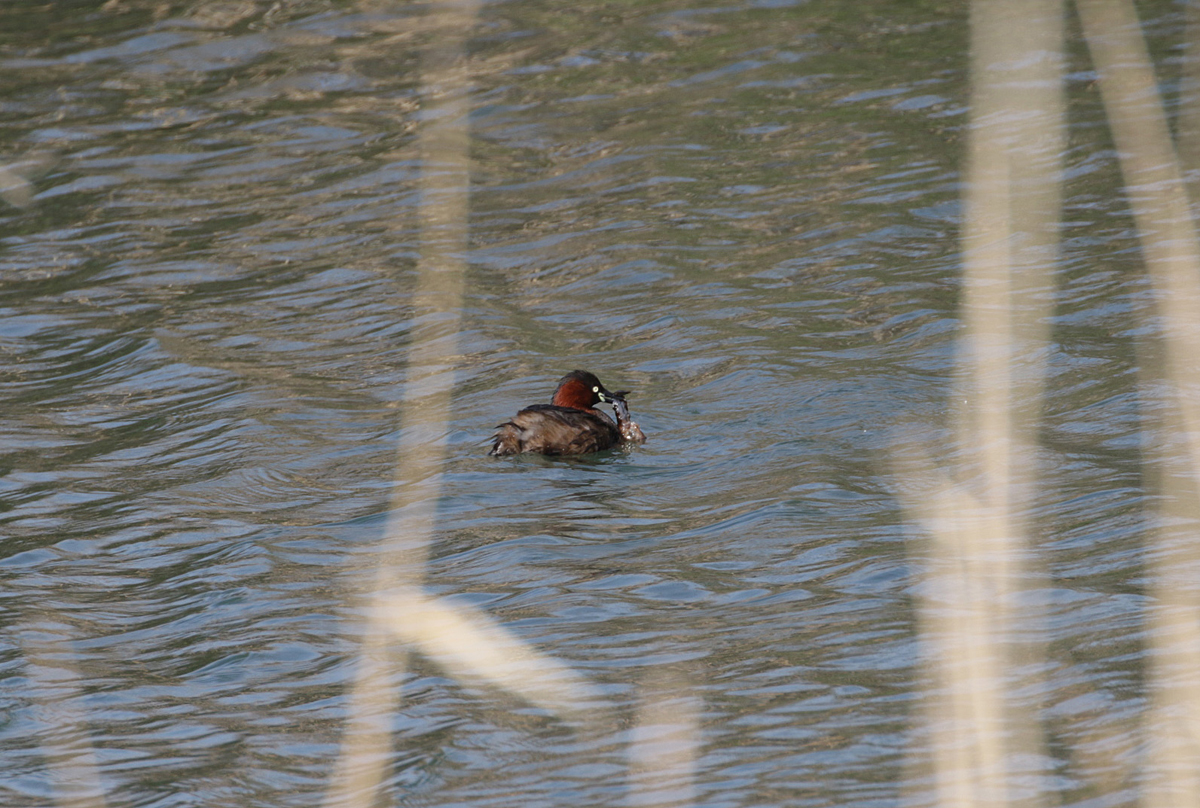
I was far too early for harriers coming in to roost but while I was there two Eastern Marsh Harriers and one Hen did fly by. Another fly-by was my first Kansai Barn Swallow of spring, on schedule I'd say. I heard both Eastern Water Rail and Ruddy-breasted Crake, the later singing, and a striking male Long-tailed Rosefinch at a feeding station was good. A Siberian weasel was having noisy fun under the van but views through the windscreen were brief when it finally came out because another car happened along and stopped just at the wrong moment. Yet another point of interest was watching a Little Grebe struggling with a fresh water shrimp of some kind. It was thrashing its prey around for a couple of minutes then I got distracted when a male Merlin dashed by and perched briefly so I never got to see whether it actually ate this shrimp or not.
 Little Grebe with shrimp. Breeding plumage accentuates the stunning white eye of poggei.
List of species recorded:-
Copper Pheasant 2 males plus 2 others heard, 1 female
Gadwall 15+
Falcated Duck 6
Eurasian Wigeon common, though numbers greatly reduced
Mallard 30+
Eastern Spot-billed Duck fairly common
Northern Shoveler 25-30
Eurasian Teal c15
Common Pochard 1
Tufted Duck c100
Little Grebe several
Great Crested Grebe 10+
Grey Heron several
Great White Egret 5
Little Egret 1
Great Cormorant common
Merlin 1 male
Osprey 1
Black Kite common
Eastern Marsh Harrier 4
Hen Harrier 1
Eastern Buzzard 1
Eastern Water Rail 1 heard
Ruddy-breasted Crake 1-2 heard
Common Coot very common
Grey-headed Lapwing 1 heard
Long-billed Plover 1 heard
Common Gull c10
Black-headed Gull 1
Rock Dove c40
Oriental Turtle Dove several
Japanese (Collared) Scops Owl 6
Common Kingfisher 1 heard
Japanese Pygmy Woodpecker common
Great Spotted Woodpecker 1
dendrocopos sp several heard
Japanese Woodpecker 2 plus 1 heard
Bull-headed Shrike 3
Jay c6 heard
Carrion Crow common on arable
Large-billed Crow common, especially in forest
Great Tit common, the only tit common along the lake side as well as in the mountains
Coal Tit common
Varied Tit fairly common
Willow Tit common
Barn Swallow 1
Long-tailed Tit common
Japanese (Eurasian) Skylark several
Brown-eared Bulbul several
Japanese Bush Warbler many singing
Wren 2-3 plus many heard
White-cheeked Starling common
Pale Thrush c10 including 1 singing
Dusky Thrush common on arable land
Daurian Redstart 1
Blue Rock Thrush 1
Eurasian Tree Sparrow common
White Wagtail fairly common
Japanese Wagtail 1heard
Buff-bellied Pipit several
Brambling 2-3 heard
Oriental Greenfinch common
Eurasian Siskin common
Long-tailed Rosefinch 1
Eurasian Bullfinch 3 parties heard
Japanese Grosbeak 3 heard
Meadow Bunting common
Rustic Bunting 4
Black-faced Bunting fairly common
Reed Bunting common