Showing posts with label Stork Black. Show all posts

Sunday, 26 December 2021

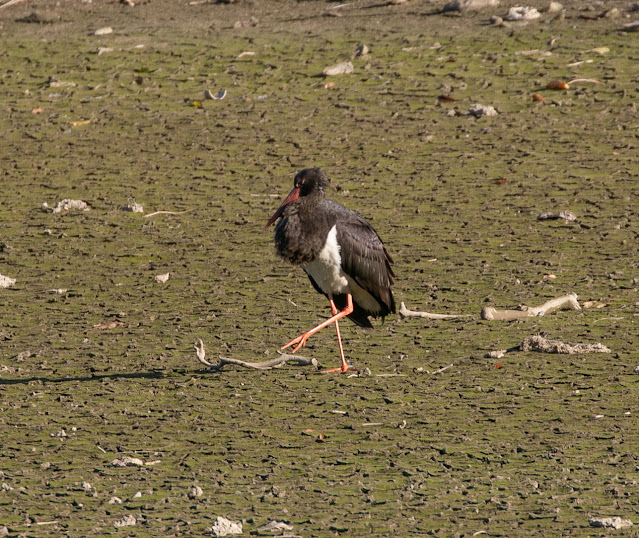
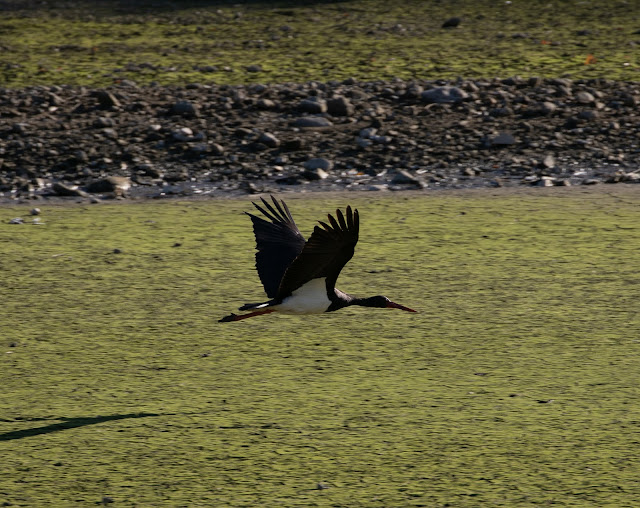
Black Stork in Wakayama

I wonder how much money I could have saved by not having gone for a rare which later turned up in Kansai. Better not think about it I suppose. Right now there's a Song Thrush in Osaka which would have saved a drive to Kanagawa and a Black Stork in Wakayama which would have saved a drive to Kyushu. 

Let's contrast a 200km round trip with no toll roads Black Stork, with a 1,200km round trip on mostly toll roads Black Stork. And that there were two Storks at Isahaya does not make that trip doubly worthwhile. No contest really; oh for a crystal ball! Last December it was a trip to Choshi for Yellow-bellied Tit, another 1,200km round trip, and immediately after that a bird turns up in Osaka. But you've got to go, haven't you? Now, I'm considering what the odds of a Bald Eagle turning up in Kyoto might be...? Exactly. Another trip to Hokkaido looms large in my near future, me thinks. Well, assuming the bird comes back this winter. 

Anyway, I heard about this Stork about three weeks after it had arrived and drove down at the first opportunity. The aim was to get on site (just south of Wakayama city) for dawn, on what turned out to be the then coldest night of the winter so far; roadside gauges consistently registered zero degrees.

After getting advice on where best to park from people already there, I walked back to the almost dry reservoir. Heading upstream from the dam end into the strong, low sun, made it difficult to see whether the Stork was present or not. It hadn't seemed to be when I'd driven a couple of circuits earlier. I had no idea where it roosted, what time it came in, or even whether it did come every day. The Kyushu Storks could be very difficult to connect with so I didn't think of this bird as nailed-on. On the other hand, perhaps it roosted on the reservoir and never left?

I needn't have worried, two thirds of the way along I saw the bird drop in up ahead, it was still necessary to get right up to the far end to have the light at a better angle to see the bird well. I don't know whether the it had flown in from the surrounding hills or up from the deep stream bed running through the centre of the reservoir. It soon disappeared (back?) into that stream an hour until flushed by a photographer who'd gone through some properties on the far side of the reservoir, hoping to be able to see into the stream gully I presume. Not the result he'd been hoping for I imagine, but everyone else got a great view as it flew towards us and landed on the still frozen ground 100m away.


The earliest view after it dropped in. It stood preening for a moment on the heavy frost of the dry reservoir bed before making for the stream in the background, where it caught a couple of small fish on the 'S-bend'. It then disappeared behind the increasingly deep stream banks to the right.

The following images show it after it was flushed out of the stream, affording some great views, until it flew back into the stream again.


By the time it came into the open a third time we'd all been there about four mostly cold hours, while the bird had been on view for perhaps 15 of those minutes. The lower reaches of the reservoir had been in sun all morning and were frost-free by this time so as the bird quickly made its way downstream to the standing water the backdrop seemed to change form winter to summer.


A great bird, and if not as close as the Kyushu birds perched on utility poles, it put on a much better overall performance thanks to several short distance, back and forth flights.


Tuesday, 10 January 2017

Barn Swallow yes, Japanese Murrelets... no

After a final morning around Arasaki I drove inland to Satsuma for yet another pointless crawl along the river, checking every view point for miles looking for the mythical Scaly-sided Mergansers. I've lost count of how many times I've done this but, finally, with darkness fallen and duty done I was free to continue across the island to my next port of call; Kadogawa harbour for Japanese Murrelet.


The best views I usually get of Japanese Murrelet are on the return leg of the Hagi-Mishima ferry but my hope in Kyushu was to find an easily photographable bird in the harbour. Perhaps a long-shot on a calm morning but worth a try. I was positioned on the end of the harbour wall before sun-up and was disappointed, though hardly surprised, to find the harbour empty of Murrelets. Pretty much empty of anything in fact. There were plenty of birds on the sea side of the wall Great Crested and Black-necked Grebes, some quite close. Two species of cormorant, the usual gulls of course and way out towards the reddening horizon a tiny speck which the scope revealed to be a small alcid. This tiny silhouette against the rising sun can only realistically have been Japanese Murrelet but being unable to even get a certain identification is a far cry from the aim of getting a decent photograph of a bird in the harbour, so this visit will have to go down as another missed bird.


By the time I got back to the car the sun was brighter and early morning dog-walkers were up and about. So too was my first flock of Barn Swallows for the trip. I was a bit surprised not to have run into any thus far but today was to make up for lost time; in addition to the 16 birds on the wires next to the harbour there was another flock of about 20 in Kadogawa town as well as numerous birds, singles or parties, as I travelled south once again along the coast in the direction of Miyazaki city.


Barn Swallows in the early sun.


The next stop was Greater Spotted Eagle, another bird I'd seen before so there was no pressure, no fear of dipping. Just as well. What was it about this trip? Black Storks, Scaly-sided Mergansers and Greater Spotted Eagle, a total failure with the returning rarities this time. I don't know whether there was Forest Wagtail at Miike this winter but on this form I'm pleased I gave the place a miss.


Though I failed with the Eagle, I did get pretty good views of a female Eastern Marsh Harrier. It's a puzzle to me why the vast majority I see in Kansai, certainly at Biwako, are juvenile/first winter birds while there are plenty of adults (as you might expect really) elsewhere. This trip has been adults 4 - juveniles 0, a convincing result.


Female Eastern Marsh Harrier.


Despite missing the returning rares I really enjoyed my time in Kyushu, there are so many birds I hardly ever see in Kansai, if at all. I saw five Eastern Yellow Wagtails which I've never seen in Kansai, there were parties of Chinese Penduline Tits which I used to see regularly near Kyoto but no longer (that way simply be down to habitat loss at the site I visit), I mustn't forget masses of cranes and also Caspian Tern at the same place for the second winter in a row... that was a Japan tick for me at this time last year! Big flocks of Common Starlings and a Brown Booby and even unusually good views of Daurian Jackdaws add both to the sense of the exotic and the feeling that a major rarity could be waiting to be found somewhere, anywhere, in this exciting part of Japan.


And is it possible to see these returning rarities? Well yes, I've seen them in the past...


Forest Wagtail


Black Stork

The original Black Stork post is here


Greater Spotted Eagle

The original Greater Spotted Eagle post is here

Sunday, 28 December 2014

Black Storks and Yellow Wagtails, Isahaya Bay

As I already posted, Booted Warbler was the star bird yesterday. But far from the only bird.

I arrived at the expanse of fields at about 10am and drove down the central road to the seawall to get a feel for the area. I didn't really expect to connect with the Storks on the way across, but it would have been nice. I was at a loss even where to start looking and a systematic approach might not be the best option with a potentially mobile target. But luck was on my side and after an hour, almost out of my search area towards the south, I caught site of a Stork flying off in the distance. It landed atop a utility pole and fortunately stayed there as a landmark while I made my way towards it. As I approached it dropped down onto the fields where I realised the other bird had been all along. I would never have found the birds at that location had I not seen one drop in, it really was amazing good luck to have been facing the right way to glimpse the distantly flying bird. A truck flushed them onto utility poles not far off as the Stork flies but it was some minutes before I could make my way dog-legging across the fields and bridging the levees across the flood gates. It was well worth it!


I'd almost forgotten I was in crane country but noisy flock of 33 Hooded Cranes crossing the fields was a reminder of what a great place Kyushu is for birding, though some birds, like this beautiful, very pale Merlin, I can see in Kyoto.


Hooded Cranes

The most productive location I found was an old maize field that was being cut. A huge flock of Rooks drew attention to it and though there were no hoped for Daurian Jackdaws with them there were plenty of other birds gathered around the rapidly shrinking stand of withered crop. About 50 European Starlings were easy to see, others less so. A Japanese Quail flushed by the harvester was totally unexpected.


Starlings perched in the final row of maize, everything was gone within 30 minutes of my arrival.


While the Quail was a surprise, it was nothing to the shock of finding the Booted Warbler of course and I can't resist posting a couple more shots of it.


There were also about 200 Buff-bellied Pipits and the same number of White Wagtails attracted to the feast. Though the only Red-throated Pipit I had was a bird calling overhead earlier in the day. There weren't any unusual White Wagtails as far as I could see but three Yellow Wagtails were far more exciting.


These are possibly the only winter Yellow Wagtails I've seen in Japan and it was interesting to see how much they differed, one very dark, another extensively yellow below and the third a pale grey individual.


Two shots of the dark bird with a very dark mask and almost thrush-like breast.


I only saw this bird briefly, it was much greener above and yellower below.


A very grey individual with greenish mainly restricted to the ear coverts but with some on the crown and mantle while pale yellow was limited to the throat.


As the afternoon wore on several Racoon Dogs came up onto the roadside and it was distressing to see how badly they're suffering with mange.


List of birds seen:-
Japanese Quail   1
Green Pheasant   1
Common Shelduck   1
Mandarin Duck   c50 on a reservoir en route to Isahaya
Eurasian Wigeon   100+
Mallard   common
Eastern Spot-billed Duck   common
Eurasian Teal   9
Common Pochard   common
Little Grebe   5
Great Crested Grebe   2
Black Stork   2
Grey Heron   several
Great White Egret   c5
Little Egret   10+
Pacific Reef Egret   1 en route
Great Cormorant   several
Eurasian Kestrel   4-5
Merlin   2
Osprey   several
Black Kite   several
Eastern Marsh Harrier   3-5
Hen Harrier   2
Eastern Buzzard   1
Moorhen   several
Common Coot   several
Hooded Crane   33
Northern Lapwing   c45
Common Snipe   1
Green Sandpiper   3-4
Rock Dove
White-bellied Green Pigeon   1 heard en route
Oriental Turtle Dove   fairly common
Common Kingfisher   5-10
Bull-headed Shrike   5-6
Rook   c500
Carrion Crow   fairly common
Large-billed Crow   several
Great Tit   1
Long-tailed Tit   a party en route
Japanese Skylark   common
Brown-eared Bulbul   fairly common
Japanese Bush Warbler   1 heard
Booted Warbler   1
Japanese White-eye   several
White-cheeked Starling   several
European Starling   50+
Pale Thrush   common
Dusky Thrush   fairly common
Daurian Redstart   common
Eurasian Tree Sparrow   common
Eastern Yellow Wagtail   3
Grey Wagtail   1
White Wagtail   very common
Japanese Wagtail   1
Red-throated Pipit   1 heard
Buff-bellied Pipit   common
Brambling   80-100
Oriental Greenfinch   several
Japanese Grosbeak   1 heard en route
Meadow Bunting   several
Black-faced Bunting   several
Reed Bunting   fairly common