Showing posts with label Crane Siberian. Show all posts

Monday, 3 March 2014

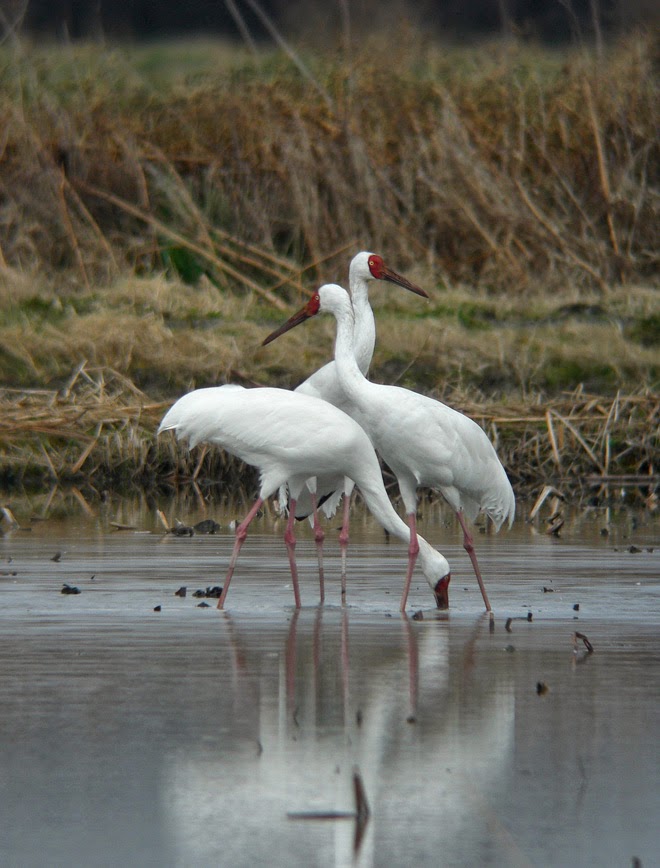
Siberian White Cranes


Yet another Japan tick, what a great start to the year it's been. These fantastic birds wintered near Tosa (Kochi prefecture) in Shikoku, slightly beyond the distance I'd be willing to go for them. How far I'd twitch beyond Kansai depends on the bird, its rarity and whether a lifer or not impart a degree of elasticity to the invisible boundaries of my got-to-go-zone. Magnificent as these birds are are, I always imagine our visits to the crane wintering grounds in Kyushu will coincide one of these winters... and Tosa is a long drive. However, when they decided to relocate to just the other side of the Nishi Akashi Bridge, about halving the distance, any common sense reason not to go could be safely binned.

Siberian White is a fairly regular though not annual winter visitor to Japan but three birds together is unheard of, at the very least in recent times, and significantly ups the wow factor.

I found another albus Great White Egret at the site, it briefly joined the Cranes before flying much closer and giving excellent views. This is my third this winter and mirrors 2012 when I found two in quick succession, it's possible I overlook some birds but it is always something I look out for. Quite by chance, not long after I'd seen this bird, a Japanese birder I met there suggested I look out for O Dai-sagi (this taxon) as he'd seen one or two around this winter which he considered unusual for the area, suggesting I'm not missing too many.


The albus Great White Egret dropped in with the Cranes and though small by comparison, it stands up surprisingly well.


Sunday, 10 November 2013

crakes to cranes

Eastern Water Rail and Ruddy-breasted Crake can both be found in the region, they're widespread but local. The latter likes reedy streams and ditches or small ponds with well vegetated surrounds. The Rail can be in similar locations but is often associated with larger marshes or woodland with standing water. It is quite common at a series of ponds and marshy wooded fringes of Lake Biwa just south of the Kohoku Wild Bird Center in winter. They can even be heard in the narrow strip of reeds in front of the center but they are next to impossible to see there.

Lake Abashiri, Hokkaido, August 2012.


Juvenile phaeopyga, Ruddy-breasted Crake at Kijyoka, Okinawa 2011.

Watercock is a rare visitor to the region, one spent some time in marshes at the Uji River in Kyoto a few years ago. White-breasted Waterhen is less rare but not to be expected, they are however very common in the southern islands and sometimes turn up on Hegurajima.

White-breasted Waterhen at Kijyoka, Okinawa August 2011.

White-breasted Waterhen on Iriomote where they are very common, April 2013.

Though with absolutely no connection with Kansai whatsoever I can't resist including Okinawa Rail, once so difficult for visiting birders to see it no longer seems to present any problems.

Okinawa Rail at the roadside August 2011.

Moorhen is very common in the region, as is Common Coot in winter with 10,000s on Lake Biwa though numbers are very low in summer.

Juvenile Moorhen, August.

Worn adult, August.

Fresh adult, December.


Common Coot on Lake Biwa, February 2014.

The only crane that occurs in the region is Hooded, but that only rarely. A few years ago one wintered at Lake Biwa and a small group passed through southern Osaka. There's been one in Hyogo this month (November 2014). Of course no one comes to Kansai looking for cranes and Arasaki is one of the most famous sites in the country, a must go to location. Watching thousands of cranes flighting in each morning is a true birding spectacle, the shots below were all taken there except the Japanese in Hokkaido and Siberian White in Shikoku.

A trio that wintered in Kochi, Shikoku. Here photographed in the north east of the island on their way north 2 March 2014.

Hooded Cranes packed in at the feeding site early in the morning.

Hooded and White-naped.

A distant Sandhill.

Hybrid Hooded x Common.

I've seen Demoiselle at Arasaki but haven't been there during a "Siberian winter". Red-crowned seems to be the rarest of the species visiting the area but as most visitors will want to head up to Hokkaido that isn't a problem.

                                              Red-crowned Cranes, Hokkaido January 2013.