Showing posts with label Pipit Tree. Show all posts

Monday, 9 November 2020

Tree and Red-throated Pipits

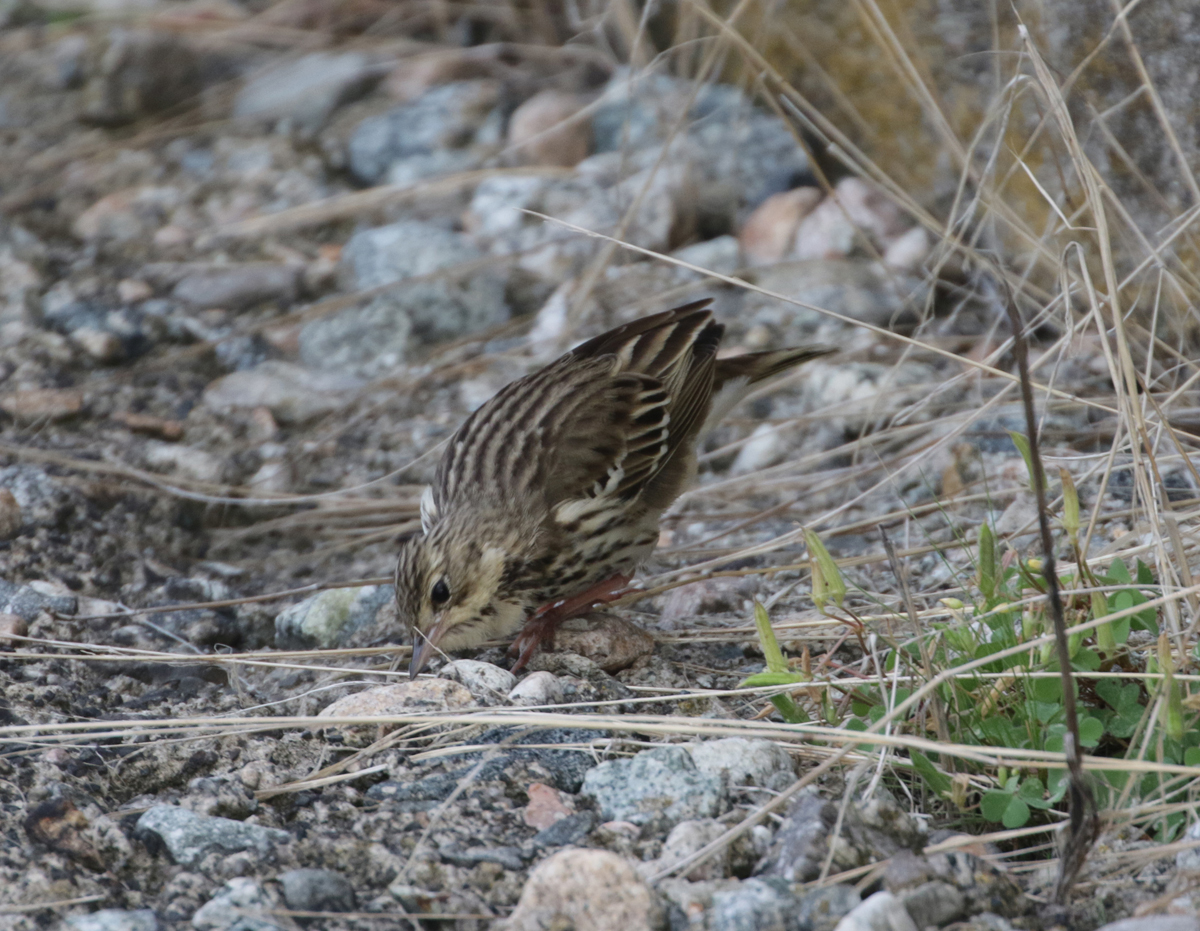
 It's been 16 years since I last saw a Tree Pipit in Japan, that also on Hegura, though I did manage to miss one by only seconds on Tsushima in spring. I almost missed this one too!

I came across a pipit in the morning on the open concrete area at the north end of the harbour and dismissed it as a first autumn Red-throated. In my defense it's a favourite spot for Red-throated Pipits, Tree Pipit superficially looks like a first autumn Red-throated and I was chatting at the time. Fortunately I got another chance when I ran into the same bird again in the late afternoon, this time at the opposite end of the harbour. It dropped down from one of the small ornamental pines onto the lawn at the ferry terminal and immediately vigorously pumped its tail. It had to be an Olive-backed Pipit, right? Getting my bins on it, the heavily streaked mantle immediately knocked that idea on the head but there was no thought of Red-throated this time; upgrade to Tree Pipit. What a difference a tail pump makes. Once on the deck I initially picked up a supercillium drop but then it seemed to disappear. It was very subtle and the same 'now you see it, now you don't' occurred in the photographs I took too.

The previous bird I'd found so long ago was instantly recognizable as something different because it was such a pale, almost sandy coloured bird, whereas this individual was much darker and made me  feel a little better about my misidentification earlier in the day.

Brazil's Birds of East Asia treats OBP as the potential confusion species with Tree, which is fair enough it being a common species across Japan as a whole. However the text completely ignores the far more similar first autumn Red-throated. 

I saw several first autumn Red-throated Pipits on Hegura mid-month but the only bird this trip was an unseen fly-over calling. So I'll compare this Tree Pipit with first autumns I've seen in this and previous Octobers.

Tree Pipit. The contrast between heavy breast markings and fine flank dashes are distinctive however Red-throated does have fine streaks low on the flanks but also a bolder line higher on the flanks close to the wing. The very stout, deep-based bill is obvious here, the supercillium drop is far less so. 


Red-throated Pipit. Fine flank dashes low on the flanks but broad, heavy markings above. The bill is very fine compared to Tree, the ear coverts more uniform. This individual shows paler braces.

Tree Pipit. Lack of braces, stout bill and inconspicuous supercillium.


Tree Pipit. Rather plain rump and uppertail coverts.

Red-throated. Heavy flank streaking and plain ear coverts. Note the very dark-centred uppertail coverts and more distinctly marked rump.

Perhaps it's worth posting my old digiscoped image of the Tree Pipit I found 16 years ago to show how different Tree Pipits can appear first glance and more pertinently or how some might easily catch the eye while others could be overlooked. In fact, looking more closely, the markings are actually very similar and it's only a matter of colour saturation that gives the superficial appearance of being rather different.

Tree Pipit. An overall paler individual with unmarked rump and fine flank dashes. 


Saturday, 17 May 2014

Olive-backed Pipits and my Tree Pipit mis-ID on Hegura

Last week I erroneously posted that I found two Tree Pipits on Hegura. I made a snap ID before having to dash for my ferry but I've no excuse for not picking up the mistake before posting! The pipits in question are clearly Olive-backed, however they are still of interest.


For years I used to look for yunnanensis without luck around Kyoto. About 25 years ago I'd been told it was a winter visitor to the region and therefore I had assumed it would also be a relatively common migrant. Despite checking primary projections on all birds I saw well enough, this was the only feature I'd been told could be used to separate the local hodgsoni and yunnanensis, I never did find any and concluded either they don't occur as often as I'd been led to believe, or they weren't sufficiently distinctive to ID in the field or that I just wasn't looking hard enough. I'd long since given up even thinking about them by the time the Birds of East Asia (Brazil 2009) came along and confirmed the Japanese population of hodgsoni has a longer primary projection than their continental counterparts. It suddenly  struck me I'd been barking up the wrong tree all that time. When I was told about continental birds I jumped to the conclusion that the birds referred to were yunnanensis, it seems not.


The two shots of the above crisp-looking February bird has a minimal primary projection and is interesting to compare with the following 30 April individual which has an easily visible primary projection. Whether this difference is sufficient to draw any conclusions regarding Japanese or continental populations I don't know. Trying to find a difference between populations of the same subspecies might in any case be a pointless exercise. Still, it has rekindled my interest in these birds and now that I have a camera it might make judging them easier.


The two birds I misidentified on May 6th were on the 'the green' in the harbour, I walked right past them once then deciding I'd better get on the ferry turned and almost trod on them. How I'd missed them on the short grass is beyond me. They flew up onto a fence, I looked at one of them through the bins and... ahha, Tree Pipits. I rattled off a few shots and ran for the ferry. Well, that's my excuse anyway.


One of the two landed on top of the fence and I paid it more attention as the other was partly hidden. I've never seen such a worn and brown Olive-backed and it's worth stressing the shots were taken six days after the fresh bird above. I think these two Hegura birds are actually yunnanensis on the basis of the very fine Tree Pipit-like flank streaks on both, as well as the lack of pre-breeding moult on one, which might suggest they belong to a far more northerly breeding population (or just that it is delayed for some other reason), and the very plain mantle on the other. As yunnanensis is the race breeding in Hokkaido this doesn't seem such a big deal but they are the only migrants I've seen that do appear to be this subspecies. Or at least the only two that look like this. Perhaps ultimately that I haven't been trying hard enough is the reason I haven't found such birds before.

Below are shots of the two Hegura Olive-backed in question.


Superficially unlike the Olive-backed I'm used to because of overall brown colouration. Lateral crown streaks not outstandingly darker than crown streaks, supercillium relatively dull compared to wing bars, very fine sparse flank dashes and rather black wing coverts with prominent white tips creating quite bold bars.


Incredibly worn tertials and little sign of any new pre-breeding feathers anywhere.

The exceptionally worn state of the plumage led me to suspect 2CY but the uniformity of the coverts suggests otherwise.


Self-shading reveals a creamy throat and breast with sharp demarcation to the white belly.

The second pipit is in much fresher plumage. The very fine dashes on the flanks and plain upperparts look quite different to the OBPs I'm used to seeing and I guess this must be yuannensis. I'm still puzzled why I've never seen birds like these before.


Just to prove Tree Pipits do occur on Hegurajima, I found this first autumn bird one September a few years ago.

Saturday, 25 January 2014

pipits


There are only two pipits the visitor can realistically expect in Kansai, Buff-bellied and Olive-backed. Buff-bellied is common, sometimes very common, in winter at Ogura. It can be found in any arable areas though usually at low density. Singles aren't always easy to find, fly-overs are as frequent as birds on the ground but concentrations gather in suitable fields and, like White Wagtails, flocks will follow a plough. I've always had an eye out for rubescens but as yet I've never seen anything that even aroused suspicion. Olive-backed always strikes me as incredibly loyal to favourite locations and these can be surprisingly small parks or shrine and temple gardens. In such places they are frequently under pines with little or no understorey. In Kyoto city the Imperial Palace is the best place to look. They can be just as loyal in forests or riverside areas and can be found at the same spot visit after visit despite what appears to be extensive suitable habitat.

In the Kyoto area Red-throated is a very uncommon winter visitor, I sometimes come across them at Ogura (exceptionally even 2-3 in a day) and I've seen them in Osaka and around Lake Biwa too. I don't normally see spring migrants here even though they can be very common on off-shore islands. Presumably the Japan Sea side of the region will be much better for them on passage.

Other species are rare; there was a Pechora along the Yodo River between Kyoto and Osaka for a couple of weeks in October 2012, a long-suppressed wintering Meadow Pipit at Ogura 2011 and I found a Richard's in the fields in Mie late one autumn. Over-wintering pipits probably don't get as much scrutiny as they deserve and are well worth checking for rare species.

Single Richard's are the norm on the islands but I've seen parties of 5-6 a couple of times. These birds on Tsushima (Nagasaki), 1 May 2012.

A wintering Richard's Pipit in Kyushu, January 2015.

Meadow Pipit at Ogura, 19 March 2011. The bird had been there for a couple of months before the news began to leak out. Even then I didn't get to hear of it immediately and when I did I was in two minds whether to go after work or hang on till the following morning when I'd have plenty of time. In the end I took all my gear work and got there late afternoon and joined quite a crowd gathered from all over Japan. It was as well I did go as it was never seen again!

I saw this Tree Pipit briefly on a beach on Hegura, 19 September 2004, but it didn't hang around.

One of two Olive-backed I originally identified as Tree in the harbour on Hegurajima, May 2014.

An OBP in favourite habitat. Senri Park, Osaka 15 February 2009.

Adult Red-throated on Hegura, this back in the good old days before the school closed and the playing field was still mown regularly, 9 October 2009.

First winter Red-throated on Hegura, 7 October 2011.

A winter Red-throated Pipit in Kyushu January 2015, plumage resembling breeding. The upperparts of the same bird below.  


A much more strikingly marked Red-throated Pipit together with the previous bird.

An October Buff-bellied (japonicus) on Hegura.

A standard japonicus in Mie, 7 January 2012.

A spring (10 April 2014) Buff-bellied coming into breeding plumage. Note the oddly hooked upper mandible.