The sky is getting light by 3:30am nowadays and I had plenty of time for birding at Rokkozaki before deciding what to do with the final day of this once-to-be three day trip. There were six singing Kamchatka Leaf Warblers this morning, Pacific Swifts and Red-rumped Swallows were passing through clearly there were birds to be found and with the notion of a lazy Sunday having already gone by the board even Hegura might still be possible. If the ferry were running that is.
Still in two minds I arrived back in Wajima and went to check at the ferry office.The boat was going and I had enough time to reach a convenience store for a coffee before departure. What to do: be sensible and drive towards home or go to the island? I had a busy week coming up and I'd get home very late and with little sleep over the weekend. The coffee hadn't helped me make up my mind but I gravitated back to the ticket office anyway. Compared to yesterday there were few cars in the car park, there might not be many birders out there. There might be some good birds out there. There could be a mega out there... not to mention a Swinhoe's Petrel from the boat. Before common sense prevailed I went and bought a ticket, if the ferry was going then so was I.
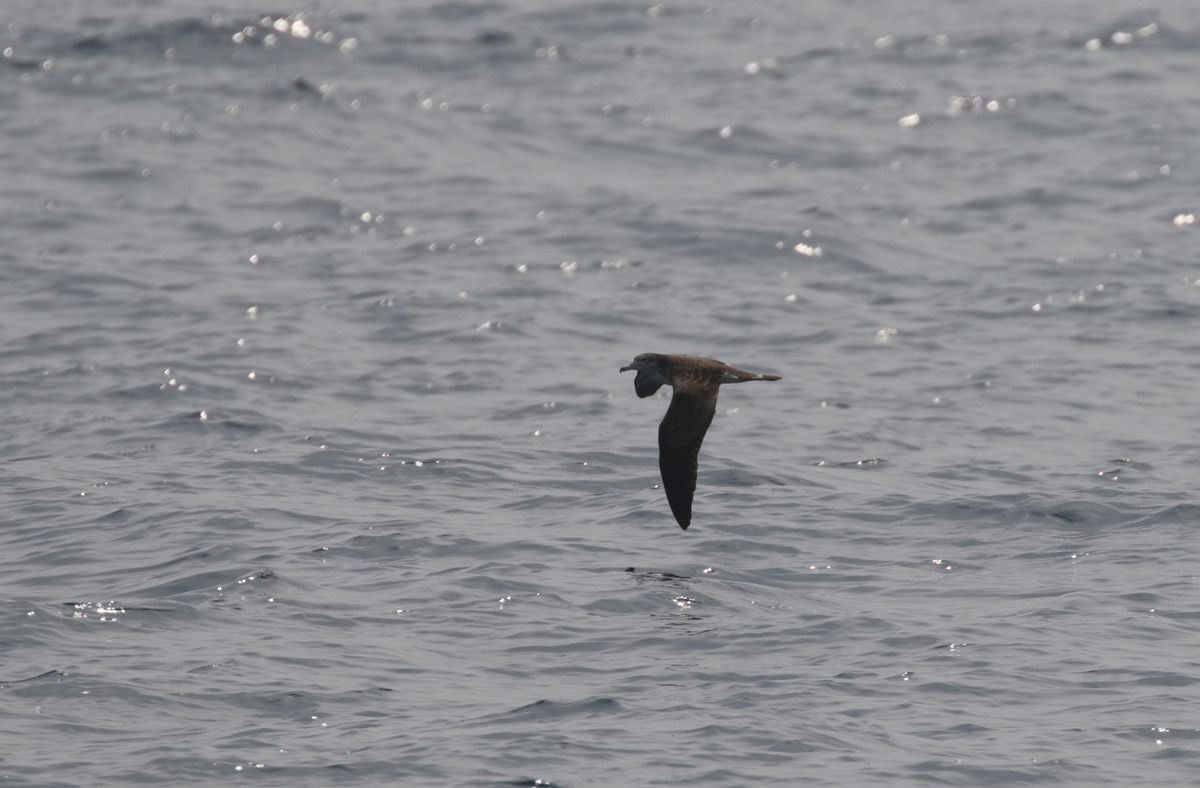
I hadn't really expect a Swinhoe's Petrel from the ferry of course, so I wasn't disappointed. The Streaked Shearwaters were good though.
Once on the island it quickly became apparent the Kamchatka Leaf Warblers at Rokkozaki had been no more than a taste of what could be found on the island. There had to be something else out here.
The Kamchatka Leaf Warblers were very vocal and unlike in autumn so many singing birds meant identification was that much easier. I suppose it's slightly surprising then that Rokkozaki provided the only Arctic Warbler when there were so many more warblers out here on the island. Unsurprisingly, total numbers of birds were lower than they would have been during peak migration period, or even just a week earlier. One of only two birders I met was bemoaning the general lack of birds, however the variety of species was quite good.
I found:-
Cattle Egret 1
Great White Egret 1
Northern Hobby 1
Eurasian Sparrowhawk 1
Lesser Cuckoo 1
White-throated Needletail 1
Broad-billed Roller (I hate the name Dollarbird) 1
Red-rumped Swallow 3
Black-browed Reed Warbler 1
Dark-sided Flycatcher 1
Asian Brown Flycatcher 2
Eurasian Siskin 1
Hawfinch 1
There were plenty of presumed local breeders to sift through too, Japanese Bush Warblers were performing everywhere.
This Black-faced Bunting probably wanted to be Yellow-breasted, it couldn't quite pull off the breast band...
And so many Black Woodpigeons! I saw ones or twos regularly at the southern end, the biggest party was four, and heard a couple more at the northern end.
In fact, though numbers of most species were low, there were new birds at every turn and the species tally grew steadily. My 4.5 hours on the island passed all too quickly and I felt certain there was something really exciting on the island. I still am to be honest. Before going out I'd been concerned I might be totally wasting my time but now I'm sure if I'd been able to stay there and put in the time I'd have found something special.
Showing posts with label Hobby Northern. Show all posts
Tuesday, 7 June 2016
Wednesday, 1 October 2014
Pechora Pipit on a Hegura day trip
I'd hoped to have plenty of free time from mid-September this year to get onto the islands but as usual it wasn't be be. I like to spend a minimum of 4-5 days at a stretch on an island and have never been much of a day-tripper. In fact I've only ever done three day-trips to Hegura, one over 10 years ago and now twice this year. After my success finding an Isabelline Shrike in spring I thought it was worth repeating the frustratingly brief stay in the hope lightning could strike twice. There's effectively just four hours on the island, I need the other 30 minutes the ferry schedule allows to make my way back to the harbour with enough time in hand just in case there's a mega en route.
My early impression was that the island was very quite, that's by Hegura standards of course, Kamchatka Leaf Warbler was the only numerous migrant. And ok, there were quite a few White Wagtails about (all leugens), the odd Asian Brown Flycatcher and a single Blue-and-White Flycatcher but basically there was nothing I couldn't have seen in a Kyoto city park. This wasn't really so remarkable of course, high pressure, clear skies and a southerly wind isn't going to bring a wave of arrivals but on Hegura, like all the top migration hotspots the world over, a major rare can turn up in the most unlikely of weather.
Getting off the concrete paths for the first time I was surprised the usual routes hadn't yet been flattened through this year's growth and high-legging through the tangled mounds of creepers required at least one eye on the ground. Not only that but even the most heavily trodden cross island short-cut through woodland was thick with countless springy webs spanning every open space, some of them tree to tree and fully two metres across. No one had been along in days judging by the accumulation of snared debris. At least that held out the hope there could be something as yet undiscovered lingering from the last influx. More Kamchatka Leaf Warblers.
Back in the open again, walking along the coastal path towards the northern end, I found the first good bird of the day, the first not-in-Kyoto bird, a Brown Shrike, but against the light it was impossible to try and pin a racial identity on it. September seems to be the time for this species. I've probably spent no more than a cumulative couple of weeks on Hegura in September yet most of my Browns have been during that period despite having clocked up a total of two or three months in successive Octobers. It's likely this bird wasn't newly arrived as no one seemed surprised when I passed on the info.
The next decent bird was a juvenile Northern Hobby flashing by, it would hardly set pulses racing on Hegura but it is another species I don't see around Kyoto.
In deep shade beneath the canopy this Sakhalin Warbler looked very brown above and buff below compared to the dark oily-green upperparts and yellow-grey underparts of Kamchatka Leaf Warblers. Though in the sun the mantle looked a bright green contrasting sharply with the grey nape.
Then it was back into the trees, the more extensive woodland towards the southern end of the island and another stop-go tussle with the huge webs. The number of species was slowly creeping up which is typical of autumn birding on the island and quite unlike spring when good birds can come all of a rush. I added an Asian Stubtail, a Sakhalin Leaf Warbler and if calls are reliable then also two Japanese Leaf Warblers. But two thirds of my time on the island was already up and there were still too many good spots still to check. There were a few turdus thrushes slipping away but little else and it was a relief to finally push through high rolling waves of heavy, resistant vegetation surrounding a woodland shore. Released, I burst tripping and stumbling back onto the coastal path and even a southerly wind was suddenly refreshing.
There are two or three productive enclosed bays below the coastal path heading south but they take time I didn't have to work so I made my way directly to the last of them which gives way gradually to a steep pebble shoreline. This area is not only excellent for birds but much quicker to cover.
As I approached someone had beaten me to it and was walking through the middle of the best area. I presume he flushed the bird because suddenly there was a treble-note call and at mind-speed I thought "Ah, Zitting Cisticola, whoa, that must be a Hegura first for me!" with the first of the three notes. With the second it was "Hold up Neil, that's not a Cisticola, is it?" And as I picked up the bird it gave the third; "Pechora!" It's a heavily-built pipit with broad-based wings and short tail, though one probably accentuates the other and with its distinctive call it's not hard to ID in flight. It flew ahead of the accidental flusher, gained a little height and doubled back dropping into the previous bay along the coast. It took time to get back there and try to get an advantageous position looking down onto the tall tussocks, the half hidden rocks and creeping pools it had dropped into but before I even reached my goal it flew of its own volition back the way it (and I) had just come. Surprisingly for a pipit with a reputation for being silent it called again as it took off. Once in the original bay again I found a comfortable rock to sit on and hope the bird walked into view. True to type two Red-throated Pipits did just that giving great views but there was no sign of any Pechora. Then as two more birders came along the coastal path above the Pechora flew in front of them (I must have walked right past it on the way to my rock!) and came down onto the beach less than 100 metres away. 100 metres or 100 kilometres, it makes little difference, I never did get to see it on the deck.
From the pipit beach I'd been able to see the earlier Hobby perched in a tree in the middle of the island and I made my way over to find quite a knot of photographers admiring it.
Not wanting to push past the photographers on the way to the harbour I turned round and made a long detour round the southern tip of the island which turned out for the best as I had a couple of Black Woodpigeons while cutting through Okutsuhime Shrine, this leaving me with just enough time to catch the ferry.
When we docked in Wajima it was too late to reach the tip of the peninsular with enough daylight for any meaningful birding so I took a leisurely drive up enjoying the scenery on the way. The famous terraced paddies of Shiroyone Senmaida were still drawing the crowds, the car park was packed but, compared to spring when when a multitude of reflected setting suns are stunning, the stubble filled fields are less than unspectacular.
At about midnight some noisy fishermen rolled up and seemed more intent on messing around the car than getting down to business so I moved to from the main car park to a nice little lay-by I've used before and where I had prolonged views of a Ural Owl under a powerfull spotlight at the exit of a road tunnel. It repeatedly dropped onto the road and perched on a roadsign, the overhead wires and in the trees. A large number of Saturn Moths were attracted to the light and they in turn drew in quite a few bats so I ought to thank the fishermen.
So I spent Saturday on Hegura and planned to spend the following day working the point but things were to turn out rather differently and unexpectedly revolved around a couple of introduced species Crested Ibis and Oriental White Stork.
List of species (H = Hegura, M = mainland)
Eastern Spot-billed Duck 2 (M)
Eurasian Teal 1 (H)
Streaked Shearwater common
Grey Heron 8 (H), common (M)
Great White Egret 2 (M)
cormorant sp 2 (M)
Northern Hobby 1 juv (H)
Peregrine 1 juv (H)
Black Kite common (none on Hegura!)
Common Snipe 1 (H)
Common Sandpiper 1 heard (H)
Black-tailed Gull common
Feral Rock Dove 1 (M)
Black Woodpigeon 2 (H)
Oriental Turtle Dove 2 (H), common (M)
Common Kingfisher 1 (M)
Great Spotted Woodpecker 1-3 heard (H), it was probably one mobile bird
Bull-headed Shrike 1 heard (M)
Brown Shrike 1 (H)
Carrion Crow common (M)
Large-billed Crow c8 (H), common (M)
Varied Tit 1 heard (M)
Barn Swallow a large flock (M)
Japanese Skylark 2 (H)
Brown-eared Bulbul several (H), common (M)
Japanese Bush Warbler common (H)
Kamchatka Leaf Warbler common (H)
Japanese Leaf Warbler 2 heard (H) appeared to be this species
Sakhalin Leaf Warbler 1 (H)
Chestnut-cheeked Starling 2 (H)
White-cheeked Starling 1 (M)
turdus sp 4-5 (H)
Siberian Stonechat 1 (H)
Blue Rock Thrush several (H), common (M)
Brown Flycatcher 5 (H)
Blue and White Flycatcher 1 (H)
Eurasian Tree Sparrow common (M)
Grey Wagtail 3 (H)
White Wagtail fairly common (H & M)
Olive-backed Pipit 1 heard (H)
Pechora Pipit 1 (H)
Red-throated Pipit 1 (H)
Oriental Greenfinch several (M)
Meadow Bunting fairly common (M)
Chestnut-eared Bunting 1 (H)
Black-faced Bunting several (H)
Reed Bunting 1 possible (H) flying over
My early impression was that the island was very quite, that's by Hegura standards of course, Kamchatka Leaf Warbler was the only numerous migrant. And ok, there were quite a few White Wagtails about (all leugens), the odd Asian Brown Flycatcher and a single Blue-and-White Flycatcher but basically there was nothing I couldn't have seen in a Kyoto city park. This wasn't really so remarkable of course, high pressure, clear skies and a southerly wind isn't going to bring a wave of arrivals but on Hegura, like all the top migration hotspots the world over, a major rare can turn up in the most unlikely of weather.
Getting off the concrete paths for the first time I was surprised the usual routes hadn't yet been flattened through this year's growth and high-legging through the tangled mounds of creepers required at least one eye on the ground. Not only that but even the most heavily trodden cross island short-cut through woodland was thick with countless springy webs spanning every open space, some of them tree to tree and fully two metres across. No one had been along in days judging by the accumulation of snared debris. At least that held out the hope there could be something as yet undiscovered lingering from the last influx. More Kamchatka Leaf Warblers.
Back in the open again, walking along the coastal path towards the northern end, I found the first good bird of the day, the first not-in-Kyoto bird, a Brown Shrike, but against the light it was impossible to try and pin a racial identity on it. September seems to be the time for this species. I've probably spent no more than a cumulative couple of weeks on Hegura in September yet most of my Browns have been during that period despite having clocked up a total of two or three months in successive Octobers. It's likely this bird wasn't newly arrived as no one seemed surprised when I passed on the info.
The next decent bird was a juvenile Northern Hobby flashing by, it would hardly set pulses racing on Hegura but it is another species I don't see around Kyoto.
In deep shade beneath the canopy this Sakhalin Warbler looked very brown above and buff below compared to the dark oily-green upperparts and yellow-grey underparts of Kamchatka Leaf Warblers. Though in the sun the mantle looked a bright green contrasting sharply with the grey nape. Then it was back into the trees, the more extensive woodland towards the southern end of the island and another stop-go tussle with the huge webs. The number of species was slowly creeping up which is typical of autumn birding on the island and quite unlike spring when good birds can come all of a rush. I added an Asian Stubtail, a Sakhalin Leaf Warbler and if calls are reliable then also two Japanese Leaf Warblers. But two thirds of my time on the island was already up and there were still too many good spots still to check. There were a few turdus thrushes slipping away but little else and it was a relief to finally push through high rolling waves of heavy, resistant vegetation surrounding a woodland shore. Released, I burst tripping and stumbling back onto the coastal path and even a southerly wind was suddenly refreshing.
There are two or three productive enclosed bays below the coastal path heading south but they take time I didn't have to work so I made my way directly to the last of them which gives way gradually to a steep pebble shoreline. This area is not only excellent for birds but much quicker to cover.
As I approached someone had beaten me to it and was walking through the middle of the best area. I presume he flushed the bird because suddenly there was a treble-note call and at mind-speed I thought "Ah, Zitting Cisticola, whoa, that must be a Hegura first for me!" with the first of the three notes. With the second it was "Hold up Neil, that's not a Cisticola, is it?" And as I picked up the bird it gave the third; "Pechora!" It's a heavily-built pipit with broad-based wings and short tail, though one probably accentuates the other and with its distinctive call it's not hard to ID in flight. It flew ahead of the accidental flusher, gained a little height and doubled back dropping into the previous bay along the coast. It took time to get back there and try to get an advantageous position looking down onto the tall tussocks, the half hidden rocks and creeping pools it had dropped into but before I even reached my goal it flew of its own volition back the way it (and I) had just come. Surprisingly for a pipit with a reputation for being silent it called again as it took off. Once in the original bay again I found a comfortable rock to sit on and hope the bird walked into view. True to type two Red-throated Pipits did just that giving great views but there was no sign of any Pechora. Then as two more birders came along the coastal path above the Pechora flew in front of them (I must have walked right past it on the way to my rock!) and came down onto the beach less than 100 metres away. 100 metres or 100 kilometres, it makes little difference, I never did get to see it on the deck.
From the pipit beach I'd been able to see the earlier Hobby perched in a tree in the middle of the island and I made my way over to find quite a knot of photographers admiring it.
Not wanting to push past the photographers on the way to the harbour I turned round and made a long detour round the southern tip of the island which turned out for the best as I had a couple of Black Woodpigeons while cutting through Okutsuhime Shrine, this leaving me with just enough time to catch the ferry.
When we docked in Wajima it was too late to reach the tip of the peninsular with enough daylight for any meaningful birding so I took a leisurely drive up enjoying the scenery on the way. The famous terraced paddies of Shiroyone Senmaida were still drawing the crowds, the car park was packed but, compared to spring when when a multitude of reflected setting suns are stunning, the stubble filled fields are less than unspectacular.
At about midnight some noisy fishermen rolled up and seemed more intent on messing around the car than getting down to business so I moved to from the main car park to a nice little lay-by I've used before and where I had prolonged views of a Ural Owl under a powerfull spotlight at the exit of a road tunnel. It repeatedly dropped onto the road and perched on a roadsign, the overhead wires and in the trees. A large number of Saturn Moths were attracted to the light and they in turn drew in quite a few bats so I ought to thank the fishermen.
So I spent Saturday on Hegura and planned to spend the following day working the point but things were to turn out rather differently and unexpectedly revolved around a couple of introduced species Crested Ibis and Oriental White Stork.
List of species (H = Hegura, M = mainland)
Eastern Spot-billed Duck 2 (M)
Eurasian Teal 1 (H)
Streaked Shearwater common
Grey Heron 8 (H), common (M)
Great White Egret 2 (M)
cormorant sp 2 (M)
Northern Hobby 1 juv (H)
Peregrine 1 juv (H)
Black Kite common (none on Hegura!)
Common Snipe 1 (H)
Common Sandpiper 1 heard (H)
Black-tailed Gull common
Feral Rock Dove 1 (M)
Black Woodpigeon 2 (H)
Oriental Turtle Dove 2 (H), common (M)
Common Kingfisher 1 (M)
Great Spotted Woodpecker 1-3 heard (H), it was probably one mobile bird
Bull-headed Shrike 1 heard (M)
Brown Shrike 1 (H)
Carrion Crow common (M)
Large-billed Crow c8 (H), common (M)
Varied Tit 1 heard (M)
Barn Swallow a large flock (M)
Japanese Skylark 2 (H)
Brown-eared Bulbul several (H), common (M)
Japanese Bush Warbler common (H)
Kamchatka Leaf Warbler common (H)
Japanese Leaf Warbler 2 heard (H) appeared to be this species
Sakhalin Leaf Warbler 1 (H)
Chestnut-cheeked Starling 2 (H)
White-cheeked Starling 1 (M)
turdus sp 4-5 (H)
Siberian Stonechat 1 (H)
Blue Rock Thrush several (H), common (M)
Brown Flycatcher 5 (H)
Blue and White Flycatcher 1 (H)
Eurasian Tree Sparrow common (M)
Grey Wagtail 3 (H)
White Wagtail fairly common (H & M)
Olive-backed Pipit 1 heard (H)
Pechora Pipit 1 (H)
Red-throated Pipit 1 (H)
Oriental Greenfinch several (M)
Meadow Bunting fairly common (M)
Chestnut-eared Bunting 1 (H)
Black-faced Bunting several (H)
Reed Bunting 1 possible (H) flying over
Sunday, 17 November 2013
falcons
Eurasian Kestrel was strictly a winter visitor to the Kyoto area when I first came to Japan but since then it has become a scarce urban breeder. It is a fairly common bird of open country in winter where it normally adopts a more Merlin-like pursuit hunting style rather than the typical hovering I'm used to in the UK.
Amur Falcon appears to be at best a very scarce autumn visitor which could turn up almost anywhere along the Japan Sea, though presumably the odds of running into one will decrease further north in Honshu. The bird in the digiscoped image below is one I found on Hegurajima which might be expected insomuch as it appears Japanese birders are on the look out for it there. Despite that, this is the only bird that's been seen there during time I've spent on the island in October, now totalling several weeks over the years, which maybe says something as to its status in central Japan.
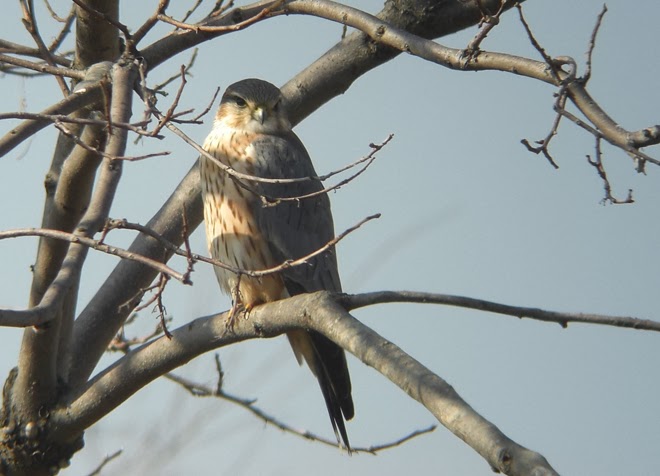
Merlin is a regular wintering species in the region, not uncommon but they cover a large area and can be difficult to find, especially over the vast expanse of fields near Lake Biwa. They are often easier to see at Ogura which is a much smaller area.
Northern Hobby is a scarce migrant through the area, and one I'm yet to catch up with around Kyoto. The closest place I've seen them is Cape Irago just outside the region and they are fairly regular on Hegurajima in October.
Gyr Falcon is very much a Hokkaido speciallity and irregular even there. I haven't heard of any in Kansai, certainly not while I've been living here, but I did see a grey morph on Hegurajima which is a pretty amazing record!
Peregrine is an altogether easier proposition, they're common in winter and a regular breeder in the region. They can be seen in open country or urban areas.
There's a lot of variation in Peregrines here and apparently Peale's has occurred in Osaka. The images of the two following birds are examples of puzzling extreme individuals.
A spring migrant at Uchiyama, Tsushima. The very worn tail suggests it had a tight roost spot during winter.
Amur Falcon appears to be at best a very scarce autumn visitor which could turn up almost anywhere along the Japan Sea, though presumably the odds of running into one will decrease further north in Honshu. The bird in the digiscoped image below is one I found on Hegurajima which might be expected insomuch as it appears Japanese birders are on the look out for it there. Despite that, this is the only bird that's been seen there during time I've spent on the island in October, now totalling several weeks over the years, which maybe says something as to its status in central Japan.
This bird spent 3-4 hours on the island allowing everyone present to catch up with it.
Merlin is a regular wintering species in the region, not uncommon but they cover a large area and can be difficult to find, especially over the vast expanse of fields near Lake Biwa. They are often easier to see at Ogura which is a much smaller area.
Female type Merlin, Hegurajima.
Male, Ogura. This tree afforded an excellent view of the fields and was used by Merlins year after year but was felled in 2013.
Northern Hobby is a scarce migrant through the area, and one I'm yet to catch up with around Kyoto. The closest place I've seen them is Cape Irago just outside the region and they are fairly regular on Hegurajima in October.
Adult on Hegurajima in October.
Juvenile on Hegurajima in October 2014.
Gyr Falcon is very much a Hokkaido speciallity and irregular even there. I haven't heard of any in Kansai, certainly not while I've been living here, but I did see a grey morph on Hegurajima which is a pretty amazing record!
Peregrine is an altogether easier proposition, they're common in winter and a regular breeder in the region. They can be seen in open country or urban areas.
Birds come to bathe on the Yamato River in Osaka.
Over the Yamato River, Osaka.
A juvenile calling to an adult (no relation as far as I'm aware) with prey on Hegurajima.
Juvenile Peregrine, Hegura.
The two shots above are of a tiny (presumed 2CY) on Ishigaki, Yaeyama Islands in April 2013. The wires the provide a sense of scale, it looks more like a Merlin than a Peregrine. Contrast this with the heavily marked monster of a bird on Tsushima, Nagasaki in May 2012. There's no way this one's going to balance on the wires.
Subscribe to:
Posts (Atom)


