Showing posts with label Garganey. Show all posts

Monday, 19 October 2020

September Common Terns (minussensis) and Garganey

Between my September trips to Ogasawara and Hokkaido I squeezed in a single visit to Mie. Ordinarily I'd be getting anxious about what I was missing there if I didn't get across as much as possible during peak wader passage so it didn't help that a Buff-breasted Sandpiper had been reported in the area, even though I didn't know exactly where it was. I've already posted about the Latham's and Pintail Snipe I saw that day but there were a few other interesting birds too.

There's usually the odd Garganey to be found during spring and autumn passage, singles or twos and threes usually mixed in with the arriving Eurasian Teal but flocks of over 20 on a couple of occasions kept to themselves. I only found one bird mixed in with a party of Eurasian Teal on this visit, though there may have been one or two more in with them, it was hard to say for sure as the Teal spent most of their time hidden on pools in the reeds.

Another good sighting for me was Common Tern. They aren't rare by any means but they aren't easy to get decent views of in this area either, tending to be distant fly-bys or way out on exposed sand bars at low tide, so it was good to have to have a couple on a coastal lagoon. According to Brazil (East Asian Field Guide), minussensis is less common in Japan than the more eastern longipennis. I'm uncertain how much less common it should be but these birds, like many I see appear to be minussensis with extensive red in the lower mandible and bright red legs.     

Garganey (and Eurasian Teal) with very rusty breast just visible above the water line. 


Presumably the same bird later in the day.

Common Tern, subspecies minussensis


Wednesday, 1 May 2019

Some migrants on Yonaguni

I've already posted regarding the most important migrants from a personal perspective, the Himalayan Swiftlet and Citrine Wagtail, but here are a few other migrants, some more to be expected than others.


There was only this one pair of Garganey during my stay. Last time there were quite a few on a tank favoured by Common Teal. These birds were on the pond/lake at Kubura.  


Grey-faced Buzzards are a daily occurrence, perhaps they are wintering birds rather than migrants, and often easily photographable on utility poles. I've gone with this poor, distant shot because this was such a striking bird, beautifully sandy above and mainly white below. 


There were a lot of Chinese Pond Herons on the island, though six was the largest group I saw they could be seen singly or in twos in many places.


This Whiskered Tern only spend about five minutes over the flooded fields at Hikawa before purposefully heading north over the island never to be seen again.


The only Oriental Cuckoo I saw perched, and the only non-hepatic.


Brown Shrikes are common and found in gardens, field edges and open scrubby areas.


Chestnut-cheeked Starling is a common spring migrant throughout Japan.


Daurian Starling on the other hand is not. There were at least three in the above flock of Chestnut-cheeked and I'd only previously seen a single bird on Mishima (Yamaguchi Pref).


Phylloscopus warblers were disappointingly scarce, I heard one Yellow-browed and eventually saw this Dusky Warbler which was singing from dense cover.


Stejneger's Stonechat is another common migrant throughout Japan and there were several dotted around the island.


The only Richard's Pipit of the trip, briefly on the school playing field. I saw several last time.


Red-throated Pipit could be seen daily, there were usually a few around the margins of flooded fields. 


I was surprised to see a Brambling but I came across two more singles on subsequent days.


Little Bunting is a fairly common migrant on migration islands but this was the only one I saw on Yonaguni. Masked was common and there were a few Black-faced but buntings, like warblers, were disappointing.


Perhaps it was a little early for some migrants even this far south? Perhaps a little late for others as I didn't see any Oriental Plovers or Upland Buzzard though I suspected I might miss these two Yonaguni specials before going.


One of the Oriental Plovers from my previous visit to the island, It's such a great bird I don't need much of an excuse to dig up an old shot.

Tuesday, 5 September 2017

A few left over images of Mie birds from last week

Grey Plover at sunrise.


Garganey; a regular migrant at this time of year.


Little Grebe; this nest is bigger and stronger every time I see it.


Juvenile Little Ringed Plover.


Adult Little Ringed Plover.


Whimbrel.


Friday, 1 April 2016

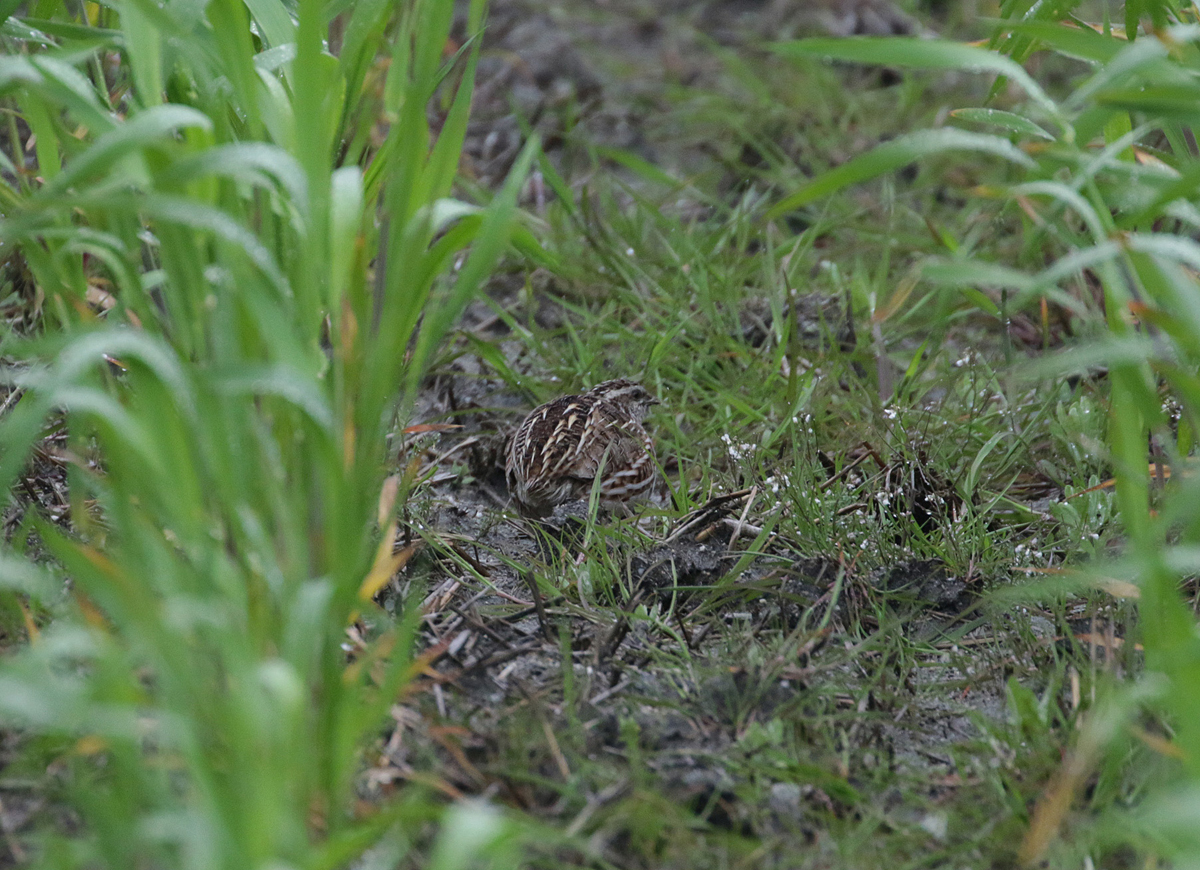
Japanese Quail

After getting my first photographs of Copper Pheasant last week I was feeling pretty pleased. This week I've outdone myself getting another personal photographic first - Japanese Quail.


I usually come across the odd Quail on migration, Hegurajima in October and on Mishima in early May, both islands seem to produce quite a few. The seasonal bias will be down to my birding habits rather than the bird's migration pattern. Views are invariably sudden and unexpected with no chance to get the bins on them let alone the camera during their brief escape flight after being flushed. The only wintering bird I've seen was Kyushu. I have no idea whether these two birds will have wintered locally or are early migrants.


The weather was awful today, heavily overcast with continuous rain from about 9am on and by mid-afternoon I'd just about had enough; I'd seen very little. However I decided I'd have a crawl along the fields checking the edges for migrant snipe. Swinhoe's, Latham's and Pintail are all possible during April but the first of the month is the earliest I've ever had success so I wasn't too hopeful. After the tedious first kilometre my mood changed dramatically as I glimpsed two birds dashed into cover. I knew instantly what they were and back tracked to a wider spacing between the crops and hoped the birds would cross the gap. One of them did... success! Not the greatest shots but good enough for me.


The effect was far better than a good night's sleep, something I was lacking, and I was ready to keep going rain or no. Within five minutes I came across this male Garganey!


Just to round off; a couple of egrets (Great White and Little) coming into breeding condition. The weather forecast is better for tomorrow, I wonder if the birding will be...

Monday, 21 September 2015

The first field trip in ages!

Tuesday last week (Sept 15th) I had no work, this was only the second birding opportunity since early May! I don't think I've ever not been birding for so long and though I didn't see anything earth-shattering it was great to get into the field. It was almost as enjoyable just to have a slow overnight drive stopping for the odd coffee along the way, letting the anticipation build.

Birdwise, the day was disappointing compared to the same date a year earlier. On the 15th last year I found two Little Stints, a Japan tick for me, and other locally scarce waders included Broad-billed Sandpiper and Ruff. On this trip the only scarce migrant wader I saw was a fairly distant Greater Sand Plover on estuary sandflats with eight Lesser Sand Plovers.

My usual winter routine in this area is first to check-out a large, deeper coastal lagoon with the early light behind me but on spring and autumn wader trips the shallower pools are obviously more productive. This so often means either a distant view with the rising sun on my back or a much closer view against the light. Tuesday dawned with a screen of clouds along the horizon. Things appeared to be going my way, this was the perfect opportunity to pull right up alongside a usually productive pool without the light problem. But as is sometimes the case, appearances can be deceptive and in this case too much water meant no waders! Undeterred I headed out onto the fields looking for suitably wet or flooded fields that might hold parties of waders while the tide was still high. I tried two extensive tracts of fields a few kilometres apart but neither had any fields which to my human eye looked attractive to waders, they apparently thought likewise.

Egrets pass through the area in big numbers and if wader numbers where down on this visit, there were far more Cattle and Intermediate compared to this time last year.


A Cattle Egret trying to pass itself off as an Intermediate with that prominent black bill tip. Presumably this is a juvenile, the black tip being a remnant of the short-lived black bill phase of very young birds.

By 3pm I'd seen 23 wader species (compared to 27 on the same date last year), not great but nevertheless not bad for a first-in-ages field trip; good enough to get the juices following again. Most weren't at a photographable range, which was also disappointing, and the following were the best shots I could get.


Grey-tailed Tattler. 


Eurasian Curlew; there were 3-4 Far Eastern but the sole Eurasian was the only curlew to come within camera range. 

Common Greenshank was one of the few species in usual numbers, these showing a range of leg colour from dull greyish-green to bright yellow. 

Common Greenshank. 

Marsh Sandpiper behind Common Greenshank. 

Marsh Sandpiper. 


There were a large number of Sand Martins passing through, this a scaly juvenile. 

Spot the Garganey. I had a high count of about 15 last year but could only find three sifting through the Common Teal on the water this time round. They were much easier to pick out in flight!


Now that my busy work schedule has eased and after moving house this week, I'll hopefully have more time to get out and find some birds!

LIST OF BIRDS SEEN
Mallard   3
Eastern Spot-billed Duck   common
Northern Shoveler   7
Northern Pintail   9
Garganey   3
Eurasian Teal   c180
Common Pochard   5
Tufted Duck   1
Streaked Shearwater   common off-shore
Little Grebe   common
Black-crowned Night Heron   1
Cattle Egret   c120
Grey Heron   fairly common
Great White Egret   200+
Intermediate Egret   300+
Little Egret   15-20
Great Cormorant   very common
Osprey   5-6
Black Kite   several
Moorhen   2
Common Coot   2
Oystercatcher   12
Black-winged Stilt   14
Grey-headed Lapwing   1 plus 3 heard
Little Ringed Plover   2 plus 1 heard
Kentish Plover   common
Lesser Sand Plover   c10
Greater Sand Plover   1
Common Snipe   2
Bar-tailed Godwit   2
Whimbrel   1 plus 1 heard
Eurasian Curlew   1
Far Eastern Curlew   3
Marsh Sandpiper   4
Common Greenshank   18
Green Sandpiper   1
Wood Sandpiper   2
Grey-tailed Tattler   c20
Terek Sandpiper   c12
Common Sandpiper   c8
Great Knot   1
Red Knot   1
Sanderling   c130
Red-necked Stint   5
Dunlin   4-5
Black-tailed Gull   1000+
Slaty-backed Gull   1-2
Black-headed Gull   sevreal
Common Tern   c140
Rock Dove   2-3 parties
Oriental Turtle Dove   several
Common Kingfisher   2
Bull-headed Shrike   3 plus several heard
Carrion Crow
Large-billed Crow
Sand Martin   common throughout the day
Barn Swallow   as above
Red-rumped Swallow   2
Japanese Skylark   several
Zitting Cisticola   several (mainly heard)
Brown-eared Bulbul   only 1 heard. Where were they?
Oriental Reed Warbler   1
White-cheeked Starling   fairly common but no large flocks
Blue Rock Thrush   8-10
Eurasian Tree Sparrow   common
White Wagtail   fairly common
Japanese Wagtail   2
Meadow Bunting   3 heard