Showing posts with label Falcon Peregrine. Show all posts

Tuesday, 5 November 2019

Red-Crested Pochard... and not at Lake Biwa!

Apart from a very brief trip to Aichi to see a Laughing Gull in early October, I haven't been birding since my Yonaguni trip in spring! That can be put down to a lack of time in autumn, lack of inclination during the boring Kyoto summer and lack of transport in spring. But: late October is the beginning of Taimyr Gull season, argueably the most important time because so very few Vega have arrived in this area, so I went across to Tsu-shi last week in the hope of getting good views of immature birds.


On arrival, pre-sunrise, I stuck my head over the seawall to get a sense of the action. The tide was high, the sea flat calm and the light just enough for identification. The main gull beach stretches away to the north, gull-less of course at this early hour with this tide, but just below me alive with birds... basically because the sea close in-shore was alive with fish. Hundreds of Great Cormorants, in tight groups were following the fish, flocks of Black-headed Gulls were plunge diving left and right and
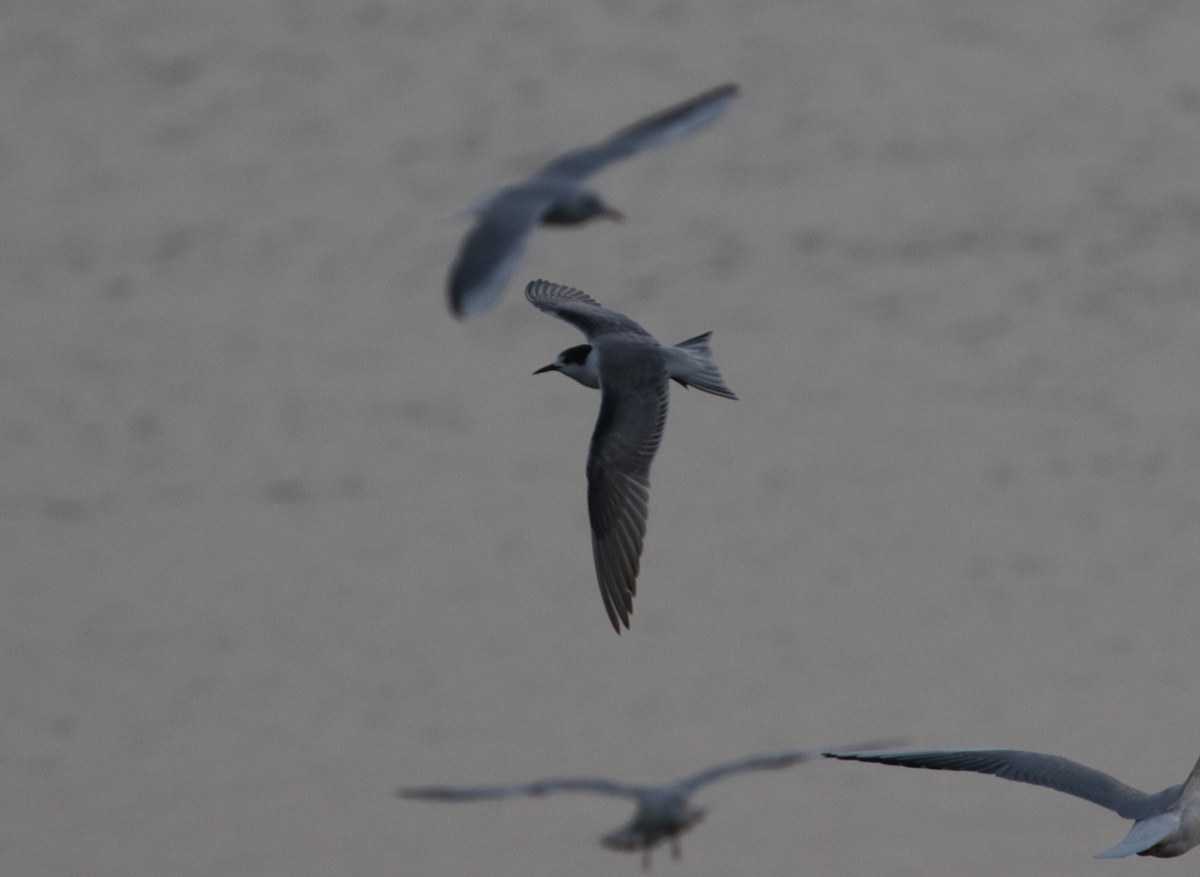
finless porpoises were whipping around but rarely breaking surface. Less expected were a couple of Whiskered Terns Patrolling this stretch of beach too, the light was too dim at first, and the birds a shade too far down the beach to get decent shots. No sooner had I made my way down to where they were than the sun rose directly behind them and that was that.


Two Whiskered Terns from the beach before sunrise.


Because the tide was high there was a large number of waders waiting for it to fall, and from the anthropomorphic perspective, with varying degrees of patience. Lesser Sand Plovers and Kentish Plovers sleeping well up the beach in permanent vegetation. About 150 Dunlin and a lone Red-necked Stint were half-heartedly checking through an old tidal wrack left by a more energetic sea and only a handful of Ruddy Turnstones were showing a bit more verve and living up to their names tossing the rotting seawwed this way and that. The actual tideline was marked by the effervescent ebb and flow of Sanderling, I suppose if you never stop running you need to keep eating.


It was time to head to south towards Matsusaka. I knew if I wanted to spend time on the gull beach later in the day, I wouldn't have time to visit all the places I'd have liked to on my first visit for nine months. For better or worse I made my choice and to be honest the creeks, fields, ponds were all rather quiet. It's early days yet and duck numbers were still very low, at least dabbling duck numbers were, there were thousands of Greater Scaup well out on the sea. There weren't any Dusky Thrushes yet which wasn't a surprise but no winter buntings apart from a single Common Reed Bunting heard was. Waders and Crested Terns have mostly gone, gulls and ducks haven't arrived in big numbers yet. If it weren't for Taimyr Gulls coming through now, the last few days of October are as if falling between two seasonal stools.


At almost the last port of call before heading back north to the gull beach I found a female Red-crested Pochard! It was on one of the formerly great coastal pools that are now covered with floating solar panels, quite far off too but as luck would have it a female Eastern Marsh Harrier flushed all the more distant ducks down to my end. The day was suddenly looking up, it had been a good while since the excitement of dawn and this was a Mie tick.


This is the first Red-crested Pochard I've ever seen away from Lake Biwa where, though probably annual, I only ever see them if they happen to take up residence on a part of the lake I normally visit. It would take days to cover the lake thoroughly and being a creature of habit I only visit a select few areas along the eastern side that the short winter days allow. So unexpectedly running into this bird here was a really good find.


I was lucky the Harrier flushed the ducks down to my end of thhe pool otherwise any shots would have been impossible. For a brief moment it was even the closest bird...


A nearby estuary held a few different waders to those I'd seen earlier, single Whimbrel and Bar-tailed Godwit, plus about 150 Oystercatchers. The start performer, however, was a juvenile Peregrine sparring with Large-billed Crows.


It's common place to see juvenile/first winter gulls stand up to provocative Crows whereas loafing adults will simply move a few steps out of the way. I whether or not this Peregrine's response was also due to immaturity, it provided me with some spectacular views as it would frequently fly low, at speed, towards the seawall and shoot upwards at the last moment. Once I'd worked out the routine I could stand in that spot and it would pass just feet over my head. It was hard to say whether the Crows or the Peregrine had the upper hand presumably neither as the performance continued for the 30 minutes I stayed to watch. A group of Crows would chase the Peregrine, not that they stood any chance of catching it if it accelerated but it was usually content to stay just ahead of them. A lone Crow, on the other hand, was asking for trouble as the Peregrine invariably turned on the persuer and tried to strike seemingly with real intent. Unfortunately not one of my shots of these exchanges is sharp. The action took place over a large area, almost a kilometre out to the most distant sandbar, part way up the river in the opposite direction or 400 metres north across the wide river mouth, or as I say just feet over my head. Near or far, the action was always in view and quite engrossing. If it hadn't been for wanting to get up to the gull beach I could have spent far more time watching the spectacle.


Saturday, 3 December 2016

Peregrine takes Black-necked Grebe

The sun was just above the horizon when I saw this Peregrine flying dashing out to sea, low and accelerating. It soon became obvious its target was a Black-necked Grebe, themselves no sluggards in flight, was heading north about 400 metres out. The Grebe's big mistake was flying alone; the Peregrine was on it in seconds and just plucked it out of the air with no fuss at all. It quickly adjusted its grip then flew a higher course back towards the beach.


It almost looks as though the Grebe is flying under its own power; held head forwards just as an Osprey would carry a fish. Oh wait... 


I can only imagine this Osprey later in the morning hasn't read the manual.


But back to the Peregrine. I'd watched it chase down the Grebe while driving along the sea wall and noted where the it came down on an worn old tree trunk and slowly drove towards it. I stopped well short and not wanting to interrupt the Peregrine's morning meal and tried to take some shots through the windscreen but the results aren't great.


Don't you just hate it when you drop breakfast; butter side down no doubt.

The Peregrine went down to it but I was surprised that it soon flew back onto the tree without its prey.


It gives the impression of being very long- and full-tailed in this image. Presumably it's due to the angle but after recently seeing Turkey Vulture here I did wonder at first whether this might be an escaped falconers hybrid.


Friday, 18 March 2016

A Peregrine shakes up the gull flocks

A schedule change at work meant I had some time to visit the Yamatogawa in Osaka to check out the gulls yesterday. I used to spend all my free time gulling on the Yamatogawa but this was my first trip this winter and I was delighted to see how many gulls were present. I didn't have my scope with me, just bins and camera, so I was a little disadvantaged checking out the flocks on the river and I wonder how many things might have got away while I was struggling to slowly sift through the bathing and loafing groups.


A case in point is (Pacific) Black-legged Kittiwake; I heard a kittiwake call and looked up to see two birds overhead that gradually gained height and disappeared. I've only ever recorded a couple of Kittwakes here so this doubled my tally for the site! However later as I was going through the many shots of gulls I took, there was a Kittiwake dropping in behind the gull I was photographing.


Peregrines aren't uncommon dropping onto the river, they come down to bathe rather than deliberately terrify the gulls but they certainly shake things up nevertheless.


Once the Peregrine had put up all the gulls, evaded those that weren't too happy about the intrusion and bathed it flew straight out without giving the gulls a backward glance.

Thursday, 12 November 2015

A short-billed Long-billed Dowitcher

There have been a couple of basic plumage Long-billed Dowitchers around for a while but there was a new comer when I last visited their favourite pond. A strikingly short-billed bird and not only that but the only autumn bird I've seen with colour. Have I never seen a juvenile before?


The short-billed bird on the right; even head-on it looks different to the other two. 


The typical basic Long-billed Dowitcher I'm used to seeing here at this time of year. 


Juvenile male (?) Long-billed Dowitcher with a distinctly short bill.


There were fewer Common Sandpipers around this visit but following bird did its very best to attract attention. The fourth shot, a bird in the early morning sun, shows probably the brightest yellow legs I've seen on a Common Sand.


This Peregrine went after anything that flew, Cormorant, Kite, Carrion Crow but the outstanding chase of the day was across a large pond on the tail of a Red-footed Booby. What was the Booby even doing the wrong side of the seawall?


On the lookout for the next aerial fun. 


The Red-footed Booby on the landward side of the seawall.


In the afternoon I headed to the north of town to have a look at the gulls, my main reason for being there if truth be told was to look for juvenile Taimyr Gull. There was only a single gull of that age group which was disappointing. Whether this was coincidence or due to conditions during the last breeding season resulting in a lower number of offspring I don't know but autumn juveniles are usually more numerous. Hopefully numbers will pick up.


Vega Gulls showing off their variable eye colour; neither extreme is unusual.


One of many adult Taimyr Gulls around at the moment.


Juvenile Taimyr Gull.


Juvenile Taimyr Gull.


Thursday, 1 January 2015

The final day in Kyushu

December 31st was my final day in Kyushu, I'd stayed at Tamana as there was plenty do there on the birding front. The weather was changing according to the forecast with rain from about 9am. As it turned out the rain didn't arrive till early afternoon but when it did it came in style with a howling wind and lightning flashing all around. Not too good for birding in open fields.

Apart from trying for the Shrike first thing I had look at the estuary in the morning then focused on the fields with pipits a particular target. Kyushu has a good track record with rare pipits in winter and there were very impressive numbers of them as well as wagtails and larks everywhere.

While waiting for the Shrike in the very early morning, before the sun had risen above the mountains I spotted a Peregrine coming across the fields towards me. That may not be unusual but I wasn't expecting it to land on the post directly above my head! After getting a few shots up its nostrils I had to walk back to try to get a more typical angle but the bird wasn't having any of that and off it went again.


It's been good for birds of prey but as yet I'd only had two accipiters. Both had been rapid flybys and neither identified for sure, though I suspected one of each. This powerful juvenile Northern Goshawk left no room for doubt.


A very pleasant surprise was finding Daurian Jackdaws, three birds, among the Rooks. There have been so many Rooks I've been puzzled by the lack of Jackdaws so it was great to connect at last. Crane numbers were down today, only 10 White-naped and no Hooded. I wasn't so worried about numbers, when they look this good a flock is almost too much. This bird was one of a party of five and in this shot it wouldn't look out of place replacing a Peacock on some stately lawn.


And the Lapwings looked even better in the morning sun...


With a little sun the Northern Lapwings looked even more stunning the previous evening.

As I mentioned, sifting through the pipits was one of my aims for the day. I'd already had a Richard's and heard a couple of Red-throated two days earlier but I was hoping to find something really spectacular, Rosy or Water. Why not aim high? There were Buff-bellied Pipits everywhere, you could stop at any field and there'd be birds creeping around. I'd seen flocks of over 100 birds rise two or three times when spooked by a raptor. In the first field I tried there were 5-8 Red-throated fairly close to the road and there could easily have been more further out. The second spot I stopped at had two more. No megas I'm afraid but if I said I only scratched the surface that would be laughable - I did far less. I could spend days on end happily going through these birds and it really puts my 20-30 Buff-bellied a day around Kyoto into perspective. No wonder there are more rare pipits found in Kyushu.

A Buff-bellied on a pile of what looked like wood-chip but was probably waste from clearing maize fields. This mainly attracted White Wagtails but there were always a few pipits there. In this early morning shot there is still a lingering covering of frost. 

Below are shots of some of the Red-throated Pipits. It's interest how different the birds look, some pale brown and finely marked appear similar to breeding plumage while others are more black and white, strongly marked and definitely winter plumage birds. First a series of the former type, simply because it came closest.


Next a colder black and white bird with bold breast and flank markings.


Finally another dark winter bird followed by another pale brown breeding type.


The terrible weather that struck suddenly in the afternoon was bringing an early dusk and effectively brought my time in Kyushu to a dramatic close. And now back in Kyoto there is deeper snow in the city than I've ever seen, only 15-20cm but a shock nevertheless, and according to the Met Office there's 1.5 metres at the north of Lake Biwa so between that and other commitments it looks like New Year birding is over.

Species seen at Tamana over the 30th and 31st:-
Green Pheasant
Common Shelduck
Eurasian Wigeon
Mallard
Eastern Spot-billed Duck
Northern Shoveler
Northern Pintail
Eurasian Teal
Common Pochard
Tufted Duck
Red-breasted Merganser
Little Grebe
Black-necked Grebe
Black-faced Spoonbill
Grey Heron
Great White Egret
Intermediate Egret
Little Egret
Great Cormorant
Eurasian Kestrel
Merlin
Peregrine
Osprey
Black Kite
Hen Harrier
Northern Goshawk
Eastern Buzzard
Common Moorhen
Common Coot
White-naped Crane
Hooded Crane
Northern Lapwing
Grey-headed Lapwing
Grey Plover
Kentish Plover
Common Snipe
Common Greenshank
Green Sandpiper
Common Sandpiper
Dunlin
Vega Gull
Black-headed Gull
Saunder's Gull
Feral Rock Dove
Oriental Turtle Dove
Common Kingfisher
Bull-headed Shrike
Great Grey Shrike
Magpie
Daurian Jackdaw
Rook
Carrion Crow
Large-billed Crow
Japanese Skylark
Zitting Cisticola
Brown-eared Bulbul
Japanese Bush Warbler
Japanese White-eye
White-cheeked Starling
Common Starling
Pale Thrush
Dusky Thrush
Daurian Redstart
Blue Rock Thrush
Russet Sparrow
Eurasian Tree Sparrow
White Wagtail
Japanese Wagtail
Richard's Pipit
Red-throated Pipit
Buff-bellied Pipit
Oriental Greenfinch
Meadow Bunting
Chestnut-eared Bunting
Rustic Bunting
Black-faced Bunting
Reed Bunting