Showing posts with label storks/spoonbills/herons/egrets. Show all posts

Thursday, 14 November 2013

storks & spoonbills

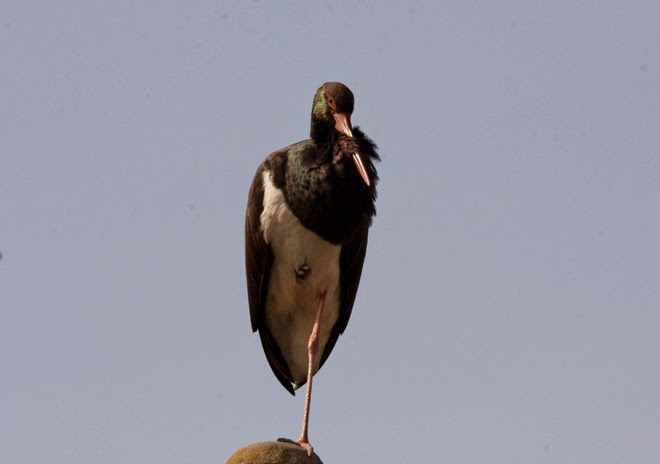
Historically there are records of Black Stork in Kansai but until recently it had disappeared from Japan as a wintering species. The previous few winter there have been a couple of birds wintering around Isahaya Bay in Kyushu but as the population as a whole isn't growing this is very unlikely to herald the return of the species to its former status.

One of two Black storks at Isahaya Bay, January 2015.

Oriental White Stork is another species that disappeared but even more dramatically as it was formerly a widespread breeding species. It still occurs, usually in winter but it's rare and could turn up anywhere in the country. I've seen two in Kansai over the years, a wandering immature which by chance stumbled upon the Hyogo re-introduction programme headquarters and stopped wandering. And another, a Chinese ringed bird, which settled for the winter at Kameoka, just outside Kyoto city. This bird seemed to become a source of civic pride among the local dog-walkers and farmers.

Video-grab of the Chinese-ringed Oriental White Stork soon after arrival, November 2004, Kameoka.

Now that birds from the re-introduction scheme based at Toyoka (Hyogo prefecture) are successfully breeding in the wild it is possible to run into these birds in rural Hyogo and Kyoto in any season, though you'd still need to be very lucky. Or indeed, even further afield as birds from this scheme have wandered the length and breadth of Honshu and as far as Hokkaido and Kyushu.


Oriental White Storks in north Shiga, 2014.

The Crested Ibis re-introduction project on Sado Island is more recent and as yet smaller scale but at least one bird has turned up in Ishikawa, an area in which they hung on until late in the day, there may be hope for this species re-occupying its former range too.

Eurasian and Black-faced Spoonbills both occur in Japan in winter. Though Black-faced is more numerous overall, it's Eurasian that's more frequent in Kansai. However numbers are very low and it's impossible to guess when or where they might turn up. Ponds around northern Lake Biwa have a good track record of hosting wintering birds and I've seen a number there over the years.

Adult Eurasian with its dipped-in-custard bill on a pond near Lake Biwa.

Black-faced Spoonbill will be of more interest to most overseas visitors but fewer come as far east as Kansai and visting birders who have the time will expect to see this species in Kyushu where it is quite easy to find at certain locations, particularly estuaries in the north and north west.

An immature Black-faced on the Yodo River in Osaka city was a good local record.

A party of Black-faced Spoonbills, Kyushu.

Eurasian and Black-faced together in Kyushu.

Almost synchronised spooners.

Immature Black-faced Spoonbill in Kyushu, December 2015. 


bitterns & small herons

Eurasian Bittern formerly bred at larger reedbeds near the south east of Lake Biwa but habitat reduction had a severe effect. I haven't tried to listen for them in recent years and I'm unsure about their current status but I believe they do still occur. Perhaps Lake Sainoko just to the north would be a better place to try nowadays. Small numbers also occur in the region in winter, I've seen three birds together at Lake Shinji just to the west of Kansai so it's certainly possible here but bitterns being bitterns, aren't always cooperative.

There was a rather atypically behaved bird in a park in Osaka a few years ago. It you were there at the right time, it would parade around on the lawn in front of the reeds giving great views. But what really set it apart was its habit of flying off into the woodland where it would hunt along small streams under closed canopy or sit motionless in sasa on steep wooded hillsides.

   Lurking in sparse sasa on a steep woodland slope, the most improbable Bittern I've seen here.

Yellow Bittern is another bird that can be found at the larger remaining reedbeds at Lake Biwa. There are also some good reedbeds along the Yodo River between Osaka and Kyoto to look for them too. Unfortunately, the large reedbed further upstream on the Uji River at Ogura is harvested then burnt-off each winter and is only beginning to re-grow when the Bitterns are returning.

If there was ever any reliable chance of seeing Schrenck's in Kansai, I'm sure that time has long gone. The only ones I'd seen until recently were at Lake Kasumigaura in Kanto when they were still regular breeders there and a spring migrant on Tsushima. However, in November 2014 an obliging individual turned up at a small pond in Nishinomya, Hyogo and provided wonderful photographic opportunities for those with better equipment than me.


Schrenck's Bittern, November 2014.

Cinnamon Bittern is no more likely to occur in Kansai but it is reasonably common in the Nansei Islands and can be seen easily at Kijyoka, Okinawa.

Female Cinnamon Bittern Kijyoka, Okinawa.

Male Cinnamon Bittern, Kijyoka, Okinawa. This is without question the best place I've visited to see this species with several flying around and reasonably approachable by car.

Striated Heron isn't rare in Kansai but it is hard to find, not just because it's an unobtrusive and solitary species but also the population density seems low. Having said that I used to see them more often than I do now. The bird below on the Katsura River is unusual in such an open setting, the September date suggests it's a migrant. Local birds are more often found further up stream along wooded stretches of river.

Straiated Heron, Katsura River, Kyoto city. 

                                  Japanese Night Heron, Osaka Castle Park, April 2013.

                                 Japanese Night Heron, Osaka Castle Park, April 2013.

Japanese Night Heron breeds in Kyoto prefecture forests but is difficult to find and the average visitor probably wouldn't want to invest the time listening out for singing males night after night with no guarantee of seeing one. Spring migrants can often be found on islands in the Japan Sea but perhaps the best chance a visitor has of seeing one is if their trip coincides with the arrival of a migrant in a city park. This isn't quite as improbable as it sounds because birds do drop into parks with reasonable regularity. There have been two in Osaka city this year (2013) and it isn't unusual for them to stay two or three days. Interestingly these birds seem to show no fear of humans, unlike birds in the forests, and I remember one in Kyoto Imperial Palace Park strolling between tripod legs, causing confusion and amusement amongst the photographers. No doubt for every bird stopping off in a park there must be many more moving through surrounding forests and I've bumped into three September/October migrants at Mt.Inari in Kyoto as well as one or two others in the area. Apart from seabirds this is perhaps the most difficult species for a visiting birder to connect with.

Malayan Night Heron can't be found in Kansai but is easily seen in the Yaeyama Islands in the far south. Driving on rainy nights on Iriomote it's possible to get great headlight views of several birds taking advantage of all the frogs crossing the wet roads. They can also be found during the day, usually asleep in village gardens or more actively foraging in the forest, particularly on wet days.

Black-crowned Night Heron on the other hand is a common breeder in Kansai and they're easy to see in the centre of Kyoto city on the Kamogawa from the breeding season when adults are fishing round the clock and through summer when juveniles start to appear. As with many herons, small weirs along the river through the city are a focal point. While larger species might wade into the faster water the Night Herons are usually standing hunched on the bank. At other times they can often be heard overhead just after nightfall as they make their way to feeding areas. There are a number of roosts at temples and shrines for example at a small pond on the north side of the main precinct of Fushimi Inari Shrine.

       Presumably a sub-adult with bi-coloured bill and grey in the crown on the Katrura River, Kyoto city.

A roosting juvenile along the Uji River, Kyoto city.

Chinese Pond Heron is definitely not to be expected in Kansai, though it is regular on islands in the Japan Sea, particularly in spring.

Presumed 2cy on Tsushima, early May 2012.

Adult Mishima, early May 2005.

Adult Yonaguni, early April 2013.

Grey and Purple

Setting aside Great White Egret which is sometimes considered ardea, there are only two herons in the genus in Japan, Grey and Purple. In Kansai Grey is very common and can be found almost anywhere on ponds, rivers or lakes, including Kyoto city centre where any park with a pond could host a Grey and it'll always be found along the two main rivers. Purple is rare in Kansai and can't be expected when visiting the region, a November immature on the Yodo River in Osaka city is the only one I've seen here.

                                  Breeding bird near the Uji River, Kyoto in February.

                        A post-breeding September adult in the Imperial Palace Park, Kyoto city.

While Purple is rare in Kansai, it is common in the southern islands. The following birds were photographed in the Yaeyama Islands, they are the common heron on Iriomote and Ishigaki.

A breeding adult on Ishigaki. This is the first time I've seen a heron eat a snake, after first removing the head.

                                                The same beautifully marked breeding adult.
 
                   Another breeding adult, this a less strikingly marked individual, on Iriomote.

This immature had evidently been caught by something unseen in the grass. It struggled pulling back violently at first but gradually sinking lower and lower until prone with just the arch of its back visible, the tugs getting fewer and weaker. This took place over at least an hour before it suddenly escaped and staggered to its feet. The whole head and neck were completely bedraggled and the bird exhausted. After a further hour it was dusk and I left, the bird which had only moved away a couple of metres still seemed to be exhausted and recovering from the ordeal. 

egrets

Kansai may miss out a lot of Japanese birds but we do well enough for egrets. Apart from Eastern Reef, which is coastal of course, all can be seen easily in or around Kyoto city.

Cattle Egrets are numerous passing through Ogura in spring and autumn, in April mixed flocks of  Cattle and Intermediate can be seen flying upstream at Yawata where the rivers Yodo, Kiso and Katsura meet. In autumn they're less hurried and spend time in flocks dotted about the fields at Ogura (and elsewhere). They can still be found in the region throughout summer, birds breeding at Biwako may be the closest to Kyoto city. I've only seen one bird in winter, an oddly pink-footed bird following a plough at Ogura. Some are meant to winter in southern Japan but this was definitely an unusual occurrence in Kansai.

Living up to the name on Yonaguni.

In early May the colourful bare parts as much as the plumage make this a really attractive bird.
 
In June black on the culmen and only a hint of colour on the fore-crown suggest this is 2CY.

Part of a post-breeding flock at Ogura in August. The adults are losing their colour and some juveniles, like the bird on the left, still have black bills.

That the legs and even feet are pink seems very odd, I don't know how often Cattle have pink legs in winter. These images are video-grabs.

Ogura, late December 2004.

Great White Egret can be seen year round and is quite common even in Kyoto city centre where they can be quite tame. I once watched an woman walking her dog along the Kamogawa near the botanical gardens with a loose flock of Great Whites and Grey Herons walking along with her as she threw food to them. I watched them till they were out of sight around a bend. A most peculiar sight for all the world as if she was taking her pet herons for a walk.

This modestus is only just starting to come into breeding condition in March. No doubt why they are sometimes losing out to Great Cormorants in competition for nest sites.

Two full breeding birds in early May (Tsushima, Nagasaki). The rosy-pink tibia, blue-green lores and black bill are a striking combination.
      Below, a full breeding bird with entirely pale pink legs in early May, Mishima, Yamaguchi.


I'm uncertain about the status of albus in Japan, according to Brazil (The Birds of Japan, 1991) modestus occurs throughout the year and breeds from southern Japan to northern Honshu and increasingly into Hokkaido but he cites only a few records for albus. However in the Birds of East Asia (2009) albus is said to be the subspecies with the wide distribution with modestus being a summer visitor to southern Japan.

For a long time I was unable to detect any discernible differences between birds I was seeing in Japan and assumed the races must be indistinguishable in the field if both were occurring here. This until I was taking a visiting Australian birder round Lake Biwa one day and he asked about two egrets on a nearby pond. Getting the scope on them, they were both clearly Great White but for the first time I was seeing a very obvious difference between individuals. For the first time I was looking at something which really appeared to be an albus.

Great White Egrets, albus (right) and modestus (left), Lake Sainoko, Shiga January 2012. The albus is obviously larger and heavier with longer tibia and deeper-based bill. This is the first yellow-legged Great White I'd seen here, the legs were yellow to below the knee with tapering extensions down the sides of the tarsi.

Lake Sainoko, January 2012.

Amazingly I found another bird a month later in Sanda, Hyogo (the three shots below). Though alone, it nevertheless gave the impression of being very large and had the same distinctive pattern of yellow on the legs.

A second albus, February 2012.

                                     Below, two shots showing the extent of yellow on the legs.

 
I noticed this albus when going to see three Siberian White Cranes in Sikoku (March 2014), a local birder told me it had been a good winter for them and that there'd been more than just this one in the area.

Intermediate Egret is common in summer and very common around Kyoto in spring and autumn, there can be huge numbers (100s) in paddyfields on passage. Some of the biggest concentrations I see are in Mie but they are common throughout the whole of Kansai.

The obvious short gape line and large eye of Intermediate.

Intermediate coming into breeding condition in early April on Yonaguni.

The rather small size, close to Little, domed head and black-tipped yellow bill in spring and autumn can make them easy to identify even at long range across the fields.

Intermediate 14 September, the dark bill tip is beginning to fade.


Intermediate 18 October, a few migrants are still passing through.

Intermediate and Great White modestus side by side for comparison.

Little Egrets are also out on the paddies but are more a bird of riversides or ponds and they're common on the Kamogawa in the centre of Kyoto throughout the year. There is still a city centre breeding colony in a temple garden but others have disappeared. This is a species that can be found in all lowland areas in Kansai.

A great looking breeding bird in early March foot paddling on the Kamogawa in the centre of Kyoto city.

There are invariably birds fishing at the base of the small weirs along the river in the city.

Little seems far more aggressive than the other egrets here but maybe river sites increase competition compared to open paddyfields.

The Kansai egret you won't find anywhere close to the city is Eastern Reef. They're normally on rocky coasts and the best areas are in Wakayama and southern Mie, though they can easily be overlooked unless you're actively looking for them. The shots below are of a bird passing through Hegurajima in October.


The two video-grabs below are of a couple of Chinese Egrets on the Yodo River at Ebie, Osaka city at the beginning of July 2005. Definitely a species that can't be expected on a visit to Kansai!