Showing posts with label Snipe Latham's. Show all posts

Thursday, 24 November 2022

Latham's, Swinhoe's and Pintail... a good month for snipe.

September was very much a staying local month, covering a small stretch of my old patch at Ogura. Mainly because I didn't have the time to do otherwise, and not seeing that much for my efforts if truth be told. I've seen some quite spectacular wader passages here over the years but 2022 won't be going down as one to remember.

I covered a relatively small part of the overall area on nine dates through the month, seeing snipe other than Common on eight of them; this after making several visits throughout August when no migrant snipe were recorded. Actually, my first non-Common snipe were two birds (probably Swinhoe's) in Mie on 2 Sept though I had already seen a party of three Latham's there in August.

As far as confirming ID was concerned, all the following birds were 'tail-checked'. I saw a total of six Latham's, four Swinhoe's, one probable Pintail and a few swintail. As I only covered a relatively small area, it's reasonable to infer numbers passing through would have been much greater. There were also many Common, up to 10 per visit but even these disappeared in October suggesting all were migrants rather than birds that will winter here.

LATHAM'S SNIPE

(5 Aug - three adults together)


(8 Sept - two adults together)


(20 Sept - single adult)


PINTAIL SNIPE

(21 Sept) Flushed by a Siberian weasel soon after I found it. I already suspected this could prove to be a Pintail and this image taken just before it takes flight appears to show pins in the spread tail. The weasel's ears are visible in the grass just to the left of the tail.


SWINHOE'S SNIPE

(22 Sept)


(28 Sept) The only juvenile/first winter.


(28 Sept) Adult


(30 Sept)


COMMON SNIPE

(20 Sept) They did exist!


Finally, I can't resist throwing this in just because it has 'snipe' in the name. These are local breeders and there were males with tiny chicks running round in September.

Greater Painted Snipe


Saturday, 14 August 2021

Latham's Snipe

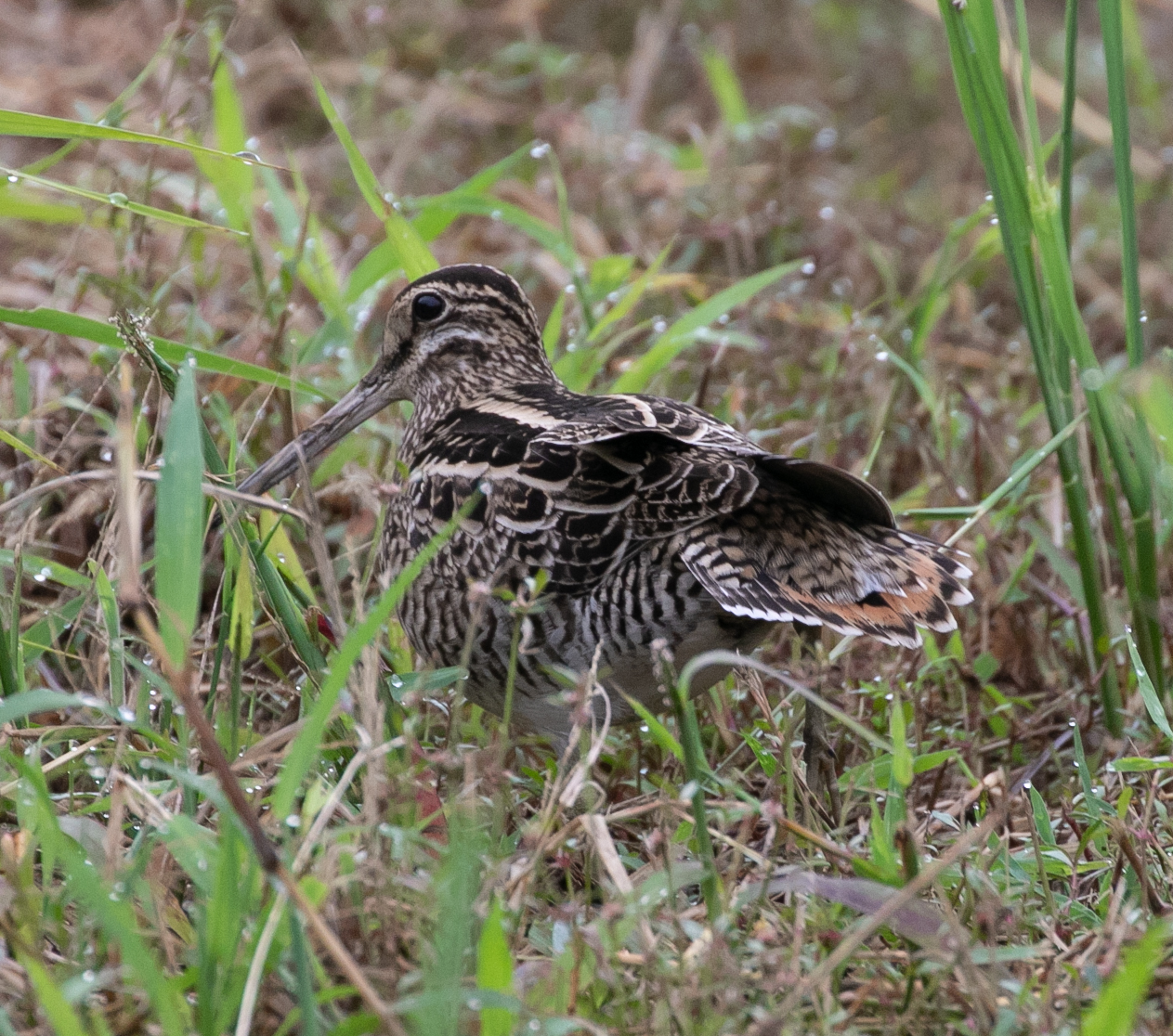
 It seems the sun is daring to put in an appearance this morning, after almost three days of more or less continuous and frequently torrential rain. In this shot of a migrant Latham's Snipe the upbound drops of water indicate how heavy the sudden onset was. 


Finding suitable fields migrant waders might stop off in is always the challenge, particularly this early during the southbound migration when everywhere seems a sea of full-grown rice. Compared to the Kyoto area, Matsusaka is slightly better off in somuch as the planting/harvest is, rather surprisingly. about three weeks ahead, hence there's more chance of there being attractive fields for the juvenile waders coming through later in the season.  

I was really pleased with this encounter because it resulted in two snipe firsts! The first of which involved a confrontation with a Pacific Golden Plover and this brief selection of images outlines how things went.

The Goldie had been gradually making its way in the direction of the field's edge and the Latham's stretched itself up as it approached. The Goldie did too, momentarily, but soon drew back its neck and walked around the situation, under the glare of the Latham's eye.


This was my first first. The tail flick is very frequent in response to any potential threat in the vicinity but this was the first time I've noticed the tail being twisted round; it's the underside we can see on this view. There must be a reason for this I imagine. The tail looks as though it's directed towards the Goldie but might the upperside be signaling to unseen snipe in the opposite direction?  

Having seen off the interloper, I was surprised the Latham's immediately flew 10m further into the open field, rather than enjoy the patch of mud it had seemingly defended. None of my flight shots came to anything due to the poor light, cranking the ISO had little effect as, though the bird came ever closer, the light steadily dimmed and the sky tap turned to near full.


As for that second first I mentioned earlier, this is it, or this is when it occurred to be more precise. As It stood on this low mound it repeatedly called, I've never seen a migrant snipe calling on the ground. The call was a repeated kech kech kech the 'ch' as in the German 'Ich' or 'Heinrich'. It wasn't very loud, though loud enough to hear over the drumming rain, and similar to the distinctive kek kek kek flight call Latham's sometimes gives when flushed. Any flushed snipe giving that call will be a Latham's.

After three hours of relentless rain I decided to head back to Kyoto, thinking the traffic would be a nightmare in these conditions. As it turned out, the rain, at this stage, was restricted to the east side of the Kii Peninsula mountains so the drive wasn't nearly as slow as I'd expected.


Monday, 21 September 2020

Pintail, swintail and Latham's; a decent snipe haul

This autumn has somehow got away from me on the wader front, it wasn't until last weekend I made my first trip across the Kii Peninsula to my favourite wader haunts in Mie. The first area of small fields I visited, about 500m x 300m in total, was in excellent wader condition so, apart from a couple of convenience store runs and three circuits of the good nearby sites, I ended up spending the whole day there. It's possible to drive miles without finding a suitable field so I considered myself lucky.

There were two or three Little as well as the two commoner stints, a couple of Broad-billed Sands which aren't that common round this way, as well as a number snipe. So plenty to keep me occupied especially as the latter are my favourite time drain.

I've no idea how many snipe there may have been on the patchwork of small fields, I focused on just one as far as the snipe were concerned. Or to be more precise, I focused on just one edge of one small field. The only Common Snipe I saw were the occasional disturbed birds that flew round overhead calling before settling back into the vegetation. There was even a calling swintail at one point that rose from no more than 20 metres away in my own small field when it was flushed by a family boisterously enjoying their Saturday morning walk around the fields.

There were usually three snipe along this edge, they never disappeared for long and I never saw more than three at any one time. I suspect that they really were the same three birds remaining loyal to the same spot. Presumably all the other snipe across the fields were doing exactly the same.

Even though a good view the outer rectrices is considered the only way to identify a swintail, there are a number of morphological 'tendencies' and generally speaking it's possible to have anything from an idea which species it is, to being willing to bet the house on which one you're viewing without seeing those pesky outer tail feathers. By 'tendencies' I mean features that one species exhibits more often than the other without being conclusive in itself. I said generally speaking because there are times when a bird which is looking a really good contender for one species will suddenly shock by revealing the wrong outer tail feathers.

Getting a good view of the incontovertible outer tail feathers can be easier said than done as Pintails' pins can remain tucked in when sunbathing and thus give the impression of not having any. Of course the sunbathing snipe may actually be a Swinhoe's (which seems far commoner than Pintail in this region) and you can spend no end of time trying to see non-existent pins. Bearing in mind that Swinhoe's and Pintail have about the same number of tail feathers if the pins are discounted, there isn't a noticeable difference in tail size or overall shape. Seeing the pins when a tail is flashed in some interaction is next to impossible so it really comes down to seeing a bird preening in the open at the right angle.

Last Saturday I saw one of the three birds preen twice, once in the open (though not at an ideal angle) early in the morning and again in the afternoon when largely hidden in the rice. I didn't see the other two birds preen at all and never got clear views of their outer tail feathers. Snipe really are a time drain.

Pintail in the foreground, then Latham's and finally swintail at the rear. They spent much of their feeding time probing into the side of the bund.

Latham's with swintail behind.


I'll start with images of the Pintail, the only bird that let me see its outer tail feathers clearly.

This bird was easily separated from the other dark juvenile its heavy barring extending well down the flanks.


One of only two shots I was able to get that gave any indication of pins.

The next bird is a Latham's but before I saw the juvenile primaries I thought it might actually be an adult Swinhoe's.


Finally some images of the swintail.


Friday, 5 June 2020

this spring's snipes and woodcocks

I haven't done any dedicated sniping this spring so I'm a bit low on my usual haul, however a spring Solitary (May 4!) is a first.


I was told that the Asamo Valley (Tsushima) used to be a regular site for Solitary in February and March but that there hasn't been a record for three years.


There had been torential rain overnight, the Met Office high resolution nowcasts normally show quite limited areas being hit by the very heaviest rain, but that night extensive sheets of red covered the map from parts of ROK, through Tsushima and well into Kyushu. The whole region had thunder storm alerts and they rolled in and out in a dazzling, and sometimes very loud, display. The upshot was some lanes more resembled streams than anything else the following morning, It seemed the Snipe agreed, and if it hadn't been for the extreme weather I don't doubt we would never have seen this great bird.


By the time we spotted the bird and stopped we were almost on top of it. Being a passenger I had to squirm my whole upper torso out the window and twist round to manage this shot of the bird on the drivers side. I'm quite pleased with the result. 


Fortunately it came across onto my side of the lane and waded up through the flowing water.


If the road hadn't resembled a stream, we'd never have connected with this bird.


This Swintail's features ticked all the boxes on the Swinhoe's side of the line, bar seeing the outer tail feathers this is as close as you can be to a certain identification of a bird on the ground. This is a very dark-winged bird, even the freshest looking (inner) coverts are quite worn.


You have to be cautious with the Swintail, of course. I had this one pegged as a relatively short-billed Swinhoe's in April of last year... Again, boxes ticked.


But what a differnce a change of posture can make, could it be a Pintail after all?


As you were; outer tail feathers to the rescue.


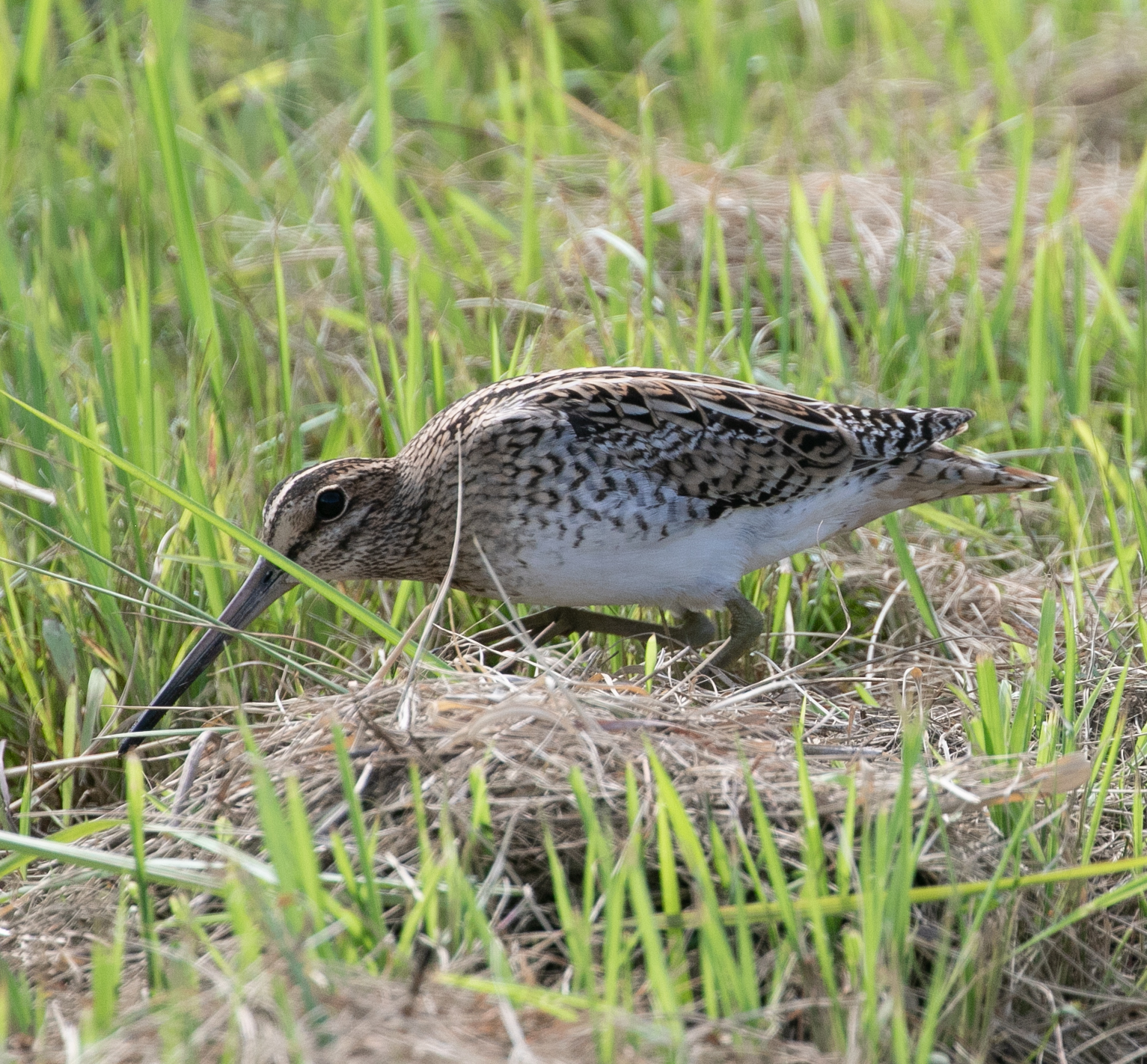
This snipe was on an raised paddy and the views were very brief but I'd put it down as Latham's on what I did see. Latham's in Hokkaido a week or two later were easily identified of course... whatever did they do before the advent of utility poles?


A noteable feature of this spring was that I was able to get multiple close views of both Japan's woodcock species, Eurasian in Hokkaido and Amami... quite. The Eurasian put on a good display, roding each early evening while the light was still quite good. Usually a single bird but occasionally a second bird would join in close formation. They could generally be heard into the early night and again pre-dawn.


Amami above, Eurasian below, they really don't look alike.


Neither snipe nor woodcock, but it is brown. I saw four Little Whimbrels when last I visited Tsushima, only the one this time. Nevertheless it would appear the island is as good a spot as any in Japan to catch up with this elegant wader.


Views were better last time too.