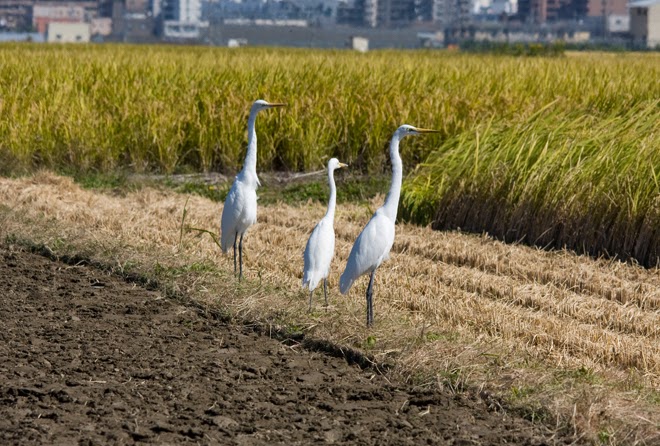
The local rice harvest was moving along at a cracking pace last Saturday, a fleet of rather noisy mini harvesters make short work of the rows and pour the grain into hoppers on top-heavy looking mini flat-bed trucks that really don't look up to taking the weight. Even though the hoppers themselves are rather mini too.
What really puzzles me is why the harvest timing is so different to that in Mie. When I was looking for waders in mid-September the rice harvest was more or less finished and a lot of the stubble already burnt or ploughed in. The Ogura fields are at the same latitude and elevation, just a couple of hours drive to the west (I'd estimate 30km further north and about 50m higher, hardly earth-shattering), but I notice this every year. There's about a five-week difference between the sites and it's the same in spring. Mie fields are flooded for planting at a time they can attract migrant waders while the fields here remain stubbornly dry till passage is over.
Anyway, to the egrets. I haven't seen any Cattle Egrets anywhere for a couple of weeks now and though we're past the Intermediate peak too there are still birds around. During harvest it's possible to get remarkably close views of them. By sitting at the field edge I had unconcerned birds come as close as 5-6m, attracted by the new abundance of food exposed by the harvesters. And this when I wasn't making any attempt to sit quietly or reduce movement as the egrets weren't my main focus of attention at the time.
 Small frogs were suddenly easy pickings in the wake of the rice harvesters.
I have to add that another puzzle is the name Intermediate. Intermediate between what? Certainly not between Little and Great White. Unless you interpret "intermediate" as meaning somewhere vaguely between two points. Intermediate Egret is much closer to Little in size and in a Japanese context you have to remember that our
modestus Great White are smaller than
albus, this becomes quite apparent on the rare opportunities for direct comparison.
An old shot of modestus (left) and albus Great Whites showing obvious size difference.
An old digiscoped spring shot of Intermediate (left) and Little Egret.
An appropriately positioned Intermediate with two Great Whites last weekend.
 Intermediate and Great White, it's not just size that makes the difference obvious.
Apart form size, which is only useful when they are together, there are a number of features that readily separate the two. Starting at the bottom and working upwards, Intermediate can look quite elegant but when you watch them for a while sooner or later they reveal their true shortish-legged, heavy-bottomed nature. As hinted at in the above shot more of the legs can appear to be cloaked when viewed from behind, the legs are shorter and the tertials often seem to fall further below the knee on Intermediate when standing upright making them look a little stunted compared to Great White. They can look dumpy and pear-shaped from the front too. The following image is an extreme example of course but could you imagine ever seeing a Great White looking quite so bottom heavy? It reminds me of some weighted rocking toy or ornament in this shot.
 It appears to have a very low centre of gravity in this shot.
In flight there's less leg extension beyond the tail and this has the effect of making the clump of toes look huge in relation to the visible leg, far more prominent than those of Great White, perhaps similar to the comparison between the eye-catching toes of Purple Heron compared to Grey.
 The middle toe is longer than the bill and compared to the total visible leg length are proportionately longer than Great White toes.
When most Intermediate pass through this area in spring and autumn they have a distinctly black-tipped yellow bill (like the bird above) and can be picked out at enormous distance because of this though most birds have lost this distinctive feature by now the bill/head shape and proportions are still very different. I could sum it up as Great White has a sleek tailor made bill that contours snuggly around the head whereas Intermediate has an ill-chosen off-the-peg bill at least two sizes too small.
 Great White's head and bill look a well designed single unit. The bill is a long and evenly balanced dagger, gradually tapering towards the tip and along the lower edge there's an almost seemless transition from the throat area creating a very long profile to the lower half of the head which is almost matched by the upper half. The forehead angles acutely from the base of the bill to a peak well behind the eye. Adding to the single unit appearance the the bare facial skin encompassing a well proportioned and positioned eye seems to blend the two together, all secured by the long gape line.
 The Intermediate bill is shorter and blunter, less tapering throught the whole length and more sharply at the tip, particularly the lower mandible. More a minature broadsword than a dagger. Depending on stance it can look sleek and well proportioned about the head but doesn't match the stylish elegance of Great White. Often the forehead is steeper and the crown rounded and the lower side can be jowly, thus the head appears larger and the bill looks stuck on the face as an after thought rather than being one streamlined unit. The eye is slightly more centrally placed between bill tip and nape and even looks proportionately larger to me, whereas that of Great White is set further back because of the longer bill. Overall Intermediate looks larger-headed and shorter-billed while Great White is the reverse, longer-billed and smaller-headed.