Showing posts with label Sandplover Lesser. Show all posts

Monday, 14 May 2018

A few breeding plumage waders

I've only managed to get out to Heurajima once this spring; an uneventful trip before better weather brought some decent birds. Since then I've either been too busy or the ferry hasn't sailed so last weekend I decided to content myself with a trip to Mie to check out the wader passage.


The forecast predicted a 90% chance of rain from about 6am onwards but as luck would have it the rain held off till 1pm and didn't come down in road flooding torrents until 2pm. One benefit of dull, heavily overcast weather is Green Pheasants are suddenly everywhere, I stopped counting at 10 roadside birds. They can be next to impossible to find on clear days and trying to find them for visitors can prove a real time waster.


The downside of being easy to find to wet weather is they lack the vivid iridescence that makes them so striking.


But this post is supposed to be about breeding plumage waders, isn't it? There were about 300 red Red-necked Stints on the mudflats but you can't be everywhere at the right time and none of the Stints were close when I was at any of the three estuaries holding large numbers. Ponds and beaches were better for reasonable views of birds and for me a couple of Spotted Redshanks were the most attractive waders of the day.


Ruddy Turnstones were looking pretty good too, 66 birds was the largest group I came across. Again the light wasn't very helpful and it was difficult to get good shots of them.


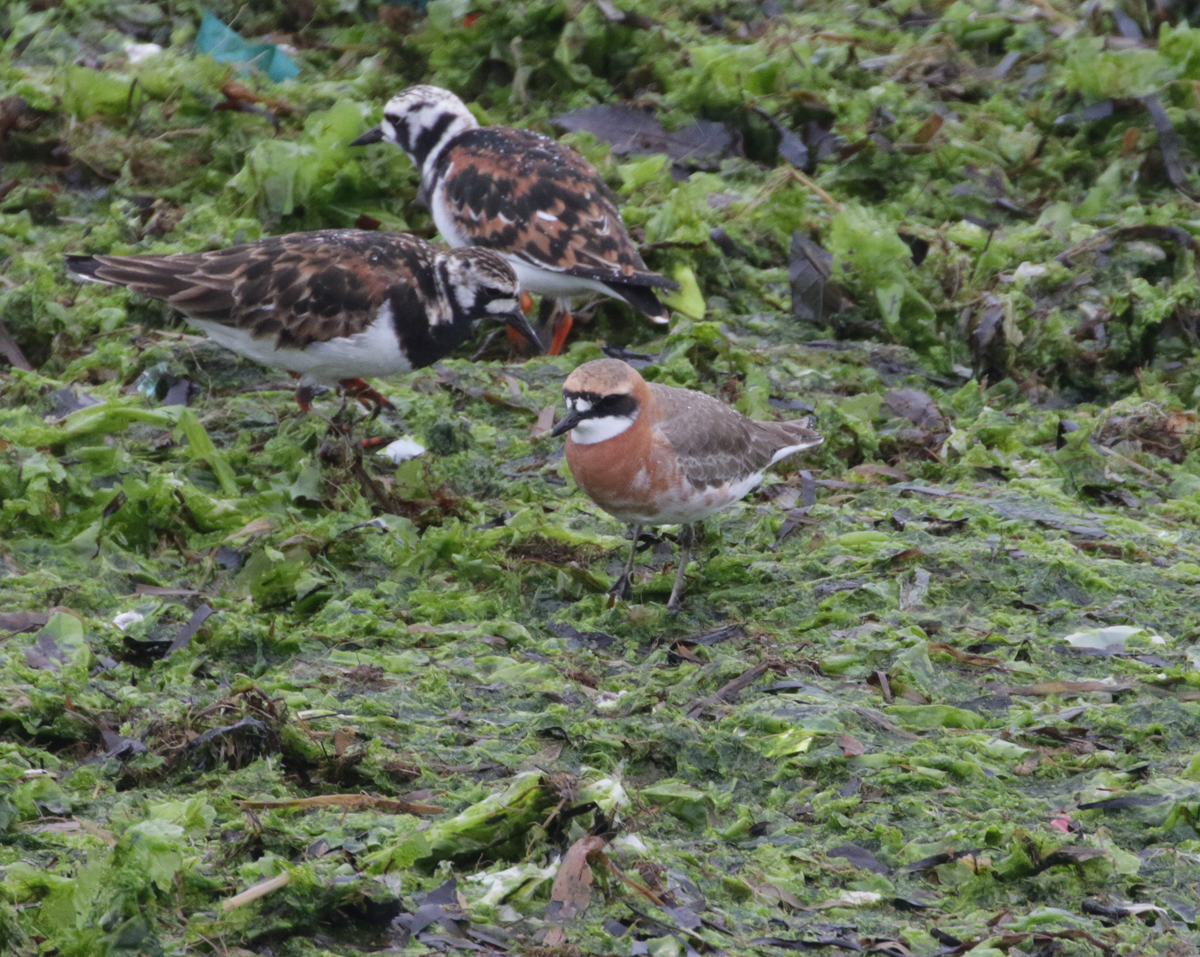
There weren't many Lesser Sand Plovers around and most were on distant sand bars, this bird with the Turnstones was the only close bird of the day. I don't see many in full breeding plumage and rarely see birds with such extensive red on the flanks and lower breast.


Not the 'best' of the Common Greenshanks but the only one that came close.


Whimbrel were very common along the shoreline and in the fields. In my pre-camera days I'd have IDed them and moved on but one of the great things about taking pictures of common birds is I notice things I would otherwise have seen. In this case I was surprised by the difference in primary projection, which presumably has nothing to do with age; the first bird has three visible tips well beyond relatively fresh looking tertials whereas the second has only two just showing beyond more worn tertials.


Saturday, 19 August 2017

Common Ringed Plover and other waders on the beach

Waders have been on the move for a while but by mid-August things should be hotting up a little so I made my first autumn passage trip to Mie earlier this week and though I managed to see about 24 species numbers were low. In fact it took 12 hours before I found my first Dunlin.


The biggest surprise was finding a Common Ringed Plover. Or should it be that the biggest surprise is that it's taken so many years to find my first Mie Ringed Plover.


The Common Ringed Plover with Ruddy Turnstone, Terek Sandpiper and Lesser Sand Plover.


The Plover was very loyal to the same tiny spot on this short rocky stretch of beach (actually lumps of old concrete I think) but for some reason it was highly unpopular with the Lesser Sand Plovers which would often make a run at it as they passed by. There didn't seem to be any other interspecific harassment so I've no idea why it attracted so much hostility other than being the stranger in town.


Ruddy Turnstones are probably my favourite shoreline wader, still even more striking and attractively marked birds at this time of year.


This was the only Lesser Sand Plover more or less in full breeding plumage. Many still have varying amounts of reddish across the breast but the forehead markings are early lost to moult. So there's never much chance of finding an easy to identify atrifrons.


There were plenty of Grey Plover in the area but they tend to stay further out on sandbars as the tide drops. This was the only bird I saw that offered any kind of photographic opportunity.


Other tidal species I saw included Kentish Plover, Whimbrel, Eurasian Curlew, Eurasian Oystercatcher, Sanderling and Red-necked Stint but none were close to get any decent shots. It's always something of a lottery birding along this coast as some spots tend to be better at different stages of the changing tides, unfortunately it isn't a linear progression along the coast as might be expected and inevitably means many areas are covered under less than optimal conditions. Personally I'm not the sit-and-wait type which, depending on the day, could be more productive. Of course at high tide there are also other habitats to check.


Friday, 9 January 2015

First 2015 trip to Mie

I'm having a wonderfully slow start to the year at work and was free the 7th and 8th, so off I went to Mie. I'd thought about northern Lake Biwa but the forecast for more snow up there didn't look to promising, though in the event the weather wasn't that great in Mie either.

As usual I waited on the seawall for dawn. The scene looked so serene with the full moon shining down on the exposed tidal flats but the buffeting the van was getting from wind told a different story. And it was cold.

By the time dawn was approaching the flats had already been drowned but the silhouettes of hundreds of ducks, thousands even, were beginning to emerge where there had previously only been disembodied voices. Uninhibited whooping whistles from the Wigeon on the sea and just the occasional subdued equivalent from the raft of Pochard on the landward side of the wall - stubborn silence hadn't given away about 600 Pintail.

On the same pool there were five Long-billed Dowitchers in exactly the same spot as two months ago, though the number of Stilts was down.

As I usually start birding in the same spot I'm never going to get better shots of the Dowitchers than these early poor light shots.

It was very much a digiscoping day, waders and ducks at long range and the quality of images isn't anything to write home about. 13 species of wader wasn't bad for the time of year but whatever time of year there's always one or two species that can't be missed, that are. The ones that inexplicably aren't to be found. And on the day it was the turn of Ruddy Turnstone and Grey-headed Lapwing to go missing. The hundreds of Dunlin and Sanderling weren't a surprise but slightly better were three Northern Greenshank and four Green Sandpiper. I think the best find must have been a couple of Lesser Sand Plovers, a bird not normally found here in winter.

Dunlin were very common and would allow great photo opportunities but as usual there's always something better somewhere, if I could only find it, and the common birds can wait. Even so, I love these long-billed birds.


An unexpected find, Lesser (Mongolian) Sand Plover.

The first really interesting bird of the day was a Slavonian Grebe, a bird I hardly ever see in Kansai. In fact I can only recall three off the top of my head. And another surprise was an eared owl, probably Long-eared going by the habitat and the fact that they do winter here whereas the once common Short-eared has all but disappeared as a wintering species. Having said that there is a wintering bird on the Yodo river just south of Kyoto this year. All I got of it was a glimpse as it weaved between some trees and was gone.

If the Slav Grebe was distant, Little and Black-necked were common and there would always be some closer birds. For Little that usually meant in a ditch rather than on a pond and for Black-necked in a harbour rather than on the open sea or pond.


I really didn't see many passerines but the following two were both in a small park behind the sea wall. There were also three or four Hawfinches but not surprisingly they weren't going to sit up for the camera.

Female Daurian Redstart. 

There are always a number of Olive-backed Pipits in a small park behind the sea wall.

Coming to ducks, I'm always checking harbours hoping to find some interesting sea ducks but the vast majority are Common Pochard.


Greater Scaup tagging along with Pochards.

Towards evening I came across a group of Stejneger's Scoters not too far off-shore, this is only the second time I've found this species in Kansai and definitely qualifies as bird of the day.

Stejneger's Scoters just too far out for decent digiscoping.

Saturday, 16 August 2014

Mt.Misen and Matsusaka wader spots

The 13th of August is maybe a bit late to be heading into the forest with high expectation of finding many birds by song. Nevertheless, as I hadn't had a chance to get into the hills of central Wakayama this year, I was keen to try for a few birds I can't see closer to home. Plus having two free days I could combine it with a first wader check of the season.

I drove down the night before taking a different route to the narrow twisty road I've used in the past, less direct but much faster. It would have been much quicker too if I hadn't missed a turning and driven an hour before realising. This meant I didn't get any sleep as the eastern sky was already pale when I arrived but on the upside I did get very nice views of a roadside Ural Owl, first sitting on the roadside barrier then on an over-arching branch.

I hadn't expected a great dawn chorus but Japanese Thrush was one species still in full voice, Blue and White Flycatcher put in a decent shift too. However some quite common yet hard to see species were totally silent, Ruddy Kingfisher and Siberian Blue Robin in particular spring to mind, so it was quite a surprised to actually see a female Siberian Blue Robin move across a small patch of uneven bare ground on the steep slope below the road. Even more of a surprise was hearing a single Japanese Robin sing sporadically, their numbers are far lower in the area than Blue Robin.

Which species were seen and which missed was a bit of a lottery but the silent cuckoos and Grey Nightjar were firmly in the miss column while Japanese Woodpeckers were very active and conspicuous as were the usually gregarious birds, Red-billed Leiothrix, the tits with Willow the best of the bunch and here and there was the wonderful discordant woodwind sound of White-bellied Green Pigeon that I find so evocative of the better quality mountain forests.

As the morning pressed on I began thinking of the two or three hours drive to Matsusaka. There were going to be exceptionally high and low tides today and tomorrow and I didn't want to mistime my arrival. It really had nothing to do with needing coffee, but I was horrified to find the nearest convenience store was over an hour away...  this is Kansai not the back of beyond!

I made it to Matsusaka by early afternoon, in time to catch the rising tide. The few hours before dusk were enough to convince me to stay overnight to catch the next rising tide but in the event the extremely high tide meant the mudflats had been drowned before dawn and the onset of heavy, persistent rain from about 06:30 reduced visability so much as to make waiting for the falling tide a waste of time.

As things turned out it was just as well I left early as the main route across the Kii Peninsular was closed requiring a lengthy detour along a maze of unmarked single track roads. It just hasn't been my week, only a few days earlier I was driving back from Niigata during a typhoon where two roads had been closed. But back to the birds...

There was a rather unremarkable total of 17 wader species, and nothing out of the ordinary. Well, that's by Mie standards anyway, by Kyoto standards it was pretty darn good. But why go there so often if a disappointing day in Mie weren't far better than any in Kyoto. Obvious absentees were Wood Sandpiper and Little Ringed Plover, others are less predictable but I'd normally hope to see Great Knot, Grey Plover and Whimbrel. To see 20 species isn't anything to get excited about but it's not just about numbers and at this time there are still a few birds in cracking breeding plumage. There were about eight Turnstones and absolutely stunning they were too...


A count of 27 Black-winged Stilts was very good and as usual they were on their favourite pond which puts them just a little too far to get good shots with my gear.

When a Peregrine tried to take a Little Grebe most waders flew off in a panic, the Stilts by contrast gathered in two tight groups close to the reeds. 

It wasn't all just waders of course, and it was probably the one that got away that would've been the highlight of the day (aren't they always?). As I was driving along a levee top I just caught the very small size and flappy flight of a small bittern or Striated Heron. By the time I pulled up it had dropped into the reeds or the river edge but when I doubled back and crossed the river there was nothing on the far side of the reeds, so it must have dropped into the reeds making a small bittern species all the more likely. Another highlight was this Osprey, it's rare to get such good views but this rather bedraggled bird was very approachable.


These two Common Redshank were probably the least common wader species of the day and though even breeding plumage birds aren't spectacular, they are still subtly attractive. The other interesting species of the day was Lesser Sandplover, not because it's rare but they present a more interesting identification challenge.


Lesser Sandplover showing the straight distal edge of the inner primary wing-bar, unlike the bulging bar of Greater Sandplover.

They don't come much smaller-billed than the male on the right in these two shots.

A few males were still very red on the breast but the black line down the centre of the forehead seems to disappear very quickly creating an unmarked white patch.

Of the large number of birds close to breeding plumage, this was the only bird with a strong forehead line.

This female looks much longer-legged and bigger-billed. Just individual variation, or how different might mongolicus and stegmanni look?

The beach turned up something else of interest too, while sitting waiting for waders to come closer I noticed a terrapin walking across the sand. It wasn't too far from the river mouth so it didn't strike me as too odd and not wanting to give up my position to the waders I just took a single shot. However once back home I checked the image and it looks to me like a tortoise!