Showing posts with label Woodpecker White-backed. Show all posts

Thursday, 9 April 2020

Amami Nature Observation Forest

The Amami Nature Observation Forest might sound as though it's more geared to showcasing natural Amami to tourists than as a must visit site for serious birders. However, the well maintained trails from the visitor centre at the top of the mountain offer excellent access into the forest. Plus there were very few visitors judging by the total of only 4-5 parked cars over four visits. I never actually saw anyone on the trails. The forest also sweeps right down the western slopes to the coast and, though patchy, continues south along the ridge. It's far more extensive than might be inferred from a cursory glance at the map.


I visited this site four times yet still didn't really do it justice. Though I spent far more time in total further south, admittedly mostly nocturnal and in rainy weather, I ended up with a slightly larger number of species seen/heard from this site. Two visits were largely diurnal and in sunny weather (the only non-rainy periods of the trip), this probably accounts for the greater number of bird species recorded.


The first visit was purely because it provided a convenient place to get some birding in before checking into my hotel after arriving on the island mid-afternoon (March 31). Likewise it was conveniently in the general direction of the airport on departure day (April 5), though I did start birding pre-dawn on that occasion. I also paid a nocturnal visit here on the first day of the trip and spent an 'easy-paced' day on April 2. This easy day because I realised I was overdoing things and needed to get some sleep. Two hours sleep out of 36 was becoming stupidly counter productive so I cut short my April 1 nocturnal jaunt and had a long sleep at my hotel followed by a relaxing morning at this site before a little more sleep to adjusted my routine to going to bed at about 2pm and getting up around 9:30 pm. This worked fine for the rest of the trip.


There were three species I found here that I didn't connect with at all further south plus a couple more I only saw at this site: the three birds only encountered here were Black Woodpigeon, there were always 8-10 along the road near the visitor centre, a ficedula calling briefly down a steep slope off the road running down to the west coast of the island was a presumed Ryukyu Flycatcher which I couldn't get to see despite my best efforts. I can't confidently rule out a migrant Narcissus but Ryukyu is far more likely given the date and place. The third was an out-of-the-blue Ijima's Warbler, more of that later. The other birds of note were Ryukyu Robin which though very common everywhere I went was only seen in the early morning here. The same could be said of Ryukyu Green Pigeon, though a frequently heard bird further south, two birds usually feeding in trees along the roadside here were the only birds I actually saw.


On the other hand I didn't see Amami Thrush here. I did hear one from the road near the foot of the mountain on the east slope while driving up pre-dawn and another, which would have been in the forest hills just south of here, while drinking my early morning coffee at the Family Mart in Tatsugo on Route 58.


If I were to start a convenience store chain list, Amami Thrush is a bit of a blocker as far as the other national chains are concerned as Family Mart seems to be the only big name currently on the island.


One other point of note; on the final morning Grey-faced Buzzards were taking advantage of the fine weather and between about 8:15 and 8:30am I counted 164 passing over the narrow valley I was in. After driving down to the coast and then into another valley further south, there were more Buzzards on the move. If birds were leaving from across the island as a whole, the total number involved would have been vast.


Black Woodpigeons were easily seen, not so easily photographed. The white eye here being the result of the fill-in flash, this still before sunrise.


Ijima's Warbler, the one and only phyllosc of the trip.


I have to thank Yusuke (comment below) for setting me straight with this one. Walking along one of the forest trails, I was initially drawn to an unfamiliar call and on realising it seemed to be coming from a phyllosc dashing around high in the trees high overhead my first thought was whether this could have been Ijima's Leaf Warbler. Surprisingly the bird came down to eye level and sat motionless (when do they ever do that!) offering a totally unexpected chance to get a series of images. Unfortunately they were all more or less head-on and I then made two important errors with the identification; firstly I forgot about the unfamiliar call, or at least carelessly supposed it must have been a different and unknown bird and ignored it, and secondly I imagined I could see the rear crown stripe in the images whereas in fact there's only a greyish tint across the whole of the crown, almost producing grener lateral crown stripes. This imagined crown stripe along with yellowish undertail coverts ruled out both Ijima's and Claudia's Leaf warblers and led to the erroneous identification of Western Crowned on my back of the camera check in the field, one that I gave no further though to.


I've only been to Myakejima once where, I apart from a few glimpses, I only saw one Ijima's Leaf Warbler so this bird is a very good sighting indeed as far as I'm concerned.


A common bird of forest, forest edge, and even not all that close to the forest it would seem, is White-backed Woodpecker Dendrocopos leucotos owstoni. leucotos, ouch, it's such a cracking bird it deserves to be split for that reason alone, but sadly the IOC don't see it that way. What is genuinely surprising though, is why did I only see females? It's not just the four different individuals below, I never saw a male the whole time I was there.


This was almost the first bird of the trip, I had to unpack my bins and camera for this bird chipping away noisily at the roadside. I was even lucky enough to capture a chipped chip in this shot!

This nest was also right by the road and only about 150m from the previous bird. Not sure what ufo I captured here, definitely not a chipped chip.

Demolishing a branch in the forest, they really hammer away. Note the sunshine in this shot, arguably the biggest rarity of the trip.


Demolition moves on apace.


No series of White-backed images would be complete without at least one bird on the ground. There it is.


White-breasted Waterhen wasn't uncommon however, this bird at the top of the mountain aside, they were all in lowland areas, around market gardens, rivers, marshy bits and so on. These images are to try to restore some balance, there have been way too many dry images in this post. Water; water hanging in the air, water failing through the air, water dripping from everywhere, water pooling on the ground... that's what I'll remember. 


Friday, 17 June 2016

Fairy Pitta

I'm sitting here today pondering my leech bites. I've never had an adverse reaction before but a couple of these are really itchy and another very red and splodgy. At least they show I was in good quality forest!


Yesterday I was birding in both Kyoto and Shiga forests and though my day began with four hours continuous rain just below a low ceiling of cloud (as I discovered after daybreak) by 6:30 the rain was easing-off, the morning destined for clear skies and a sticky 100% humidity.


I didn't leave the shelter of the van during the hours of darkness; umbrellas and trees don't go well together in daylight let alone at night. All I heard were three Japanese Scops Owls, none of them close, and barking foxes. At first I heard the foxes snuffling, grumbling and grunting behind me and I could see two adults and at least one half-grown cub on the road. I'm unsure whether there was more than one cub as 'it' was racing back and forth mostly hidden by a bend in the road while the adults sat watching over play time.


Once light began to broaden I couldn't justify sitting any longer so pulled on waterproof bottoms (Does that sound any better than waterproof over-trousers? Didn't think so.), grabbed my umbrella and made my way along the woodland edge. It still wasn't light enough to identify many of the small birds flitting in the tree tops but a Broad-billed Roller suddenly appearing flying away for a brief second was a shock, to say the least. This isn't a bird I expect in Kansai during the breeding season, I think I've only seen one here on passage! Then I promptly began the process of talking myself out of it. "It's still pretty dark, the flight was a bit like a Jay... it must have been a Jay" It was a Jay.


I covered the nearby area as much as possible but under the trees wasn't getting much brighter and just before 7am I was back at the van for a break and some roasted almonds in lieu of breakfast. Then, unbelievably, a Fairy Pitta was singing! The rain had stopped (more or less) so I could ditch the brolly before dashing towards the sound; don't stop... don't stop! I struggled to spot it in the tree tops and after a short pause the song was another 150 metres away. And so began a Pitta chase. For a long while this pattern was repeated, it wasn't bothered by me, I could just never pick it up before it changed song perch. This time perseverance paid dividends, I finally latched onto it, this wasn't going to be one that got away; another one that got away.


I was able to watch it for several minutes before it shifted again.


When I first heard the Pitta it seemed in competition with a Ruddy Kingfisher singing from the same location. The big difference was I was able to connect with the Pitta eventually. The Kingfisher, along with several others heard that day (and countless others) remained just a voice in the forest. The Pitta was a photo tick for me, the Kingfisher will have to wait, yet again.


I heard the Pitta once more, very briefly, but it was way off across a broad valley on an entirely different hillside. A second bird? Or this one moving along?


The morning was heating up as it progressed, so was I, there wasn't a breath of air. I was thinking about a move, trying somewhere else and I'd driven a couple of hundred metres back down the access road enjoying the breeze through the open window but decided to check one last spot. A track led to a clearing through a narrow belt of trees and no sooner had I stopped to check some movement in the bushes than a Roller, living up to its name, flopped rapidly across the open space. Ha! Jays with dark rumps don't exist. No, not even in the early half-light. Note to self: don't talk yourself out of good birds in future.


My next stop was a deep, dark (leech infested) valley bottom. I've seen Japanese Night Heron here in the past, Copper Pheasant too. But not today.


Fire-bellied Salamanders are very common in old wet forest but after a lot of rain you've got watch where you put your feet, they seem to think they own the place wandering willy-nilly from puddle to puddle.
Northern Hawk Cuckoo is a fairly common bird, very vocal at night and into early, post-dawn morning before they notice night has given way they're supposed to melt away with the darkness. Where do they go? They go to dark, deep (leech infested) valley bottoms.


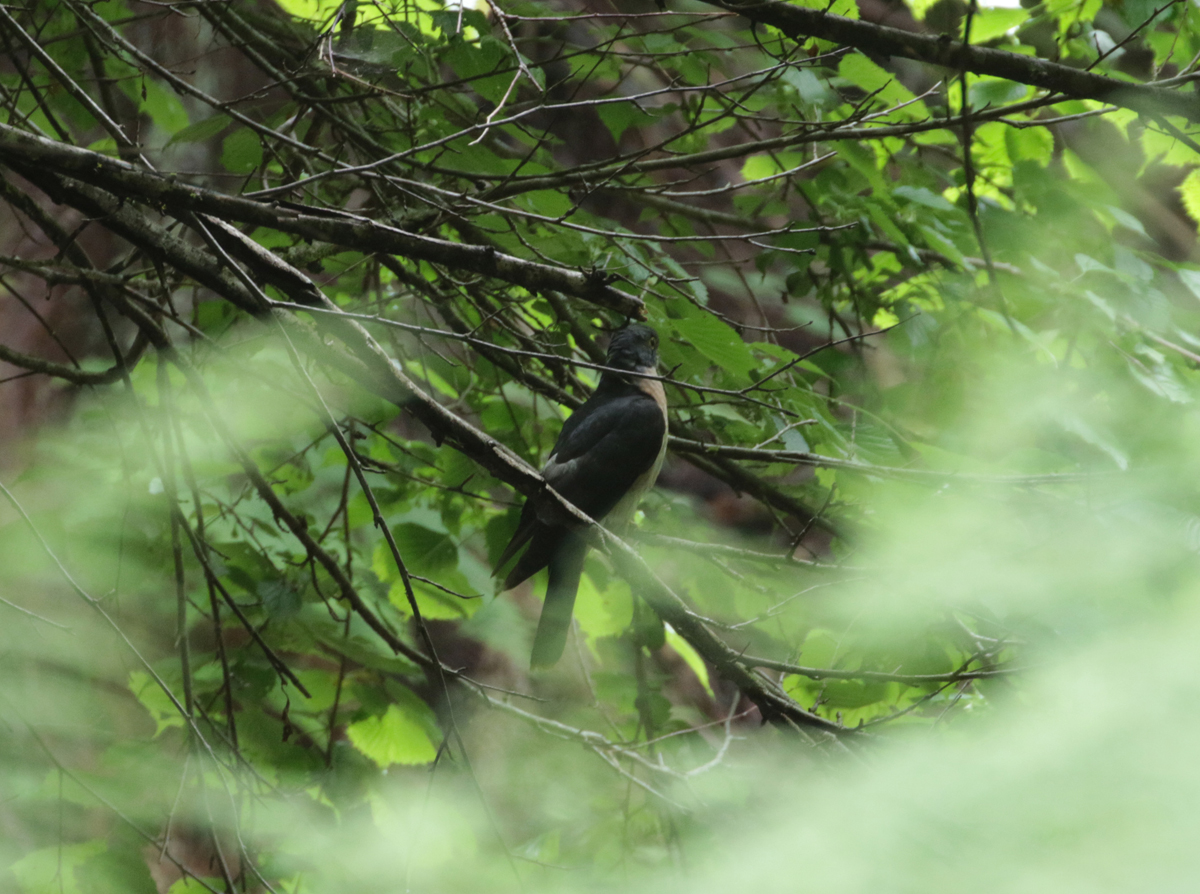
Another feature of dark (leech infested) valley bottoms is shredded trees. Deer rubbing off their velvet? Not going up to four or five metres I'd have thought. Bears it is then, though I've only ever seen one here. Another good bird down there was a Japanese Sparrowhawk. I heard a harsh scolding and saw something dashing towards me with a Blue and White Flycatcher in hot persuit. After a minute I'd persuaded myself that it could have been the Hawk Cuckoo, they look incredibly accipiter-like in flight. I was at it again, trying to deprive myself of a good sighting. But for the second time I had another chance to confirm its identity when after several minutes (where had they been all this time?) the Sparrowhawk and Flycatcher came back up the track. The hawk passed by at head height just a couple of metres away, I don't think I've ever been quite as close to a wild bird of prey.


Before light began to fail I took a thoughtfully place but little used road that crosses the mountain. The best bird (not that I saw it) was a singing Japanese Leaf Warbler, something I hardly ever encounter, plus the only (also unseen) Japanese Thrush. The first Grey Nightjar started 'chucking' while light was still good but it was another 40 minutes before others joined in. While I was waiting a terrific roadside White-backed Woodpecker kept me entertained.


Saturday, 21 December 2013

woodpeckers

Wryneck is probably a more common wintering species than my sightings suggest, probably only 2-3 per winter around the city. It can be found in areas of bushes or young trees close to water, major rivers, lakes (including the park variety) or hill streams alongside a road where the combination provides more open habitat. Reedbeds with scattered bushes are a favourite with them. Birds are normally solitary, quiet and probably overlooked, though when there are two or three together they can be very vocal.

A wintering bird on a small mountain river on Mt.Katsuragi, Osaka.

Three woodpeckers can be seen in Kyoto, Japanese Pygmy is very common in parks and gardens as well as woodland, Great Spotted is common, especially in winter, on the surrounding hills and Japanese though less numerous can still be found on surrounding hills. Japanese used to breed in the Fushimi Inari Shrine precinct and on occasion visit city parks. Higher into the mountains away from the city White-backed is fairly common. In areas like Ashyu Forest to the north or Nara/Wakayama mountains to the south Great Spotted and White-backed seem comparable in number, and Japanese is far more easily seen in these areas.

For anyone interested in woodpeckers Hokkaido is the place for both variety and numbers.

Japanese Pygmy Woodpecker in the botanical gardens, Kyoto city, 7 March 2012.

Japanese Pygmy Woodpecker in the Imerial Palace Park, Kyoto city.

Two Lesser Spotted Woodpeckers in what I'd have thought was unusual habitat near Abashiri, Hokkaido 31 December 2012.

Another LSW in the same general area as the above birds.

Male White-backed Woodpecker, Woody Pal, Shiga. They're more often heard than seen in summer but once the leaves have fallen they're much easier, as long as snow allows access to the mountain tracks.

White-backed near Kawayu Onsen, Hokkaido 12 August 2012.
    
Male Great Spotted Woodpecker Abashiri, Hokkaido 15 August 2012.

Female Great Spotted Woodpecker, Abashiri 15 August 2012. 

Juvenile Great Spotted Woodpecker, Wakatohanto 12 August 2012.

Juvenile male moulting to adult Abashiri 15 August 2012.

Female Japanese Woodpecker Mt.Misen, Wakayama 28 June 2013.

Grey-headed Woodpecker Abashiri, Hokkaido 14 August 2012.