Showing posts with label Stork Oriental White. Show all posts

Tuesday, 7 October 2014

Oriental White Storks

This weekend trip was to have been titled "migrant hunt along the north coast of the Noto Peninsular" but owing to an almost total absence of migrants (maybe that was just me) I might fall foul of some trade description legislation if I were to go ahead with it. Ultimately Oriental White Stork stole the show by default.

I spent Saturday up north around Noroshi and dropped down to Kenmin Kaihin Park in Kanazawa on Sunday morning.

Saturday morning actually started well in fact. I pulled up at a stretch of unkemp grassy beach backed with scrub then by mixed woodland. The first bird I saw was a Siberian Stonechat, atop a straggly stalk. Soon after a phylloscopus hovering in some bushes turned out to be Kamchatka Leaf. Four Mandarin Ducks were circling the bay and were later joined by two more.

This was a really promising start. So what went wrong? I didn't find a single other bird the rest of day that couldn't have been a local resident.

The fruits of a slow bird day.

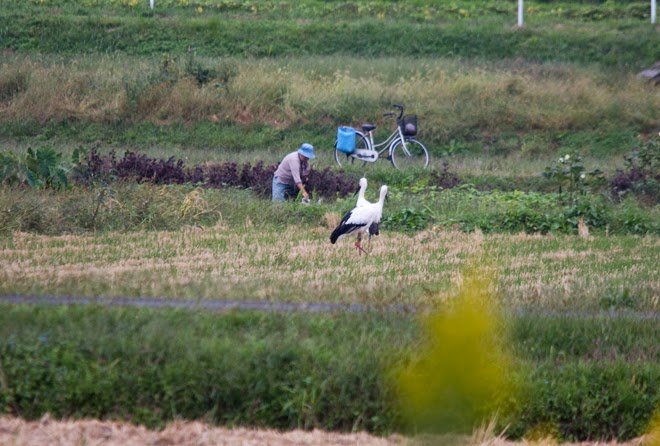
I was delighted to find eight Oriental White Storks just north of Lake Biwa on my way towards home - I had to go back for one day at work that I just couldn't get out of. Interestingly one of the three I'd seen the weekend before was fitted with a satellite tracker, something none of these birds had suggesting there may be more Storks using this area.

The new neighbours checking out a local. 

A local checking out the new neighbours.

Been here five minutes and already ignoring the crossing... and it's such a busy road!


Wednesday, 1 October 2014

Crested Ibis and Oriental White Stork

After the good Hegura trip of the previous post, I woke early and mostly freewheeled back to the base of the headland. Basically the area is going to get the same birds as Hegura but they'll be able to disperse further more quickly and many will be harder to find. As there wasn't a large number of migrants on the island yesterday, I wasn't expecting the trees and bushes to be dripping with them here. How right I was.

By 8:30 I'd covered a fair amount of ground and the only migrants to show for tramping up and down the hills under the already hot sun was a small group of turdus thrushes clucking as they melted away. One at least was Japanese. And down in the village there was a large flock of mainly Red-rumped Swallows but with a few Barn, at least one Sand Martin and three Pacific Swifts.


It was then my phone pinged and a text on Sunday can only be for a bird. Sure enough someone I emailed while waiting for dawn got back to say a Crested Ibis was watched just 16km away at Suzu yesterday. He didn't have more details, where exactly other than in fields, or how long it might have been there. But only 16km for a Crested Ibis was too good to miss.

To be honest I thought the Ibis was nailed-on. Coastal villages have squeezed into every fingernail of flat space the hills neglected and their small associated areas of paddies cling to the slopes or shoehorn into narrow valley bottoms - this Ibis is going to be easy. Just a 16km dash. I'd never been to the western side of the peninsular, or southern which would be more appropriate up here at the crook, so eagerly cut across the peninsular with the bird already half ticked, totally oblivious to the awaiting reality.

Suzu is a moderately-sized rural city set on a coastal plain, around it an ocean of paddies with an archipelago of low hills creating inlets, straits and any number of secluded coves. My heart sank. There were Intermediate Egrets and grey Herons dotted singly or in small groups but no Ibis. Even on the extensive open areas there were so many ditches to lurk in and overgrown bunds to hide behind this wasn't going to be as straight forward as I'd imagined and ultimately ended in failure.

This is the second Crested Ibis I've chased in Ishikawa which seemed and I suppose still seems an easier bet than going to Sado Island. If the birds are successful on Sado, it must only be a matter of time before they re-colonise this former stronghold.

Because there hadn't been many migrants at the point and the weather certainly wasn't conducive to new arrivals I decided to drift homewards and with my mind already shifted to introductions it was only natural that the Oriental White Storks in Shiga presented themselves as an acceptable alternative. I'd never been to look for these birds but had pretty good directions and knew the general area quite well.

After trawling round the fields and seeing big numbers of egrets and Grey herons I was getting a familiar sinking feeling and stopped to gather my thoughts. No sooner had I switched off the engine when a Stork came gliding over the village through the nearside window. Then another, and another. Success! These birds come with no ethical listing ambiguity, I'd seen two in Japan before the re-introduction programme began, I could just enjoy them for the spectacular birds they are.

And yes, that egret is Great White.

Thursday, 14 November 2013

storks & spoonbills

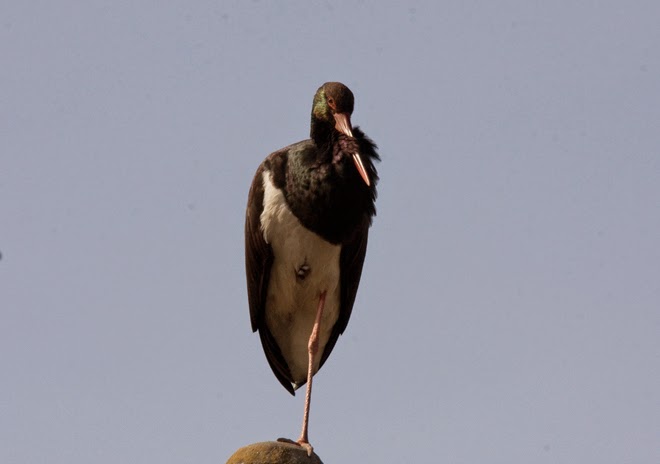
Historically there are records of Black Stork in Kansai but until recently it had disappeared from Japan as a wintering species. The previous few winter there have been a couple of birds wintering around Isahaya Bay in Kyushu but as the population as a whole isn't growing this is very unlikely to herald the return of the species to its former status.

One of two Black storks at Isahaya Bay, January 2015.

Oriental White Stork is another species that disappeared but even more dramatically as it was formerly a widespread breeding species. It still occurs, usually in winter but it's rare and could turn up anywhere in the country. I've seen two in Kansai over the years, a wandering immature which by chance stumbled upon the Hyogo re-introduction programme headquarters and stopped wandering. And another, a Chinese ringed bird, which settled for the winter at Kameoka, just outside Kyoto city. This bird seemed to become a source of civic pride among the local dog-walkers and farmers.

Video-grab of the Chinese-ringed Oriental White Stork soon after arrival, November 2004, Kameoka.

Now that birds from the re-introduction scheme based at Toyoka (Hyogo prefecture) are successfully breeding in the wild it is possible to run into these birds in rural Hyogo and Kyoto in any season, though you'd still need to be very lucky. Or indeed, even further afield as birds from this scheme have wandered the length and breadth of Honshu and as far as Hokkaido and Kyushu.


Oriental White Storks in north Shiga, 2014.

The Crested Ibis re-introduction project on Sado Island is more recent and as yet smaller scale but at least one bird has turned up in Ishikawa, an area in which they hung on until late in the day, there may be hope for this species re-occupying its former range too.

Eurasian and Black-faced Spoonbills both occur in Japan in winter. Though Black-faced is more numerous overall, it's Eurasian that's more frequent in Kansai. However numbers are very low and it's impossible to guess when or where they might turn up. Ponds around northern Lake Biwa have a good track record of hosting wintering birds and I've seen a number there over the years.

Adult Eurasian with its dipped-in-custard bill on a pond near Lake Biwa.

Black-faced Spoonbill will be of more interest to most overseas visitors but fewer come as far east as Kansai and visting birders who have the time will expect to see this species in Kyushu where it is quite easy to find at certain locations, particularly estuaries in the north and north west.

An immature Black-faced on the Yodo River in Osaka city was a good local record.

A party of Black-faced Spoonbills, Kyushu.

Eurasian and Black-faced together in Kyushu.

Almost synchronised spooners.

Immature Black-faced Spoonbill in Kyushu, December 2015.