Showing posts with label Goosander. Show all posts

Monday, 26 December 2016

Scaly-sided Merganser...? Not a chance!

Football is rife with cliches. Most seem to state the obvious even if we're meant to infer there's hidden depth; "It's a game of two halves." and the like. One that winds me up every time is "You make your own luck". What nonsense! How would you apply that logic to winning the lottery? Hard work is hard work, luck is arbitrary.


I'm feeling irritated I suppose, just back from my annual Scaly-sided Merganser dip: or at least the first of them. This was the Saigawa dip, now a four-winter streak, I've still got a couple of Kyushu rivers to dip on later this month or early in the New Year.


We all have a bogey bird or two but I never anticipated the Merganser slipping into that category. The first time I tried I saw a male and female on the Kisugawa in Gifu, as well as seeing my first ever Baikal Teal and Long-billed Plover as an added bonus (it really was a long time ago!), though I did have to walk 50km that day. Those 50km pale in comparison to the total distance I've covered since then without so much as a sniff of another Scaly-sided. Just let any football manager to tell me I have to make my own luck!


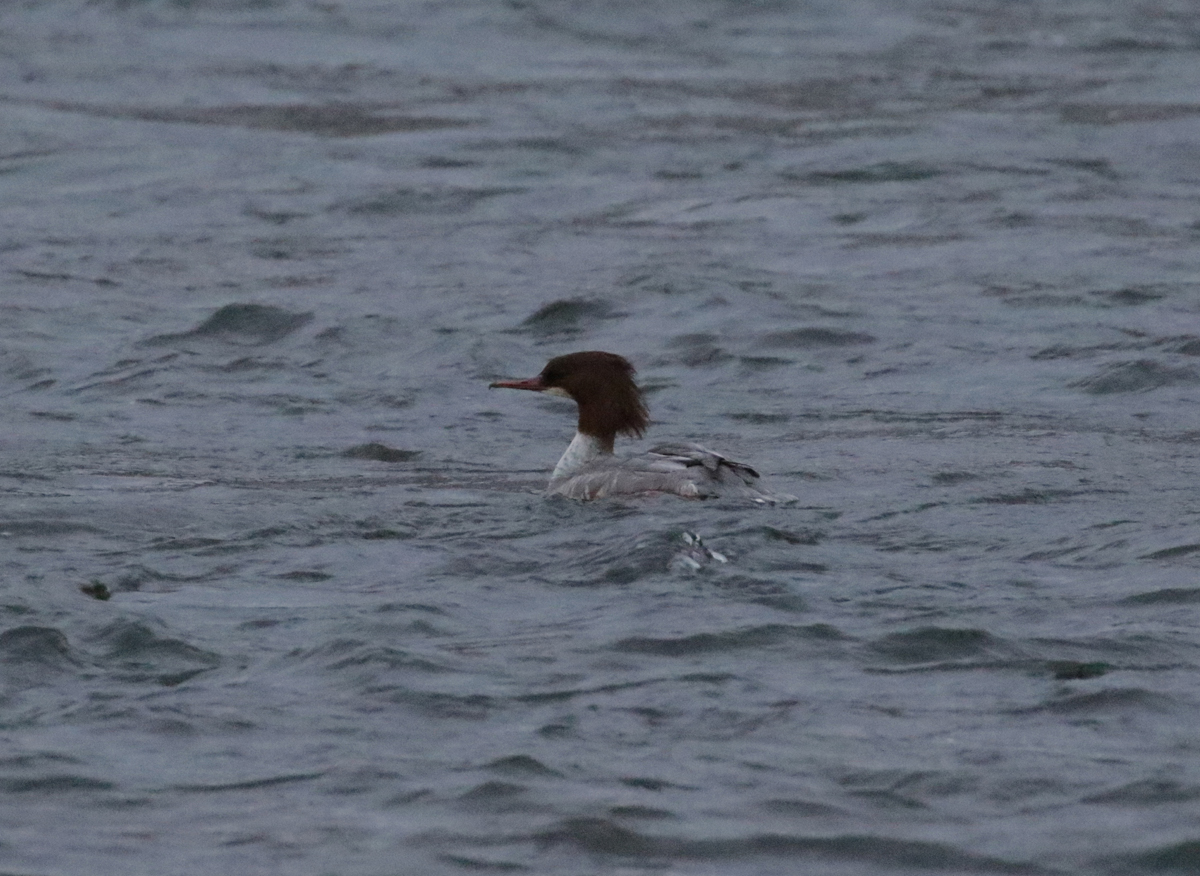
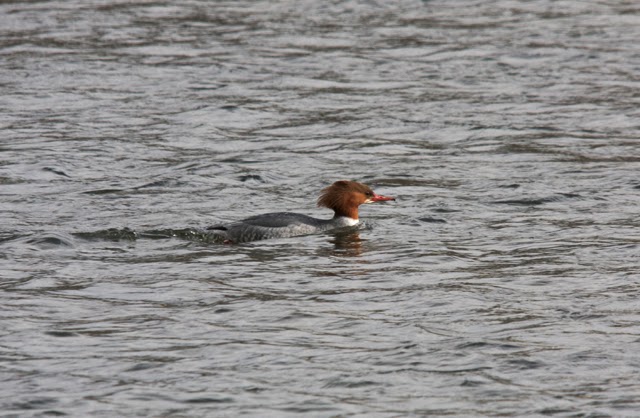
As you'd imagine I've seen an awful lot of Goosanders on all these dips. I'm not complaining, they're great birds and the river views are often better than those on Lake Biwa. And yet, it now seems I'm guilty of not looking closely enough at them. Goosander has always struck me as one of those birds you get what you pay for; not a lot of variation. Until now.


I spent the best part of the morning trudging the banks of the Saigawa before taking a break to see the Redpolls in my previous post. Then back to river duty in the late afternoon hoping that there'd be some pre-dusk movement. There were definitely more Goosanders on the city stretch of river in the afternoon. Light hadn't been up to much all day, noon was little different to dawn, and as afternoon progressed night was an all too eager replacement. Finally giving up I stopped to look at a Goosander perched on a rock, I'd already seen it on my upstream walk but, as the last bird light would permit, it was worth a second and longer glance. Can a glance be long? Well, you know what I mean. Car headlights were getting brighter by the minute as they passed along the far bank and even at 16000 ISO photography was increasingly the preserve of the over-optimistic.


I sat myself on the damp stones as a feeling was growing that there was something a bit off about this Goosander. While it didn't look like a Scaly-sided Merganser, it did have a greater suggestion of merganser about it. Since getting home and looking into it I find the features that first caught my eye are maybe not so unusual, so clearly I haven't been looking closely enough, but I've yet to find any information or images showing such a large size difference between birds.


So starting off with 'standard' Goosanders both on the dull day and the following morning in brighter light.


Not a great deal of variation there. Below is the slightly odd bird...


On my way upstream it looked a typical Goosander, though in retrospect the breast markings and lower flank 'scales' are more pronounced than any of the other birds present along the river.


Coming back down stream I first thought the breast markings were more conspicuous than I normally notice.


The bill seemed thinner, the nape feathers wispier and the lower flank markings stronger than the typical muted grey and white barring.


Once into the water it still looked slightly 'off' with its thinner bill and less full, rounded nape feathering.


It floated down river to a point where two other Goosanders were hauled out on rocks, one of which jumped into the water as this bird approached. This was when the size difference became apparent and really was quite striking in the field, definitely something I've never noticed before with Goosanders.


It never looked less thinner-billed or longer-, wispier-crested, and not only was the size difference striking but also overall paler colouration stood out in direct comparison.


I suppose I'll have to look at Goosanders more closely in future.

Tuesday, 10 March 2015

Ishikawa trip last weekend

While the Hoopoe I wrote about a couple of days ago was the highlight of the trip to Ishikawa last weekend, the aim was to see the Scaly-sided Merganser on the Saigawa in Kanazawa. And just like last winter I failed miserably.

I started on the Saigawa at the usual (?) spot and though there were 11 Goosanders on the river at first light there was no sign of the Merganser. Here we go again I thought, but hey, there was plenty of river still to check, still plenty of optimism... still plenty of misplaced optimism as it turned out. The Goosanders were expected here but a Bohemian Waxwing wasn't. A splendid adult hanging on the fringe a group of about 20 Hawfinches, not quiet sure if it should join those seed eaters. I suppose if you're a Waxwing being on your own is an odd experience.

I gave up on the spot far more quickly than last winter, no more walking up and down, and drove up river stopping everywhere the road touched the river, at every vantage point giving a view along an unreachable stretch. There were no more Goosanders, nothing to keep my hopes up, where does it go? Or maybe it had gone, it is March after all.

I saw no more sawbills up river, but a couple of Crested Kingfishers in riverside trees and a Brown Dipper were reward enough. Or at least that's what I told myself, I could maybe have seen them without the four-hour drive. Returning for a quick look back at the starting point where there were now only four Goosanders convinced me to give up and trawl the fields to the north of the city for anyhting else of interest.


Two of the Goosanders just after dawn. 


The lonely Bohemian Waxwing, a cracking adult.

It seemed a day for disappearing birds so it was somehow appropriate that I could hear invisible Tundra Swans calling on the fields. They didn't sound too far away but I couldn't find them, they weren't overhead either. Fail to find a Scaly-sided Merganser on a long and difficult river is one thing but audible Tundra Swans on open fields is an entirely different matter. The fields weren't a total bust though, I did find three Daurian Jackdaws in one of the Rook flocks, all dark birds though one had ghosted white underparts. I have a soft spot for Daurians and these were really were worth the trip as there haven't been any close to home this winter. Or none that I've seen anyway. Unfortunately, unlike many I've seen, I couldn't get creep up on them as the flock wasn't settled enough. The muddy fields they were feeding in resulted in many of the Carrion Crows having whiter-based bills than I'd expect from Rooks in Europe let alone the less white-based eastern birds.

White-billed Carrion Crow. 

The real deal, an obvious Rook.

The Daurians weren't the only good crows in the area. This is Azure-winged Magpie country, a fairly common species along the coast near Kanazawa but one I can't see in Kansai. The first ones I came across were in a tiny scrubby area in the docks and for a change I was able to get a couple of shots off before they managed melt away into what little undergrowth there was. Another disappearing bird.


Two of half a dozen Azure-winged Magpies.

I intended to go down to Katano Kamo-ike and almost didn't drop into Kenmin Kaihin Park before heading south. Fortunately I did and hence ran into the Hoopoe, suddenly things were really looking up and Merg or no Merg coming to Kanazawa now seemed a smart choice.

Baikal Teal and Taiga Bean Geese always leave early and I wasn't surprised there were none at Katano Kamo-ike. Nevertheless it was worth dropping in to connect with the only Falcated Ducks of the day. Then it was just a short trip to the coast in the hope of seeing a few divers and auks. There weren't any auks but three species of diver were excellent and on rocks off Kasano Misaki were Temminck's and Pelagic Cormorants.


A breeding Great Cormorant in the harbour.

Nearby, in the harbour were hundreds of gulls. Sadly the light was going and and most gulls were out on the breakwater. I was torn; stay here overnight and check the gulls in the morning or keep heading south and start Sunday at Biwako. A small harbour on a Sunday? I doubted there'd be much gull action in the morning so down to Biwako it was. It was on the dive south I paused in a convenience store car park I posted the Hoopoe shots.

Wednesday, 5 February 2014

Scaly-sided Merganser dip


I tried to see the Saigawa Scaly-sided Merganser last weekend but unfortunately it wasn't on its usual stretch of the river. Nevertheless I could get great views of Goosander and Goldeneye, two species which are usually distant at my usual haunts in Kansai. The three Goldeney proved an interesting set with adult male and female and a first winter female.

The weather was exceptionally mild and though the forecast predicted 70% chance of rain it remained fair throughout the morning. In fact driving up the night time temperatures were astonishingly mild for the time of year, culminating in a 14 degree reading on one of the roadside temperature gauges at 04:30!

A number of birders/photographers gathered at the site during the morning vainly waiting for it to appear and though I walked several kilometres up and down stream there was no sign of the duck.

I gave up at midday, not wanting to waste the whole day waiting for a species I've seen before and made Katano Kamoike my next port of call. There were many Baikal Teal on the lake but as usual they stuck to the far end and the combination of distance and having to view through glass wasn't very satisfying. Three Smew and the flock of Taiga Bean Geese were the only other birds of interest. The sea behind the lake can often be excellent with numbers of divers, grebes and auks off-shore but today it was grey and utterly birdless.

A quick drive round the fields north of Fukui city failed to locate any geese and I continued south to Lake Biwa. Arriving late in the afternoon the Taiga Bean Geese were becoming more active but only the head and neck of a single Greater White-front popping up briefly behind the island indicated any were present and the Swan Goose slept soundly till the light failed despite the increasing activity of the other geese.

With the light from the west a large number of photographers were gathered at the foot of the Steller's Sea Eagle hill but I was more interested in what may have been an albus Great White Egret on the goose island, however with no other herons around for size comparison it was difficult to be sure.

Northern Shiga is normally blanketed with snow at this time of year, even the roads can be treacherous, so it was odd to see the bare, snowless landscape. Coming through the mountains just north of the lake I passed a single small field nestled on the north side of a forested hill, two thirds must never be touched by the winter sun and was snow-covered. Right in the centre of this snowy scrap sat a Japanese Macaque, looking for all the world as though it was wondering if things were any better in Sochi.


Tuesday, 5 November 2013

diving ducks

For the resident birder diving ducks offer more opportunity of finding a rarity but for the visitor to Kyoto city they're far less conspicuous than anas species, most local waters being shallow. A few Tufted duck on the rivers is the most that can be hoped for, astonishingly I've only encountered a single Goldeneye in over 20 years despite them being common in Kansai in general.


One of the most sought after species nowadays is Baer's Pochard, the shots below are of a bird that spent two winters (2009-'10 and 2010-'11) on temple ponds in the north west of the city. Aside from this bird the only others I've seen in Kansai were a bird I found on Lake Biwa that I failed to see on subsequent visits and a bird that wintered in Osaka. While the total population has decreased alarmingly the odd bird still manages to find its way to Japan each winter but it certainly can't be expected on a visit to Kansai.


Daigakuji temple Kyoto city, February 2010, the bird returned the following winter.


Male Baer's in Osaka, 21 December 2013.


A number of years ago I also found two Baer's x Common Pochard hybrids on the Yodogawa in Osaka city. Both were obviously hybrids, which isn't to say all cases will be as clear-cut, but is interesting in the light of recent doubt about some records in Japan.


A video-grab of two distant Baer's x Common Pochard hybrids.


Ferruginous Duck is another irregular visitor from the continent. The bird below wintered in a park in Osaka and soon joined the bread queues with the regulars. There was another male on Lake Biwa one winter but as with all the lake ducks it could be rather far out on the water. The same can be said of Red-crested Pochard however because it's so much larger it tends to stand out whatever the range. Also it occurs more frequently and is probably annual on Lake Biwa and though I don't recall hearing of them elsewhere in the region that may be because they're less newsworthy.


                                                       Riyokuchi park, Osaka city.


Like a battleship ship passing through aythya destroyers, it's hard to miss even way out on Lake Biwa.


The rarest duck I've seen in Kansai is Bufflehead, perhaps it's annual in northern Japan but this is the only record I've heard of down here. This immature male spent the winter on a country park lake near Sanda in Hyogo, though it could disappear for a day or two at a time. Where it went was never discovered but it did mean I needed to go there three times to catch up with it.


-align: center;">
Early sun beginning to cut through a layer of morning mist across the water.


White tips to the greater coverts indicate this is a male and by the time it left it looked like one too. 


The common wintering species in Kansasi are Common Pochard which is numerous suitable bodies of water usually deeper, tidal stretches of rivers in Osaka and there are large numbers and on Lake Biwa. Tufted Duck which is more widespread, seemingly happy on shallower waterways. Greater Scaup which occurs throughout Lake Biwa in low numbers as well as being common in coastal waters where it can combine into huge rafts with Common Pochard.


Pochard in Mie, January 2015.


                                                The only common aythya in Kyoto city.


A female Tufted with an extensive white base to the bill on the Kamogawa, Kyoto city.


Male and female Greater Scaup in Matsusaka harbour, Mie.
 
A female type (possibly a young male) Greater Scaup with very little white at the bill base, Hokkaido 2013.


A presumed 2CY male Greater Scaup with three females, Tsu city April 2012.


Greater Scaup in Mie, January 2015.


The shot below shows a Tufted Duck x Greater Scaup hybrid, a combination that occurs sometimes but obviously it'll only males that catch the eye.


Tufted x Greater Scaup hybrid, Lake Biwa February 2008.


Record shot of a female Ring-necked Duck through thick falling snow on Lake Biwa.


Goldeneye is another fairly common bird in the region. It's generally more coastal but it occurs on deeper inland waters too, on Lake Biwa numbers are usually larger at the north end. It's very common along the coast and river mouths around Tsu and Matsusaka cities in Mie.


Female with an all dark bill in January.


Female in Ishikawa, February 2014.


Male in Ishikawa, February 2014.


                                                       A male showing the scapular pattern.


Then there are the northern ducks, these are far more likely to be seen on the Japan Sea side of Kansai, particularly Black Scoter, which is unusual in the Inland Sea (Seto Naikai) on the Pacific side, while Stejneger's (White-winged) Scoter, Harlequin Duck and Long-tailed Duck probably aren't even annual. Of course news of scarce birds doesn't always reach a wider audience but either way the visitor to the region can't expect to see any of these species even though the scoters become abundant not much further north. The closest place to Kyoto worth checking would be Ise Bay because, as with northern gulls, the Kii Peninsula seems to present an what would seem an improbable barrier to southward movement.


Stejneger's Scoters along with several Black Scoters in Mie, January 2015. They were attracting a number of photographers as might be expected with such a scarce bird, there were also several in Osaka at the same time.


                                                                 Female Black Scoter.


Immature male Black Scoter.


Male Black Scoter, Hokkaido January 2013.


                                                      Harlequin Ducks, Hokkaido 2013.


                                                        Long-tailed Ducks, Hokkaido 2013.


And finally the sawbills. When I first came to Japan there were two or three Scaly-sided Merganser within easy reach of Kansai on the Kisogawa near Gifu city each winter. Since then occurrences in the region have been few and usually brief. Over-wintering birds have arrived either side of Kansai but no direct hits. Where birds might turn up is unpredictable but there's no shortage of suitable habitat in the region, even if coverage by birders might not 100%.


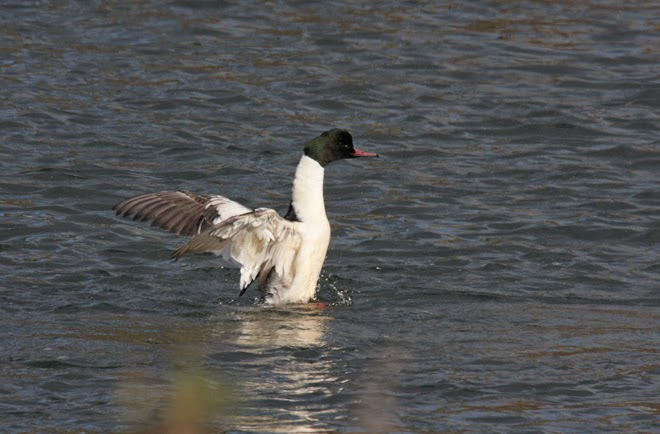
Red-breasted Merganser is common in coastal areas but with I wouldn't expect to see more than three or four at most on a visit to Lake Biwa. Goosander, on the other hand, is a common duck on the far north of the lake with numbers dwindling southwards. They can usually be found on the Katsuragawa in Kyoto city, the best area being between Matsuo and Arashiyama stations on the Hankyu Arashiyama line.


Red-breasted Merganser, easy to see on rivers in Tsu city, Mie.


Female Goosander in Kanazawa, February 2014. 


Male Goosander in Kanazawa, February 2014.


Smew is common on Lake Biwa but rafts of males are usually well off-shore south of the Rainbow Bridge, whereas females outnumber males in the north and can often be found in small harbours or small ponds near the lake. Some turn up on the Yodo and Katsura rivers in Kyoto city every winter but they don't usually stay long so a bit of luck is needed to connect with them.


Drake Smew on the Katsuragawa, Kyoto city.


Female Smew near Lake Biwa, February 2014.