I was hoping to spend three days on Hegura this week but just as last week it was impossible to get accommodation at such short notice. If most guest were fishermen last week, the island was certainly jumping with birders this week. The weather charts for the two days preceding my visit had looked very promising to bring birds in and so it proved; there were far more present this time.
Perhaps the two most striking changes were the arrival of Daurian Redstarts, which are now flaunting the presence around the island, and a huge number of buntings; buntings at every turn. Much more like mid-October in other words.
It wasn't difficult to resist the temptation to photograph the Daurians, they are after all a very common bird in Japan and there's no need to go to Hegura to get frame-fillers. The only Daurians I'd photograph there are birds that are of special interest for some reason, he said pompously. I often grumble inwardly when people are messing around on Hegura photographing common birds rather than getting on trying to find something. So let me first of all confess my own sins...
 One of many Bramblings on the island.
Do they come much more common than Brambling? Well how about this...
 One of two Great Spotted Woodpeckers I saw (and yes, I even got shots of both).
Well one excuse could be the Woodpeckers could be an interesting race; or how about they're damn difficult to get even half decent shots of in Kyoto. I know, clutching at straws. But why is it that Hokkaido woodpeckers always throw themselves at the camera while elsewhere they do their best to be on the wrong side of the tree. I'm still struggling for a Brambling excuse though.
Another bird that isn't exactly rare is Hawfinch but again it's a species I never normally get close to so...
An unusually confiding Hawfinch.
For many people Elegant Bunting would be another common winter species but it's something I rarely see in Kyoto, though they do winter elsewhere in Kansai.
Elegant Bunting was suddenly one of the commonest species on the island, there had been none a week earlier.
Last week I had my first Yellow-browed Bunting for Hegura and the following bird may even be the same individual as it was only 50 metres from that sighting. A cracking bird though and these better shots were worth a little stalking to get.
 Yellow-browed Bunting; a very uncommon, dare I say rare, autumn migrant.
And sticking with Yellow-browed, the next one's a warbler. I saw nine Yellow-brows in my brief visit, no doubt there could have been many more.
This shot of Yellow-brow was taken by accident while trying to photograph a Willow Warbler!
There were two interesting clusters of birds. The first was in the strip of dense, low, tangled woodland running through the centre of the southern half of the island. I found a Willow Warbler and while driving myself nuts trying to get a decent shot of it I also saw two Yellow-brow, single Mugimaki and Narcissus Flycatchers as well as several Pale Thrushes, an irritating flock of Japanese White-eyes (irritating because they made it so difficult to follow the Willow Warbler), quite a few Goldcrest (they didn't help much either) and a handful of Coal Tits. Just last week I said I don't often see Coal Tits on the island, had I known they would suddenly appear in bigger numbers I'd have made the comment about something a bit more exotic. A Eurasian Sparrowhawk put in two appearances which was very nice though as I'd already found three piles of Pale Thrush feathers on my way through the trees I doubt any of the thrushes still present felt the same way.
Coal Tit.
If you're thinking "Another common species!", this is because I was hoping for Yellow-bellied Tit and even though this doesn't look anything like a Yellow-bellied Tit it was good camera practise just in case...
Mugimaki Flycatcher.
The second good-bird cluster was in a little grassy bay near the north end. I was staggering and stumbling through the hidden rocks and grassy tussocks when in fairly quick succession a large silent pipit, a large silent bunting and a small silent bunting flew up and perched on the rocky shore. In the end the large bunting turned out to be Pine which is good but expected in October and the pipit was a Richard's which may be the first I've seen on Hegura. I normally see Richard's either as spring migrants on other islands or as wintering birds further south. The small bunting I dismissed as a Reed in the excitement but grabbed a couple of quick shots to check later as I hadn't seen Reed this trip yet. With the big things sorted and the little thing gone I looked at the two images and was puzzled; I still am. It looks as though it's going to be easy to identify but looking closer it's almost as if it's made of old left over bunting bits, it's not a Reed. The small conical bill with the pale lower mandible could fit on a Pallas's Reed okay, there are bits of washed out Little and of Rustic too but neither seem perfect. This is killing me. Surely the answer is so obvious it's staring me in the face but I'm just not getting it!

 A bunting on some colourful but not pleasant to walk over rocks...
A couple of people have commented saying this looks like a Pine Bunting. Indeed it does, the answer really was staring me in the face. Pine was the only streaky bunting (within reason) I never considered, simply because there was a Pine Bunting a few rocks over and this bird looked about 30% smaller hence my mind was focused on something small.
Having a last look around the harbour before boarding the ferry two guys came up and told me there was a Schrenck's Bittern at the hospital. My first reaction was hospital! What hospital? Anyway I thought right, two minutes up to the docs, two minutes back, 15 minutes till the ferry's official departure time. This has to be the only public transport in Japan that often leaves a few minutes early. Fortunately the bird really was just sitting in the "garden", a quick series of shots and back just as they shutting up shop, raising the gangplank or whatever, and we were out of the harbour five minutes ahead of schedule.
This reminded me of the time I was going to the ferry and someone told me he'd just found a Spotted Flycatcher! Still Japan's one and only record. Why didn't I just let the ferry go and stay on the island another day?! In that light even a Schrenck's pales. Another puzzle; why do I always get cracking views of Schrenck's Bittern (okay not always, but three of them have been point-blank range) and Yellow is always (always) a distant speck flying over some enormous reedbed?
 Garden gnome or Schrenck's Bittern.
Species recorded:-
Eurasian Wigeon 1
Streaked Shearwater common from the ferry
Schrenck's Bittern 1
Grey Heron 1
Great Cormorant 1 Wajima harbour
Black Kite 2
Eurasian Sparrowhawk 1
Black-tailed Gull c200
Slaty-backed Gull several Wajima harbour
Oriental Turtle Dove 1
Great Spotted Woodpecker 2
Coal Tit c10
Red-rumped Swallow 1
Brown-eared Bulbul c15
Japanese Bush Warbler fairly common
Willow Warbler 1
Dusky Warbler 1
Yellow-browed Warbler 9
Kamchatka Leaf Warbler 1 heard
Japanese White-eye c10
Goldcrest several
Pale Thrush several
Siberian Rubythroat 2
Daurian Redstart common
Stejneger's Stonechat 3
Narcissus Flycatcher 1
Mugimaki Flycatcher 1
White Wagtail 2
Richard's Pipit 1
Olive-backed Pipit 1
Red-throated Pipit 1
Buff-bellied Pipit 2
Brambling common
Eurasian Siskin c30
Oriental Greenfinch 5
Hawfinch 3
Pine Bunting 1
Little Bunting 1
Yellow-browed Bunting 1
Rustic Bunting several
Elegant Bunting common
Yellow-breasted Bunting 1 seen by others
Black-faced Bunting common
Lapland Bunting 1 seen by others


 Common Greenshank.

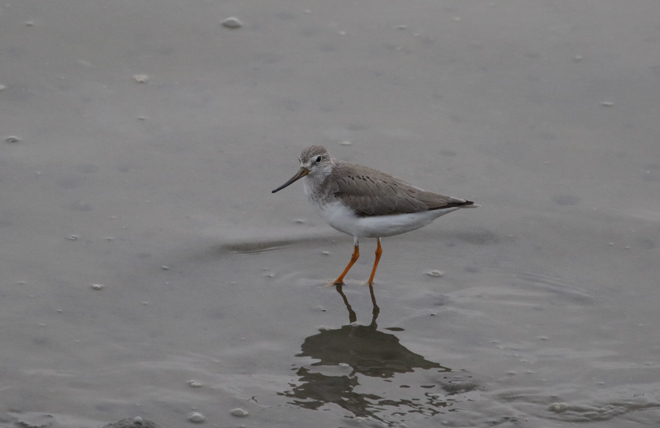
 Terek Sandpiper.
 Little Grebe is common but rarely close enough to photograph.
 A very typical Vega at this time; p8 is in and only a handful have retained outer primaries. The bird below is the exception that proves the rule I suppose. This was a real surprise a Vega outer primaries but only new p6 in place.
 Juvenile Vega.
 Juvenile Slaty-backed.
 The very black primary projection is odd for Slaty-backed but it's very deep and the pale underside of the far wing are the first give-aways that this is a Slaty-backed.
  The head shape is getting more like a Slaty-backed here. That's a more typical Slaty-backed behind it.
  Suddenly it couldn't possibly be anything else!


