Monday, 21 September 2020

Pintail, swintail and Latham's; a decent snipe haul

This autumn has somehow got away from me on the wader front, it wasn't until last weekend I made my first trip across the Kii Peninsula to my favourite wader haunts in Mie. The first area of small fields I visited, about 500m x 300m in total, was in excellent wader condition so, apart from a couple of convenience store runs and three circuits of the good nearby sites, I ended up spending the whole day there. It's possible to drive miles without finding a suitable field so I considered myself lucky.

There were two or three Little as well as the two commoner stints, a couple of Broad-billed Sands which aren't that common round this way, as well as a number snipe. So plenty to keep me occupied especially as the latter are my favourite time drain.

I've no idea how many snipe there may have been on the patchwork of small fields, I focused on just one as far as the snipe were concerned. Or to be more precise, I focused on just one edge of one small field. The only Common Snipe I saw were the occasional disturbed birds that flew round overhead calling before settling back into the vegetation. There was even a calling swintail at one point that rose from no more than 20 metres away in my own small field when it was flushed by a family boisterously enjoying their Saturday morning walk around the fields.

There were usually three snipe along this edge, they never disappeared for long and I never saw more than three at any one time. I suspect that they really were the same three birds remaining loyal to the same spot. Presumably all the other snipe across the fields were doing exactly the same.

Even though a good view the outer rectrices is considered the only way to identify a swintail, there are a number of morphological 'tendencies' and generally speaking it's possible to have anything from an idea which species it is, to being willing to bet the house on which one you're viewing without seeing those pesky outer tail feathers. By 'tendencies' I mean features that one species exhibits more often than the other without being conclusive in itself. I said generally speaking because there are times when a bird which is looking a really good contender for one species will suddenly shock by revealing the wrong outer tail feathers.

Getting a good view of the incontovertible outer tail feathers can be easier said than done as Pintails' pins can remain tucked in when sunbathing and thus give the impression of not having any. Of course the sunbathing snipe may actually be a Swinhoe's (which seems far commoner than Pintail in this region) and you can spend no end of time trying to see non-existent pins. Bearing in mind that Swinhoe's and Pintail have about the same number of tail feathers if the pins are discounted, there isn't a noticeable difference in tail size or overall shape. Seeing the pins when a tail is flashed in some interaction is next to impossible so it really comes down to seeing a bird preening in the open at the right angle.

Last Saturday I saw one of the three birds preen twice, once in the open (though not at an ideal angle) early in the morning and again in the afternoon when largely hidden in the rice. I didn't see the other two birds preen at all and never got clear views of their outer tail feathers. Snipe really are a time drain.

Pintail in the foreground, then Latham's and finally swintail at the rear. They spent much of their feeding time probing into the side of the bund.

Latham's with swintail behind.


I'll start with images of the Pintail, the only bird that let me see its outer tail feathers clearly.

This bird was easily separated from the other dark juvenile its heavy barring extending well down the flanks.


One of only two shots I was able to get that gave any indication of pins.

The next bird is a Latham's but before I saw the juvenile primaries I thought it might actually be an adult Swinhoe's.


Finally some images of the swintail.


Wednesday, 16 September 2020

10,000/1 outsider romps home in the Ogasawara 'Bryan's chase'

Yet another trip into Ogasawara waters concluded, yet another dip on Bryan's Shearwater recorded. However, even though Bryan's, the popular favourite to provide a Japan tick failed to get under starters orders, all was not lost as a 10,000/1 outsider came through and saved the day.

After a day back and forth on the Hahajima ferry to maximise time at sea, I decided a shower and a spell in my air conditioned room was the only thing likely to lift my spirits; the first Red-footed Booby of the trip, just outside the harbour, certainly hadn't managed it.

This could have been a cataclysmic error had it not been for my cohort on this trip, who, eschewing the refreshment choice of mere mortals, opted instead for a quick dash to a coffee shop followed by a visit to the playing field at the end of the road to try for migrant waders. To try for Ruff to be precise. Think about it for a minute, dipping (again) on Bryan's Shearwater yet still being sufficiently motivated to walk two kilometres in that heat on the off chance that there's a Ruff on the field. A Ruff... year tick or not it's just a Ruff. From the giddy heights of a Bryan's chase to your humble, workaday Ruff. Why might there even be a Ruff there in the first place?! I guess that's what separates the chiff from the chaff.

Showered, dressed in fresh clothes that weren't that unpleasantly persistent seawater-damp, and fridge chilled box of chocolate almonds in hand I returned to my air-conditioned room. This was living... or this would have been living except I could hear my phone ringing impatiently even as I came up the stairs, along the corridor, into the room. Now there are rings and there are rings but my phone had absolutely no business to be ringing at all, let alone with this insistence. This ring reeked of urgency, this was a make or break ring, there could be no inbetweens. Life... or... death. I'd already chucked aside and forgotten my chocolate almonds before I'd crossed the room to my charging phone.

Richard had found a wheatear. Oh come on! We're in the Ogasawaras for heavens sake!

It was about 2km from the accommodation to the playing field at the end of the road, the wheatear field at the end of the road. But which wheatear? I only need one for the Japan set*. Only 10 metres out and already drenched in persperation, 50% from the unrelenting sun and an even wetter 50% from the which-wheatear panic consuming me.

*I have a nagging feeling Eastern Black-eared has now been recorded in Japan, in which case I needed two but I didn't want to consider that completing the set wasn't on.

The wheatear had disappeared by the time I arrived; we all know that particular sinking feeling. The wait began. More people arrived. The wait went on.

"There it is!!!" was the cry. Simultaneously "Here he comes!!!" was my thought as a man in naval uniform approached purposefully. Someone really ought to have been manning the guardhouse if they didn't want birders sneaking in through the open gates. Ostriches have three options, fight, flight or head burying. Richard and I chose the latter, metaphorically speaking, and let the Japanese birders deal with the situation while we continued observing the bird.

I've never had anything but the politest encounters with the military in Japan and to date never been asked to move more than a few metres from my offending position. We were asked if we wouldn't mind going to beach and watching from there. Make a note of it Neil... 25 metres. Of course we wouldn't mind, but it wasn't possible to get the views I'd have liked, as these images will attest, before the bird disappeared again deeper into forbidden territory. BUT the important thing is that it was a Northern and so the four-species wheatear set was complete. Chocolate almonds weren't going to cut it now , the sun was setting and a cold one was calling.

Oh, and what of Richard's Ruff hunt you might ask. Unsurprisingly he hadn't found one given the circumstances. So it was by way of a small thank you that after a quick pre-departure scan of the playing field I was able to tell him there was a Ruff and reeve lurking amongst the Pacific Goldies, Lesser Sand Plovers and Ruddy Turnstones.


Brilliant, who would have thought it a wheatear tick in Ogasawara. The other wheatears I've seen, spread over many years were largely in more expected locations, Desert and Isabelline on Hegura, Pied on Mishima, though my first Isabelline along the Yodogawa half way between Kyoto and Osaka was more surprising.

Images of the other wheatears also show an improvement from my early digiscoping efforts.

Desert Wheatear; Hegura 2004


Pied Wheatear; Mishima 2010


Isabelline Wheatear; Hirakata, Osaka 2012


Friday, 7 August 2020

Mt.Tateyama: the expected and unexpected birds up there

There are those who are so rigorously scientific in their approach to birding that the word scrupulous is almost an insult, falling so far beneath their admirable standards. These birders don't even have a cupboard let alone a skeleton stashed away. At the other extreme there those who might be labeled stringers, usually, but not always, due to a lack of care rather than scruples, and are probably also blissfully skeleton-free. Then there's me, and if we're totally honest then there's probably most of us, falling somewhere between the two ends of this large and somewhat elastic scale. 

Do I have a cupboard? I do. 

There have been various times over the last 50-60 years when mysterious scratchings and scrapings have led to uneasy nights. If ignored, I can attest, these will row into soft rapping and muffled thuds and eventually escalate to outright banging. Those earlier nights of unease will be as nothing to the inevitable tortured tossing amidst tangled sheets. Two birds that were once on my Japan list had to come off to preserve my sanity. It's not that I'm sure the identifications were wrong, more I'm unsure the identifications made at the time were right. I'm not referring to the ridiculous newbie stuff, the basic errors that anyone could make coming to a new country with no prior knowledge about its avifauna. Yes, I'm looking at you Black Woodpigeon in Kyoto city. 

There has been another skeleton, one of a rather different sort, that has persisted for years, dare I say it... decades! How often have I nervously shuffled my feet or tried to quickly re-direct a conversation? Why do I always fail to mention a couple of birds when someone asks whether I've seen all Japan's breeding species?

Why indeed.

Just as it took me 10 years to visit Nara, a must-see destination for overseas visitors which is less than an hour away by train, I haven't, sorry hadn't, scaled anything over a handful of metres high in the Japan Alps. Just like Nara, Mt. Tateyama isn't a million miles up the road but that's just the thing, isn't it? It's the proximity that makes some things so easy to put off.  As a master of deferment it's always been a case of "next year"... "well definitely next year!" You may have noticed the use of the verb 'scale' earlier, I'm going to leave that hanging.

Unlike the impalpable tomorrow, next year has finally come... it came this week in fact! Not only that but the two toe-curlingly postponed Japan ticks duly came along too. At long last I have Alpine Accentor and Rock Ptarmigan on my list. No more embarrassed shuffling of feet, no more ham-fisted attempts to steer the conversation elsewhere. And yesss, no more sleepless nights, my cupboard has been vacated.

As an utter alpine novice, I was surprised to have absolutely fabulous weather. Two completely calm, cloud free days is surely strange, isn't it? Or is it? I wouldn't know but what should have been more predictable I suppose was the number of people up there. Yet I was taken aback that every distant ridge was lined with pilgrims, each far-flung peak clustered with adherents and all the steep zig-zagging paths crawling with uniformly ascending or descending humanity depending on the time of day.  

Okay, the birds. My mate wanted to get Japanese Leaf Warbler for his trip list but I told him they'd be really difficult by now as they wouldn't still be singing. No prizes for guessing what the commonest species was then, the commonest and most vocal. Japanese Leaf Warblers were singing everywhere from dawn to dusk!

Japanese Leaf Warbler: the unexpected element referred to in the title. These birds were singing everywhere but tended to remain concealed in the haimatsu except in the early morning or late evening.

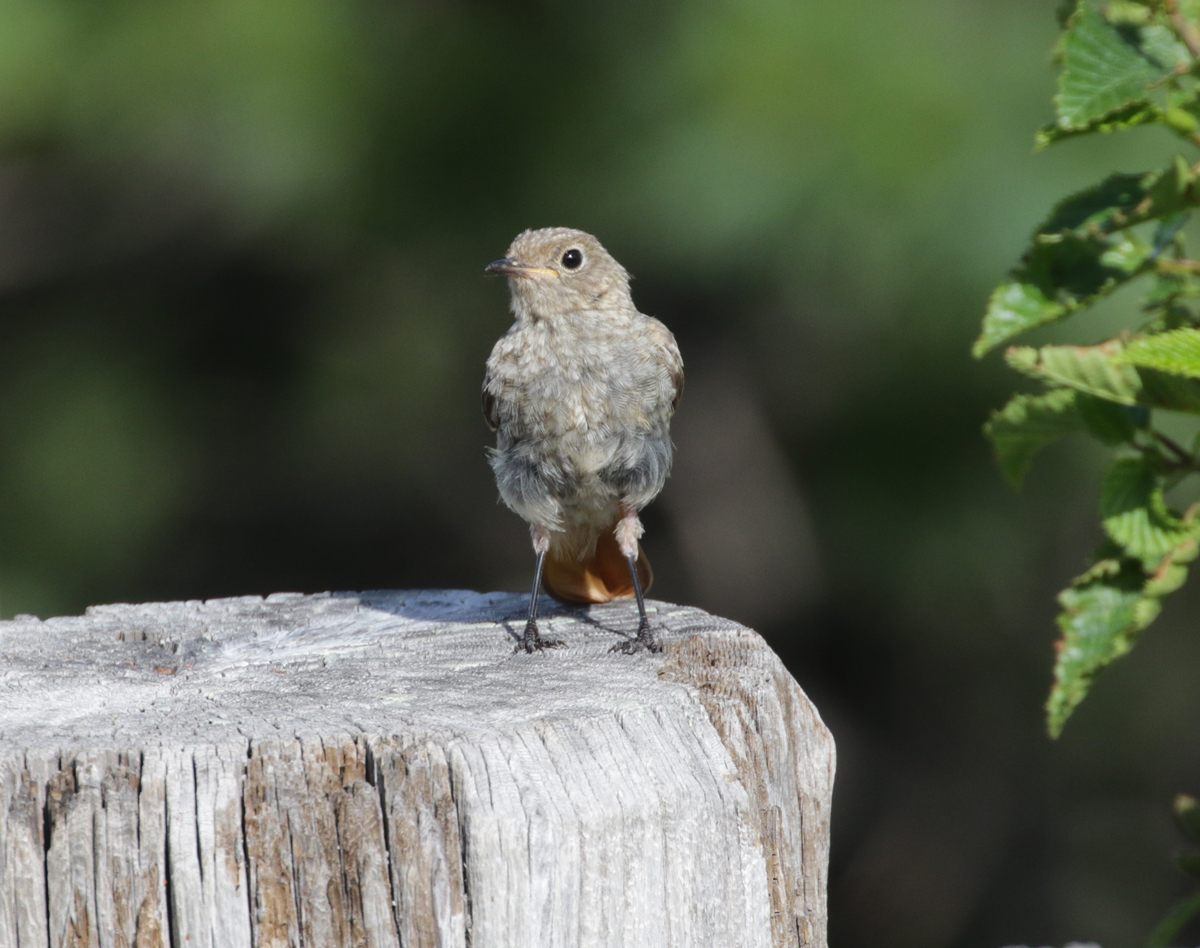
If the Jp Leaf was unexpected then juvenile Daurian Redstart wasn't even on the long distance radar. We glimpsed a bird diving into cover before we'd reached our accommodation just after arriving up there on the first morning. We looked at each other both thinking but hardly daring to suggest we'd just seen a Daurian Redstart. On the 4th of August... impossible! The next day, about 150m from that sighting we had an indisputable juvenile Daurian Redstart. It seems that, unknown to me, there have been breeding records in Japan in the last few years so a juvenile at this upland location at this time of year must prove another example.


A totally unexpected juvenile Daurian Redstart. If it weren't for the two new birds I saw, this would have been the bird of the trip.


The expected birds of the title were Japanese Accentor and Nutcracker, both of which I've seen many times before though the latter is rare in Kansai. 

Japanese Accentor was singing throughout areas covered by haimatsu but it wasn't always easily seen. I wonder had the weather been less calm, warm and sunny this, and the Japanese Leaf Warbler, might have been far more elusive.

Nutcrackers are such great birds and seen infrequently enough, from the Kyoto perspective, to ensure they stay that way.


So I've covered the expected and unexpected birds, now it's the hoped for. Ptarmigan was tough, the weather was too good for them I suppose. The only two (plus two chicks) we saw were on the evening of the first day and though we had surmised the following morning was going to be our best bet to connect with them, we drew a total blank then. The trip could have been oh so different had we not caught up with these birds when we did. If the Ptarmigan were difficult, the Alpine Accentor couldn't have been more obliging, I saw my first sitting on a fence post surrounded by milling tourists before I'd left the bus terminal. Compared to the Japanese Accentors, they were far more mobile but tended to be in more open situations and along with being very approachable meant they were easily seen well.


Not exactly the point blank views many people are lucky enough to get with this confiding species, but good enough for me! Truth be told everything up there was confiding, it was simply a matter of luck how close a bird happened to be.


Despite having spent a total of about five months trekking in the Nepal and Indian Himalayas, not to mention trips to the European Alps, Alpine Accentor was a lifer!