Friday, 7 August 2020

Mt.Tateyama: the expected and unexpected birds up there

There are those who are so rigorously scientific in their approach to birding that the word scrupulous is almost an insult, falling so far beneath their admirable standards. These birders don't even have a cupboard let alone a skeleton stashed away. At the other extreme there those who might be labeled stringers, usually, but not always, due to a lack of care rather than scruples, and are probably also blissfully skeleton-free. Then there's me, and if we're totally honest then there's probably most of us, falling somewhere between the two ends of this large and somewhat elastic scale. 

Do I have a cupboard? I do. 

There have been various times over the last 50-60 years when mysterious scratchings and scrapings have led to uneasy nights. If ignored, I can attest, these will row into soft rapping and muffled thuds and eventually escalate to outright banging. Those earlier nights of unease will be as nothing to the inevitable tortured tossing amidst tangled sheets. Two birds that were once on my Japan list had to come off to preserve my sanity. It's not that I'm sure the identifications were wrong, more I'm unsure the identifications made at the time were right. I'm not referring to the ridiculous newbie stuff, the basic errors that anyone could make coming to a new country with no prior knowledge about its avifauna. Yes, I'm looking at you Black Woodpigeon in Kyoto city. 

There has been another skeleton, one of a rather different sort, that has persisted for years, dare I say it... decades! How often have I nervously shuffled my feet or tried to quickly re-direct a conversation? Why do I always fail to mention a couple of birds when someone asks whether I've seen all Japan's breeding species?

Why indeed.

Just as it took me 10 years to visit Nara, a must-see destination for overseas visitors which is less than an hour away by train, I haven't, sorry hadn't, scaled anything over a handful of metres high in the Japan Alps. Just like Nara, Mt. Tateyama isn't a million miles up the road but that's just the thing, isn't it? It's the proximity that makes some things so easy to put off.  As a master of deferment it's always been a case of "next year"... "well definitely next year!" You may have noticed the use of the verb 'scale' earlier, I'm going to leave that hanging.

Unlike the impalpable tomorrow, next year has finally come... it came this week in fact! Not only that but the two toe-curlingly postponed Japan ticks duly came along too. At long last I have Alpine Accentor and Rock Ptarmigan on my list. No more embarrassed shuffling of feet, no more ham-fisted attempts to steer the conversation elsewhere. And yesss, no more sleepless nights, my cupboard has been vacated.

As an utter alpine novice, I was surprised to have absolutely fabulous weather. Two completely calm, cloud free days is surely strange, isn't it? Or is it? I wouldn't know but what should have been more predictable I suppose was the number of people up there. Yet I was taken aback that every distant ridge was lined with pilgrims, each far-flung peak clustered with adherents and all the steep zig-zagging paths crawling with uniformly ascending or descending humanity depending on the time of day.  

Okay, the birds. My mate wanted to get Japanese Leaf Warbler for his trip list but I told him they'd be really difficult by now as they wouldn't still be singing. No prizes for guessing what the commonest species was then, the commonest and most vocal. Japanese Leaf Warblers were singing everywhere from dawn to dusk!

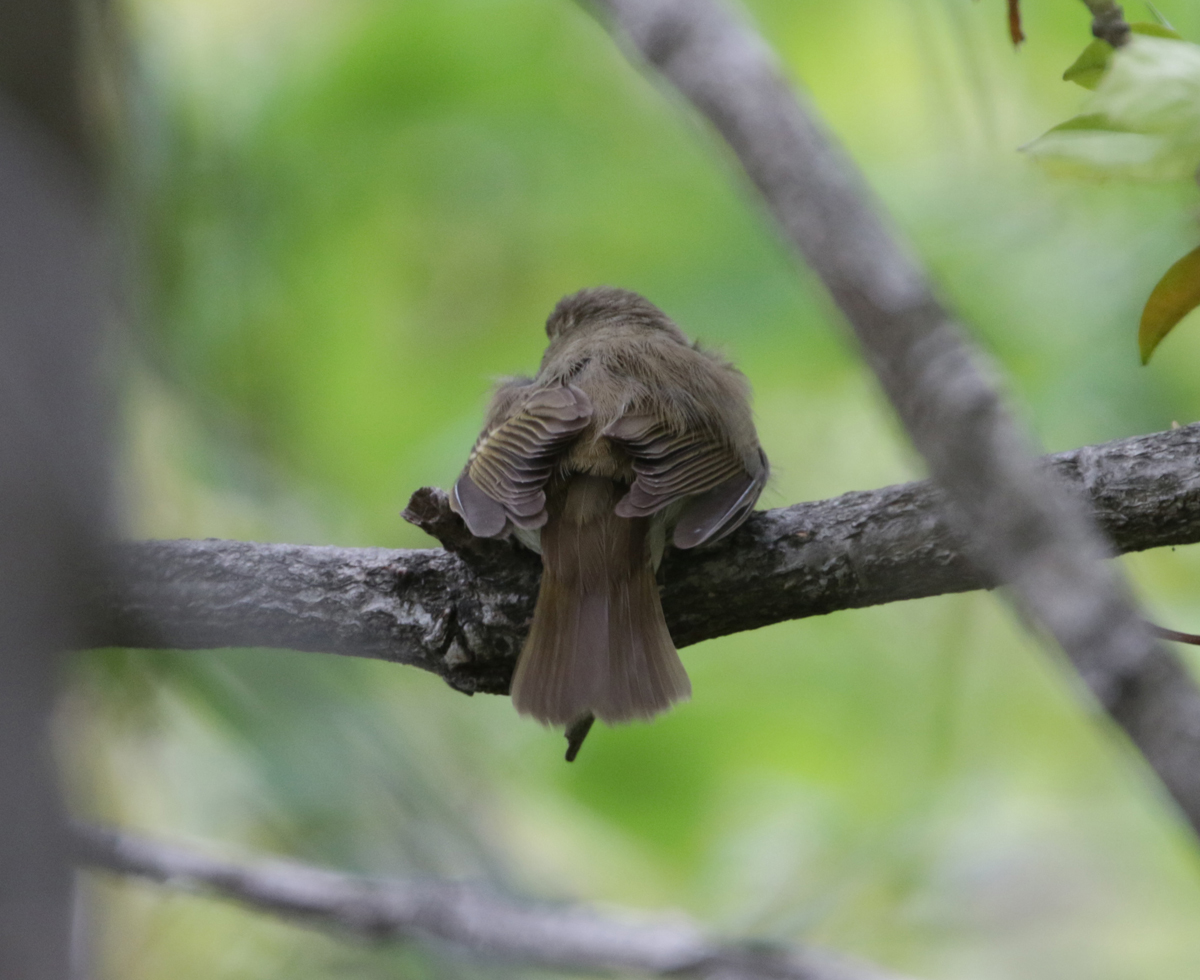
Japanese Leaf Warbler: the unexpected element referred to in the title. These birds were singing everywhere but tended to remain concealed in the haimatsu except in the early morning or late evening.

If the Jp Leaf was unexpected then juvenile Daurian Redstart wasn't even on the long distance radar. We glimpsed a bird diving into cover before we'd reached our accommodation just after arriving up there on the first morning. We looked at each other both thinking but hardly daring to suggest we'd just seen a Daurian Redstart. On the 4th of August... impossible! The next day, about 150m from that sighting we had an indisputable juvenile Daurian Redstart. It seems that, unknown to me, there have been breeding records in Japan in the last few years so a juvenile at this upland location at this time of year must prove another example.


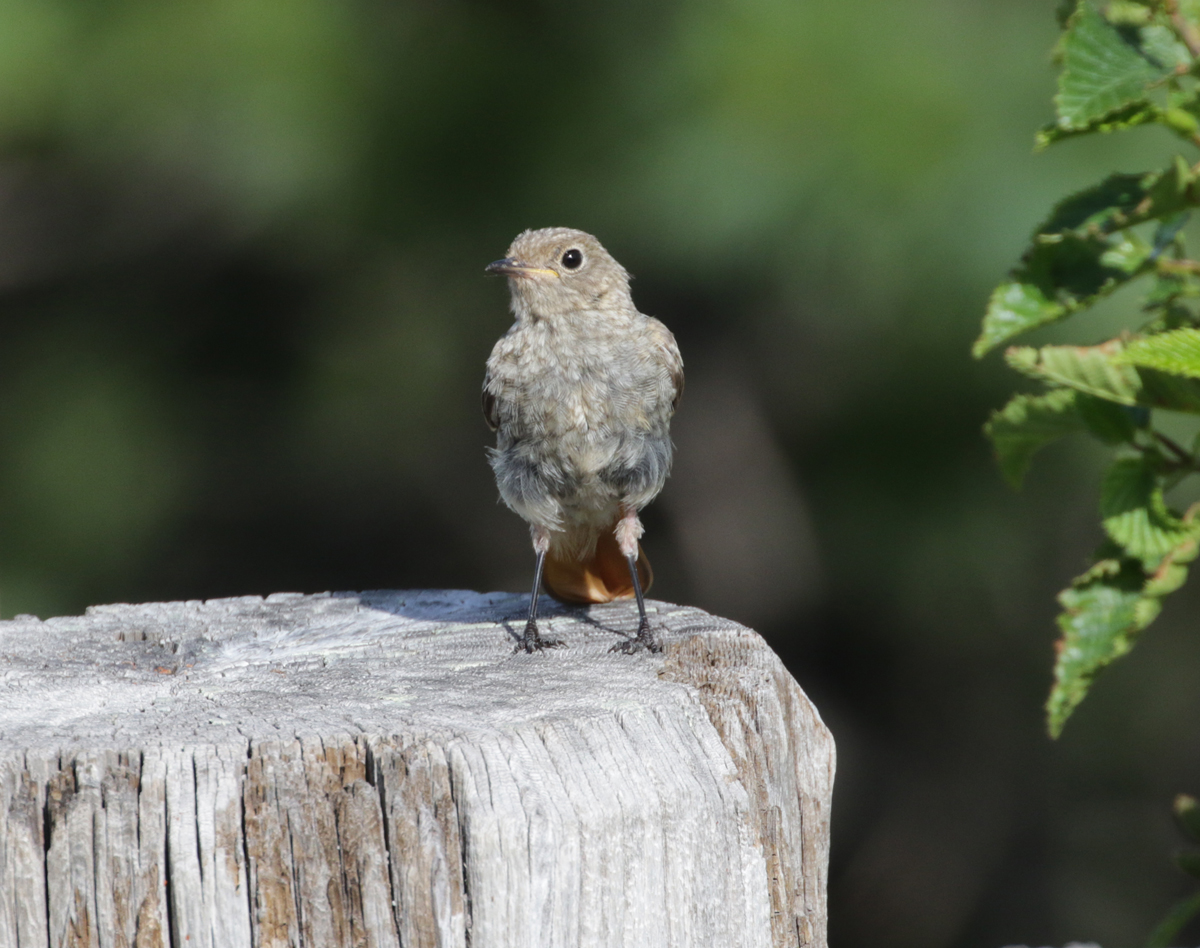
A totally unexpected juvenile Daurian Redstart. If it weren't for the two new birds I saw, this would have been the bird of the trip.


The expected birds of the title were Japanese Accentor and Nutcracker, both of which I've seen many times before though the latter is rare in Kansai. 

Japanese Accentor was singing throughout areas covered by haimatsu but it wasn't always easily seen. I wonder had the weather been less calm, warm and sunny this, and the Japanese Leaf Warbler, might have been far more elusive.

Nutcrackers are such great birds and seen infrequently enough, from the Kyoto perspective, to ensure they stay that way.


So I've covered the expected and unexpected birds, now it's the hoped for. Ptarmigan was tough, the weather was too good for them I suppose. The only two (plus two chicks) we saw were on the evening of the first day and though we had surmised the following morning was going to be our best bet to connect with them, we drew a total blank then. The trip could have been oh so different had we not caught up with these birds when we did. If the Ptarmigan were difficult, the Alpine Accentor couldn't have been more obliging, I saw my first sitting on a fence post surrounded by milling tourists before I'd left the bus terminal. Compared to the Japanese Accentors, they were far more mobile but tended to be in more open situations and along with being very approachable meant they were easily seen well.


Not exactly the point blank views many people are lucky enough to get with this confiding species, but good enough for me! Truth be told everything up there was confiding, it was simply a matter of luck how close a bird happened to be.


Despite having spent a total of about five months trekking in the Nepal and Indian Himalayas, not to mention trips to the European Alps, Alpine Accentor was a lifer!  

Monday, 13 July 2020

Northern Fulmar dark and light birds off Hokkaido


My favourite uncle, at the time an ancient guy of almost 20, who had recently passed his driving test and bought a Mini was ripe for conversion to birding, so thought the much younger me. As he's still a birder 50 odd years later, I must have done a damn fine job. One of many new places the Mini allowed us to explore was the nearby County Durham (now Tyne and Wear) coast in the north east of England and our discovery of Marsden Rock was a jaw-dropping experience. So many birds! And, it was the first time I saw a tubenose. My uncle and I knew it was a tick, it had to be, but which tick was it? I was nudged and prodded forward to ask some people birding from the cliff-top whether I was right in thinking these fantastic birds were shearwaters. You'll appreciate how nervous I was when I tell you these people were birding with binoculars! They told me the birds were in fact Fulmars but congratulated me on my attempted identification because they were very similar to shearwaters. I came away with a puffed-out chest as well as a tick.


Northern Fulmar was, and still is, a fairly common breeder along that coastline and it became a common sight during my young birding life as I more often made trips down to the coast. Here in Japan I don't see them nearly so often as a ferry through northern waters is a must to catch up with them. My late spring seabirding sortie from Tomakomai to Hachinohe and back was just such a trip.


Distance, visibility and brevity of views all contributed to my confusion over the plumage types but even those seen well weren't always easily assigned as both active moult, which could expose pale feather bases in the coverts, and the presence of more than one generation of flight feathers producing a striking light and dark contrast within the same feather tract were all cause for befundlement for a morph novice. One bird that left no room for doubt, and the unquestionable fulmarine highlight, was a stunning treble light (LLL). It really was unlike any seabird I've seen in the northern hemiphere.


The familiar distribution of colour morphs I was aware of in the Atlantic is reversed in the Pacific, with the lighter morphs breeding in the northern parts of the range here whereas it's the darker morphs that are more frequent in the northern reaches of the Atlantic. Therefore ferry trips in Japan will yield far more dark birds. It's worth adding that while double dark (DD) and double light (LL) birds can be found in the Atlantic, the Pacific also holds both darker (treble dark, DDD) and lighter (treble light LLL) morphs.


Though, to be honest, quite where one D or L stops and the next one starts is a bit of a mystery to me. I never saw dark birds in the UK, or if I did I don't remember, so I was very pleased to see them when I first started seabirding in Japan but always being intent on finding something rarer than Fulmar on northern ferry runs I didn't think too much about morphs. Hence my tentative efforts to stick a label on these birds shouldn't be taken too seriously. This is also one of those occasions where a camera is indispensable trying to make sense of varied and complex patterns see briefly in a less than ideal conditions. No wonder birders used guns in the old days.


First up, images of the stunning LLL which looks so different to the Fulmars I'm used to seeing.


What a stunner, luckily this LLL flew by during one of the less misty stretches. It's a pity it isn't a tick, it's certainly worthy in terms of appearance compared to the bird below.


By contrast this next bird was arguably the clearest example of a DDD.


More than a little different and terrific bird to see. However, there are so many all dark Procellariidae in the Pacific, it can't quite compete with the above LLL.


Flipping back to the light side, I'm uncertain whether this would be classed as an LLL or whether it isn't an LL with 'enhanced white' due to moult. Your guess is as good as mine, or knowledge better as the case may be.


It was the only other light of any degree on the trip and under other circumstances I'd have been delighted to see it but it does lack the pizazz of the first bird.


All the other birds I saw and photographed were darks so they are clearly the expected type in those waters, in this season at least. I selected images of the following three birds not because they're insightful but simply because they were the best shots I could manage. Yes, really.


Bird 1 is quite uniformly dark on the underparts, I might pitch for DDD here.


Bird 2 colour contrast between outer and inner secondaries clearly showing they are different generations.


Bird 3 looks like the outer secondaries have been replaced here but moult still ongoing.


Bird 3 as it moves off into the murk. Many birds had mottled underparts to a greater or lesser extent, but all were dark overall.


Thursday, 9 July 2020

Unusual behaviour of a Sakhalin Leaf Warbler - presumably health related

Of the huge number of Sakhalin Leaf Warblers on Tsushima this spring, the behaviour of this bird stood out and remains a bit of a puzzle. I can only imagine it wasn't healthy but I've no idea what could have been wrong with it.


It was present on two consecutive days but apparently gone on the third after a general clear-out of warblers. It was very approachable on the ground but when it flew it did so strongly giving no hint of any problem. It occasionally flew up into overhanging bushes but mostly it sat somewhere along a 100 metre stretch of roadside verge. We saw it several times that day as the road, along a steep hillside, was an excellent birding spot which we returned to regularly. The bird was always easily picked up on arrival because it was so vocal, which isn't something I'd normally associate with sick individuals. The second day it was mostly in the trees on the downward slope from the road and seemingly feeding well abundance of caterpillars. Looking at the images I have of the bird, I'm now struck that none show legs, it's always sitting. If it had a problem with feet/legs, this may account for it nevertheless being vocal, feeding well and flying strongly.


However, it also had a colour aberation which I presume was due to the onset of whatever health problem it was suffering from. At a glance it could give the impression of having a narrow white rump patch but as can be seen in the following images there was also a faint greyish wash on the back and some lesser wing coverts suggesting perhaps that pigmentation production ceased as these feathers were growing.


It almost looks like a ground nester here, in the leaf litter it habitually kept its tail cocked like this.


In a more open situation it fanned and pumped its tail. Of course Sakhalin do pump their tails anyway but this was very pronounced.


Just once it flopped down in this abnormal position revealing the 'white rump' and pigment deficient feathers on back and lesser wing coverts.


The second day it was in the trees the whole time, and feeding well, but the continuous, vigorous tail pumping was only more apparent in that situation.


Periods of sitting still on a branch vigorously pumping its tail was very different behaviour to the many other Sakhalin Leaf which were very active.

.


The next couple of images have nothing to do with this post but I want to tag them on anyway. The former I want to post because it's my best ever shot of this heron species and the latter because the nest is such an amazing structure.


Probably my best ever shot of this rather scarce heron. This is only the second Striated I've seen this year.


Perhaps a case of an ever-growing nest crushing the bush beneath it but I prefer to think this is a very traditional Osprey site which over time is creating its own micro-environment on top of the bare off-shore stack.