Thursday, 12 May 2016

Thayer's Gull or Vega?

I've been able to get quite a lot of birding done since early April and haven't posted on all the good birds I've seen. I'll try to catch up on a few bits and pieces as time allows, starting with this interesting gull which I initially considered an odd Vega showing some features of Thayer's. However, to my own surprise, in the course of writing this post I've swung the other way and now believe it's more likely to actually be a Thayer's.


I posted about an adult Thayer's Gull I saw in Mie on April 8 but I failed to find it when I looked again the following day. I did however find a Vega with a good thayeri-type primary pattern followed by the bird I want to write about today. Vega with thayeri-type outer primaries are uncommon but certainly not rare, and in my experience they never suggest Thayer's on closer examination. The gull I'm focusing on clearly wasn't the Thayer's I'd seen the day before therefore I was all too ready to dismiss it as the second thayeri-type Vega of the day. A second adult Thayer's the day after my first ever... preposterous notion!


Thayer's is a very scarce winter visitor further north in Japan but it's a real rarity in Kansai and I met a lot of local birders actively looking for the gull during the three or four weeks since it had first been found. I finally caught up with "it" after several attempts. I haven't seen any online images of this Thayer's in Mie and I'm wondering whether people seeing the Thayer's may have been connecting with two different birds without realising it.


Apart from the sheer improbability of seeing different individuals of such a regional rarity on consecutive days, I was inclined to think this an odd Vega because it was clearly larger and bulkier than the first gull and there didn't appear to be any difference in saddle colour between it and the Vegas present. However I only saw it for a few seconds on the beach before it flew off, there was no time to even get a record shot after first getting the scope on it. With hindsight I can easily imagine after seeing my first ever adult the day before, presumably a female which ticked all the wished for size and structure boxes, a male wouldn't look quite as convincing to my inexperienced eye. Add to that the previous day had been perfect gulling light allowing the subtly paler saddle to be noticed whereas this bird was in sunshine which could negate any slight variation. On that first occasion the gull flew further down the beach to join another flock and the Thayer's wing pattern was striking. Far more eye-catching than that of the normal thayeri-type Vega. I was really keen to get better views and hurried down the beach but failed to relocate it. It wasn't until April 20 that I managed to catch up with it again.


The first encounter; flying off (right) before I could get a shot of it at rest.

Dropping into another flock showing its "Whoa, wait a minute" wing pattern. 


I was able to get great views of the bird on the 20th, and a good set of images too. The reasons that convinced me it wasn't a Thayer's at the time, and my subsequent doubts, are as follows:-


1 The overall size was well into Vega territory, it never suggested being particularly small but as doubts creep in I suspect a male Thayer's could easily reach this size. I was worried about the head shape at the time too, sometimes rounded but distinctly angular at others. However as there will be overlap between a large male Thayer's and a female Vega this may not be as damning as I first thought. Additionally I felt the bill looked rather heavy with a quite pronounced gonydeal angle unlike the bird I'd seen recently, or as I'd expect from Thayer's, but might not a male have a more powerful bill? Looking at the images I find that the bill isn't as hefty as I'd thought, nor as large as that of the other gulls present. At the time I was struck by how uniformly yellow the bill looked compared to the Thayer's a couple of weeks earlier. Having heavily cropped some images I now see it does have the same pattern of a slightly paler base with a yellower saddle patch before the tip. Is it possible that at this later date bill colour is intensifying and therefore the Thayer's winter pattern no longer stands out?


2 The black in the outer five primaries always looked just that, it never showed the slightly grey cast I'd hope for from a potential Thayer's. Having said that flight views were fairly distant over the sea in very strong sunlight. How obvious would the difference in shade be in these conditions? The difference was clear with the previous bird but the overcast viewing conditions had been excellent.


3 The saddle at no time looked paler than Vega. It's important to stress the light was extremely harsh and the slightest change of angle could make a Slaty-backed appear the palest bird in the flock or a Black-headed as dark as a Vega. However I was paying particular attention to this, comparing it to other gulls in a range of positions and I felt did have a consistently same-as-Vega saddle. This continues to be the most convincing pro-Vega feature for me. As Thayer's averages slightly darker than smithsonianus it should be somewhere between that taxon and Vega in shade and though I hope that even in the severe light conditions I would have detected a difference perhaps it wouldn't be as easy as I imagine. However making that judgement only from the images isn't safe. It seems clearly as dark as Vega in these images I'm posting (as was my impression in the field) but I could have selected shots that contrive to make it paler.


I haven't touched on the dreaded H-word simply because I'm a bit stumped for a progenitor combination in our region that could produce this appearance. So, to the images, see what you think.


The bird in question on the right with a couple of Vega. Smaller but not dramatically so. The strong midday light renders judging true saddle colour difficult and here it looks very dark.


Somewhat on the delicate side perhaps but a female Vega could look like this too.


The Thayer's from earlier in the month showing bill colour and shape, head shape and orbital ring colour.


The bill and orbital ring colouration of this new bird is more similar here than my impression in the field had suggested, it does have a washed out base with yellower saddle over the gonys. But is the orbital ring a little too red for Thayer's?


Is the bill shape merely commensurate with a smaller female Vega, likewise the more angular but still rounded head shape? The saddle stubbornly refuses to get any paler.

At this angle the primaries have a very striking black and white pattern and look good for Thayer's other than being intensely black. Would any greyish tint be apparent in this light? The legs were deeper pink than any gulls it was directly compared to but it isn't unusual to see Vega with this dark colour - or even darker.


Such an extensively white underside to the far wing is really pushing at the bounds of possibility in Vega. This bird also has a consistently short-legged appearance. The structure isn't bad for a bulked-up version of the previous Thayer's.


The broken p5 band is also reaching the limit of the Vega comfort zone.
There's a slightly greyer tint to the primary tips on the left wing but light conditions make safe evaluation doubtful.
The dark marks in the coverts must be a photographic artifact as they don't appear in any other images. Again the outer primaries have a slightly greyish cast but I still don't trust rendition in this light.
It makes for a very odd Vega... structurally almost Common Gull-like in this shot. I'm rather surprised at how much my own opinion has swung just while writing this post, from considering it to be a Vega at the outset, to now thinking this could be the second Thayer's, rare as they are in this part of Japan, on the same beach.
Possibly the light is still playing tricks; the blackish undersides to the primaries look very bold but the light is shining through the wing.  

The only other underwing shot I managed, unfortunately this is heavily cropped to compensate as the bird was moving further out. 


The wing pattern of the Thayer's a couple of weeks earlier, as seen in optimal light conditions.

Another shot of the first Thayer's with Vega on the left and Taimyr on the right. The different angles play their part of course but in this light subtle differences in saddle colour are easier to detect.


Well, there we are. The second Thayer's of the month, a weird Vega or could it be a hybrid of some description?


Friday, 6 May 2016

Lots of thrushes

I had hoped to get back to Hegurajima this week but it wasn't to be. I set off on the off-chance the sea might calm sufficiently to allow the ferry to sail. As I continued to check the marine forecast while heading north it became clear this wasn't going to happen so I didn't waste my time driving up the Noto Peninsular to Wajima.


I had left home the afternoon before yesterday allowing time for a quick stop in the hills on the way up, even if the ferry had been running. No sign of Copper Pheasant, display has tailed off somewhat but this showy Japanese Woodpecker was nice.


Ashy Minivets were frequently overhead but none came within decent camera range and this pair was the best I could manage.


I was disappointed I wasn't going to make it out to the island, the weather looked promising but it meant when I arrived in Kanazawa there was time to grab a little sleep before dawn. When I did clamber out of the van I had this snowy reminder that some parts of Japan get real winter, unlike Kansai.


To be honest the winter scene was the second surprise, the first was before I even clambered out of the van. There were Eyebrowed, Brown-headed and Dusky Thrushes running round on the short grass next to where I'd parked. Dusky I could understand but the other two are often no more than a fleeting tail breaking from the undergrowth before vanishing through the canopy. Unfortunately in the early light they required a very high ISO to capture them so the results aren't as impressive as they might have been.


Almost a nice grouping: male and female Eyebrowed Thrushes but the Blue and White Flycatcher (tail just visible behind a branch on the left) chose to move before I could get the shot.


A stunning male, they don't even look this good in field guides.


Brown-headed Thrush.


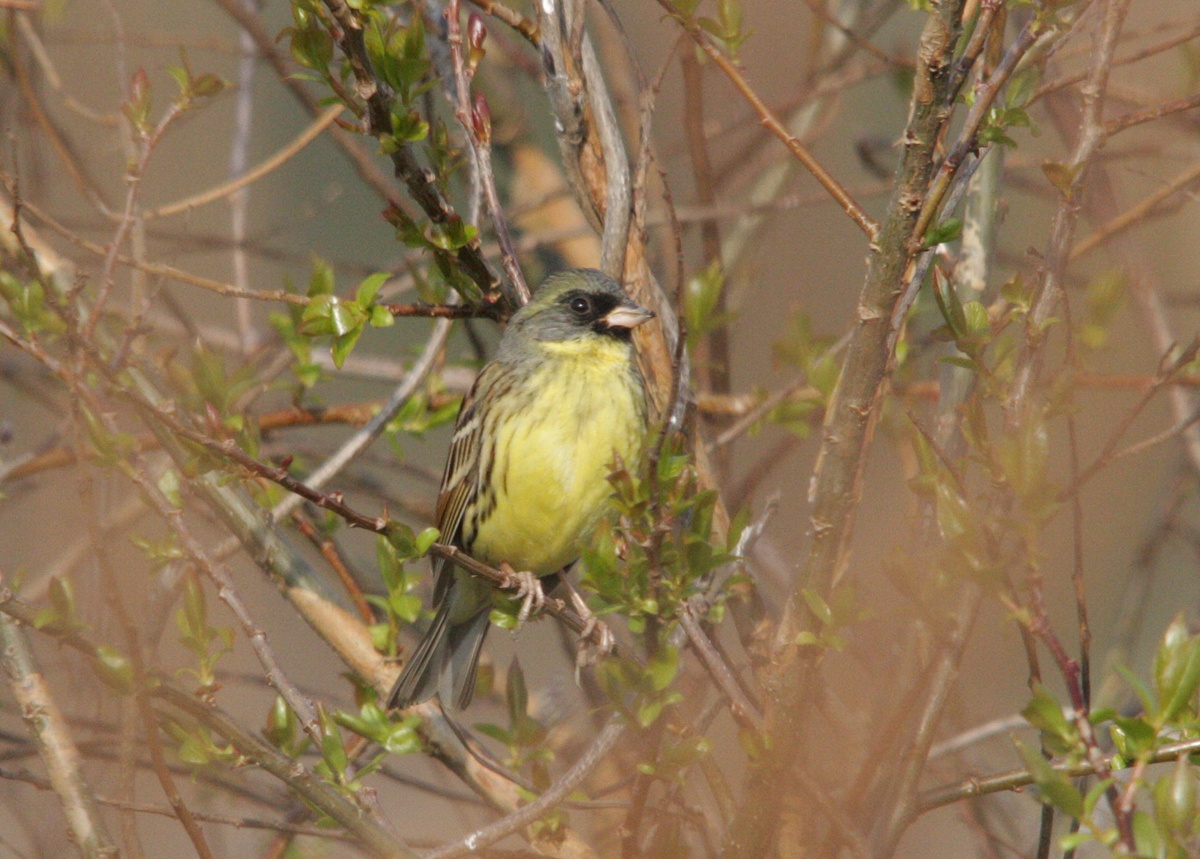
There were plenty of other migrants around, the place was teaming with phylloscs, Eastern Crowned were everywhere, very vocal, very active, and Sakhalin Leaf were fairly numerous too. A couple of Chestnut-cheeked Starlings became half a dozen as the morning wore on and an Ashy Minivet heard only once probably passed straight through. Two or three Japanese Robins were singing and there was at least one Siberian Rubythroat as well. Several Narcissus, Asian Brown and Blue and White Flycatchers were dotted around the park but I came across just a single Japanese Yellow Bunting. Also represented by a lone individual, Oriental and Northern Hawk Cuckoo sand intermittently throughout the day but I only saw the former. Another invisible songster was an Oriental Reed Warbler, quite what it was doing in woodland I don't know but there were several in more expected habitat nearby. Just as good for me was an Azure-winged Magpie so I'll mention it with the migrants. I don't see them in Kansai and this is the closest to home I can find them, great looking birds.   


Chestnut-cheeked Starlings is a passage migrant in my region.


My drive up to Hegurajima is my only chance to see Azure-winged Magpie, if I have the time to stop and look.


Asian Brown Flycatcher.


Because the park had a good selection of migrants it was easy to the feel things were on the move and something could really good turn up. Unfortunately it didn't and by day's end I was wishing I'd been on Hegura. The marine forecast didn't look any better for today so I stayed overnight but this morning seemed much quieter. In fact the same birds were present but less vocal, the periods of drizzle perhaps dampened the birds' exuberance, making everything seem harder work. I'd walked for 11 hours yesterday but there was no way I could muster the enthusiasm to repeat that even if I'd had the time. Someone saw a Japanese Paradise Flycatcher early in the morning in an area I'd spent a lot of time yesterday so that may have been newly arrived.


Female Meadow Bunting caught in a rare sunny moment.

Tuesday, 3 May 2016

Black-faced Bunting: different looking males


I usually see a few nominate Black-faced Buntings on off-shore islands in spring. They always strike me as pale and uniform compared to personata (Masked Bunting), the local taxon. When I was out on Hegurajima last month I came across these two males.


I managed to get a few shots of the first bird before it flew deeper into the coastal scrub where I happily left it, keen to make the most of my short time on the island. It was only when I found the second bird that I was struck by how very different they looked. Again I only managed a few shots because of time pressure but now it was me that had to disappear as the ferry was about to leave.


The northerly breeding nominate spodocephala is the passage taxon in Japan, the more southerly breeding sordida must have very limited spring overshoot potential and it hasn't been recorded in
Japan according to the most recent official OSJ list. 


Buntings and Sparrows (Byer's, Olsson and Curson - 1995) states, "Populations from extreme eastern Siberia are slightly smaller, with belly deeper yellow and demarcation between grey breast and belly more ill-defined, sometimes separated as the race extremiorientis. Some authors treat north-east Chinese and Ussuriland populations as part of the race sordida.". There's no mention of extremiorientis by any of the widely followed authorities as far as I'm aware but I can't help wondering if these two individuals could be representatives of the two populations whatever their taxonomic status might be.


The first bird...


The second bird...


After quickly posting this earlier today I'd like to add a little more.


I considered age as the reason for the differing appearance but as care is needed separating 1CY birds from adults after the post juvenile moult I doubt they'd become easier as they all become more worn in spring. Nevertheless this may still be the case.


Points of interest comparing the first bird with the second:-
The most eye-catching is the very bold flank streaking along with streaks on the centre breast.


The greater primary coverts seem tipped whitish compared to the more uniform brownish fringes of the second bird.


Is the primary projection really longer and spacing of the outermost primaries different? It looks as though there could be a missing tertial creating the longer projection but this wouldn't account for different spacing. If the tertial is missing this must be accidental loss as there shouldn't be any moult of major feather tracts at this time. I'm unaware of any difference in primary length between any of the races so this probably meaningless.


The different face pattern. The difference in mask shape may simply be due to the timing of pre-breeding moult and how many feathers on the face have been replaced.


Some additional images...


These heavy crops show the primary grouping and in the final shot apparently the full complement of tertials.


Greater coverts with brownish tips very nearly concolourous with the fringes. Clean breast and minimal flank streaking.


All along I'd been thinking it was the first bird that was the oddball but after posting this I went through my old images of spococephala and realised it was the second bird that doesn't fit the usual appearance. Here are images of a couple more birds I've seen in the past, the first in early May and the second an October bird.


A May 6 bird on Hegurajima, less boldly streaked on the flanks but otherwise very similar.


A fresh male in early October with a female personata below. Is it smaller? Is the bill smaller?


A spring personata to round off.


Now I'm getting turned around and I'm wondering whether the first bird is typical example of the north-east Asian population and that the paler, more uniform bird could be a rarer visitor from further west. Apparently there is a cline with paler birds in the west and darker birds in the east.