Wednesday, 1 October 2014

Crested Ibis and Oriental White Stork

After the good Hegura trip of the previous post, I woke early and mostly freewheeled back to the base of the headland. Basically the area is going to get the same birds as Hegura but they'll be able to disperse further more quickly and many will be harder to find. As there wasn't a large number of migrants on the island yesterday, I wasn't expecting the trees and bushes to be dripping with them here. How right I was.

By 8:30 I'd covered a fair amount of ground and the only migrants to show for tramping up and down the hills under the already hot sun was a small group of turdus thrushes clucking as they melted away. One at least was Japanese. And down in the village there was a large flock of mainly Red-rumped Swallows but with a few Barn, at least one Sand Martin and three Pacific Swifts.


It was then my phone pinged and a text on Sunday can only be for a bird. Sure enough someone I emailed while waiting for dawn got back to say a Crested Ibis was watched just 16km away at Suzu yesterday. He didn't have more details, where exactly other than in fields, or how long it might have been there. But only 16km for a Crested Ibis was too good to miss.

To be honest I thought the Ibis was nailed-on. Coastal villages have squeezed into every fingernail of flat space the hills neglected and their small associated areas of paddies cling to the slopes or shoehorn into narrow valley bottoms - this Ibis is going to be easy. Just a 16km dash. I'd never been to the western side of the peninsular, or southern which would be more appropriate up here at the crook, so eagerly cut across the peninsular with the bird already half ticked, totally oblivious to the awaiting reality.

Suzu is a moderately-sized rural city set on a coastal plain, around it an ocean of paddies with an archipelago of low hills creating inlets, straits and any number of secluded coves. My heart sank. There were Intermediate Egrets and grey Herons dotted singly or in small groups but no Ibis. Even on the extensive open areas there were so many ditches to lurk in and overgrown bunds to hide behind this wasn't going to be as straight forward as I'd imagined and ultimately ended in failure.

This is the second Crested Ibis I've chased in Ishikawa which seemed and I suppose still seems an easier bet than going to Sado Island. If the birds are successful on Sado, it must only be a matter of time before they re-colonise this former stronghold.

Because there hadn't been many migrants at the point and the weather certainly wasn't conducive to new arrivals I decided to drift homewards and with my mind already shifted to introductions it was only natural that the Oriental White Storks in Shiga presented themselves as an acceptable alternative. I'd never been to look for these birds but had pretty good directions and knew the general area quite well.

After trawling round the fields and seeing big numbers of egrets and Grey herons I was getting a familiar sinking feeling and stopped to gather my thoughts. No sooner had I switched off the engine when a Stork came gliding over the village through the nearside window. Then another, and another. Success! These birds come with no ethical listing ambiguity, I'd seen two in Japan before the re-introduction programme began, I could just enjoy them for the spectacular birds they are.

And yes, that egret is Great White.

Pechora Pipit on a Hegura day trip

I'd hoped to have plenty of free time from mid-September this year to get onto the islands but as usual it wasn't be be. I like to spend a minimum of 4-5 days at a stretch on an island and have never been much of a day-tripper. In fact I've only ever done three day-trips to Hegura, one over 10 years ago and now twice this year. After my success finding an Isabelline Shrike in spring I thought it was worth repeating the frustratingly brief stay in the hope lightning could strike twice. There's effectively just four hours on the island, I need the other 30 minutes the ferry schedule allows to make my way back to the harbour with enough time in hand just in case there's a mega en route.

My early impression was that the island was very quite, that's by Hegura standards of course, Kamchatka Leaf Warbler was the only numerous migrant. And ok, there were quite a few White Wagtails about (all leugens), the odd Asian Brown Flycatcher and a single Blue-and-White Flycatcher but basically there was nothing I couldn't have seen in a Kyoto city park. This wasn't really so remarkable of course, high pressure, clear skies and a southerly wind isn't going to bring a wave of arrivals but on Hegura, like all the top migration hotspots the world over, a major rare can turn up in the most unlikely of weather.

Getting off the concrete paths for the first time I was surprised the usual routes hadn't yet been flattened through this year's growth and high-legging through the tangled mounds of creepers required at least one eye on the ground. Not only that but even the most heavily trodden cross island short-cut through woodland was thick with countless springy webs spanning every open space, some of them tree to tree and fully two metres across. No one had been along in days judging by the accumulation of snared debris. At least that held out the hope there could be something as yet undiscovered lingering from the last influx. More Kamchatka Leaf Warblers.

Back in the open again, walking along the coastal path towards the northern end, I found the first good bird of the day, the first not-in-Kyoto bird, a Brown Shrike, but against the light it was impossible to try and pin a racial identity on it. September seems to be the time for this species. I've probably spent no more than a cumulative couple of weeks on Hegura in September yet most of my Browns have been during that period despite having clocked up a total of two or three months in successive Octobers. It's likely this bird wasn't newly arrived as no one seemed surprised when I passed on the info.

The next decent bird was a juvenile Northern Hobby flashing by, it would hardly set pulses racing on Hegura but it is another species I don't see around Kyoto.

In deep shade beneath the canopy this Sakhalin Warbler looked very brown above and buff below compared to the dark oily-green upperparts and yellow-grey underparts of Kamchatka Leaf Warblers. Though in the sun the mantle looked a bright green contrasting sharply with the grey nape. 

Then it was back into the trees, the more extensive woodland towards the southern end of the island and another stop-go tussle with the huge webs. The number of species was slowly creeping up which is typical of autumn birding on the island and quite unlike spring when good birds can come all of a rush. I added an Asian Stubtail, a Sakhalin Leaf Warbler and if calls are reliable then also two Japanese Leaf Warblers. But two thirds of my time on the island was already up and there were still too many good spots still to check. There were a few turdus thrushes slipping away but little else and it was a relief to finally push through high rolling waves of heavy, resistant vegetation surrounding a woodland shore. Released, I burst tripping and stumbling back onto the coastal path and even a southerly wind was suddenly refreshing.

There are two or three productive enclosed bays below the coastal path heading south but they take time I didn't have to work so I made my way directly to the last of them which gives way gradually to a steep pebble shoreline. This area is not only excellent for birds but much quicker to cover.

As I approached someone had beaten me to it and was walking through the middle of the best area. I presume he flushed the bird because suddenly there was a treble-note call and at mind-speed I thought "Ah, Zitting Cisticola, whoa, that must be a Hegura first for me!" with the first of the three notes. With the second it was "Hold up Neil, that's not a Cisticola, is it?" And as I picked up the bird it gave the third; "Pechora!" It's a heavily-built pipit with broad-based wings and short tail, though one probably accentuates the other and with its distinctive call it's not hard to ID in flight. It flew ahead of the accidental flusher, gained a little height and doubled back dropping into the previous bay along the coast. It took time to get back there and try to get an advantageous position looking down onto the tall tussocks, the half hidden rocks and creeping pools it had dropped into but before I even reached my goal it flew of its own volition back the way it (and I) had just come. Surprisingly for a pipit with a reputation for being silent it called again as it took off. Once in the original bay again I found a comfortable rock to sit on and hope the bird walked into view. True to type two Red-throated Pipits did just that giving great views but there was no sign of any Pechora. Then as two more birders came along the coastal path above the Pechora flew in front of them (I must have walked right past it on the way to my rock!) and came down onto the beach less than 100 metres away. 100 metres or 100 kilometres, it makes little difference, I never did get to see it on the deck.

Red-throated Pipit.

From the pipit beach I'd been able to see the earlier Hobby perched in a tree in the middle of the island and I made my way over to find quite a knot of photographers admiring it.

Northern Hobby.

Not wanting to push past the photographers on the way to the harbour I turned round and made a long detour round the southern tip of the island which turned out for the best as I had a couple of Black Woodpigeons while cutting through Okutsuhime Shrine, this leaving me with just enough time to catch the ferry.

When we docked in Wajima it was too late to reach the tip of the peninsular with enough daylight for any meaningful birding so I took a leisurely drive up enjoying the scenery on the way. The famous terraced paddies of Shiroyone Senmaida were still drawing the crowds, the car park was packed but, compared to spring when when a multitude of reflected setting suns are stunning, the stubble filled fields are less than unspectacular.

 At about midnight some noisy fishermen rolled up and seemed more intent on messing around the car than getting down to business so I moved to from the main car park to a nice little lay-by I've used before and where I had prolonged views of a Ural Owl under a powerfull spotlight at the exit of a road tunnel. It repeatedly dropped onto the road and perched on a roadsign, the overhead wires and in the trees. A large number of Saturn Moths were attracted to the light and they in turn drew in quite a few bats so I ought to thank the fishermen.

So I spent Saturday on Hegura and planned to spend the following day working the point but things were to turn out rather differently and unexpectedly revolved around a couple of introduced species Crested Ibis and Oriental White Stork.

List of species (H = Hegura, M = mainland)
Eastern Spot-billed Duck   2 (M)
Eurasian Teal   1 (H)
Streaked Shearwater   common
Grey Heron   8 (H), common (M)
Great White Egret   2 (M)
cormorant sp   2 (M)
Northern Hobby   1 juv (H)
Peregrine   1 juv (H)
Black Kite   common (none on Hegura!)
Common Snipe   1 (H)
Common Sandpiper   1 heard (H)
Black-tailed Gull   common
Feral Rock Dove   1 (M)
Black Woodpigeon   2 (H)
Oriental Turtle Dove   2 (H), common (M)
Common Kingfisher   1 (M)
Great Spotted Woodpecker   1-3 heard (H), it was probably one mobile bird
Bull-headed Shrike   1 heard (M)
Brown Shrike   1 (H)
Carrion Crow   common (M)
Large-billed Crow   c8 (H), common (M)
Varied Tit   1 heard (M)
Barn Swallow   a large flock (M)
Japanese Skylark   2 (H)
Brown-eared Bulbul   several (H), common (M)
Japanese Bush Warbler   common (H)
Kamchatka Leaf Warbler   common (H)
Japanese Leaf Warbler   2 heard (H) appeared to be this species
Sakhalin Leaf Warbler   1 (H)
Chestnut-cheeked Starling   2 (H)
White-cheeked Starling   1 (M)
turdus sp   4-5 (H)
Siberian Stonechat   1 (H)
Blue Rock Thrush   several (H), common (M)
Brown Flycatcher   5 (H)
Blue and White Flycatcher   1 (H)
Eurasian Tree Sparrow   common (M)
Grey Wagtail   3 (H)
White Wagtail   fairly common (H & M)
Olive-backed Pipit   1 heard (H)
Pechora Pipit   1 (H)
Red-throated Pipit   1 (H)
Oriental Greenfinch   several (M)
Meadow Bunting   fairly common (M)
Chestnut-eared Bunting   1 (H)
Black-faced Bunting   several (H)
Reed Bunting   1 possible (H) flying over

Thursday, 18 September 2014

Little Stints with 30 Red-necked

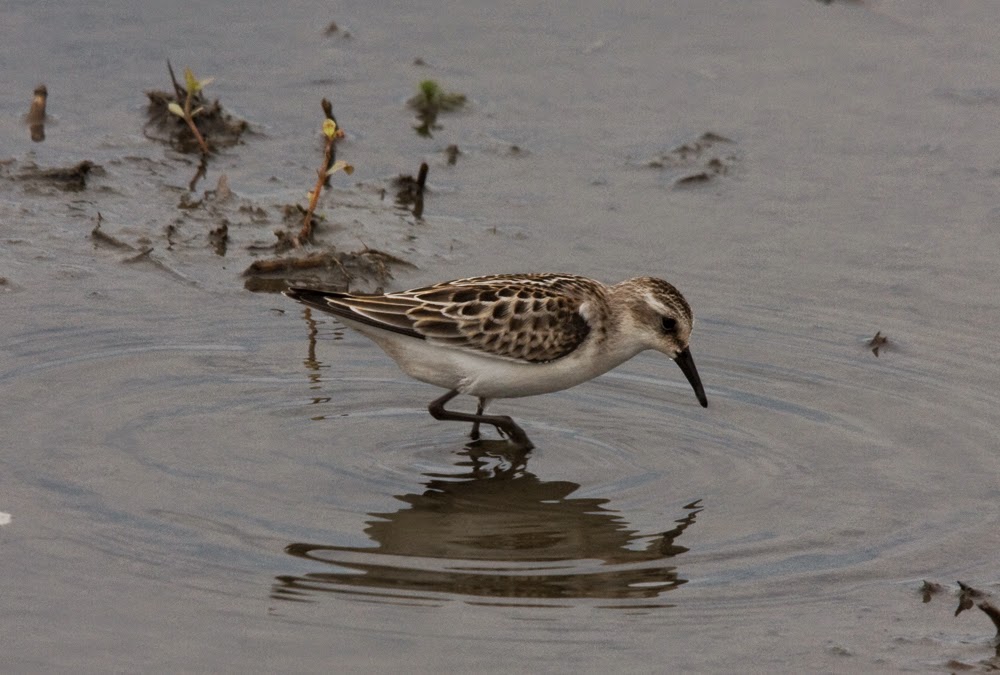
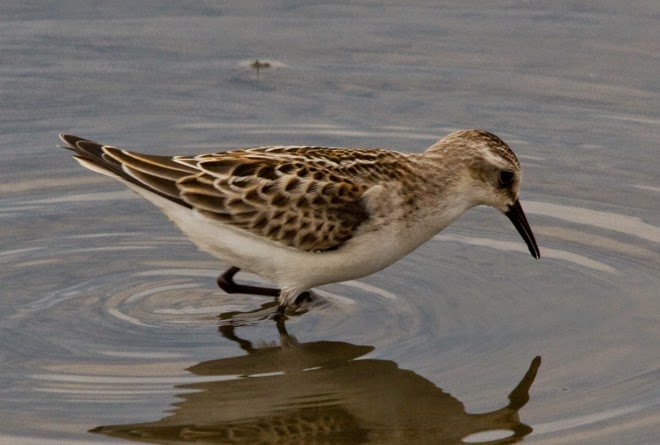
Continuing from my previous post on my most recent Mie trip, these are the two Little Stints I found in a flock of about 30 Red-necked.

I slipped out of gear as soon as the excellent looking field came into view and free-wheeled up blocking the single track road. At first I only noticed three or four Red-necked Stints towards the far end of the field about 100 metres away but these and many others that seemed to appear from nowhere came running directly towards my parked van! I presume it provided some cover in an otherwise very open situation, they flew up nervously several times while I was there but always made a beeline back to the van after re-settling.

As the birds first approached I found what looked suspiciously like a Little. This would be a Japan tick for me so I was more than a little excited and as I watched it another bird, even more distinctive looking, walked into my field of view. Close views of these two along with all the Red-necked provided an excellent opportunity for comparison.

The following three shots show how well the Little can stand out at about 50 metres, this was after one of their short nervous flights. However care needs to be taken as some red-necked have largely solid black mantle, scapulars and coverts and so be just as eye-catchingly dark at distance, though presumably would never show such a bold white mantle V as in the third shot. The other plumage feature that stands out here is the brown breast side, some Red-necked do have browner markings and more warmly marked (more buffish) ground but most are greyish and tend to have neater smaller streaks.
Structurally the views I had of these birds were quite instructive. There's seems to be some contradictory information in the literature regarding proportions, relative leg, tail and primary lengths, but I think this is simply due to differing ways of interpreting the features. Though of course even slight individual variation may lead to confusion with such similar species. In general the Red-necked in these shots certainly look long and attenuated while the dumpier Little looks rather truncated but in fact the Little had both a longer primary projection and extension, but the latter may be an effect of shorter t1. With their more upright stance on longer legs Little look deeper-bellied (and so less attenuated) and these two often seemed to teeter along tipping forward steeply to peck at the mud whereas the shorter-legged Red-necked with flatter undercarriage line gave the appearance of being longer and seemed to glide or hover smoothly just above the surface.


There's unquestionablyly significant individual variation within both Red-necked and Little Stints and images of just two Little aren't going to do anywhere near justice to the full range of possibilities. Nevertheless below are more shots of both Little Stints plus a few Red-necked for comparison.

Long primary projection clearly beyond tail. The tip of p7 is visible beyond the tertials and the p7-8 spacing is large. Note the central tail feather is only slightly longer than the others. The legs are long compared to Red-necked and the exposed tibia between the knee and feathering is much greater and easily seen however much the legs may be bent or immersed in water. Mantle black with fine bright rufous spots and a bold white V. Scapulars black with some grey in the base of central lower row, the innermost visible scapulars are rufous fringed but others have white fringes. Lesser and marginal coverts black. Median coverts, greater coverts and tertials black or very dark grey variably with slightly warmer fringes. Juvenile Red-necked can have largely black-centred scapulars (and coverts) too but these invariably seem to have very prominent white tips with far less conspicuous grey edges and often some rufous in the base. Adult Red-necked scapulars can look very similar to those of these Little Stints but they contrast with grey coverts. 

This adult Red-necked Stint has almost identical scapulars but the coverts and tertials are greyer. It also has quite distinct brown breast side streaking. The bill is deeper-based, shorter and blunt-tipped compared to Little. The primary projection is short with p7 coming nowhere near the longest tertial and the spacings between p7-8 and p8-9 are a closer match. The central tail feather is much longer than the others (unlike Little) and the primary  projection falls just short of it. The legs are short with relatively little exposed tibia between knee and feathering. 

This is the other Little Stint (the first I found) behind a Red-necked. Compared to the Red-necked the bill is longer and finer-tipped. The lesser and marginal coverts are black rather than grey. The legs are long with extensive exposed tibia, best seen on the respective far legs as the Red-necked has a metal ring on the right leg. P7 seems to fall just short of the longest tertial on this bird but it still shows a long spacing to p8.

Further images of the more distinctive of the two Little Stints.

Bill long, over double loral length, dark centre of crown and bold white braces contrasting with largely black mantle and Scapulars. Heavy brown markings on breast sides.


Here compared to Red-necked...

 Compared to this adult Red-necked the Little is much longer-legged, the bill is longer and finer at the tip. The primary projection is obviously longer and there are four tips beyond the tertials. This Red-necked has more typically marked lower scapulars plus much greyer coverts.

The brighter juvenile Red-necked in the background is very typical of birds passing through at the moment and though out of focus it accurately portrays the overall colouration of rather warm sandy mantle and upper scapulars and cold pale grey coverts. The differences in primaries and legs is again readily apparent.

Here with a very bright juvenile Red-necked. It's interesting that rufous tertial and greater covert fringes are more often associated with Little rather than red-necked. Though the rufous edges with white tips to the lower scapulars are more expected even if, yet again, the these feathers are far more solidly black than most references suggest. The split supercillium is only more obvious because of the darker crown and more contrasting whiter edgings, the shape is the same to all intents and purposes. 

More shots of the other Little Stint...

It actually looked more distinctive at slightly longer range.