Friday, 11 April 2014

Tsu/Matsusaka, Mie

I spent all day on the 9th and the morning of the 10th in the Tsu/Matsusaka area of Mie this week hoping to see migrant waders. My enthusiasm was probably getting the better of me, numbers are still fairly low and some common species weren't in yet, no Red-necked Stint or Grey-tailed Tattler for example, but I still managed 20 species.  Eight Spotted Redshank, single Long-billed Dowitcher and Ruff were the pick of the bunch. None are rare but I don't see Spotted Redshank every time I go, Dowitchers are unpredictable and Ruff really is a scarce passage bird.

Because spring passage wasn't in full swing and many wintering species had departed there was something of a 'between seasons' feel to the trip. There weren't any Common Shelduck or even the normally so common Goldeneye but others were still hanging on with a single Black Brant and a couple of Saunder's Gulls. Two Chestnut-cheeked Starlings, which is a reliable early passerine, were the only non-wader migrants I came across.

I'd planned to make it a one-day trip but decided to hang on and spend the night in the van as the tide tables showed a much bigger drop the following day. Counter intuitively waders are often much closer at low tide as birds can gather on distant sandbars and follow the receding waterline towards the coast. As things turned out the views were better on tidal areas but wader numbers were identical except for four new Bar-tailed Godwits.

I left just before midday as I wanted to check out an area in the mountains on the return journey. It always looks promising driving through but in the event the accessible areas, and much of the rest, were monotonous ranks of cedar. Even Large-billed Crows and Brown-eared Bulbuls were thin on the ground.

There were huge rafts of Greater Scaup well off-shore, 200-300 on a large pond and a few, like these in some of the harbours.

The Ruff was a nice surprise.

Long-billed Dowitcher

Spotted Redshanks

This is usually one of the commoner species so in that respect just a single was disappointing but as the moult of most I see isn't as advanced I was happy enough. 

On the 9th there was just a slight dip between high tides and the Oystercatchers were only seen at one location but on the 10th there was a much bigger fall in the water level and birds were dispersed over a wide area and were much easier to find.

Some of the Bar-tailed Godwits were very red and views were quite close on the 10th.

These three Barwits were more distant on the 9th, so was their breeding plumage. One of them was a monster with an amazingly long, thick and straight bill, I was expecting it to be Black-tailed until I got the scope on it.

The Grey Plover must be either late breeders or fast moulters, there wasn't a single black 'n' white amongst them. 

I don't think it's possible to get a shot of Sanderling with two feet on the ground, with two birds there's at least a chance.

First summer Saunder's Gull, one of only two I managed to see. 

 
I was going to say a slightly odd looking Slaty-backed but then what's really odd is to see two that look the same.

The Buff-bellied Pipits are starting to come into breeding plumage but this bird caught my eye more because of its long, hook-tipped upper mandible. 

List of birds seen
Chinese Bamboo Partridge   1 heard
Green Pheasant   3 plus many heard each morning
Gadwall
Falcated Duck
Eurasian Wigeon
Mallard
Eastern Spot-billed Duck
Northern Shoveler
Northern Pintail
Eurasian Teal
Pochard
Tufted Duck
Greater Scaup
Red-breasted Merganser
Little Grebe
Great Crested Grebe
Grey Heron
Great White Egret
Intermediate Egret   1
Little Egret
Great Cormorant
Osprey   1
Black kite
Moorhen   1
Coot
Eurasian Oystercatcher   29
Black-winged Stilt   3
Grey-headed Lapwing   10-15
Grey Plover   16
Little Ringed Plover   fairly common 9th, only 1 10th
Kentish Plover   common
Lesser Sandplover   2
Common Snipe
Long-billed Dowitcher   1
Bar-tailed Godwit   7
Eurasian Curlew   1
Far Eastern Curlew   2
Spotted Redshank   8
Redshank   2
Greenshank   2
Wood Sandpiper   1
Common Sandpiper   4
Sanderling   common on some beaches
Dunlin   c300
Ruff   1
Black-tailed Gull   several
Common Gull   fairly common
Vega Gull   fairly common
Slaty-backed Gull   3
Taimyr Gull   fairly common
Black-headed Gull  
Saunder's Gull   2
Feral Rock Dove
Oriental Turtle Dove
Japanese Pygmy Woodpecker   1
Bull-headed Shrike   several
Carrion Crow
Large-billed Crow
Great Tit   1
Barn Swallow
Zitting Cisticola   3
Brown-eared Bulbul
Japanese Bush Warbler   many heard
Chestnut-cheeked Starling   2
White-cheeked Starling
Dusky Thrush
Blue Rock Thrush   2
Eurasian Tree Sparrow
White Wagtail
Olive-backed Pipit   1
Buff-bellied Pipit   10+
Oriental Greenfinch
Meadow Bunting
Black-faced Bunting   4-8
Reed bunting   several

Additional species driving back
Varied Tit   1
Coal Tit   fairly common
Long-tailed tit   1 party
Japanese White-eye   several
Eurasian Wren   3 heard
Grey Wagtail   1

Mammals on the drive out
Sika Deer   c30
Japanese Marten   1
mouse sp   1

Sunday, 6 April 2014

possible Ring-billed Gull (first winter) in Osaka


I was going through my old files of Common Gull images last week trying to make sense of the huge range of kamtschatschensis appearance when I came across this bird. When I originally saw it (13 March 2011) my initial though was Ring-billed, however it didn't look the classic I would hope to find in Japan so there was plenty of room for doubt. To my knowledge there have only been three or four Ringers recorded in Japan, all adults. So perhaps a first of sorts, is it a major rarity for Japan or a further, and far from needed, stretch of the identification parameters of kamtschatschensis?

After resolving it was unlike any kamtschatschensis I'd ever seen but that the brief views I'd had weren't good enough to claim such a rare sighting, I put it on the back burner until re-discovering the images last week. Now I find myself agreeing with my feeling at the time, that it could well be Ring-billed, particularly as Howell and Dunn (Gulls of the Americas) state that the inner primary window and corresponding wedge of greater primary coverts can be dull.

It was on one of the closest sandbars when I picked it up, the long legs, deep body, heavy chest, angular head and thick bill combined to create an arresting jizz. Probably because of the longer legs it frequently adopted a far more upright stance than the Common Gulls. The plumage features here can all be shown by kamtschatschensis though birds with very scaled breast markings usually also have heavier hind neck blotching and the rear ear coverts spot never seems to look as isolated and conspicuous as it does on this gull. Though the saddle is very pale, almost all first winter kamtschatschensis have much paler grey saddles than adults. The primary projection looked deeper than that of Common and had three evenly spaced tips between the tertials and p9. The blade of Common looks narrower creating a longer impression and the tip of p5 often, though not always, falls conspicuously beyond the tertials frequently producing a pattern of four unevenly spaced tips.  


There was barring on the outer feathers proximal of the tail band but nothing sub-terminally.  

Though Ring-billed is supposed to have a contrasting whitish centre to the underwing, the coverts bar on this bird is actually less contrasting than on most kamtschatschensis.

The only shot on water; angular head and heavy bill aside it looks a little odd, flat-backed and low in the water. The tertial fringes appear very narrow but see below. 

It would be strange to see a first winter kamtschatschensis, any age for that matter, with such worn tertials in March. It makes judging how broad the white fringes might have been difficult, but possibly too broad for Ring-billed?

The overall impression in flight was of a broad-winged powerful gull. The primary window and inner greater primary coverts often looked more prominent at distance.

The outer webs of the inner primaries are dusky, not what I'd hope for in Ring-billed but not typical of Common either. The inner webs are surprisingly pale across the outer wing.

The jizz was more of a large white-headed gull rather than Common.

A heavily cropped and sharpened head shot.

Feedback about this gull from a few people mentioned some features, which I was really already aware of, pointing away from Ring-billed but one in particular refering to the median coverts pattern has convinced me this is kamtschatschensis. Albeit, in my opinion, an exceptional one.

Thursday, 3 April 2014

Ogura


The cherry blossom is almost in full bloom, spring is in the air and it's time for migrant snipe. I headed down to Ogura today as much to find likely spots to look for them as in hope to find many and as it turned out I did find a nice looking area but no snipe, well, three Common but they don't count.

A large area of reedbed at Ogura is harvested each winter then burnt off to promote spring growth. Last winter they cut a section normally left untouched and at its heart there's a great marshy stretch that looks as though it could pull in a number of wader species not just snipe so I have high hopes for this spring.

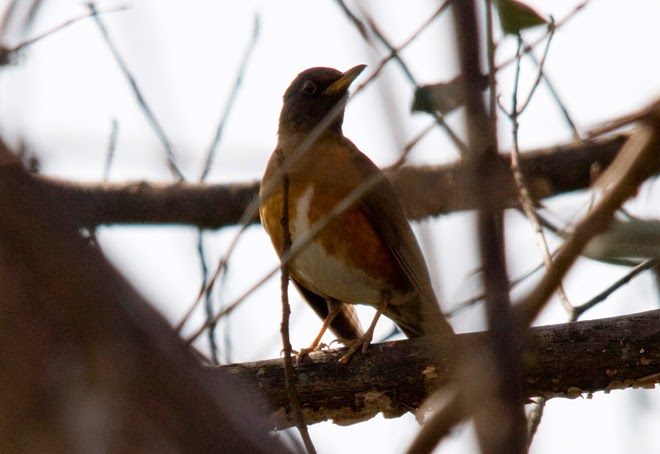
Though the snipe hunt was a bust a clump of nearby trees proved excellent for migrant thrushes. The strip of woodland that had grown up along the river over the last 20 years was clear-felled this winter, I suspect the exceptional floods last autumn created a problem with branches and even whole trees being swept downstream. The upshot is that instead of thrushes, and no doubt other migrants later in the season, melting away as I approach they are nicely concentrated and with patience will sit up. The flock consisted of about 40 Eyebrowed and a few each of Brown-headed and Pale while good numbers of Dusky were also flying up into the same trees from the nearby sports fields.


The Eyebrowed were the highlight, though they aren't unusual passing through the area, I don't normally get good views along the river. Brown-headed and Pale on the other hand are often more confiding. Which is why I spent all my time waiting for Eyebrowed to come out of the undergrowth and perch up. The above shots were the best I managed.


The rest of the trip was uneventful with fewer winter birds around but most summer stuff not in yet though I was surprised there were still lingering Rooks on the fields near the station.

I didn't try to get shots of Pale Thrush or Dusky Thrush so just for completeness I'll tack on a couple of old shots before giving the list of species seen.


Green Pheasant   1 plus 1 heard
Eastern Spot-billed Duck   2
Eurasian Teal   60-70
Tufted Duck   3
Grey Heron   8
Great White Egret   1
Little Egret   3
Great Cormorant   3-4
Eurasian Kestrel   1
Black Kite   2
Grey-headed Lapwing   3
Common Snipe   3
Green Sandpiper   1
Feral Rock Dove   c100
Oriental Turtle Dove   several
Common Kingfisher   1
Japanese Pygmy Woodpecker   1 heard
Bull-headed Shrike   7-10
Rook   10-15
Carrion Crow   common
Large-billed Crow   common
Barn Swallow   6
Skylark   many singing
Brown-eared Bulbul   very common
Japanese Bush Warbler   common
White-cheeked Starling   common
Eyebrowed Thrush   c40
Pale Thrush   3+
Brown-headed Thrush   2+
Dusky Thrush   common
Eurasian Tree Sparrow   common
White Wagtail   7
Japanese Wagtail   1
Oriental Greenfinch   several
Long-tailed Rosefinch   1 heard
Meadow Bunting   several
Rustic Bunting   3
Black-faced Bunting   10-15
Common Reed Bunting   1