Showing posts with label Flycatcher Dark-sided. Show all posts

Sunday, 27 May 2018

Hegurajima bookends for May

Unbelievable, already the 27th... where did May go?


Well, wherever it went, Northern Hawk Cuckoo singing over my house a few nights ago spurred me to visit Ashyu Forest (central Kyoto prefecture) for the first time this spring as soon as I had time. Time turned out to be the weekend, when I also managed to get out to Hegurajima for only the second time of the season.


I didn't have any offshore plans for Golden Week this year but instead I had hoped to make day trips to Hegurajima. This isn't ideal for several reasons. First, the huge number of birders/photographers present during Golden Week means you're never alone on a trail, the best you can hope for is that you aren't part of a shuffling line spaced about 30 metres apart - that actually happened when I was there on May 1st, I almost felt I had to indicate and wait for a gap in the birder traffic when I exited woodland onto the main north/south trail. Second, the ferry only gives you the least optimal midday period on the island to find the birds. Finally, and worst of all, will the ferry even sail? Ferry cancellations aren't unexpected in autumn when the Japan Sea is less friendly, whereas spring is usually less risky. Of course 'usually less risky' doesn't mean sailings can be relied on as spring of last year proved and this year hasn't been any better, last week was the first time there were more sailings than cancellations.


My visit to Ashyu was really enjoyable, it was great to be in the field and not see another soul in 18 hours! Of course I heard many more birds than I saw but Grey Nightjars were good with two birds sitting on the road in the early hours and a third high overhead in display flight after first light. The heard only highlights were a Japanese Night Heron and a Japanese Scops Owl.


Ruddy Kingfishers were singing early in the morning but as it was sunny, apart from a few calls, it was as if they hadn't existed shortly after the sun crested the hills. Cuckoos, Northern Hawk, Oriental and Lesser vanished in the same way. One bird that never even appeared was Asian Brown Flycatcher, where were they? But a much bigger question was raised. I heard a Kamchatka Leaf Warbler singing in the forest and for an instant when it started singing I was delighted thinking it was Japanese Leaf. The only previous occasion I've heard 'Japanese Leaf' here was before the Arctic complex was split and now I wonder whether that too was a passage Kamchatka. It seems this area is just outside the Japanese Leaf range.


One of several Grey Wagtails around the car park in the forest. 'Car park' means a broad muddy turning area where the road finally ends.


On the not-a-bird front this monster earthworm was a stand-out.


At about 40cm long this would give any early bird pause for thought. Note the 10 Yen coin next to it for scale. 


Shortly after I saw this hummingbird hawk moth daylight was gone and a bigger surprise was an otherwise invisible bush across steep dark ravine lit up by glow worms like a ghostly Christmas tree.


After nightfall on the second day I drove north to Wajima as it seemed very likely the ferry would be operating the following morning.


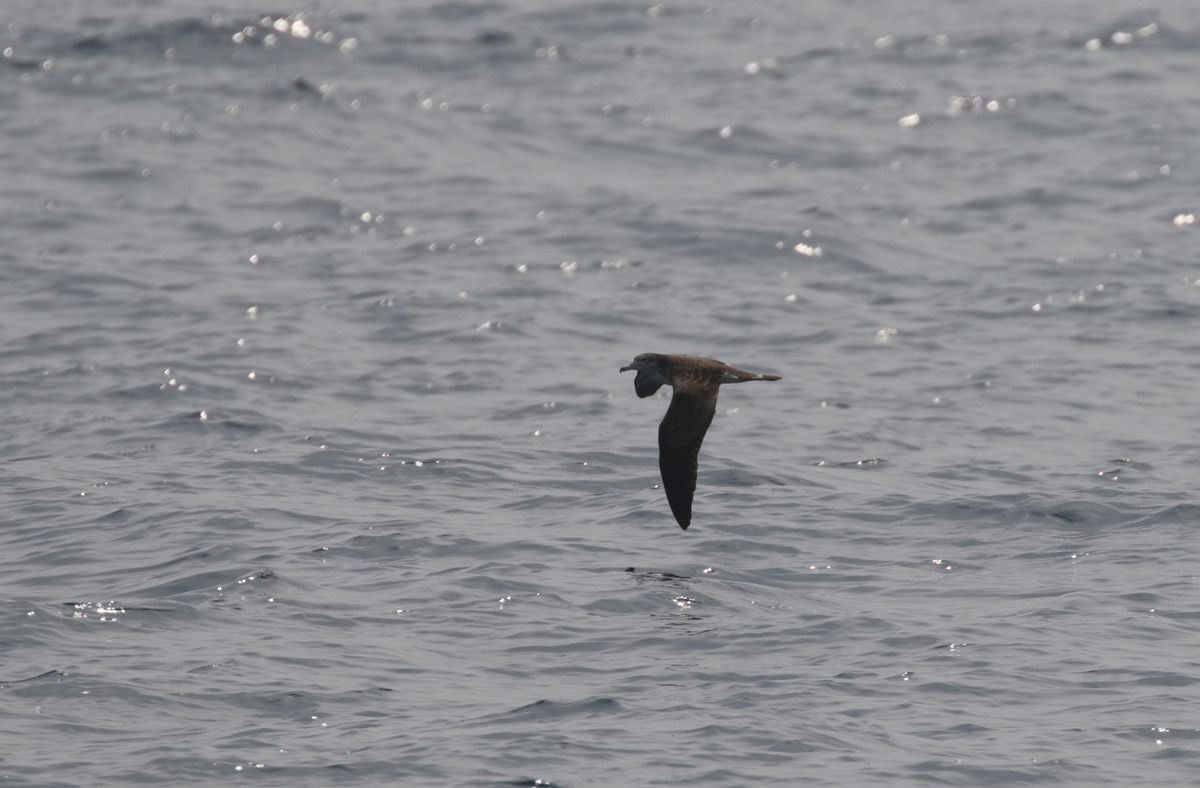
There was a time, a long time in fact, I'd be out on the ferry deck from port to port but after multiple sailings each year, year after year, with very little to show for it I tend to catch up on sleep nowadays. Admittedly I visit the island more often in autumn than the more productive spring. When I went out on May 1st I did try for seabirds and the trip produced about 30 Ancient Murrelets in small parties, at least two Japanese Murrelets, ever present Streaked Shearwaters and the Pelagic Cormorants which are still around at that time of year. I had also hoped for good numbers of phalaropes, Red-necked can be common and usually there are a few Grey (Red) thrown in. In the event there were only a handful of Red-necked. This time, two days ago, I did sleep on the crossing but still managed a single Red-necked Phalarope through the window.


One of several small fly-by parties of Ancient Murrelets.


A few were slightly closer.


Red-necked Phalaropes with an Ancient Murrelet.


On the island at the beginning of the month this Sakhalin Leaf Warbler was the only bird of interest I managed good shots of. That was my first ever trip to Hegura when I was glad to be taking the ferry back to the mainland, I've never seen the place so birdless.


Strictly speaking I ought to call this a Sakhalin/Pale-legged Leaf as I didn't hear it but Sakhalin is the overwhelming favourite here.


I wasn't terribly optimistic about this trip, even though there have been some really good birds between my visits, because the weather hadn't looked too productive all week. However the hill behind Wajima harbour was thick with Kamchatka Leaf Warblers which put me in a much better frame of mind before the ferry left. Kamchatka were absolutely everywhere on the island, Asian Brown Flycatchers were pretty common too. No wonder there were none at Ashyu, they're all still on vacation!


Kamchatka Leaf Warbler


A clean looking Asian Brown Flycatcher, even paler in the sun. 


Asian Brown looking dark.


No amount of sun is going to make a Dark-sided Flycatcher look pale.


The best/rarest birds on the island were Black-naped Oriole, a flock of Common Crossbills and a Dollarbird; hmmm so okay, nothing major. But there were so many birds around, and such a variety of scarce stuff, there surely had to be something important waiting to be found. If there was, neither I nor anyone else found it during my four hours on the island.


Cuckoos were fairly obvious, Lesser and Common at any rate.


Lesser Cuckoo.


Black Woodpigeon is ever present but it's not often they sit about in the open like this.


Friday, 30 September 2016

A not-so-hot Hegura

I got out to Hegura on September 27, my first visit in three months, the birding was good by Kyoto standards but not by those of the island. The best bird I saw was a first autumn Middendorff's Warbler; good but not photgraphable views.


Middendorff's is a funny bird, funny isn't quite the right word, you can see one in a week some years or 10 in a day another. This may be a reflection of how many are passing through but with such a skulker it could also be down to dumb luck. I tend to think if you see one, there must be a lot more of them there.


Eye-browed Thrush was very common, they are the earliest of the thrushes to pass through in big numbers each year. Buntings were common too but with the exception of one Rustic all were personata Black-faced.


Phyllocs were common and to my ear were Kamchatka Leaf, though on one occasion a Japanese Leaf called and another nearby responded. Expected flycatchers were present in low numbers; Grey-streaked (6), Dark-sided (1), Asian Brown (2), Narcissus (2) and Blue and White (3).


An island first for me was seeing the police out there. Not the regular police by the look of them, a gang of rather fit-looking guys maybe in their 30s, some kind of training exercise I suspect. And another first was a police helicopter landing on the island.


Back to birds though, or potential birds at least, after I left the island the weather charts have been showing consistent westerlies from deep in central Asia running into nasty rain bearing fronts across Japan or the Japan Sea. It would be nice to get out there again.


Kamchatka Leaf or Japanese Leaf? This one didn't call.


Grey-streaked Flycatcher.


Grey-streaked Flycatcher.


Dark-sided Flycatcher.


Dark-sided Flycatcher.


Tuesday, 7 June 2016

Hegura: a weekend in Ishikawa part 2

The sky is getting light by 3:30am nowadays and I had plenty of time for birding at Rokkozaki before deciding what to do with the final day of this once-to-be three day trip. There were six singing Kamchatka Leaf Warblers this morning, Pacific Swifts and Red-rumped Swallows were passing through clearly there were birds to be found and with the notion of a lazy Sunday having already gone by the board even Hegura might still be possible. If the ferry were running that is.


Still in two minds I arrived back in Wajima and went to check at the ferry office.The boat was going and I had enough time to reach a convenience store for a coffee before departure. What to do: be sensible and drive towards home or go to the island? I had a busy week coming up and I'd get home very late and with little sleep over the weekend. The coffee hadn't helped me make up my mind but I gravitated back to the ticket office anyway. Compared to yesterday there were few cars in the car park, there might not be many birders out there. There might be some good birds out there. There could be a mega out there... not to mention a Swinhoe's Petrel from the boat. Before common sense prevailed I went and bought a ticket, if the ferry was going then so was I.


I hadn't really expect a Swinhoe's Petrel from the ferry of course, so I wasn't disappointed. The Streaked Shearwaters were good though.


Once on the island it quickly became apparent the Kamchatka Leaf Warblers at Rokkozaki had been no more than a taste of what could be found on the island. There had to be something else out here.


The Kamchatka Leaf Warblers were very vocal and unlike in autumn so many singing birds meant identification was that much easier. I suppose it's slightly surprising then that Rokkozaki provided the only Arctic Warbler when there were so many more warblers out here on the island. Unsurprisingly, total numbers of birds were lower than they would have been during peak migration period, or even just a week earlier. One of only two birders I met was bemoaning the general lack of birds, however the variety of species was quite good.


I found:-
Cattle Egret 1
Great White Egret 1
Northern Hobby 1


Eurasian Sparrowhawk 1
Lesser Cuckoo 1
White-throated Needletail 1
Broad-billed Roller (I hate the name Dollarbird) 1


Red-rumped Swallow 3
Black-browed Reed Warbler 1
Dark-sided Flycatcher 1


Asian Brown Flycatcher 2


Eurasian Siskin 1
Hawfinch 1


There were plenty of presumed local breeders to sift through too, Japanese Bush Warblers were performing everywhere.


This Black-faced Bunting probably wanted to be Yellow-breasted, it couldn't quite pull off the breast band...


And so many Black Woodpigeons! I saw ones or twos regularly at the southern end, the biggest party was four, and heard a couple more at the northern end.


In fact, though numbers of most species were low, there were new birds at every turn and the species tally grew steadily. My 4.5 hours on the island passed all too quickly and I felt certain there was something really exciting on the island. I still am to be honest. Before going out I'd been concerned I might be totally wasting my time but now I'm sure if I'd been able to stay there and put in the time I'd have found something special.

Tuesday, 13 October 2015

Ishikawa October 6 Dark-sided Flycatchers

It feels a bit odd posting in reverse chronological order but on my way north to Hegurajima last week I stopped off at Kenmin Kaihin Park in Ishikawa. The same place I already posted Lesser Cuckoo shots from on the return southward drive.

On the way up muscicapa flycatchers were better represented with at least 15 Asian Brown, a Grey-streaked and 2-3 Dark-sided. I was particularly pleased with the latter as they are surprisingly uncommon, bordering on rare, in the Kyoto area. To see fewer Grey-streaked than Dark-sided was a novelty.

Asian Brown is the only one of the trio that breeds locally and it isn't difficult to get reasonable shots of them from spring onwards but I'll post a few of the better images anyway to contrast with the Dark-sided.


Of course I was far more interested in getting shots of the Dark-sided, this may well be the first opportunity I've had in fact.


Unfortunately I couldn't get any shots of the thrushes, an altogether trickier proposition but I did get good views of Japanese, Brown-headed and Pale rather than the usual tail disappearing through the foliage. Equally disappointing was a juvenile Goshawk, presumably a female going by its enormous size, which didn't sit still long enough for me to get the camera on it. My first reaction is still to go for the bins first.

The only other bird I was tempted by was an obliging Japanese Wagtail.


Once at Wajima waiting for the ferry the following morning I had quite good comparative views of paler and darker 1CY Slaty-backed Gulls. The Black Kites were as photogenic as usual.


Species in or near the park:-
Green Pheasant   1
Mandarin Duck   9
Eastern Spot-billed Duck   9
Eurasian Wigeon   3
Mallard   1
Northern Pintail   c100
Common Pochard   1
Tufted Duck   3
Great Crested Grebe   2
Grey Heron   2
Great White Egret   c20
Little Egret   c15
Great Cormorant   1
Eurasian Kestrel   2
Osprey   2
Oriental Honey Buzzard   1
Black Kite   c15
Northern Goshawk   1
Common Coot   2
Black-tailed Gull   c20
Vega Gull   5
Black-headed Gull   several
Rock Dove   c30
Oriental turtle Dove   c15
Lesser Cuckoo   1
Japanese Pygmy Woodpecker   c8
Great Spotted Woodpecker   1 heard
Bull-headed Shrike   12
Carrion Crow
Large-billed Crow
Great Tit   common
Varied Tit   1
Sand Martin   c50
Long-tailed Tit   several parties
Skylark   3
Brown-eared Bulbul   common
Kamchatka Leaf Warbler   common
Japanese White-eye   several
Chestnut-eared Starling   1
White-cheeked Starling   c20
Japanese Thrush   2
Pale Thrush   1
Brown-headed Thrush   1
Blue Rock Thrush   3
Grey-streaked Flycatcher   1
Asian Brown Flycatcher   15
Dark-sided Flycatcher   2-3
Narcissus Flycatcher   1 heard
Blue and White Flycatcher   4
Eurasian Tree Sparrow   3-4
Grey Wagtail   1
White Wagtail   c10
Japanese Wagtail   2
Oriental Greenfinch   fairly common
Eurasian Siskin   5 plus a flock heard
Hawfinch   c25
Meadow Bunting   2 heard